How Teckgeekz Uses AI to Turn PageSpeed Data into Revenue Intelligence
There is a quiet misconception that has shaped how most businesses approach website performance. It is the belief that performance is a technical concern, something to be handled by developers, measured in milliseconds, and evaluated through scores. In reality, performance is one of the most direct levers of revenue, yet it remains one of the least understood at a decision-making level.
Tools like Google PageSpeed Insights and GTmetrix have made performance data widely accessible. They surface metrics such as Largest Contentful Paint, Total Blocking Time, and Time to Interactive with remarkable precision. But they stop at the surface. They tell you what is happening, not why it matters, and certainly not what it is costing you.
This gap between measurement and meaning is where most businesses lose ground. A slow page is rarely just a slow page. It is an abandoned booking, a lost lead, a wasted click, or a diminished ranking signal. The problem is not the absence of data. It is the absence of interpretation.
At Teckgeekz, this realization led to a fundamental shift. Performance could no longer be treated as a diagnostic output. It had to become an intelligence system.
The Problem with Raw Performance Data
The modern web stack is complex. A single page load involves network requests, rendering pipelines, JavaScript execution threads, and resource prioritization decisions made by the browser in real time. Tools surface these as metrics, but metrics alone do not translate into business clarity.
A marketing team does not need to know that their Time to Interactive is 4.4 seconds. They need to understand that users cannot click “Search Flights” for four seconds, and in that window, intent collapses. A founder does not benefit from seeing a page weight of 8 MB unless it is explained that mobile users on constrained networks will abandon before the first meaningful interaction.
The issue is not technical literacy. It is contextual relevance. Most performance tools are built for developers, not for decision-makers. They describe the system, but they do not describe the consequences.
Even platforms like SEMrush, which excel at tying data to marketing outcomes, rarely bridge real-time performance signals with revenue impact at a page or funnel level. The result is a fragmented understanding. SEO is optimized in isolation. Performance is optimized in isolation. Conversion is optimized in isolation.
In reality, they are inseparable.
Rethinking Performance as Intelligence
Teckgeekz approached the problem differently. Instead of asking how to improve performance measurement, the question became: how do we transform performance data into actionable intelligence?
This led to the development of a layered system rather than a single tool. At the base is the data layer, where signals are collected through reliable sources such as PageSpeed APIs and Core Web Vitals diagnostics. Above that sits the interpretation layer, where AI models are used not to generate content, but to map technical signals to behavioral outcomes. At the top sits the decision layer, where insights are structured into recommendations that reflect business priorities.
The distinction is subtle but important. The goal is not to automate reporting. It is to compress the gap between signal and action.
As Jeffrey Mathew explains:
The industry has spent years getting better at measuring performance, but almost no time has been spent on interpreting it. We’re not interested in telling you your site is slow. We’re interested in telling you what that slowness is costing you.
How the WebPerf Insights Engine Works
The system that powers WebPerf Insights was designed around how real businesses operate, not how individual pages behave in isolation. Most websites are not single-entry experiences. They are funnels, often spanning landing pages, search interfaces, listing pages, and checkout flows. Evaluating one URL in isolation rarely reflects the real user journey.
This is why the first layer of the system focuses on multi-page data extraction. Instead of analyzing a single page, the engine processes up to twenty URLs simultaneously. This allows patterns to emerge across the funnel. A homepage may perform well while a booking page introduces latency. A landing page may be optimized for speed but fail under the weight of third-party scripts further down the journey.
Once the data is collected, it is broken down into signals. Metrics such as Largest Contentful Paint are not treated as standalone numbers but as indicators of when meaningful content becomes visible to the user. Time to Interactive is not just a performance milestone; it is the moment when intent can be acted upon. Total Blocking Time reflects not just technical inefficiency but perceived unresponsiveness.
The interpretation layer is where the system begins to differentiate itself. Instead of presenting these signals as isolated values, AI models map them to behavioral patterns. A delayed Largest Contentful Paint is interpreted as a visibility gap. A high Total Blocking Time becomes an input lag issue. Excessive page weight is translated into abandonment risk, particularly on mobile networks.
What makes this layer effective is not the use of AI in a generic sense, but the constraints applied to it. The models are not generating speculative insights. They are grounded in known relationships between performance metrics and user behavior, refined through industry-specific contexts such as travel, where intent is high and tolerance for friction is low.
The final layer structures these interpretations into outputs that are immediately usable. Executive summaries provide a narrative of the system’s state. Business performance analysis connects technical issues to conversion, UX, and marketing efficiency. Critical wins identify high-impact improvements, while high-priority opportunities offer a roadmap that aligns with both technical feasibility and business impact.
Performance as a Revenue Multiplier
Once performance is reframed through this lens, its role becomes clearer. It is not a cost center. It is a multiplier.
A delay of even a few seconds in interactivity does not simply frustrate users. It changes how search engines perceive the page. It alters how paid traffic performs. It influences whether a user trusts the platform enough to proceed with a transaction.
In high-intent environments such as travel, these effects are amplified. Users arrive with a goal. They are comparing options, evaluating prices, and making decisions quickly. Any friction introduced at the interface level directly competes with that intent.
A heavy page increases the cost of acquiring that user because paid clicks are wasted when users abandon before interacting. A slow interactive state reduces conversion rates because users interpret the delay as unreliability. Accessibility issues exclude segments of users entirely, not just from a compliance perspective, but from a revenue standpoint.
Performance, in this context, is not about optimization for its own sake. It is about preserving intent.
The Importance of Multi-Page Analysis
One of the most overlooked aspects of performance analysis is its fragmentation. Traditional tools evaluate pages independently. But user journeys are not independent. They are sequences.
A user might land on a campaign page, navigate to a listing, and proceed to a booking interface. If only the entry point is optimized, the experience still fails. The drop-off may occur deeper in the funnel, where complexity increases and performance often degrades.
This is where multi-page analysis becomes critical. By evaluating multiple URLs in a single pass, the system can identify inconsistencies. It can detect where performance diverges across devices, where payload increases unexpectedly, or where third-party scripts introduce latency at specific stages.
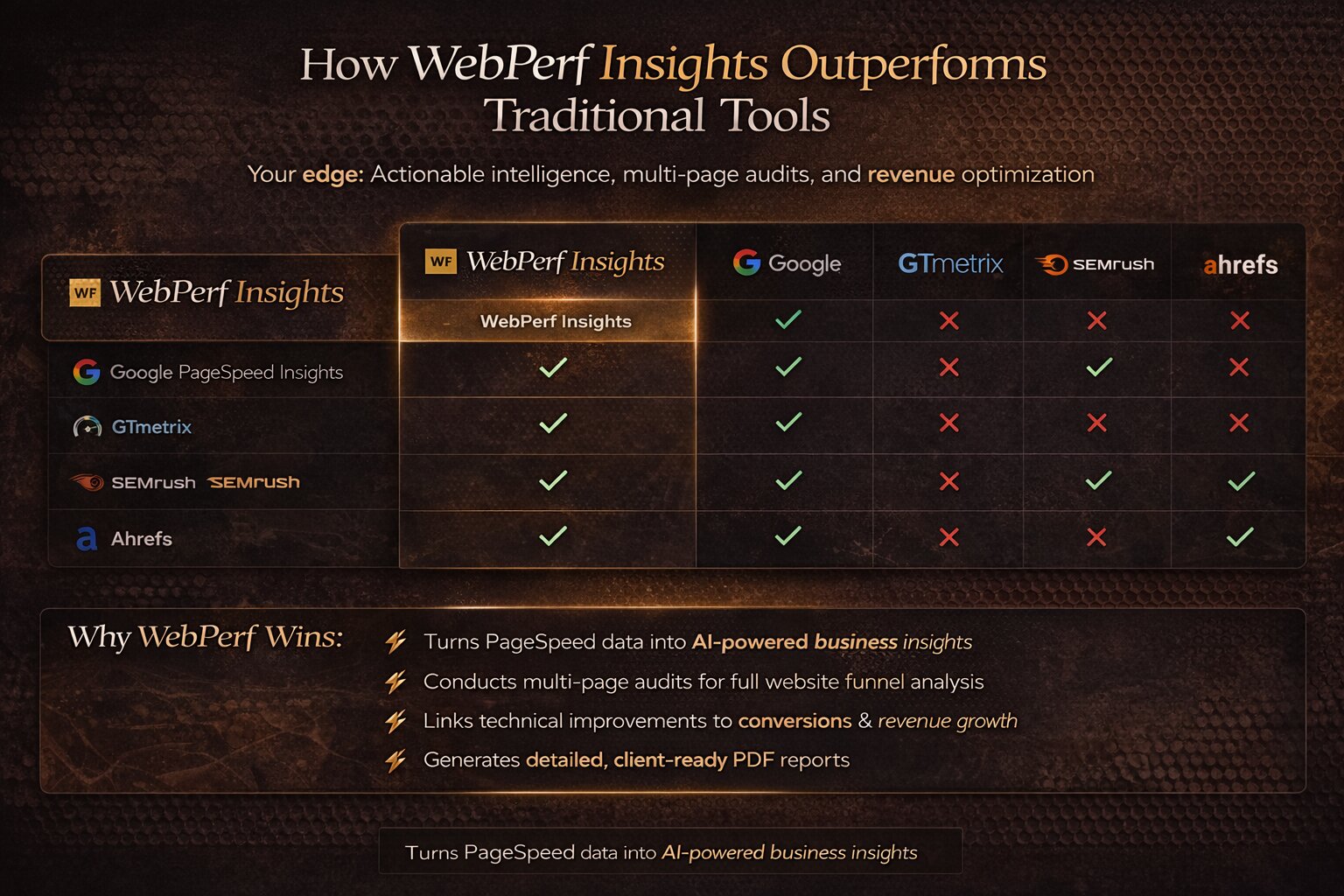
Tools like Ahrefs excel at understanding visibility and ranking dynamics, but they are not designed to map performance across a transactional funnel. WebPerf Insights fills that gap by aligning technical diagnostics with user flow.
The Role of AI in Modern Performance Analysis
There is a tendency to overstate the role of AI in digital tools, often reducing it to a content-generation layer. In reality, its most valuable application in this context is pattern recognition and contextual mapping.
AI enables the system to move beyond static thresholds. Instead of flagging a metric as “poor,” it evaluates what that metric implies within a specific context. A four-second delay may be acceptable in one scenario and catastrophic in another. The difference lies in user intent, device constraints, and industry behavior.
By embedding these contextual relationships into the interpretation layer, the system can produce insights that are both technically accurate and strategically relevant. It does not replace expertise. It scales it.
From Insight to Execution
Insights, no matter how well structured, do not create value unless they are implemented. This is where the connection between the tool and Teckgeekz as a service provider becomes important.
Performance issues often require architectural decisions. Reducing payload may involve rethinking image delivery strategies, implementing modern formats such as WebP or AVIF, and optimizing caching layers. Addressing interactivity delays may require refactoring JavaScript execution, deferring non-critical scripts, or restructuring dependency trees. Accessibility improvements demand careful attention to semantic structure, ARIA attributes, and contrast ratios.
These are not isolated fixes. They are system-level changes. The role of the tool is to surface the priorities. The role of the team is to execute them effectively.
Introducing WebPerf Insights
WebPerf Insights is not positioned as another audit tool. It is a performance intelligence platform designed to bridge the gap between measurement and decision-making. It allows businesses to analyze multiple pages simultaneously, interpret performance data through an AI-driven lens, and receive recommendations that align with real-world outcomes.
It reflects a shift in how performance should be approached. Not as a checklist of optimizations, but as a continuous feedback loop between data, interpretation, and execution.
Try the tool for Free at : https://tools.teckgeekz.com/
Looking Ahead: From Diagnostics to Autonomy
The future of performance optimization is not static reporting. It is adaptive systems. As AI models become more refined and data pipelines more integrated, the possibility of autonomous optimization becomes more tangible. Systems that not only diagnose issues but predict them. Systems that recommend changes before performance degrades. Systems that align technical execution with business goals in real time.
Teckgeekz is moving in that direction. The current platform represents a step toward that vision, where performance is no longer reactive but proactive.
How Teckgeekz Can Help
Understanding performance is one thing. Translating that understanding into measurable growth is where most businesses struggle. This is where Teckgeekz operates—not as a reporting layer, but as an execution partner that bridges insight and outcome.
The advantage of working with Teckgeekz is not just access to tools like WebPerf Insights, but access to the thinking behind them. Every recommendation generated by the system is grounded in real-world implementation experience across SEO, paid media, and high-conversion web architectures. That means the focus is never on isolated fixes, but on how each improvement contributes to a broader objective—higher visibility, better engagement, and ultimately, increased revenue.
When Teckgeekz approaches a website, the first step is not optimization—it is diagnosis at a system level. Using the AI audit framework, performance is evaluated across multiple pages and user journeys, identifying not just where issues exist, but where they matter most. A slow homepage may be visible, but a delayed booking step is often more expensive. Prioritization is based on impact, not just severity.
From there, the work moves into performance engineering. This is where technical depth becomes critical. Improvements are implemented at the architectural level, whether that involves restructuring the rendering path to eliminate blocking resources, optimizing asset delivery through modern formats and CDN strategies, or reducing JavaScript execution overhead to restore responsiveness. These are not surface-level tweaks—they are structural changes designed to make performance sustainable, not temporary.
At the same time, Teckgeekz aligns performance with conversion strategy. A faster page is only valuable if it leads to better outcomes. This is why optimization is always paired with an understanding of user behavior. How quickly can a user act? Is the interface responsive at the moment of intent? Are there friction points that break the flow between discovery and action? Performance improvements are evaluated not just in milliseconds, but in how they influence user decisions.
There is also a critical intersection with paid media. Many businesses invest heavily in traffic acquisition without realizing that performance inefficiencies erode their returns. A slow landing page increases bounce rates, lowers Quality Scores, and drives up acquisition costs. By addressing performance at the source, Teckgeekz helps ensure that every click has a higher probability of converting, effectively improving the efficiency of existing marketing spend.
Accessibility is treated with the same level of importance. Beyond compliance, it is about ensuring that the experience is inclusive and usable across a broader audience. Fixing structural issues in navigation, labeling, and contrast does more than meet standards—it expands reach and strengthens trust.
What makes this approach effective is its continuity. Performance is not optimized once and forgotten. It is monitored, refined, and adapted as the site evolves. As new features are introduced or campaigns are launched, the system ensures that performance remains aligned with business goals.
As Jeffrey Mathew puts it :
Most agencies fix what’s visible. We focus on what’s costing you money. That requires going deeper than audits and into how systems are built, how users behave, and how decisions are made.
For businesses looking to move beyond surface-level optimization, Teckgeekz offers a structured path. It begins with understanding, moves into implementation, and continues with ongoing refinement. The result is not just a faster website, but a platform that performs as a reliable, scalable growth engine.
If you want to see where your current performance stands—and more importantly, what it means for your business—you can start with the AI audit tool. From there, the path forward becomes much clearer.


Jeffrey Mathew
Founder & CEO • Travel Marketing Specialist
"With over 14 years of dominance in the travel and tech sectors, Jeffrey Mathew has engineered growth for hundreds of OTAs and airlines worldwide. He specializes in the intersection of Performance PPC and Agentic AI, building high-performance digital ecosystems for modern brands."
Start a Conversation
Ready to Elevate Your Business?
Fill out the form below and let's discuss how Teckgeekz can help you reach your goals.
Describe your project to unlock real-time AI service recommendations and matching portfolio cases.
Our Trusted Partners