Travel & Hospitality Growth Strategy: How 4 Brands Turned Traffic into Qualified Bookings
A travel business can generate thousands of website visits, run Google Ads across dozens of destinations, publish new holiday packages every month, and still struggle to grow confirmed bookings. In most cases, the breakdown happens in the gap between initial customer discovery and a genuine sales conversation.
Consider how a typical travel agency operates. Paid campaigns bring in visitors, yet many are early-stage researchers rather than ready buyers. Prospective customers land on the site and bounce because flight searches lag or the booking path feels clunky. Others submit inquiries, leaving the sales team guessing which prospects are serious, which phone numbers or emails are valid, and which leads require immediate follow-up. Meanwhile, organic traffic may climb without clear attribution showing which pages actually produce revenue.
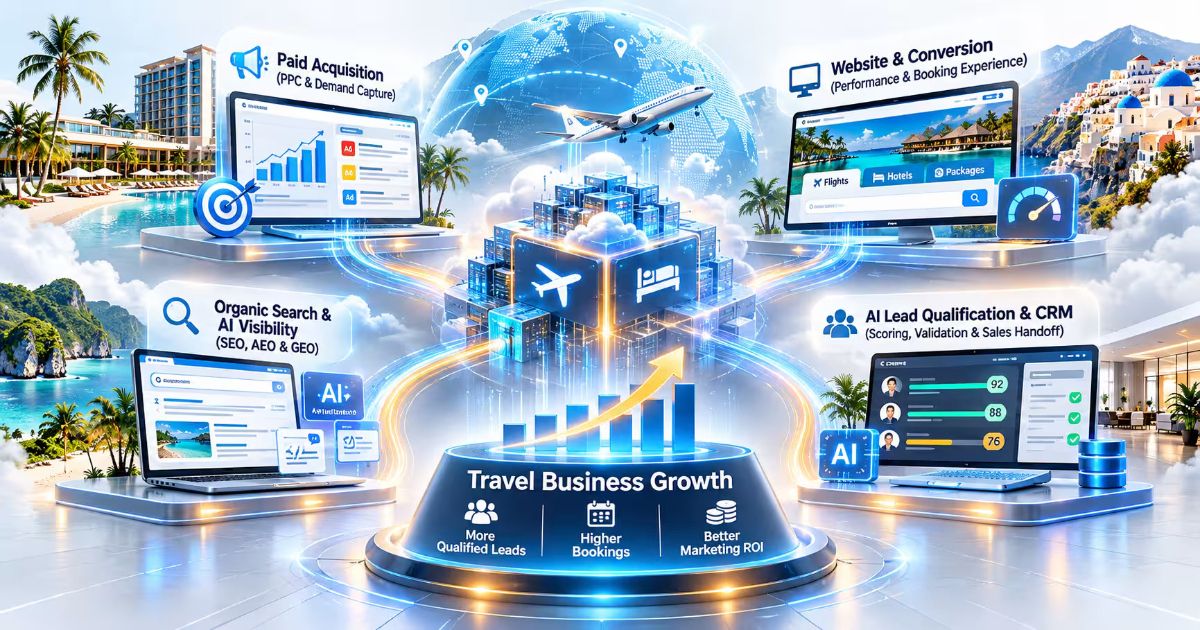
At Teckgeekz, we treat travel growth as one connected system rather than isolated marketing tasks. Four recent client implementations demonstrate how fixing specific bottlenecks across that chain unlocks revenue from existing demand across Google Ads restructuring, Next.js travel platform engineering, SEO and AI search visibility, and AI-powered CRM lead qualification.
Why More Marketing Spend Doesn't Automatically Produce More Bookings
Travel is a high-consideration purchase. Rarely does a traveler discover a destination and complete a reservation in a single session. They compare airlines, check departure windows, review baggage rules, weigh accommodation tiers, consult family or colleagues, and revisit pricing multiple times before committing.
That multi-step behavior creates four common leak points across the customer journey:
Acquisition inefficiency: Campaigns capture high click volumes from early-stage browsers rather than high-intent buyers. Someone researching the best places to visit in Thailand requires a completely different message and budget allocation than someone comparing Thailand holiday packages for a specific departure month. Treating both audiences identically concentrates ad spend on traffic volume instead of commercial intent.
Post-click friction: Even well-targeted ads underperform when the landing page loads slowly, hides key itinerary details, or forces users through multi-step external redirects. The ad platform delivers the visitor; the website has to earn the inquiry.
Unfiltered lead volume: Receiving hundreds of monthly form submissions tells you very little if a large share contain fake contact details, unrealistic budgets, or dates outside your inventory.
Disconnected attribution: When phone calls, booking searches, form fills, and CRM records sit in separate silos, marketing teams cannot see which campaigns or pages actually produce confirmed reservations.
Scaling ad spend before fixing post-click friction simply multiplies wasted clicks. Publishing more destination blogs without commercial structure inflates sessions without lifting inquiries. Automating a CRM without validating incoming records just pushes bad data through the pipeline faster. The real lever is increasing how effectively you convert the demand already reaching your business.
Attracting the Right Demand: Why Campaign Structure Matters More Than Simply Increasing Ad Spend
Google Ads remains a primary acquisition engine for travel agencies because it captures active searches for flights, holiday packages, and custom tours. Yet campaign profitability depends on whether your account structure mirrors how travelers actually plan and book.
A common mistake in PPC for the travel industry is organizing campaigns strictly around destinations and departure dates without separating research intent from booking intent. Someone searching for general Bali travel tips is months away from buying, whereas someone searching for a Bali holiday package with flights from London is ready to compare quotes. Both queries matter, but they deserve separate budgets, ad copy, and landing pages.
We saw this firsthand when restructuring Wanderlust Journeys' Google Ads account around booking windows in a seasonal market where click costs spike during peak booking periods.
The problem with calendar-driven campaign structures
The account was generating inquiries, but a large share of spend went toward broad destination searches that produced clicks without conversions. Campaigns were grouped around departure dates rather than the booking windows when travelers actively compare and purchase trips.
During peak periods, broad terms drove CPCs up as competing agencies bid on identical queries. During shoulder windows, budget pacing missed emerging buyer demand. Worse, ads sent visitors to generic catalog pages instead of tailored landing pages, and phone inquiries were missing from conversion tracking. Lowering bids alone would not fix the account; it needed tighter alignment across search intent, landing pages, and conversion signals.
Rebuilding the acquisition strategy around booking intent
We rebuilt the account around customer booking windows and specific trip requirements, shifting budget away from broad destination browsing toward high-intent searches for private tours, multi-center itineraries, and ready-to-book packages. Aggressive negative keyword filtering cut spend on informational queries that never converted.
Each campaign was paired with a dedicated landing page built around the exact search query, reducing friction between the ad click and the inquiry form. Finally, we integrated call tracking, dynamic booking forms, and CRM webhooks directly into GA4 and Google Ads so bidding algorithms optimized for real inquiries rather than shallow page views.
What changed?
Over a 90-day comparison period on the exact same $60,000 quarterly ad budget:
Quarterly inbound leads: Increased from 600 to 1,500 (+150%)
Cost per lead (CPL): Dropped from $100 to $40
Leads per $100 spent: Rose from 1.00 to 2.50
Visitor-to-inquiry conversion rate: Doubled from 2.5% to 5.0% (while average CPC fell from $2.50 to $2.00)
Note: These metrics measure lead-generation efficiency rather than final ticketed revenue, as closing rates depend on downstream sales execution. By combining intent-based campaign architecture with conversion-focused pay-per-click management, Wanderlust Journeys more than doubled its inquiry pipeline without adding a dollar to ad spend.
Frontend is Part of the user Acquisition, You need to Convert
An ad click is only the midpoint of customer acquisition. On mobile devices especially, travelers compare multiple tabs simultaneously. If your site hesitates, hides fare rules, or bounces users to an external booking engine, they hit the back button immediately.
Site speed and architecture are commercial levers, not just technical SEO checkboxes. That reality shaped our WordPress-to-Next.js migration for Trip Agency, a travel business held back by an aging plugin-heavy site.
When an outdated website starts affecting marketing performance
Trip Agency's site was running more than 35 active plugins, resulting in a mobile Lighthouse performance score of 38, a Largest Contentful Paint (LCP) of 7.2 seconds, and a 4.8 MB page weight.
The user experience broke down further during flight searches, which relied on third-party iframe redirects that pulled travelers off the main domain to view airfares. Furthermore, while over half of the company's bookings closed over the phone, the site lacked dynamic call attribution and standardized GA4 generate_lead tracking, leaving marketing blind to which channels drove phone sales.
Rebuilding the platform around performance and conversion
Instead of patching plugins, we migrated the frontend to Next.js App Router deployed on an edge CDN. Modern asset optimization and streamlined client-side rendering cut total page weight from 4.8 MB down to 1.1 MB.
To keep travelers on-site, we replaced the third-party iframes with native serverless API routes connected directly to GDS/Amadeus flight inventory, enabling instant real-time fare lookups inside a unified interface. We also deployed Dynamic Number Insertion (DNI) across landing pages to tie inbound phone calls back to UTM campaign parameters in GA4 and Google Ads.
The commercial impact of the migration
Within 90 days of launch:
Mobile Lighthouse score: Climbed from 38 to 96 (LCP improved from 7.2s to 1.7s; page weight dropped 77.1%)
Monthly inbound leads: Grew from 120 to 180 (+50%)
Visitor-to-lead conversion rate: Rose from 0.6% to 0.9%
Lead source attribution in GA4: Jumped from 40% to 95%
Purpose-built travel website development treats frontend speed, API inventory integrations, and call attribution as core conversion infrastructure rather than isolated IT tasks.
Organic Visibility Must Generate Commercial Demand, Not Just Rankings
Paid search captures immediate demand, while organic search and AI assistants shape how travelers discover brands during early and mid-stage planning. Ranking for your own agency name protects existing demand, but sustainable growth requires winning non-brand commercial searches when travelers are actively comparing packages without a specific provider in mind.
That was the core objective in our SEO and AEO engagement.
Moving beyond branded search visibility
Bird Voyage ranked reliably for branded queries, yet competitors captured the top spots for high-value non-brand package and itinerary searches. On-site, itinerary pages lacked structured answers to common planning questions, faceted navigation created technical crawl traps, and organic inquiries could not be traced back to specific landing pages.
Connecting SEO, AEO, and GEO to the travel discovery journey
Today, travel discovery happens across both traditional search results and generative AI platforms like ChatGPT, Perplexity, and Gemini. Pages need clean technical architecture for search crawlers alongside structured, entity-rich facts that answer engines can parse and cite accurately.
Through a unified SEO, AEO, and GEO strategy, we resolved crawl traps in faceted filters, consolidated internal link equity toward priority commercial itineraries, and deployed comprehensive JSON-LD schema (TouristTrip, ItemList, FAQPage, and Organization) across tour hubs. Content was restructured around commercial comparison queries rather than generic destination overviews. Alongside traditional rank tracking, we monitored brand citations across 50 high-intent prompts in ChatGPT, Perplexity, and Gemini.
What changed for Bird Voyage?
Over six months on a steady $4,000 monthly SEO investment:
Qualified organic inquiries: Increased from 30 to 105 per month (+250%)
Non-brand organic sessions: Grew from 2,500 to 7,000 per month
Cost per qualified organic inquiry: Dropped from $133.33 to $38.10
Top-3 keyword rankings: Expanded from 3 to 18 out of 40 tracked commercial terms
AI answer citations: Increased from 4 to 23 across the 50 monitored prompts
While AI citations and organic rankings measure distinct visibility surfaces (and an AI mention does not automatically equal a direct click), structuring itinerary data around real traveler questions strengthened Bird Voyage's presence across both traditional search and AI-assisted research.
Turning Inquiries into Sales Opportunities with AI and CRM Automation
Generating an inquiry only creates value if your sales team can verify, prioritize, and contact the prospect before they book elsewhere. For hotels, resorts, and high-volume tour operators, treating every form submission in a flat first-in, first-out queue wastes advisor hours on incomplete or fake leads while high-value group or corporate bookings wait hours for a callback.
This operational bottleneck was holding back the reservations team before we deployed AI lead scoring and CRM automation for Azure Resorts.
The problem was volume without prioritization
Azure Resorts was generating over 800 booking inquiries every month, yet its legacy CRM offered no automated validation or lead scoring. Roughly 20% of submitted email addresses were fake or undeliverable, the sales team only reached 30% of incoming leads, and just 64 inquiries per month converted into sales-qualified leads (SQLs). Spending more on ads would have simply buried the reservations desk deeper in unverified records.
Building an AI-powered lead qualification system
Combining custom web and CRM development with production agentic AI implementation, we built a Next.js and Prisma CRM dashboard powered by real-time webhook routing and automated lead scoring.
Every incoming inquiry runs through a dual Gemini and OpenAI scoring engine in under two seconds. The model evaluates commercial signals, including requested stay dates, party size, corporate affiliation, and repeat-guest history, to assign a priority tier. Simultaneously, a serverless verification layer runs real-time SMTP and MX checks to flag undeliverable email addresses before they clutter the sales queue.
High-tier inquiries route immediately to senior reservation managers with instant alerts, and the scoring weights are calibrated weekly against actual confirmed bookings so the model learns from closed revenue rather than static assumptions.
The impact on lead quality and sales efficiency
Within 90 days on the exact same $12,000 monthly lead-generation budget:
Monthly sales-qualified leads (SQLs): Tripled from 64 to 192 (+200%) out of 800 inquiries
Lead contact rate: Improved from 30% to 65%
Invalid or undeliverable emails: Dropped from 20% to 4%
Cost per sales-qualified lead: Fell from $187.50 to $62.50
By applying AI to a concrete operational decision (which prospect a reservation agent should call first), Azure Resorts tripled its qualified pipeline without increasing marketing spend.
Four Interventions, One Connected Growth System
Each of these four clients entered with a different primary constraint, yet their results reinforce the same operating reality: marketing efficiency comes from aligning acquisition, web engineering, organic discovery, and sales operations around a single measurement framework.
Client | Primary Bottleneck | Core Intervention | 90 to 180-Day Commercial Impact |
|---|---|---|---|
High ad spend on broad, low-intent searches | Intent-based PPC restructure, dedicated landing pages, call/CRM attribution | 150% more leads (600 to 1,500/qtr); CPL cut from $100 to $40 on flat budget | |
7.2s load times, external flight iframes, blind call tracking | Next.js App Router rebuild, native GDS/Amadeus API, DNI call tracking | 50% more monthly leads (120 to 180); GA4 attribution raised from 40% to 95% | |
Strong brand search but weak non-brand package visibility | Technical SEO cleanup, | 250% more organic inquiries (30 to 105/mo); cost per inquiry cut by 71% | |
800 unranked monthly leads, 20% fake emails, 30% contact rate | Next.js/Prisma CRM, dual LLM lead scoring (under 2 seconds), SMTP/MX validation | 200% more SQLs (64 to 192/mo); cost per SQL cut from $187.50 to $62.50 |
Better ad targeting cannot rescue a slow, broken flight search. Higher organic traffic will not grow bookings if valid inquiries sit unanswered in an unranked CRM queue. Conversely, when campaign intent, fast web architecture, structured search visibility, and automated lead routing work together, every marketing dollar compounds across the funnel.
"Across dozens of travel and hospitality builds, I've seen the same pattern repeat: most agencies don't have a traffic problem, they have a handoff problem. When Wanderlust Journeys aligned ad spend with real booking windows, Trip Agency moved flight search onto a sub-two-second Next.js stack, Bird Voyage structured its itineraries for both Google and AI engines, and Azure Resorts started scoring inquiries before a rep picked up the phone, growth came from fixing the leaks between departments rather than blindly raising budgets. True scale happens when your ads, website, SEO, and CRM operate as one connected system." - Jeffrey Mathew, Founder & CEO, Teckgeekz
How Travel Businesses Can Diagnose Their Biggest Growth Bottleneck
Before launching a new ad channel, commissioning a redesign, or buying AI software, pinpoint where your existing funnel is losing value:
Observed Symptom | Likely Bottleneck | Where to Start |
|---|---|---|
Ad spend is rising, but inquiry volume stays flat | Acquisition intent and landing-page mismatch | Audit search terms, separate research vs. booking-window campaigns, add negative keywords, and build intent-specific landing pages. |
Website traffic is healthy, but form fills and calls remain low | Post-click UX and booking friction | Test mobile Core Web Vitals, remove third-party iframe redirects, simplify fare displays, and reduce inquiry steps. |
Branded search is strong, but new customer discovery stalls | Non-brand SEO and AI answer visibility | Fix crawl traps, build commercial itinerary hubs, deploy |
Inquiry volume is high, but confirmed bookings stay flat | Lead validation and sales response speed | Add real-time email/phone validation, score inquiries by trip value/dates, and route top leads immediately to senior reps. |
Marketing dashboards don't match actual sales bookings | Broken conversion attribution | Connect Dynamic Number Insertion (DNI), form events, and CRM booking webhooks back into GA4 and Google Ads. |
Moving From Isolated Campaigns to Connected Growth
At Teckgeekz, our travel and hospitality work brings travel PPC management, custom travel website development, SEO, AEO, and GEO, and agentic AI automation under one roof. Rather than prescribing a one-size-fits-all retainer, we start by diagnosing where your current demand is leaking and engineering the exact technical or marketing fix required to capture it.
For travel agencies, OTAs, and hospitality brands, the fastest path to higher bookings rarely starts with a bigger media budget. It starts with connecting how you attract, convert, and qualify the demand already coming through your door.


Jeffrey Mathew
Founder & CEO • Travel Marketing Specialist
"With over 14 years of dominance in the travel and tech sectors, Jeffrey Mathew has engineered growth for hundreds of OTAs and airlines worldwide. He specializes in the intersection of Performance PPC and Agentic AI, building high-performance digital ecosystems for modern brands."
Start a Conversation
Ready to Elevate Your Business?
Fill out the form below and let's discuss how Teckgeekz can help you reach your goals.
Describe your project to unlock real-time AI service recommendations and matching portfolio cases.
Our Trusted Partners