PPC Ad Creatives & Copy Strategy for Travel: Writing Ads That Actually Convert

Most travel PPC campaigns don’t struggle because of targeting. They struggle because the ads don’t connect.
You can have well-structured campaigns, high-intent keywords, and even optimized landing pages—but if the ad creative fails to resonate, the user never makes it to the next step. And even when they do, poor messaging often brings the wrong kind of traffic.
In travel, this becomes more noticeable. People aren’t just clicking on ads—they’re imagining destinations, comparing options, and evaluating whether something feels worth their time and money.
This is where PPC ad creatives make the difference. They’re not just about attracting clicks—they shape expectations, filter intent, and set the tone for the entire user journey.
Why PPC Ad Creatives Matter in Travel PPC
The ad is the first real interaction between your campaign and the user. Before landing pages, before conversion—everything starts here.
If the message doesn’t match what the user is looking for, they either don’t click or click and leave quickly. Both outcomes hurt performance. Strong creatives, on the other hand, attract users who are more likely to engage and convert.
Another important role of ad creatives is filtering. Not every click is valuable. Well-written ads naturally filter out low-intent users by clearly communicating what’s being offered.
In competitive travel markets, where multiple advertisers target similar keywords, creatives often become the deciding factor. Two ads may target the same search—but the one that feels more relevant wins.
High-Intent Keywords & Campaign Structure
Understanding User Intent Before Writing Ads
Matching Creative to Search Intent
Writing effective PPC ad creatives starts with understanding why the user is searching.
A user looking for “cheap flights to Dubai” is focused on pricing. If your ad talks about luxury experiences instead, the disconnect is immediate. The message doesn’t match the intent.
On the other hand, someone searching for “Dubai luxury holiday packages” expects a completely different tone—something more aspirational, less price-driven.
The closer your ad aligns with the user’s intent, the higher the chances of both a click and a conversion.
Emotional vs Transactional Intent
Travel sits at an interesting intersection between logic and emotion.
Some users are purely transactional. They want the best price, the fastest route, or the simplest booking process. Others are influenced by the experience—destinations, visuals, and the idea of travel itself.
Effective ad creatives balance these two elements. Too much focus on price can make ads feel generic. Too much focus on emotion can reduce clarity.
The right mix depends on where the user is in their decision process.
Core Components of High-Performing PPC Ad Creatives
Headlines That Capture Attention
Headlines are where most decisions are made. Users scan quickly, and the headline determines whether they stop or move on.
In travel, headlines that include destination names, pricing signals, or clear benefits tend to perform better. They immediately answer the user’s question: “Is this relevant to me?”
Clarity matters more than cleverness. A simple, direct headline often outperforms something creative but vague.
Description Copy That Builds Value
Once the headline captures attention, the description provides context.
This is where you expand on the offer—what’s included, why it’s valuable, and what makes it different. It doesn’t need to be long, but it needs to be clear.
Users should be able to understand the offer without having to think too much. Confusion at this stage usually leads to lost clicks.
Display URLs and Relevance Signals
Display URLs are often overlooked, but they play a subtle role in performance.
When users see a URL that reflects what they searched for—like “/flights/dubai” or “/holiday-packages”—it reinforces relevance. It signals that the page is likely to match their intent.
These small details contribute to overall trust and can improve click-through rates over time.
Types of Travel Ad Messaging
Price-Driven Ads
Price-focused ads work well for users who are actively comparing options.
These ads highlight deals, discounts, or starting prices. They attract users who are ready to evaluate options and potentially book.
However, they also attract price-sensitive users, so messaging needs to be clear to avoid low-quality clicks.
Experience-Driven Ads
Not all users are driven by price. Some are influenced by the experience itself.
Experience-driven ads focus on destinations, activities, and overall appeal. They are particularly effective for users in the early or mid stages of the funnel.
These ads don’t always generate immediate conversions, but they play an important role in building interest.
Urgency-Based Ads
Urgency works when timing matters.
Highlighting limited availability, time-sensitive offers, or seasonal deals can push users toward action. This type of messaging is most effective for users who are already close to booking.
Used correctly, urgency can improve conversion rates without increasing spend.
Case Study | Challenge | Strategy Applied | Result (Anonymized Metrics) |
|---|---|---|---|
Global OTA | High CPC on “cheap flights” keywords | Intent-driven ad copy + urgency signals | CTR ↑ 22%, CPC ↓ 18% |
Regional Airline | Low conversions on branded queries | Emotional framing + destination appeal | Conversion Rate ↑ 15% |
Luxury Travel Agency | Poor engagement on package ads | Transactional clarity + aspirational visuals | CTR ↑ 28%, Avg. Order Value ↑ 12% |
Writing Ads for Different Travel Segments
Flights
Flight searches are often driven by price and convenience.
Users want clear information—routes, pricing, and availability. Messaging should reflect this by being direct and informative.
Complex or overly creative messaging usually underperforms in this segment.
Holiday Packages
Packages involve more variables—destinations, inclusions, duration, and value.
Ads should simplify this complexity. Highlighting what’s included and the overall value helps users make quicker decisions.
Clarity and structure are key here.
Luxury Travel
Luxury travel requires a different approach.
Price is not always the primary factor. Instead, messaging should focus on exclusivity, comfort, and unique experiences.
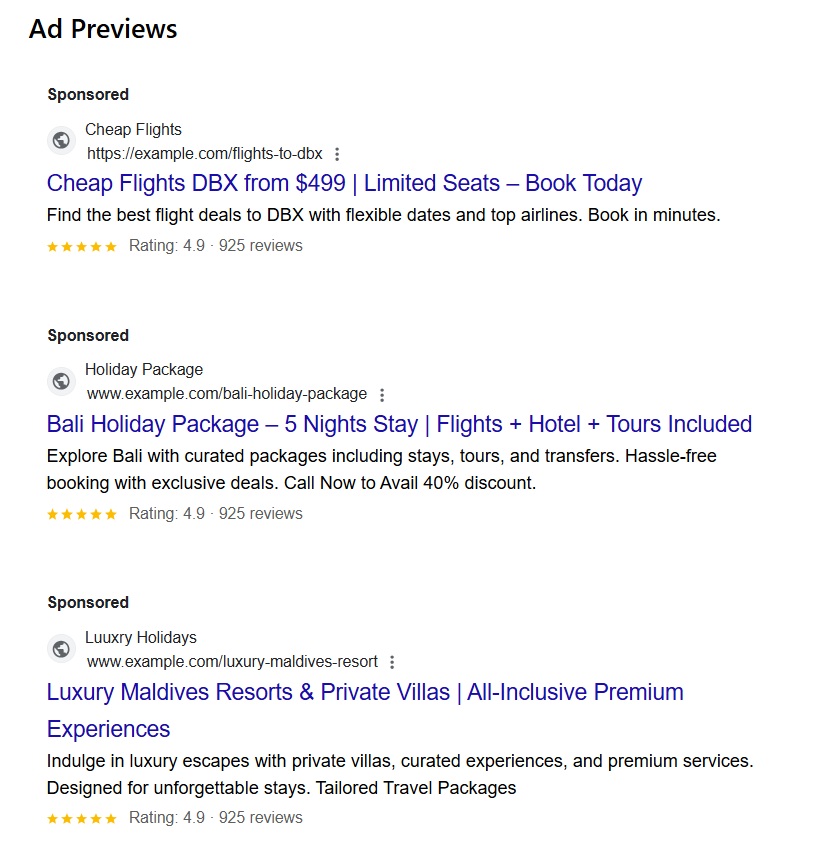
These ads should feel premium, not promotional. Few Example of Ad Copies:
Ad Creative Optimization Techniques
A/B Testing Strategy
No ad creative works perfectly from the start.
Testing different variations—headlines, descriptions, and messaging angles—helps identify what resonates with your audience. Even small changes can lead to noticeable improvements.
Testing should be continuous, not a one-time effort.
Using Dynamic Elements
Dynamic ads adapt based on user queries.
This improves relevance because the ad reflects what the user is searching for. It reduces the gap between search intent and messaging.
When used correctly, dynamic elements can significantly improve performance.
Ad Extensions for Better Visibility
Ad extensions provide additional information without cluttering the main ad.
They can highlight pricing, additional links, or key benefits. This increases visibility and gives users more reasons to click.
Extensions often improve both CTR and overall ad performance.
Aligning Ad Creatives With Landing Pages
Ad creatives set expectations. Landing pages need to meet them.
If an ad promises a specific deal or destination, the landing page should reflect that immediately. Any mismatch creates friction and increases bounce rates.
Consistency between ads and landing pages improves user experience and conversion rates.
Landing Page Optimization for Travel PPC
Market Insights (Travel Ad Performance Trends)
Factor | Impact | Insight |
|---|---|---|
Headline Relevance | High | Directly influences CTR and engagement |
Pricing Signals | High | Strong driver for clicks in travel campaigns |
Emotional Messaging | Medium-High | Improves engagement in early funnel stages |
Ad Extensions | High | Increase visibility and improve click-through rates |
Anonymized Case Studies
Industry | Challenge | Strategy Implemented | Result |
|---|---|---|---|
Travel Agency | Low CTR despite strong targeting | Introduced price-focused headlines aligned with user intent | Improved click-through rates and better traffic quality |
Online Travel Platform | High clicks but low conversions | Segmented ad messaging based on user intent stages | Improved conversion rates and reduced wasted spend |
Luxury Travel Provider | Low engagement on premium packages | Shifted to experience-driven messaging instead of pricing | Increased engagement and higher-value inquiries |
Common PPC Ad Creative Mistakes
Many campaigns rely on generic messaging that doesn’t stand out. This leads to low engagement and poor performance.
Ignoring user intent is another common issue. Ads that don’t match what users are searching for create disconnect and wasted clicks.
Overloading ads with too much information can also reduce clarity. Simplicity often performs better.
Finally, failing to test variations limits improvement. Without testing, campaigns rely on assumptions rather than data.
Practical Insight
Good ad creatives don’t just attract attention—they guide it.
They help users decide whether to click, what to expect, and whether the offer is worth exploring further. When done well, they improve both traffic quality and conversion potential.
Key Takeaways
PPC ad creatives are a core part of campaign performance, not just an add-on.
Messaging must align with user intent to be effective.
Different travel segments require different approaches.
Continuous testing and refinement are essential for improvement.
Travel PPC is not just about targeting the right users—it’s about communicating with them effectively.
Ad creatives shape the first impression, influence user decisions, and determine the quality of traffic entering your funnel.
When messaging, intent, and structure align, campaigns perform more consistently and become easier to scale.
Budget Allocation & ROI Optimization
How Teckgeekz Can Help Businesses Improve PPC Ad Performance
Effective ad creatives require more than writing—they require understanding how users think and how campaigns behave.
This is where Teckgeekz focuses its approach. Instead of treating ads as isolated elements, the emphasis is on aligning messaging with user intent, campaign structure, and overall performance strategy.
One of the key areas is creative strategy development. Ads are built around real search behavior, ensuring that messaging matches what users are actually looking for rather than relying on assumptions.
Another important aspect is continuous testing and optimization. Ad performance is monitored and refined over time, allowing campaigns to adapt and improve based on real data.
There is also a focus on integrating creatives with the full funnel. Ads are not treated separately—they are connected with landing pages, retargeting strategies, and budget allocation to create a cohesive system.
In practice, this approach helps businesses move beyond generic advertising and build campaigns that are more relevant, more efficient, and easier to scale.


Jeffrey Mathew
Founder & CEO • Travel Marketing Specialist
"With over 14 years of dominance in the travel and tech sectors, Jeffrey Mathew has engineered growth for hundreds of OTAs and airlines worldwide. He specializes in the intersection of Performance PPC and Agentic AI, building high-performance digital ecosystems for modern brands."
Start a Conversation
Ready to Elevate Your Business?
Fill out the form below and let's discuss how Teckgeekz can help you reach your goals.
Describe your project to unlock real-time AI service recommendations and matching portfolio cases.
Our Trusted Partners