How Instagram Can Help Your Business Grow: A Complete In-Depth Guide
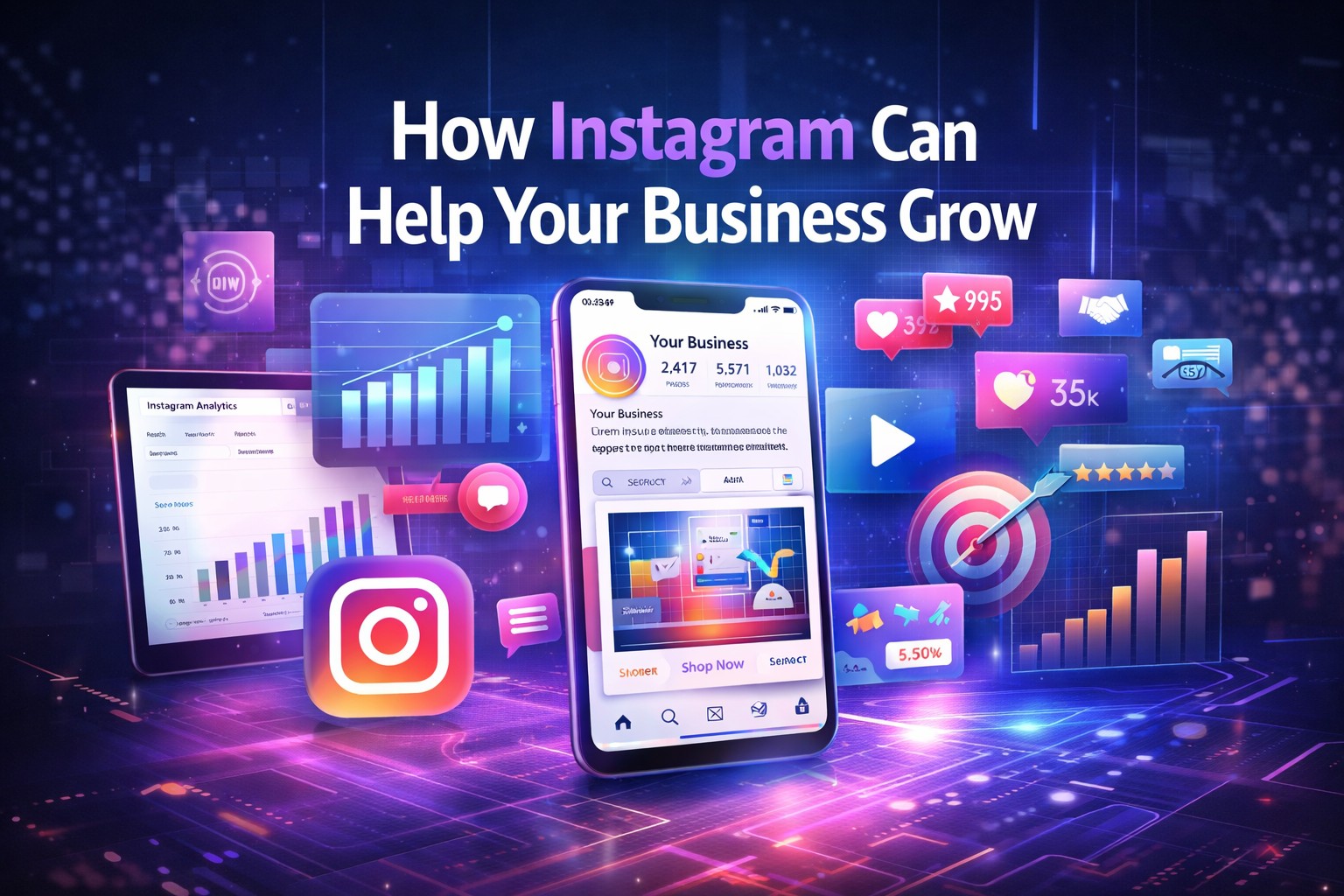
Instagram is no longer just a photo-sharing app. With 3 billion monthly active users as of Q3 2025 and over 350 million active business accounts on the platform, it has quietly evolved into one of the most powerful full-funnel marketing channels available to businesses of any size. Yet most brands barely scratch the surface of what the platform can actually do.
Social Media Marketing
If your current Instagram strategy amounts to posting product photos twice a week and hoping for the best, this guide is for you. What follows is a breakdown of how Instagram genuinely drives business growth — from brand awareness to direct revenue — along with the tactics, formats, and strategic frameworks that work in 2026.
Why Instagram Still Deserves a Serious Place in Your Marketing Strategy
A lot has changed since Instagram hit its first billion users. The algorithm is more complex, organic reach has tightened, and users are savvier than ever. So is it still worth investing in? Unambiguously, yes — but the reasoning matters.
Instagram generated $66.9 billion in ad revenue in 2024 alone, and that figure is projected to climb to $75 billion in 2026. That is not the behavior of a dying platform — it is the behavior of one maturing into serious commercial infrastructure. Over 65% of those 350 million business accounts belong to small businesses — freelancers, local shops, and D2C brands rather than enterprise giants.
With 3 billion monthly active users as of Q3 2025 and over 350 million active business accounts on the platform, it has quietly evolved into one of the most powerful full-funnel marketing channels available to businesses of any size. Reviewing this companion piece strengthens topical coverage and prevents high-intent reader bounce.
To amplify brand authority and capture top-of-funnel discovery, implement the audience acquisition playbooks in Why SMM panel bad for business?. This tactical breakdown details content velocity schedules and engagement conversion benchmarks.
More importantly, Instagram is now functioning as a search and discovery engine. Users increasingly type keywords directly into the search bar to find products, services, and content — not just hashtags. If your business is not showing up in those searches, you are invisible to an enormous pool of intent-driven potential customers.
Setting Up Your Business Account the Right Way
Before diving into content or strategy, your profile needs to do its job. Most businesses underestimate how much a poorly configured profile costs them in lost clicks and conversions.
Business vs. Creator Account
Choose a Business account if you sell products or services, run paid ads, or want access to Meta Business Suite for cross-platform management. Creator accounts are better suited for individual influencers and public figures. The key differences come down to inbox management, analytics depth, and ad permissions — businesses almost always benefit from the Business account designation.
Profile Optimization Checklist
Profile Element | Best Practice |
|---|---|
Username | Keep it consistent with your brand name across all platforms |
Profile Photo | Use your logo at 320×320px; avoid text-heavy images |
Bio | 150 characters max; include your primary keyword and a clear value proposition |
Link in Bio | Use a landing page (not your homepage) or a link aggregator for multiple CTAs |
Category Tag | Select the most accurate business category — it appears publicly and aids discovery |
Contact Button | Enable email or phone so visitors can act immediately |
Story Highlights | Use branded covers; organise by FAQs, testimonials, services, and offers |
Your bio should answer three things immediately: who you are, who you help, and what someone should do next. "Digital marketing agency helping D2C brands grow | Free audit → link below" is far more effective than a list of emojis and a generic tagline.
10 Proven Ways Instagram Drives Real Business Growth
Instagram does not grow your business by accident — it does so through specific, repeatable mechanisms. Here is how each one works in practice.
1. Building Brand Awareness at Scale
Instagram's ad network reaches 1.91 billion people globally, and organic Reels extend your reach well beyond your existing follower base. The platform's Explore page alone is visited by over 200 million accounts every day — content that performs well has a legitimate shot at reaching an entirely new audience without a single rupee in paid spend.
The key to awareness-stage content is consistency of identity, not frequency of posting. Your visual language, tone, and content pillars should be recognizable within two seconds of someone landing on your profile. Brands that achieve this see compounding returns — each new piece of content reinforces the ones before it.
What to do:
Define 3–5 content pillars that reflect your expertise and your audience's interests
Use consistent brand colors, fonts, and caption voice across all posts
Prioritize Reels for reach — they are distributed to non-followers by default
Optimize captions with keywords (Instagram now indexes caption text for search)
2. Driving Meaningful Customer Engagement
Raw follower counts are a vanity metric. Engagement — likes, comments, saves, shares, and DM conversations — signals to the algorithm that your content deserves wider distribution and, more importantly, signals to real people that your brand is worth paying attention to.
The Instagram algorithm places its heaviest weight on watch time, DM shares (sends per reach), and likes per reach — confirmed by Instagram head Adam Mosseri in January 2025. DM shares are weighted 3–5x higher than a standard like. When someone shares your post to a friend's inbox, Instagram interprets it as a high-quality endorsement and boosts distribution accordingly.
Formats that drive the highest engagement:
Carousels — highest save rate of any format; users swipe through, increasing time-on-post
Reels — 2.7% average engagement rate, the highest of any Instagram format
Question stickers in Stories — generate replies that count as DM engagement signals
3. Generating Website Traffic
Instagram does not make external linking easy — but businesses that approach this strategically consistently drive meaningful referral traffic. Rather than pointing all traffic to your homepage, create a dedicated landing page that matches whatever campaign you are running. If your latest Reel covers your service pricing, the link should take people to your pricing or enquiry page — not a generic homepage that forces them to navigate on their own.
Traffic generation tactics that work:
Story CTAs with direct swipe-up links (now available to all accounts, not just those with 10k+ followers)
Caption CTAs directing users to "the link in bio" — still effective when the content genuinely earns the click
Pinned Reels featuring a specific offer with a bio link
Instagram Shopping links routing directly to product pages
4. Direct Sales Through Instagram Shopping
Instagram Shopping has matured significantly. Businesses can now tag products directly in Feed posts, Reels, Stories, and the Explore tab — creating a near-frictionless path from discovery to purchase without the user ever leaving the app. Setting up requires connecting your account to a product catalogue through Meta Commerce Manager; once approved, tagged posts display a shopping bag icon that surfaces pricing and product details instantly.
Instagram Shopping works best for:
Physical product businesses (fashion, beauty, home décor, electronics)
D2C brands with clear visual products
Businesses running seasonal promotions or limited-time offers
For service-based businesses, the DM-to-sale funnel is equally powerful. Many B2C service providers in India close significant revenue purely through Story polls and DM conversations — no shopping infrastructure required.
5. Showcasing Products and Services Visually
This is Instagram's oldest advantage, but it is still underused strategically. The platform rewards visual storytelling — not polished catalogue photography, but authentic demonstration of value. Before-and-after content, behind-the-scenes process videos, client transformations, and product-in-use Reels consistently outperform static promotional posts. Users want to see the thing work, not just be told it works.
User-generated content (UGC) is particularly powerful here. When real customers post about your product unprompted, repurposing that content (with credit) acts as both social proof and authentic visual content. Brands that build UGC pipelines — through review requests, branded hashtags, or gifting programs — compound their visual library without proportional effort.
6. Building Brand Trust and Social Proof
Trust is the currency of social commerce, and Instagram has several built-in mechanisms for establishing it. The challenge is that trust is earned through consistency over time, not through a single campaign.
Customer testimonials in Stories — saved to a Highlights reel labelled "Reviews" or "Results"
Influencer mentions and tags — even micro-influencer endorsements carry disproportionate weight with niche audiences
Comment engagement — brands that respond thoughtfully to comments signal that real people are behind the account
Consistent posting history — a profile with regular posts over months reads as more credible than sporadic activity
The influencer market surpassed $22 billion in 2025, and Instagram influencer marketing delivers approximately $4.12 in earned media value per $1 spent. Micro-influencers (10k–100k followers) offer stronger trust signals with niche audiences than mega-influencers with diluted reach.
7. Collaborating with Influencers and Creators
The most cost-effective collaborations happen at the nano and micro-influencer tier — accounts with 5,000 to 100,000 followers who maintain 3–8% engagement rates in specific niches. A fitness equipment brand partnering with 10 micro-influencers in the Indian fitness niche will almost always outperform a single deal with a celebrity who posts everything from protein shakes to luxury cars.
How to structure influencer collaborations:
Gifting campaigns — provide free product in exchange for honest coverage; lower cost, authentic content
Paid partnerships — negotiate a fixed fee plus measurable performance metrics
Ambassador program — long-term relationships that build compounding brand association
Instagram Collab posts — co-author a single post that appears on both profiles simultaneously, doubling organic reach
8. Running Targeted Instagram Advertising
Organic reach dropped 31% between 2024 and 2025. Paid advertising fills that gap, and Instagram's targeting capabilities through Meta Ads Manager remain among the most sophisticated in digital marketing.
Ad Format | Best Use Case | Key Advantage |
|---|---|---|
Reels Ads | Awareness and reach | Highest video completion rate |
Carousel Ads | Product showcases | 72% higher conversion than single image |
Story Ads | Time-sensitive offers | Full-screen, high immersion |
Collection Ads | E-commerce catalogues | Seamless in-app shopping |
Explore Ads | Reaching new audiences | High discovery intent |
Instagram ads achieve an average 1.6% conversion rate — outperforming Facebook's 1.1%. For businesses in India, CPMs are comparatively lower than Western markets, making Instagram advertising particularly cost-efficient for regional audience targeting.
9. Using Analytics to Make Smarter Decisions
Most businesses check their Instagram stats once a month and draw vague conclusions. The brands that grow consistently treat analytics as an ongoing feedback loop — not a report card.
Metrics that actually indicate growth:
Metric | Why It Matters |
|---|---|
Reach rate | % of followers who saw your post; declining reach signals content-audience mismatch |
Save rate | Saves indicate high-value content; algorithm prioritizes strong save signals |
Shares (sends) | The single most heavily weighted engagement signal in 2025–26 |
Profile visits from posts | Indicates content is converting curious viewers into potential followers |
Website taps | Directly measures traffic conversion from Instagram |
Follower growth rate | More meaningful than total count; stagnation signals content fatigue |
Review these weekly, not monthly. The patterns that emerge over 4–6 weeks are actionable. Patterns over 6 months are just history.
10. Building a Community Around Your Brand
The difference between an audience and a community is participation. An audience consumes your content. A community contributes to it, defends it, and recruits for it. This is the long game — and the one most businesses neglect entirely.
Instagram's newer features are explicitly designed for community building. Broadcast Channels push exclusive updates, early access offers, and behind-the-scenes content to subscribers who opt in. Close Friends Stories work similarly for high-trust segments. Branded hashtags, when used consistently, aggregate UGC and create a shared identity around your brand. Community-driven accounts experience significantly lower churn and higher lifetime value — and are far more resilient to algorithm changes.
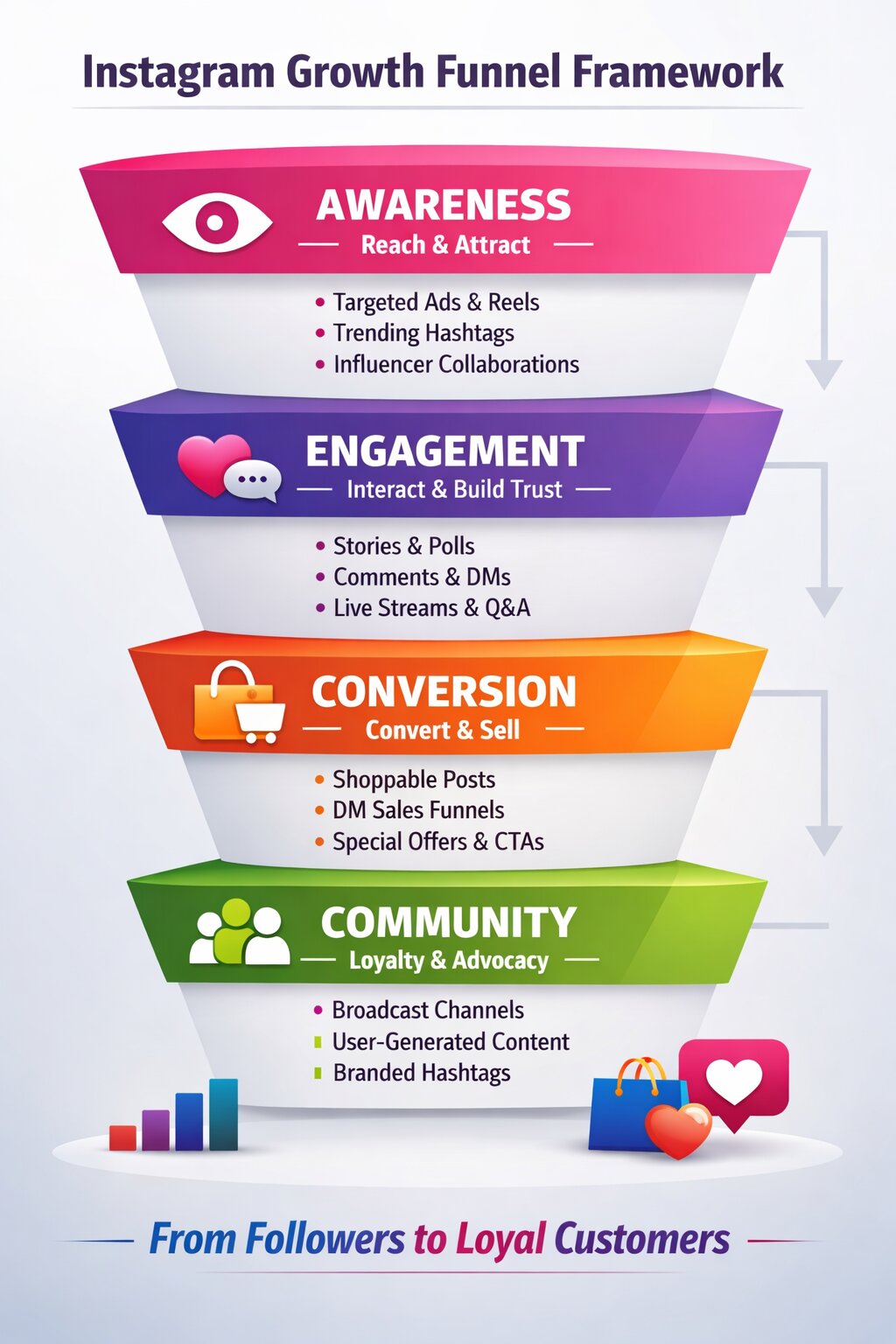
Instagram Growth Funnel
Content Formats Ranked by Business Impact
Format | Primary Goal | Reach Potential | Recommended Frequency |
|---|---|---|---|
Reels | Discovery & reach | Highest (non-followers) | 4–5x per week |
Carousels | Education & saves | Medium | 2–3x per week |
Stories | Nurturing & CTAs | Followers only | Daily |
Live | Trust & real-time Q&A | Medium | 1–2x per month |
Static Posts | Brand identity | Low–Medium | 2–3x per week |
Broadcast Channel | Retention & loyalty | Subscribers only | 3–4x per week |
A sustainable content strategy does not require all formats simultaneously. Start with Reels for reach, Carousels for depth, and daily Stories for connection — that combination covers the full funnel without requiring a dedicated content team.
Instagram Marketing
Understanding the Instagram Algorithm in 2026
Instagram does not use a single algorithm. It uses four separate AI-powered ranking systems — one each for Feed, Reels, Stories, and Explore — and each prioritizes different signals.
The Three Universal Ranking Factors
Watch Time — The single most important signal for Reels. Viewers decide within 1.7 seconds whether to continue watching. Your opening frame is everything.
Sends Per Reach — DM shares are weighted 3–5x more than a like. When someone shares your content to a friend, it is treated as a strong quality endorsement.
Likes Per Reach — The percentage of people who liked your post relative to how many saw it; matters more for existing followers than cold reach.
What Changed in Late 2025
Instagram's December 2025 algorithm updates had significant consequences. Accounts that aggregated and reposted others' content saw 60–80% reach drops. Original creators, by contrast, saw 40–60% reach increases. The message from Meta is unambiguous: create original content or face algorithmic suppression.
Your last 9–12 posts determine how Instagram categorizes your account topically. Inconsistency — jumping between food content, travel posts, and business tips — confuses the classification system and results in distribution penalties. Niche consistency is now a technical requirement, not just a strategic preference.
A 90-Day Instagram Growth Strategy for Businesses
Phase 1 — Days 1–30: Foundation
The goal here is not growth. It is clarity.
Audit and fully optimize your profile (bio, highlights, pinned posts, link in bio)
Define your 3–5 content pillars — specific topics you will cover consistently
Research 20–30 niche-relevant keywords and hashtags; build a master list
Post 3–4 times per week without obsessing over metrics — you are establishing baseline data
Spend 15–20 minutes per day engaging meaningfully with accounts in your niche
Phase 2 — Days 31–60: Growth
Introduce a consistent Reels schedule — minimum 3 per week
Launch a UGC or testimonial campaign — ask existing customers for content or reviews
Begin one collaboration: a micro-influencer gifting campaign or an Instagram Collab post
A/B test two different bio CTAs and measure which drives more link taps
Analyze your top 5 performing posts — replicate the format, topic, and structure
Phase 3 — Days 61–90: Monetization
Set up Instagram Shopping (if you sell physical products)
Launch your first paid campaign — start by boosting a Reel that already performed well organically
Create a Broadcast Channel and invite your most engaged followers
Track the full funnel: follower growth → profile visits → website clicks → conversions
Identify your top 2–3 content formats by engagement rate and double down exclusively on those
Instagram Marketing by Business Type
Business Type | Best Content Approach | Key Features to Leverage |
|---|---|---|
E-commerce brand | Product Reels, UGC reposts, shopping tags | Instagram Shopping, Collection Ads |
Service business | Process videos, client results, educational carousels | Story CTAs, DM conversations, Broadcast Channel |
Local business | Location-tagged posts, Stories for daily offers | Location stickers, local hashtags, Story polls |
B2B company | Founder thought leadership, behind-the-scenes, case study carousels | Collab posts, Reels |
Freelancer / Consultant | Portfolio showcases, testimonials, expertise content | Close Friends, Highlights, link-in-bio portfolio |
Common Instagram Marketing Mistakes That Stall Growth
Buying followers. Purchased followers do not engage, which collapses your engagement rate relative to your follower count. The algorithm reads low engagement as a signal that your content is not worth distributing. You end up with a larger number and smaller reach — the opposite of what you actually need.
Posting without content pillars. An account that covers five unrelated topics confuses both the algorithm and the audience. The platform cannot categorize your content accurately, so it distributes it poorly. Pick your lanes and stay in them.
Ignoring the comment section. Every unanswered comment is a missed relationship signal. The algorithm notices interaction velocity — how quickly engagement happens after posting. Brands that reply to every comment within the first hour consistently outperform those that do not.
Treating captions as afterthoughts. Instagram now indexes caption text for search. A thoughtful, keyword-relevant caption with a clear question or CTA at the end is a meaningful SEO and engagement lever that most brands waste entirely.
Skipping alt text on images. Instagram allows you to add alt text to every image post. This improves accessibility and provides additional keyword signal for Instagram's internal search indexing — a free, low-effort win that almost no one uses.
Frequently Asked Questions
How long does it take for Instagram to start generating business results?
Most businesses begin seeing meaningful engagement improvements within 60–90 days of consistent, strategic posting. Significant follower growth and measurable lead or revenue attribution typically emerge between months 3 and 6. Instagram rewards consistency — accounts that post erratically and then go quiet rarely build the algorithmic momentum needed for compounding growth.
How many followers do you need to sell on Instagram?
There is no minimum. Businesses with fewer than 1,000 followers regularly generate revenue through Instagram Shopping, DM conversations, and Story-based offers. What matters is the quality of your engagement and the clarity of your offer — not the size of the number next to your username.
How often should a business post on Instagram?
For most businesses, 4–5 Reels per week, daily Stories, and 2–3 carousels or static posts per week is a sustainable cadence. Consistency matters more than frequency. Posting daily for one month and then disappearing causes more algorithmic damage than posting 3 times a week steadily for six months.
Does Instagram marketing work for small businesses in India?
Extremely well. India is Instagram's largest market with over 350 million active users, and ad CPMs are significantly lower than in Western markets — making paid reach far more affordable. The DM-based sales model also aligns naturally with how Indian consumers prefer to communicate with businesses before purchasing.
What is the best type of Instagram content for business growth in 2026?
Reels remain the highest-reach format with a 2.7% average engagement rate. For conversion, Carousels perform best due to their high save rates and extended time-on-post. For retention, Stories and Broadcast Channels are the most direct path to your existing audience. The ideal strategy combines all three with a clear purpose for each.
Is a Business account better than a Creator account for growth?
For the vast majority of businesses, yes. Business accounts offer access to Meta Business Suite, detailed analytics, ad management tools, and commerce features that Creator accounts do not. The only meaningful advantage of Creator accounts is tiered inbox management — which matters more for high-volume influencers than for businesses.
Need help building a tailored Instagram strategy for your business? Teckgeekz offers full-service social media marketing audits and growth strategies — get in touch to find out what your account is currently leaving on the table.


Jeffrey Mathew
Founder & CEO • Travel Marketing Specialist
"With over 14 years of dominance in the travel and tech sectors, Jeffrey Mathew has engineered growth for hundreds of OTAs and airlines worldwide. He specializes in the intersection of Performance PPC and Agentic AI, building high-performance digital ecosystems for modern brands."
Start a Conversation
Ready to Elevate Your Business?
Fill out the form below and let's discuss how Teckgeekz can help you reach your goals.
Describe your project to unlock real-time AI service recommendations and matching portfolio cases.
Our Trusted Partners