PPC Funnel Mapping for Travel: Connecting Keywords, Ads, Landing Pages & Conversions

Most travel PPC campaigns look optimized on the surface. Keywords are carefully selected, ads are tested, and landing pages are improved over time. Yet, despite all of this, performance often feels inconsistent. Traffic comes in, but conversions don’t scale in the same proportion.
The issue usually isn’t with any single component—it’s with how those components work together.
Travel decisions rarely happen in a straight line. A user might search today, compare options tomorrow, and return later to complete a booking. When campaigns are built in isolation, this journey becomes fragmented. Users drop off at different stages, and it’s not always clear where or why.
This is where PPC funnel mapping becomes important. Instead of optimizing individual parts, it focuses on the full journey—from the first search to the final booking—and helps you understand how each stage contributes to performance.
Travel PPC Marketing Guide
Why Funnel Mapping Matters in Travel PPC
In travel PPC, user behavior is layered. People explore destinations, compare prices, revisit options, and often delay decisions. This means that campaigns cannot rely on a single interaction to drive conversions.
Without a mapped funnel, campaigns operate as disconnected systems. Keywords bring traffic, ads generate clicks, and landing pages attempt to convert—but there’s no clear connection between these stages. This lack of alignment creates inefficiencies that are difficult to diagnose.
When you apply funnel mapping, you start to see the journey more clearly. You understand how users move between stages, where they hesitate, and where they drop off. More importantly, you gain the ability to adjust each stage in a way that supports the overall system.
Understanding the Travel PPC Funnel
A travel PPC funnel is not just a theoretical model—it reflects how users actually behave.
Discovery Stage (Top of Funnel)
At the top of the funnel, users are still exploring. They may not have a fixed plan yet. Searches are broad, often focused on destinations or general travel ideas.
At this stage, intent is low, but volume is high. The goal here is visibility and engagement, not immediate conversion.
Consideration Stage (Mid Funnel)
As users move forward, their behavior changes. They begin comparing destinations, routes, and pricing options. Engagement increases, and intent becomes clearer.
This is where campaigns need to provide value—clear offers, structured information, and reasons to choose one option over another.
Conversion Stage (Bottom Funnel)
At the bottom of the funnel, users are ready to act. They are searching for specific routes, checking availability, and evaluating final pricing.
Here, clarity and urgency become critical. Small friction points—unclear pricing, slow pages, or weak messaging—can lead to lost conversions.
Return & Retargeting Stage
One of the defining characteristics of travel PPC is that users often return before booking. This stage is where retargeting connects the funnel, bringing users back and reinforcing decisions.
Without this layer, a significant portion of potential conversions is lost.
Retargeting Strategies for travel PPC
Mapping Keywords to Funnel Stages
Not all keywords represent the same level of intent. Treating them equally leads to inefficient targeting and wasted spend.
Broad keywords usually belong to the discovery stage. These include destination searches and general travel queries. They bring volume but not necessarily immediate conversions.
More specific searches—such as route-based queries or pricing-related terms—indicate stronger intent. These belong closer to the conversion stage.
By aligning keywords with funnel stages, campaigns become more structured. Budget, messaging, and expectations can then be adjusted accordingly.
High-Intent Keywords & Campaign Structure
Mapping Ad Creatives to User Intent
Ad creatives play a critical role in guiding users through the funnel.
At the top of the funnel, messaging should focus on inspiration and discovery. Users are not ready to book—they are exploring possibilities. Ads that highlight destinations or experiences perform better here.
In the mid funnel, messaging should shift toward value. Users are comparing options, so clarity around pricing, inclusions, and benefits becomes important.
At the bottom of the funnel, urgency-driven messaging becomes more effective. Limited availability, price changes, and time-sensitive offers can push users toward action.
When ad creatives do not align with user intent, campaigns generate clicks without conversions. This misalignment is one of the most common causes of inefficiency.
PPC Ad Creatives & Copy Strategy
Mapping Landing Pages to Funnel Stages
Landing pages are where intent is either reinforced or lost.
If a user clicks on an ad for a specific route or offer, the landing page should reflect that immediately. Any mismatch between the ad and the page creates friction.
For example, sending a high-intent user to a generic page forces them to search again within your site. This additional step often leads to drop-offs.
When landing pages are aligned with funnel stages, the experience becomes smoother. Users find what they expect, engagement improves, and conversions become more consistent.
Landing Page Optimization for Travel PPC
Budget Allocation Across the Funnel
One of the common mistakes in travel PPC is treating all stages equally when it comes to budget.
In reality, each stage serves a different purpose.
Top funnel campaigns generate awareness and bring new users into the system.
Mid funnel campaigns nurture these users and guide decision-making.
Bottom funnel campaigns capture conversions and deliver the highest return.
Budget should reflect these roles. While bottom funnel campaigns often deserve higher priority due to their conversion potential, top and mid funnel campaigns are essential for sustaining long-term growth.
Budget Allocation & ROI Optimization
Identifying Funnel Drop-Off Points
Funnel mapping becomes most valuable when it helps identify where performance breaks.
A campaign with a high click-through rate but low conversions often indicates a mismatch between ad messaging and landing page experience.
Traffic that does not engage with the page suggests relevance issues or poor user experience.
Repeat visitors who do not convert point toward missing retargeting strategies or lack of trust signals.
By identifying these patterns, adjustments become more targeted and effective.
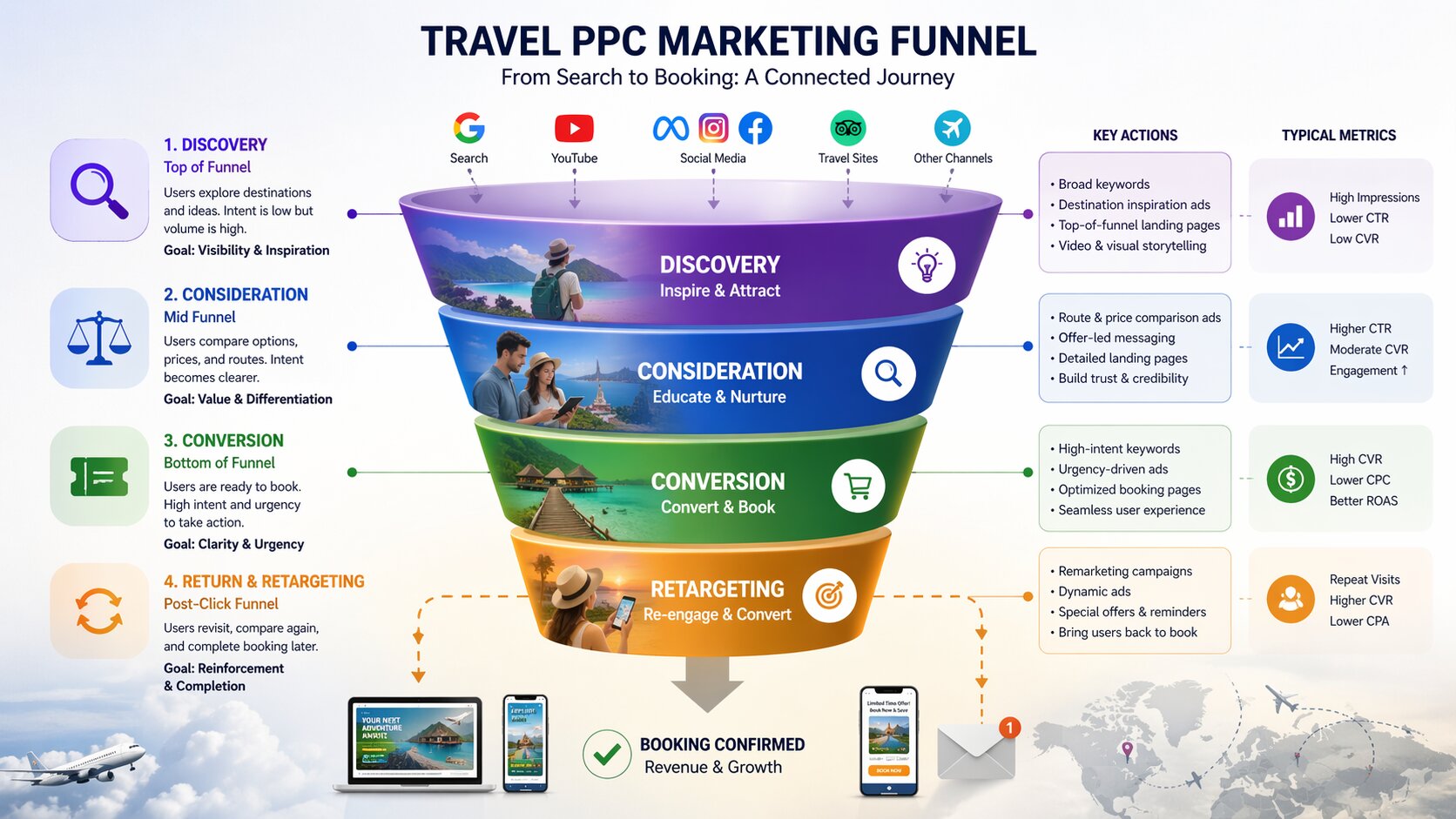
Travel PPC Marketing Funnel
Market Insights Across Funnel Stages
Funnel Stage | Behavior | Risk |
|---|---|---|
Top | High traffic, low intent | Wasted spend |
Mid | Comparison-driven | Drop-offs |
Bottom | High intent | Price sensitivity |
These patterns reinforce the importance of alignment. Each stage behaves differently, and strategies must adapt accordingly.
Anonymized Case Study (US & UK Campaign)
A travel campaign targeting both US and UK audiences was performing reasonably well, but results lacked consistency. Each component—keywords, ads, and landing pages—was optimized individually, but there was no unified funnel structure.
Before funnel mapping, performance looked stable but limited:
CTR: 5.4%
Conversion Rate: 2.2%
CPA:
US: $52
UK: £41
The issue wasn’t poor performance—it was the lack of scalability.
Once funnel mapping was introduced, the approach changed. Campaigns were restructured to align keywords, ad creatives, and landing pages with specific funnel stages. Retargeting was integrated more effectively, and messaging was adjusted based on user intent.
The results became more consistent:
CTR increased to 6.9%
Conversion Rate improved to 3.6%
CPA reduced to:
US: $39
UK: £31
The improvement wasn’t just in numbers—it was in stability. Campaigns became easier to manage, and scaling decisions became more predictable.
US vs UK Travel PPC Funnel Differences
While the funnel structure remains similar, user behavior differs between markets.
In the US market, competition is higher, and CPCs typically range between $1.50 and $3.50. Users tend to move faster during peak periods and are more responsive to convenience and premium offerings.
In the UK market, users are generally more price-sensitive. CPCs are lower, often between £0.90 and £2.20, but decision cycles can be more comparison-driven. Seasonal spikes—particularly during summer and holiday periods—are more pronounced.
Understanding these differences allows campaigns to adapt more effectively without changing the core funnel structure.
Practical Insight
The biggest shift that comes from funnel mapping is perspective.
Instead of asking why a campaign is underperforming, you start asking where the breakdown is happening. This shift leads to more precise adjustments and better long-term performance.
“Most travel PPC campaigns don’t fail because of bad targeting—they fail because the journey is broken. When you start looking at the funnel as a connected system instead of isolated steps, performance doesn’t just improve—it becomes predictable.” — Jeffrey Mathew
Travel PPC works best when it is treated as a connected system, not a collection of separate optimizations.
Key Takeaways
PPC funnel mapping provides clarity across the entire user journey. It helps identify inefficiencies, align campaign components, and improve overall performance.
Each stage of the funnel requires a different approach. Aligning keywords, ad creatives, landing pages, and budget ensures that users move smoothly through the journey.
Retargeting plays a critical role in connecting stages and capturing delayed conversions.
How Teckgeekz Helps Build Full-Funnel PPC Systems
This is where Teckgeekz approaches PPC differently.
Instead of focusing on isolated optimizations, the emphasis is on building connected funnel systems. Campaigns are structured around how users move through the journey, not just how they enter it.
Keywords, ad creatives, landing pages, and retargeting strategies are aligned to support each stage. This creates a system where performance becomes more predictable and easier to scale.
In practice, the goal is not just better campaigns—but a better structure that consistently delivers results.


Jeffrey Mathew
Founder & CEO • Travel Marketing Specialist
"With over 14 years of dominance in the travel and tech sectors, Jeffrey Mathew has engineered growth for hundreds of OTAs and airlines worldwide. He specializes in the intersection of Performance PPC and Agentic AI, building high-performance digital ecosystems for modern brands."
Start a Conversation
Ready to Elevate Your Business?
Fill out the form below and let's discuss how Teckgeekz can help you reach your goals.
Describe your project to unlock real-time AI service recommendations and matching portfolio cases.
Our Trusted Partners