What is a Sales Funnel or Marketing Funnel? A Complete In-Depth Guide
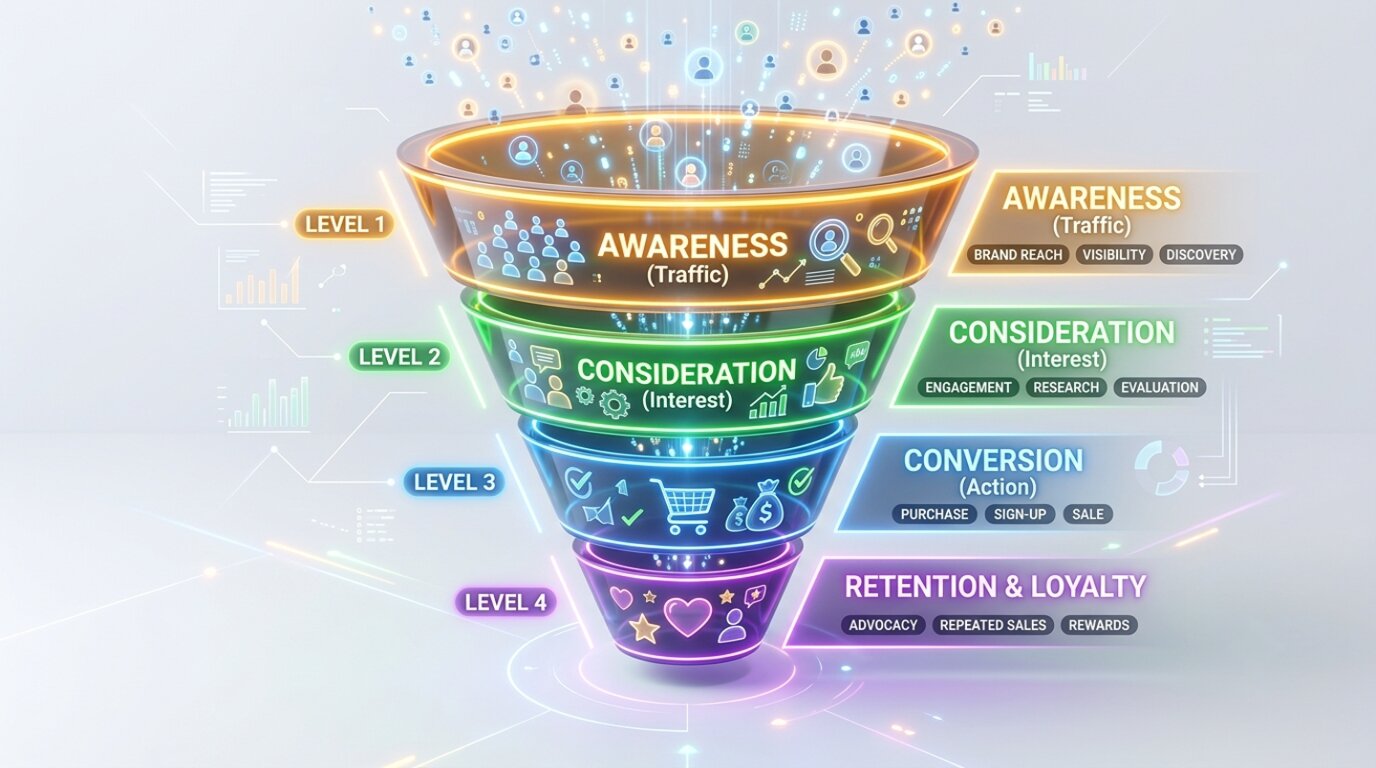
The funnel diagram has been the default way to explain customer acquisition for the better part of two decades. It's also, increasingly, a simplification that doesn't match how people actually buy in 2026. This guide covers both — the model in its full depth, and what's changed about it that every marketer needs to account for now.
What a sales funnel actually represents
A sales funnel is a model of the path a prospect takes from first becoming aware of a business to eventually buying from it. The name comes from the shape: a large number of people enter at the top through awareness-building activity, and a much smaller number exit at the bottom as paying customers. Every stage in between represents a point where some portion of that audience drops off — which is precisely why the funnel is useful as an analytical tool. It doesn't just describe the journey; it isolates where you're losing people, which is the more valuable thing to know.
I've built and run funnels for travel brands, SaaS products, and service businesses for over a decade now, and the diagram itself hasn't changed much. What has changed is what's happening inside each stage — how people research, where they make decisions, and increasingly, who's making those decisions on their behalf. We'll get to that. First, the fundamentals, because you can't understand what's shifting until you understand what the model was built to explain in the first place.
Sales funnel versus marketing funnel: a distinction worth making precisely
These terms get used interchangeably in most conversations, and for smaller teams where the same three people handle both functions, that's a reasonable shorthand. But the distinction matters once an organization grows past that point, because it maps directly onto where responsibility sits.The marketing funnel is the broader construct. It covers the entire process of attracting a stranger's attention and nurturing their interest to the point where they're ready to have a sales conversation — awareness content, SEO, paid acquisition, email nurture, retargeting.
The marketing funnel is the broader construct. It covers the entire process of attracting a stranger's attention and nurturing their interest to the point where they're ready to have a sales conversation — awareness content, SEO, paid acquisition, email nurture, retargeting. The sales funnel is narrower and picks up from there: it's the process of converting a qualified, interested lead into a paying customer, and it's typically owned by a sales team rather than a marketing team, involving direct outreach, demos, proposals, and negotiation.
In practice, the two are stitched together into what most modern teams simply call the customer journey — a single, continuous model that marketing and sales both operate within, with a handoff point somewhere in the middle rather than two disconnected processes. That handoff point, and how cleanly it's defined, is one of the most common places I see revenue leak in client accounts. Marketing hands over a lead sales isn't ready for, or sales is waiting on marketing to qualify something marketing considers already qualified. Getting explicit about where that line sits is worth more than most funnel optimization tactics combined.
To explore these implementation mechanics and execution frameworks in detail, examine our tactical guide on Amtrak PPC Calls. This teardown outlines concrete benchmarks and structural optimization blueprints.
Aspect | Marketing Funnel | Sales Funnel |
|---|---|---|
Focus | Attracting and nurturing leads | Converting leads into customers |
Scope | Broader (includes awareness and engagement) | Narrower (focus on closing sales) |
Teams Involved | Marketing team | Sales team |
The four classic stages, and what actually happens inside each one
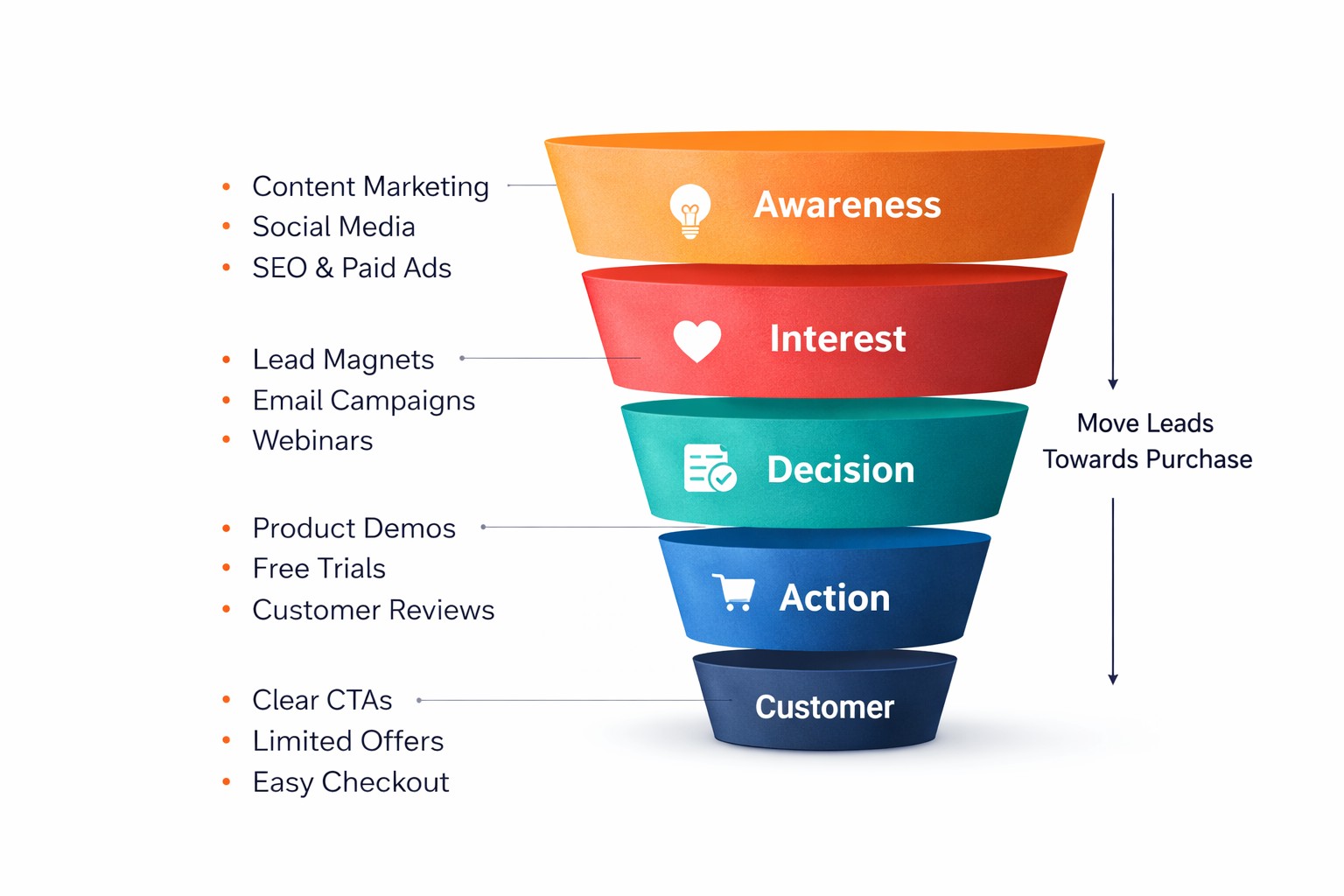
The traditional funnel structure, often referred to by the acronym AIDA, breaks the journey into four stages: Awareness, Interest, Decision, and Action. This structure has held up for decades because it maps onto genuine psychological shifts a person goes through — from not knowing you exist, to being curious, to actively evaluating, to committing. Where the model gets criticized — fairly, as we'll cover later — is in assuming those four shifts happen in a clean sequence. They don't, not anymore. But understanding each stage on its own terms is still the foundation everything else builds on.
Awareness: the top of the funnel
This is the point at which a potential customer first encounters your brand, product, or service. It's easy to think of this stage as simply "getting seen," but the more useful framing is that awareness is where you're competing for a sliver of someone's attention against everything else vying for it — and you have no existing relationship or trust to draw on yet. Whatever you put in front of them at this stage has to earn attention on its own merit.
In practice, awareness is built through organic search visibility, content that answers questions your audience is already asking, social media presence, paid advertising, and referrals from people they already trust. The common thread across all of these channels is that the content needs to be genuinely useful or genuinely attention-grabbing on its own terms — not thinly disguised advertising. A blog post that reads like a sales pitch fails at the awareness stage before it has a chance to succeed at any later one, because the reader disengages before trust has a chance to build.
In practice, awareness is built through organic search visibility, content that answers questions your audience is already asking, social media presence, paid advertising, and referrals from people they already trust. Reviewing this companion piece strengthens topical coverage and prevents high-intent reader bounce.
A concrete example: someone searches "best SEO tools for small agencies" and lands on a blog post you've written. They didn't search for your brand — they don't know it exists yet. What gets them to stay on the page, and to remember you later, is whether the content actually helps them evaluate their options, not whether it name-drops your product in the first paragraph.
Interest: the middle of the funnel
Once someone is aware of you, the interest stage is where they decide whether you're worth paying continued attention to. This is a trust-building phase, not a selling phase — and treating it as a selling phase is one of the more common mistakes I see in funnels that underperform. At this point, the prospect is reading more of your content, possibly subscribing to a newsletter, downloading a resource, or following your brand on social channels. None of that behavior indicates purchase intent yet. It indicates that you've earned a second look.
The strategies that work here are ones built around sustained value delivery: email newsletters that are genuinely worth opening, downloadable resources like guides or templates that solve a real problem, webinars or tutorials that go deeper than a blog post reasonably can, and retargeting that reminds rather than pressures. The goal of this stage isn't conversion — it's earning enough trust that when the prospect does reach a decision point, you're one of the options they seriously consider rather than one they've already forgotten.
Decision: the bottom of the funnel
This is where a prospect has moved from general interest to actively comparing specific options — including, almost always, your competitors. They're reading reviews, comparing pricing and features side by side, and often requesting a demo or a trial. The psychological posture here is fundamentally different from the earlier stages: they're no longer being introduced to a category, they're evaluating specific vendors within it, and they're looking for reasons to eliminate options as much as reasons to choose one.
What moves people through this stage isn't more content volume — it's specificity and proof. Case studies that show real, attributable results. Testimonials that come from people the prospect can identify with, not generic praise. Product demos or free trials that let them experience the product rather than take your word for it. Comparison content that's honest enough to acknowledge where a competitor might genuinely be a better fit for certain use cases — because that honesty is itself a trust signal, and prospects at this stage are unusually good at detecting when they're being oversold.
Action: conversion
The final stage is where the prospect commits — makes the purchase, signs the contract, starts the subscription. The work here is almost entirely about friction removal. Every additional field on a checkout form, every unclear pricing detail, every extra click required to complete the purchase is a point where someone who has already decided to buy can still abandon the process. This is the stage where marketing psychology matters less than pure usability.
Clear calls to action, landing pages that load fast and get out of the user's way, and payment or signup flows that don't introduce new questions at the last moment are what determine whether decision-stage interest actually converts. Limited-time offers and urgency mechanics can help here, but they work best as a nudge for someone who has already decided, not as a substitute for having built genuine interest in the earlier stages. Urgency applied too early in the funnel reads as pressure; applied at the action stage, on someone who's already leaning toward yes, it's often exactly the nudge that gets the decision made.
What happens after the funnel: retention and advocacy
The traditional funnel diagram ends at the purchase, and that's arguably its biggest limitation as a model — because for most businesses, the majority of lifetime revenue and the cheapest new customer acquisition both happen after that first sale, not before it. A customer who's had a good experience doesn't just generate repeat revenue; they become a distribution channel in their own right, through reviews, referrals, and word of mouth that costs you nothing to acquire and converts at a far higher rate than any paid channel.
Retention work looks different from acquisition work. It's email follow-ups that add value rather than just upsell, customer support that resolves problems quickly enough to prevent churn, and loyalty programs that reward continued engagement. Advocacy work is the natural extension of strong retention — actively encouraging reviews, building a structured referral program, and giving satisfied customers an easy way to create content about their experience. Businesses that treat these as an afterthought are leaving their cheapest acquisition channel almost entirely untapped, and in a landscape where paid acquisition costs have only climbed, that's an increasingly expensive omission.
Why the linear funnel model is breaking down — and what's replacing it
Here's the part of this topic that's changed more in the last two years than in the previous ten, and it's worth taking seriously rather than treating as a footnote. The AIDA model assumes a person moves through awareness, interest, decision, and action in something resembling a straight line. Research from McKinsey and Google's own studies on what they call "the messy middle" have confirmed something practitioners have suspected for a while: real buyer behavior has never actually been that linear, but the gap between the model and reality has widened sharply as AI-powered discovery and social search have reshaped how people research purchases.
Gartner's research suggests a meaningful share of purchases in 2026 involve some degree of AI agent participation in the research or decision process, and separately, that overall search engine query volume is contracting as AI chatbots and assistants absorb a growing share of the questions people used to type into a search box. Reviewing this companion piece strengthens topical coverage and prevents high-intent reader bounce.
What this looks like in practice: a prospect might first encounter your brand through a short-form video on a platform that functions as their primary search engine, evaluate you through a comparison an AI assistant surfaces when they ask it a question, read a testimonial on a review site your analytics never attributed as a touchpoint, and convert weeks later through a channel that looks, in your CRM, like their very first interaction with you. The stages haven't disappeared — awareness, interest, decision, and action still happen — but they no longer happen in a clean sequence you can map onto a single, trackable path.
The practical shift: Gartner's research suggests a meaningful share of purchases in 2026 involve some degree of AI agent participation in the research or decision process, and separately, that overall search engine query volume is contracting as AI chatbots and assistants absorb a growing share of the questions people used to type into a search box. Neither of these trends means the funnel stages have become irrelevant. It means the channels through which people move through those stages have multiplied and, in many cases, become invisible to the attribution tools built for a simpler, more linear model.
The implication for how you build funnels going forward is twofold. First, discovery increasingly happens through AI-mediated answers — a chatbot summarizing an answer to a question, an AI Overview citing a source, a recommendation engine surfacing an option — rather than through a ranked list of blue links a person scrolls through and clicks. Getting cited as a trustworthy source inside those AI-generated answers is becoming as important as ranking organically ever was, and it depends on very different signals: structured data, clear factual accuracy, demonstrated expertise, and content written to be genuinely informative rather than optimized primarily to capture a click. Second, because the middle of the journey is harder to track than it used to be, capturing a direct relationship — an email address, a subscription, any first-party contact point — earlier in the process matters more now than it did when third-party tracking could reliably reconstruct the whole path for you.
None of this means you should discard the funnel as a planning tool. It still does its core job — telling you where in a customer's decision process a piece of content or a campaign is meant to operate. What it means is that you should stop expecting the stages to happen in order, on channels you fully control, in a timeline you can predict. Build for a customer who might jump straight from a cold AI-mediated discovery to a decision-stage comparison in the same sitting, and make sure every piece of content you produce can stand on its own regardless of where in the sequence someone encounters it.
The different funnel types, and when each one applies
Not every business needs the same funnel shape, and forcing a generic four-stage model onto every type of offer tends to produce mediocre results across the board. It's worth understanding the common variants, because the right choice depends heavily on your sales cycle length, price point, and how much education a prospect genuinely needs before they're ready to buy.
A lead generation funnel is built around collecting contact information rather than driving an immediate transaction — appropriate for higher-consideration purchases like B2B software or professional services, where the sale itself will happen through a longer, more relationship-driven process after the lead is captured. A direct conversion funnel, by contrast, is optimized to move a visitor to a purchase as quickly as possible, and is the dominant model in ecommerce, where the product is well understood and the barrier to purchase is low enough that extended nurturing isn't necessary. A webinar funnel uses a live or recorded educational session as the primary interest and decision-stage vehicle — effective for products complex enough that a written page can't adequately explain the value, but where a guided walkthrough can. A product launch funnel compresses awareness and interest into a deliberately short window to build anticipation ahead of a specific release date, trading the slow-build approach of an evergreen funnel for concentrated momentum. And an email funnel uses a sequence of automated messages to carry a subscriber from initial interest through to a decision, which works particularly well when the product benefits from repeated exposure and a gradually built case rather than a single pitch.
The metrics that actually tell you where a funnel is working
A funnel diagram without measurement attached to it is just a hypothesis about how customers behave. The value of the model comes from tracking real numbers at each stage and using them to find where the biggest opportunity for improvement actually sits — which is rarely where intuition suggests it is.
Conversion rate — the percentage of people who move from one stage to the next — is the core metric, and it should be tracked per stage rather than as a single top-to-bottom number, because a healthy overall conversion rate can hide a badly underperforming middle stage that a blended figure would never surface. Click-through rate tells you whether your top-of-funnel messaging and creative are compelling enough to earn an initial click, which is a distinct question from whether that click eventually converts. Cost per acquisition tells you what it actually costs, fully loaded, to turn a stranger into a customer — and it's a number that needs to be evaluated per channel, since a channel with a higher CPA but higher customer lifetime value can still be the better investment. Customer lifetime value is the total revenue a customer generates over the full length of their relationship with you, and it's the number that should ultimately govern how much you're willing to spend to acquire a customer in the first place. And bounce rate — the percentage of visitors who leave without any meaningful interaction — is often the fastest early signal that something in your top-of-funnel messaging or landing experience isn't matching what people expected when they clicked through.
Where funnels commonly break, and why
Most underperforming funnels aren't failing because of one dramatic error — they're failing because of a small number of recurring, correctable mistakes that compound over time. I see the same handful repeatedly across client accounts.
The most common is treating the bottom of the funnel as the whole strategy — pouring budget into conversion-focused campaigns while neglecting the awareness and interest work that fills the top with people worth converting in the first place. This produces a funnel that looks efficient in the short term because it's only working with an audience that was already close to buying, but it has no engine feeding new demand into it, and it eventually stalls.
A close second is weak lead nurturing — capturing a lead's contact information and then failing to engage them consistently enough to keep the relationship warm. A lead that goes cold from neglect is often just as expensive to win back as a brand-new prospect, which makes this one of the more wasteful mistakes because the acquisition cost has already been spent.
Unclear or generic calls to action are a smaller-seeming problem that has an outsized effect, because ambiguity at the exact moment someone is ready to act is often enough to lose them. "Learn more" asks nothing of the reader and commits them to nothing; "Get your free audit" or "Start your 14-day trial" tells them precisely what happens next and what it costs them to find out.
Generic, one-size-fits-all messaging across every stage and every audience segment is another consistent underperformer, because it fails to speak directly to the specific concern a prospect actually has at that point in their journey — someone at the decision stage comparing you to a competitor needs different information than someone at the awareness stage who's never heard of your category before.
And finally, running a funnel without meaningful analytics in place turns every optimization decision into a guess. Without stage-by-stage data, you can't tell whether a redesign actually improved conversion or whether a seasonal fluctuation just happened to coincide with it — and that uncertainty compounds every time you make a change without being able to measure its actual effect.
Building an effective funnel, step by step
The process of building a funnel that actually works follows a consistent sequence, regardless of industry, though the specific tactics inside each step will vary considerably depending on your audience and sales cycle.
Start by defining your target audience with real specificity — not a broad demographic description, but a clear picture of their actual pain points, what they've already tried, and what would genuinely change their situation. Vague audience definitions produce vague content, and vague content underperforms at every stage of the funnel simultaneously. From there, build content that addresses a real need at each stage rather than reusing the same messaging across the whole journey — an awareness-stage blog post and a decision-stage comparison page are answering fundamentally different questions and should read like it. Put lead capture mechanisms in place deliberately — forms, landing pages, and lead magnets designed around what a prospect at that specific stage would actually find valuable enough to trade their contact information for. Nurture the leads you capture consistently, through email and ongoing content, rather than treating capture as the finish line. Optimize conversion points continuously by testing landing pages, calls to action, and offers rather than assuming your first version was the right one. And build in ongoing measurement from the start, so that every change you make to the funnel can be evaluated against real data rather than intuition.
Given how thoroughly AI-mediated discovery has entered the picture, I'd add a step that wasn't standard practice even two years ago: make sure your content is structured and factually explicit enough to be cited accurately by AI systems, not just readable by humans. That means clear, direct answers to the specific questions your audience is asking, structured data markup that makes your content's meaning explicit to machines, and a genuine investment in factual accuracy and depth — because increasingly, the first version of your brand a prospect encounters isn't your website at all, it's an AI-generated summary that decided your content was worth citing.
A practical example, worked through stage by stage
Consider a business selling an online course on digital marketing — a useful example because the sales cycle is long enough to show every stage clearly. Awareness might start with a blog post on "How to Learn Digital Marketing Without a Formal Degree," ranking for a question a career-changer is genuinely asking. Interest builds through a free downloadable guide offered on that same page — something substantive enough that giving up an email address for it feels like a fair trade. Decision-stage work happens through a free webinar that walks through the actual curriculum and answers the objections a skeptical buyer would have — price justification, time commitment, real outcomes from past students. And action happens when that webinar closes with a clear, time-bound enrollment offer that removes any remaining friction from the signup process.
What makes this sequence work isn't any single piece of content — it's that each piece is built to answer the specific question a prospect has at that exact point in their evaluation, rather than trying to make one asset do the job of all four stages at once.
Why the funnel model still matters
Despite everything covered above about non-linear journeys and AI-mediated discovery, the funnel hasn't become obsolete — it's become one input into a more complex picture rather than the complete picture on its own. It still gives you a clear customer journey to plan against, it still surfaces where conversion is breaking down, and it still forces a useful discipline: matching your content and messaging to where a prospect actually is in their thinking, rather than pitching everyone the same way regardless of context. Marketing without any funnel-based structure tends to become scattered — a collection of disconnected tactics with no shared logic tying them together.
The businesses getting this right in 2026 aren't the ones that have thrown the funnel out. They're the ones that still use it to organize their thinking about the customer journey, while building for the reality that the journey now runs across more channels, in less predictable order, and increasingly through AI intermediaries that didn't exist as a factor worth planning for even three years ago. Understanding the classic model in depth — which is what this guide has walked through — is still the necessary foundation. What's changed is that foundation now needs to support a structure that's considerably less linear than the diagram itself suggests.


Jeffrey Mathew
Founder & CEO • Travel Marketing Specialist
"With over 14 years of dominance in the travel and tech sectors, Jeffrey Mathew has engineered growth for hundreds of OTAs and airlines worldwide. He specializes in the intersection of Performance PPC and Agentic AI, building high-performance digital ecosystems for modern brands."
Start a Conversation
Ready to Elevate Your Business?
Fill out the form below and let's discuss how Teckgeekz can help you reach your goals.
Describe your project to unlock real-time AI service recommendations and matching portfolio cases.
Our Trusted Partners