Why You Need Facebook Advertising?
There is no shortage of digital advertising channels competing for marketing budgets right now — Google Search, YouTube, TikTok, LinkedIn, programmatic display, and more. Yet Facebook advertising continues to be one of the most commercially effective platforms available to businesses of virtually any size, industry, or budget. Not because it is the newest or the most exciting, but because of a combination of audience scale, targeting precision, and full-funnel capability that very few platforms can match simultaneously.
Why You Need Facebook Advertising?
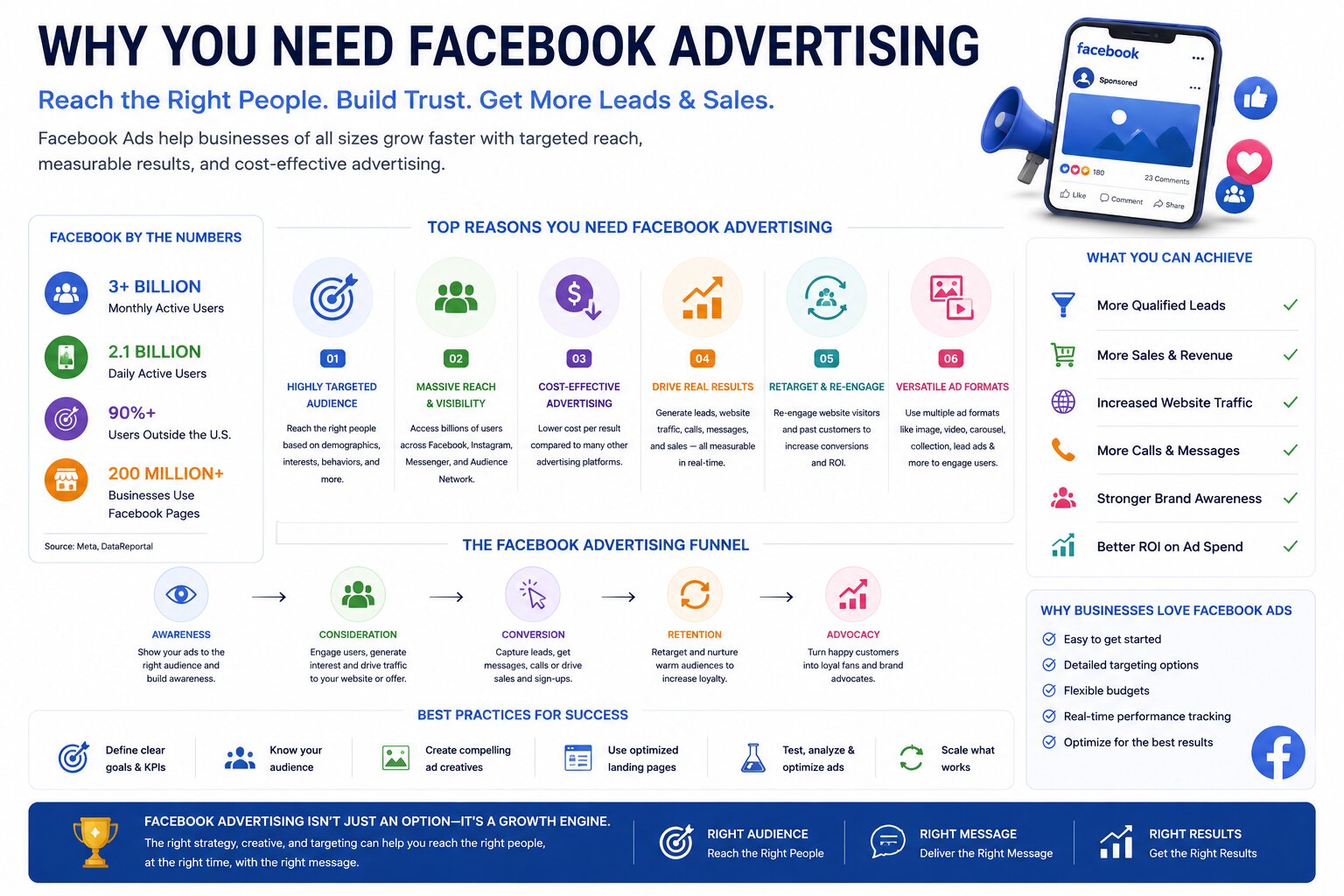
Most advertising channels ask you to target broadly and hope that a relevant audience finds your ad. Facebook inverts this. With over 3.07 billion monthly active users across Meta's family of apps and a data infrastructure built on more than a decade of user behaviour signals, Facebook advertising allows you to define exactly who you want to reach — by location, age, gender, household income, life stage, interests, purchasing behaviors, job title, and dozens of other attributes.
For businesses, this means advertising spend is directed, from the outset, at the specific users who match the profile of your ideal customer. No other paid social channel offers this combination of audience breadth and targeting granularity at Facebook's scale.
Unlike search advertising — which captures users who are actively looking for something — Facebook advertising reaches users at all stages: those who have never heard of your brand, those passively aware, those actively comparing options, and those who were close to converting but did not. This full-funnel coverage, managed through a single ad platform, is one of Facebook's most significant structural advantages.
For additional technical context, review our in-depth analysis on Facebook Ads Terminologies.
Reaching the Millions
Facebook is not just large — it is structurally embedded into how billions of people spend time online. The average Facebook user spends approximately 33 minutes per day on the platform. Across all Meta properties including Instagram, WhatsApp, and Messenger, that figure is significantly higher. This means your ads are not competing for attention during a narrow search window — they are competing for a slot in a content stream users return to multiple times every day.
In India alone, Facebook has over 400 million users — the largest national user base of any country. For businesses targeting Indian consumers across metro, tier-2, and tier-3 markets, no other paid social channel reaches this audience at comparable depth. Combined with the reach of Instagram marketing through Meta's unified ad platform, the combined addressable audience across Facebook and Instagram is unmatched in the social advertising landscape.
Audience Targeting That Goes Beyond Demographics
Facebook's targeting capabilities have matured well beyond basic demographic filters. The platform builds detailed behavioral profiles from user activity — pages liked, content engaged with, purchase patterns, travel behaviors, device usage, life events — and makes these signals available to advertisers as targeting parameters.
This means a travel agency can target users who have demonstrated recent travel purchase intent. A software company can target decision-makers at businesses within a specific revenue range. A local retailer can target users within a 5km radius who have shown interest in their product category. The specificity available is genuinely extraordinary — and it is one of the primary reasons well-managed Facebook campaigns consistently outperform broader digital advertising approaches in cost-per-qualified-lead.
Custom and Lookalike Audiences
Custom Audiences allow businesses to upload first-party data — customer email lists, phone numbers, CRM segments — and match them to Facebook profiles for direct retargeting. A business can reach its existing customers, lapsed buyers, email subscribers who never converted, or loyalty program members with campaigns tailored to each segment's relationship with the brand.
Lookalike Audiences extend this by using the characteristics of your best existing customers to find new users across the platform who share similar behavioral and demographic profiles. This turns your existing customer base into a continuously expanding prospecting engine — reaching high-quality cold audiences whose profile suggests they are likely to respond to your offer.
Converting Potential Clients
Reach without conversion is just expense. What makes Facebook advertising genuinely valuable is not the volume of impressions it generates — it is the platform's capacity to move users through the purchase journey and produce measurable business outcomes at each stage.
The platform supports this through campaign objectives, bidding strategies, and ad formats designed for different funnel stages. At the top, awareness campaigns build familiarity and brand recall. In the middle, consideration campaigns drive traffic, video views, and lead form completions. At the bottom, conversion campaigns optimize directly for purchases, sign-ups, and calls — using the Meta Pixel and Conversions API to feed outcome data back into the algorithm and improve delivery over time.
Why Facebook Ads Drive Conversions Better Than Most Channels
When you run a conversion campaign, you are not just buying ad space — you are accessing a machine learning system trained on billions of conversion events across millions of advertisers. The algorithm predicts which specific users in your target audience are most likely to complete your defined action and prioritizes showing your ads to those users first.
For additional technical context, review our in-depth analysis on Most Effective ways to Retain Leads on Facebook Ads.
This is why well-optimized Facebook conversion campaigns improve in performance over time. A campaign achieving a $40 cost-per-lead in its first week may be achieving $25 by week six — not because anything structural changed, but because the learning system has refined its understanding of what a likely converter looks like for your specific offer.
Lead Generation at Scale
For service businesses, consultancies, and B2B companies, Facebook Lead Ads offer a particularly efficient path to lead generation. Rather than directing users to an external landing page, Lead Ads present a pre-filled form within the Facebook interface — reducing friction and improving form completion rates dramatically compared to external page journeys. Combined with CRM integration, lead data can flow directly into your sales pipeline in real time — reducing follow-up latency and improving lead-to-customer conversion rates.
Retargeting: Converting Users Who Already Showed Intent
One of Facebook advertising's most commercially powerful capabilities is retargeting — serving tailored ads to users who have already interacted with your business. Website visitors who did not convert, cart abandoners, users who watched 75% of your video but did not click through, or customers who last purchased 90 days ago — all of these segments can be defined and targeted with precision.
Retargeting audiences consistently outperform cold audience campaigns in conversion rate because they reach users who have already demonstrated some level of intent. The cost of re-engaging a warm prospect is almost always lower than acquiring a new cold visitor — which makes retargeting one of the highest-return components of any comprehensive social media marketing strategy.
The Business Case: Why Facebook Advertising Outperforms Many Alternatives
Cost Efficiency Relative to Reach
CPMs (cost per 1,000 impressions) on Facebook typically range from $5–$15 for most audience types — significantly lower than premium display networks and broadcast media. For businesses in markets like India, CPMs are even more competitive, often falling below $3 for broad audience targeting. The combination of low CPM, precise targeting, and algorithm-driven optimization means advertising budgets on Facebook tend to produce more qualified impressions and more conversions per dollar than less targeted channels.
Measurable ROI from Day One
Unlike traditional advertising — print, outdoor, broadcast — where attribution is largely inferential, Facebook provides direct measurement of outcomes. Every click, lead submission, checkout initiation, and purchase that flows from your campaign is tracked, attributed, and reported in Ads Manager in real time. When a campaign demonstrates a consistent $60 cost-per-acquisition against a customer lifetime value of $400, the business case for scaling is straightforward and evidence-based — not aspirational.
Full-Funnel Capability in a Single Platform
Facebook is the rare channel that performs meaningfully at every funnel stage — awareness, consideration, conversion, and retention — from a single unified platform with shared audience infrastructure. Rather than managing separate platforms for each stage, Facebook allows businesses to run the entire paid social journey in one place. Combined with the unified Meta Ads Manager that also covers Instagram advertising, this single-platform approach reduces operational complexity while increasing audience data quality.
Learn in Depth about Facebook Terminologies and Meaning
What Types of Businesses Benefit Most from Facebook Advertising?
Business Type | Why Facebook Advertising Works | Key Ad Format |
|---|---|---|
E-commerce brands | Visual product discovery, Dynamic Product Ads, shopping campaigns | Catalogue Ads, Carousel, Collection |
Service businesses | Lead generation at scale with low-friction forms | Lead Ads, Video, Messenger |
Local businesses | Hyperlocal targeting by ZIP code or radius; foot traffic campaigns | Local Awareness, Offer Ads |
Travel agencies & OTAs | Retargeting high-intent users, dynamic destination ads | Dynamic Ads, Carousel |
B2B companies | Job title and company-size targeting; lead and event promotion | Lead Ads, Video |
Apps and SaaS | App install campaigns, trial sign-ups, user reactivation | App Install, Conversion |
Real estate | Geo-targeted campaigns to in-market buyers and renters | Lead Ads, Video Tours |
For additional technical context, review our in-depth analysis on How Instagram Can Help Your Business Grow.
Facebook Advertising vs. Other Channels
Channel | Primary Strength | Works Best With Facebook For |
|---|---|---|
Google Search Ads | Captures high-intent, in-market demand | Top-of-funnel awareness + bottom-funnel capture |
Google Display Network | Broad reach at low CPM | Brand recall layer for Facebook retargeting |
Instagram Ads | Visual engagement; younger demographics | Unified Meta campaigns for broader social reach |
LinkedIn Ads | B2B targeting by job function | B2B campaigns where Facebook warms the audience first |
TikTok Ads | Strong reach with Gen Z | Creative testing; audience building for Meta retargeting |
Email Marketing | Highest ROI for retention; owned channel | Re-engaging existing contacts via Custom Audience matching |
Facebook does not replace any of these channels — it complements them. The most effective paid media strategies combine Facebook's audience targeting and retargeting capabilities with Google Search's intent capture, creating a full-funnel system where Facebook builds awareness and nurtures interest while Google converts users at the moment of active search intent.
Common Objections to Facebook Advertising — and Why They Miss the Point
"Organic reach is enough." Organic reach on Facebook for business pages now averages below 5%. The targeting and optimization infrastructure of Facebook's paid platform is entirely separate from its organic distribution algorithm — paid campaigns reach the specific audiences you define, regardless of whether those users follow your page.
"It doesn't work for B2B." Facebook offers job title, employer, and industry targeting, and it reaches B2B decision-makers in their personal browsing context. For top-of-funnel brand building, event promotion, and lead generation, Facebook consistently delivers results for B2B businesses when campaigns are structured appropriately.
"My customers are not on Facebook." With 3+ billion monthly active users, the more accurate version of this concern is usually "my customers are not engaging with the types of ads I have been running" — which is a creative and targeting problem, not a platform reach problem.
"I tried it and it didn't work." This almost always reflects a campaign execution problem rather than a platform limitation. Choosing the wrong objective, using poor creative, targeting too broadly, lacking proper Pixel tracking, or not allowing sufficient learning time can all produce poor results on a platform that, when properly managed, is one of the highest-performing paid channels available. The difference between a well-run Facebook campaign and a poorly run one is not marginal — it is often the difference between a 3x ROAS and a campaign that loses money.
How Teckgeekz Approaches Facebook Advertising
Facebook advertising is one of the core service verticals at Teckgeekz — and the approach is built on the understanding that the platform's performance is almost entirely a function of how intelligently it is set up and managed.
Our Facebook Ads management service covers the full campaign lifecycle: audience strategy, campaign architecture, creative briefing and copy, Pixel and Conversions API setup, A/B testing frameworks, and continuous performance optimization. We do not run template campaigns — every account is built around the specific business objective, target audience, and competitive landscape of the client.
For businesses looking to build a broader paid social presence, our social media marketing service covers strategy and campaign management across Meta, Instagram, LinkedIn, and TikTok. For brands where Instagram is a primary channel, our Instagram marketing service provides platform-specific campaign and content strategy built for Meta's Instagram-first formats and audience behavior.
Key Takeaways
Facebook advertising is not the right channel for every campaign — but it is the right channel for an extraordinarily wide range of businesses and objectives. Its combination of audience scale, behavioral targeting precision, full-funnel ad format coverage, and algorithm-driven optimization make it one of the most commercially powerful paid advertising platforms available.
The businesses that get the most from it are those that approach it seriously: with proper tracking infrastructure, structured campaign architecture, thoughtful creative, and the discipline to test, measure, and refine continuously. When those elements are in place, Facebook advertising becomes one of the most reliable and scalable growth engines in digital marketing.
The question is not really whether your business needs Facebook advertising. The question is whether you are running it in a way that reflects its actual capability — or whether you are leaving significant performance on the table.

Jeffrey Mathew
Founder & CEO • Travel Marketing Specialist
"With over 14 years of dominance in the travel and tech sectors, Jeffrey Mathew has engineered growth for hundreds of OTAs and airlines worldwide. He specializes in the intersection of Performance PPC and Agentic AI, building high-performance digital ecosystems for modern brands."
Start a Conversation
Ready to Elevate Your Business?
Fill out the form below and let's discuss how Teckgeekz can help you reach your goals.
Describe your project to unlock real-time AI service recommendations and matching portfolio cases.
Our Trusted Partners