AI Marketing Adoption Statistics 2026–2027: Benchmarks, ROI & Forecasts

Executive Summary & Key Takeaways
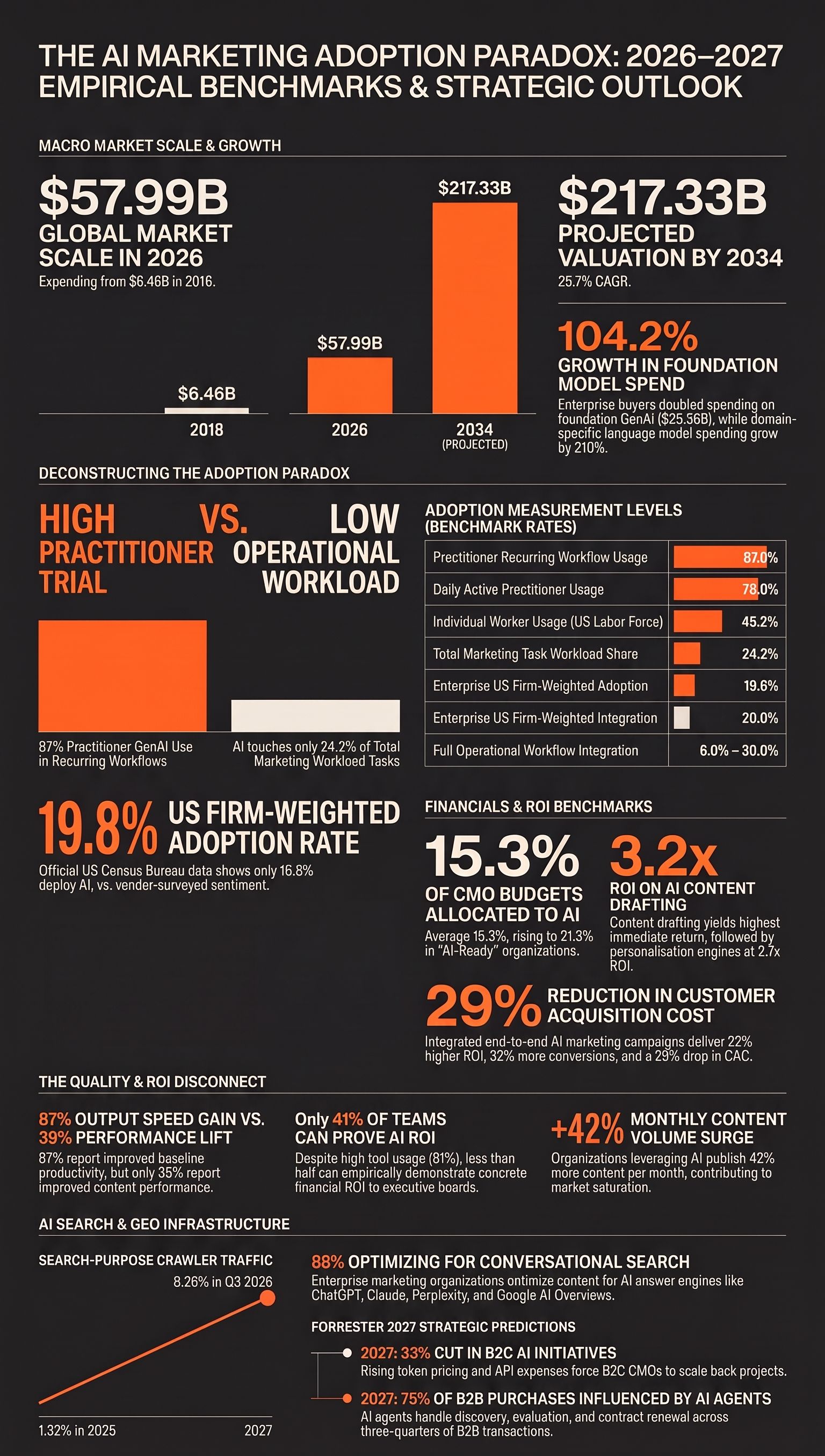
Macro Expansion vs. Workload Reality: While global market valuation of AI in marketing reached $57.99 Billion in 2026 and enterprise practitioner trial hit 87% to 94%, actual task-level workload involvement sits at 24.2%, proving that over three-quarters of marketing execution remains human-driven.
The ROI & Productivity Disconnect: Marketers save an average of 6.1 hours per week and publish 42% more content. However, a severe quality gap has emerged: 87% of B2B content teams report higher productivity, but only 39% report improved content performance, and only 41% can empirically prove AI ROI to corporate boards.
Tool Proliferation & Platform Consolidation: The specialized AI martech landscape expanded 3.2x in two years to over 3,800 tools. Yet live web detection shows enterprise deployment is dominated by native incumbents: HubSpot is live on 602,953 domains, Mailchimp on 547,029, and Klaviyo on 429,474, compared to 230,932 standalone OpenAI integrations.
The Shift to GEO & AEO: Search-purpose AI crawling surged to 8.26% of all global AI crawler traffic in Q3 2026. In response, 41.5% of marketing orgs execute Generative Engine Optimization (GEO) and 24% audit for Answer Engine Optimization (AEO).
2027 Strategic Reckonings: Escalating usage-based pricing will force consumer-facing brands to scale back 33% (one-third) of active AI initiatives. Concurrently, 50% of brands will reprioritize human-generated content to combat synthetic saturation, while autonomous AI agents will influence 75% of B2B purchase decisions.
Artificial intelligence has officially crossed the threshold from speculative technological demonstration to fundamental operational infrastructure across global enterprise marketing. As we navigate late 2026, marketing executives, growth engineers, and revenue operations leaders operate within a martech environment where generative models, predictive intelligence, and autonomous agents are deeply embedded in daily campaign execution.
However, behind headline-grabbing vendor adoption stats lies a complex operational reality. While practitioner trial and task-level experimentation have reached historical highs, enterprise-wide end-to-end integration, rigorous financial return on investment (ROI) attribution, and corporate governance frameworks lag significantly behind.
AI marketing statistics at a glance (2026–2027)
Metric | Value | Source |
|---|---|---|
Marketers using GenAI in 1+ recurring workflow | 87% (51% in 2024, 76% in 2025) | Salesforce, State of Marketing, 10th ed. |
Enterprise organizations (500+ marketers) using GenAI | 94% | Salesforce, State of Marketing, 10th ed. |
Marketing professionals using AI daily | 78% | HubSpot, State of Marketing 2026 |
Share of marketing workload involving AI | 24.2% (executives project 55.9% within three years) | Duke Fuqua / Deloitte / AMA CMO Survey 2026 |
US employer firms using AI | 19.8% | US Census Bureau, BTOS (May 2026) |
US employed adults using GenAI for work | 45.2% | Real-Time Population Survey (May 2026) |
AI in marketing market size | $57.99B in 2026; $217.33B by 2034 | Precedence Research |
Worldwide spending on AI platforms and models | $64.25B in 2026 (+63.4% YoY) | Gartner, July 2026 forecast |
Share of marketing budget allocated to AI | 15.3% | Gartner, CMO Spend Survey 2026 |
Average ROI improvement from AI in marketing | 35% (5.2x blended return on tooling) | McKinsey Digital |
B2B content creators reporting higher productivity vs. higher performance | 87% vs. 39% | Content Marketing Institute |
Marketing teams able to prove AI ROI to boards | 41% | Jasper, 2026 State of AI in Marketing |
Specialized AI marketing tools | 3,800+ (3.2x since 2024) | Chiefmartec, 2026 landscape |
Search-purpose AI crawling, share of AI crawler requests | 8.26% in Q3 2026 (1.32% in Q3 2025) | Cloudflare Radar |
Companies executing a GEO framework | 41.5% | Duke Fuqua CMO Survey 2026 |
Marketing teams actively auditing for AEO | 24% | HubSpot |
Marketing teams running agentic AI in production | 13% | Salesforce |
B2C leaders expected to scale back AI initiatives in 2027 | One-third (33%) | Forrester, 2027 predictions |
B2B purchase decisions influenced by AI agents by 2027 | 75% | Forrester, 2027 B2B predictions |
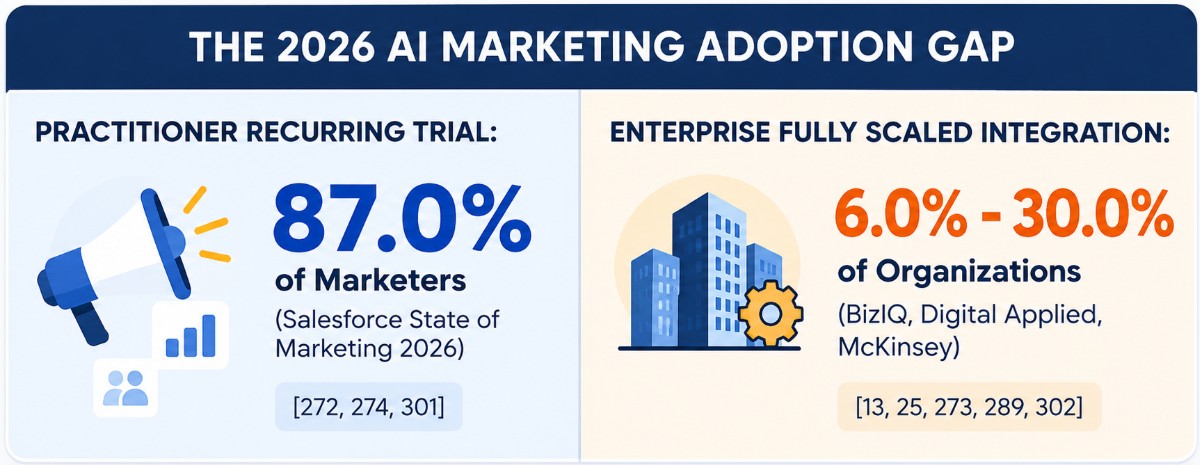
Chart: the 2026 AI marketing adoption gap. Sources: Salesforce, Duke Fuqua CMO Survey, US Census Bureau BTOS.
What percentage of marketers use AI in 2026?
Between 78% and 94% of marketers use AI in 2026, depending on the survey and on what counts as "use." Salesforce reports 87% of marketers use GenAI in at least one recurring workflow and 94% of enterprise organizations with 500+ marketers use it. HubSpot reports 78% use AI tools daily, and Jasper reports 91% active use among surveyed marketers.
The wide range comes from differences in sample, question wording and unit of analysis. Published adoption figures run from 19.8% to 95%, so compare each number only against others that measure the same thing.
What is measured | Value | Source | Unit and scope |
|---|---|---|---|
Enterprise GenAI adoption | 94.0% | Salesforce | Organizations with 500+ marketers using GenAI in workflows |
Recurring-workflow use | 87.0% | Salesforce | Marketers using GenAI in 1+ recurring workflow |
Daily use | 78.0% | HubSpot | Marketing professionals using AI tools every day |
Active use | 91.0% | Jasper | Self-reported active use among surveyed marketers |
Workload share | 24.2% | Duke Fuqua CMO Survey | Share of marketing tasks involving AI |
US firm adoption | 19.8% | US Census Bureau BTOS, May 2026 | All US employer firms, any industry |
US worker use | 45.2% | Real-Time Population Survey, May 2026 | Employed US adults using GenAI for work |
Full operational scaling | 6% to 30% | Digital Applied / BizIQ / McKinsey | Organizations with end-to-end scaled AI operations; range reflects different definitions |
What share of marketing work does AI actually do?
AI is involved in 24.2% of total marketing workload, according to the Duke Fuqua CMO Survey 2026. That means about 75.8% of marketing execution is still done by people. Executives in the same survey expect the AI share to reach 55.9% within three years.
This is the number to use when someone cites "90%+ adoption." Most departments use AI for isolated tasks such as drafting copy or resizing images. Very few have rebuilt whole processes around it.
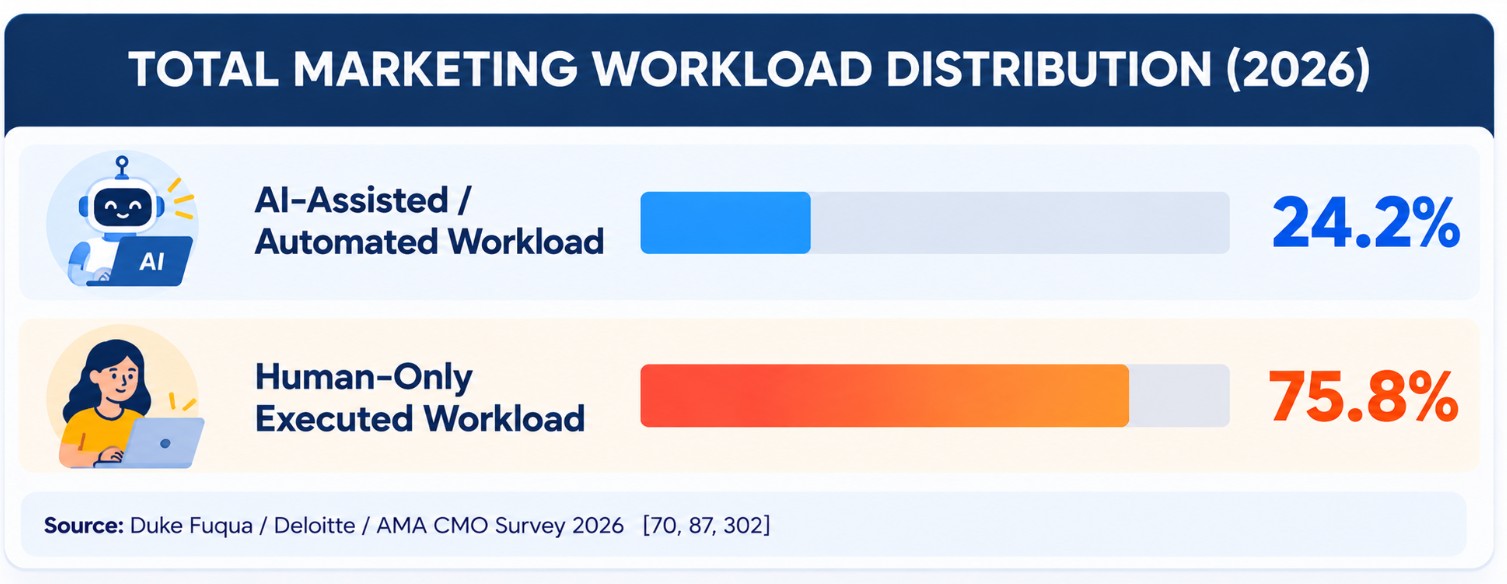
Chart: total marketing workload distribution, 2026. Source: Duke Fuqua CMO Survey.
How big is the AI in marketing market in 2026?
Precedence Research puts the AI in marketing market at $57.99 billion in 2026, growing to $217.33 billion by 2034. By our calculation from those two figures, that is a compound annual growth rate of roughly 18% over 2026–2034. Market-size estimates from research firms vary widely, so treat this as one published estimate rather than a measured total.
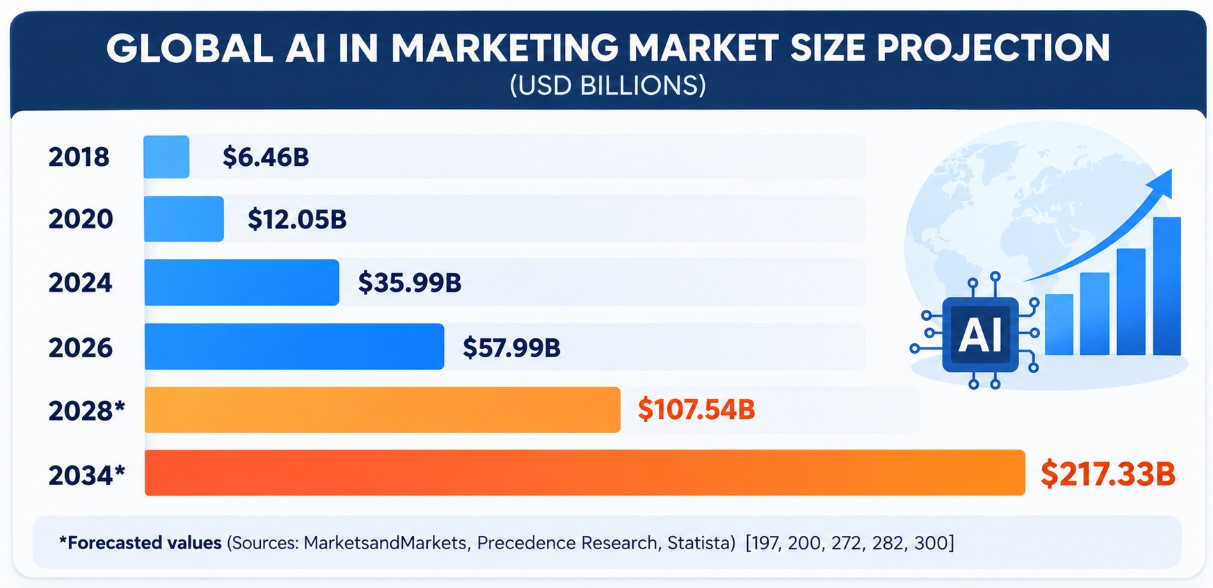
Chart: global AI in marketing market projection. Source: Precedence Research; growth rate calculated by Teckgeekz.
Spending on AI platforms and models
Gartner's July 2026 forecast has worldwide end-user spending on AI platforms and models growing 63.4% year over year to $64.25 billion in 2026, up from about $39 billion in 2025. Two model classes drive it:
Foundation generative AI models: up 104.2% to $23.36 billion.
Domain-specific language models (DSLMs): up 210.0% to $4.91 billion. Buyers are moving from generic public LLM endpoints to models fine-tuned on their own industry data, for lower latency, tighter data privacy and more predictable compliance behavior.
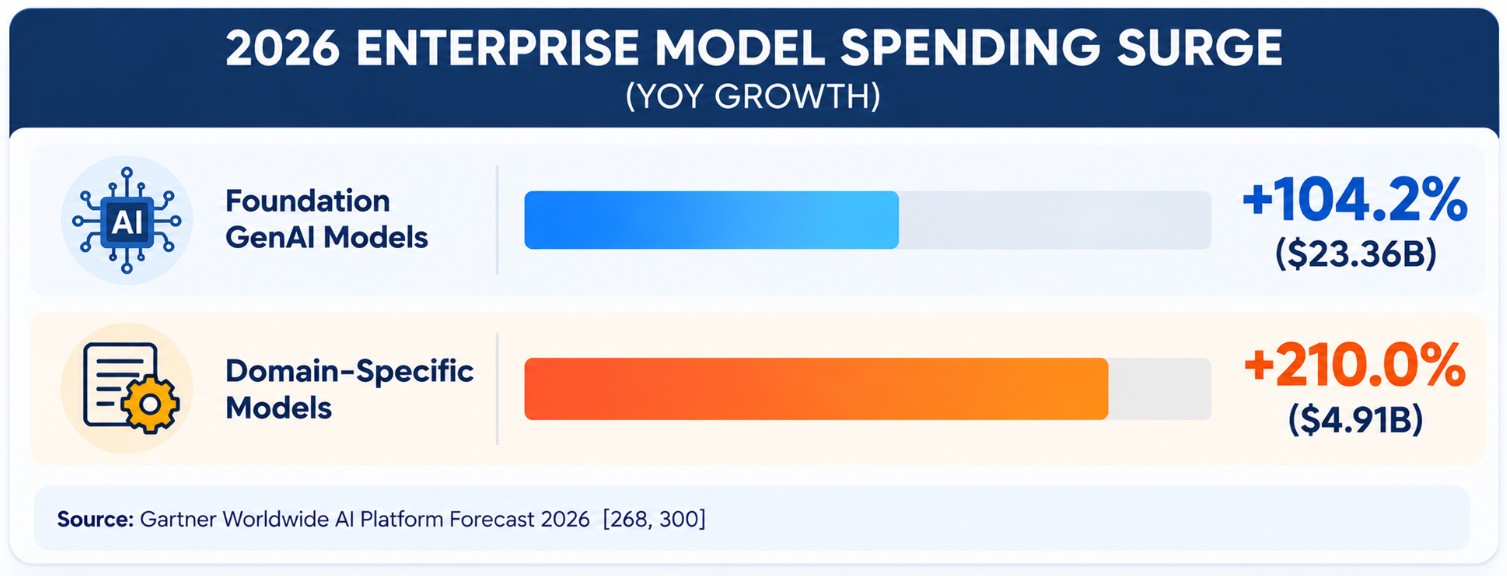
Chart: 2026 enterprise model spending growth. Source: Gartner.
How much do marketing teams spend on AI?
CMOs allocated an average of 15.3% of their marketing budgets to AI in 2026, according to Gartner's CMO Spend Survey. Total marketing budgets stayed flat at 7.8% of company revenue, against 7.7% in 2025, so AI is being funded by reallocation. Organizations categorized as "AI-ready," about 30% of mature marketing enterprises, allocate 21.3%.
At the tool level, median mid-market AI software spend rose 183% in twelve months, from $1,200 per month in Q1 2025 to $3,400 per month in Q1 2026. Enterprises with 500+ employees spend between $13,500 and $50,000 per month on specialized AI suites.
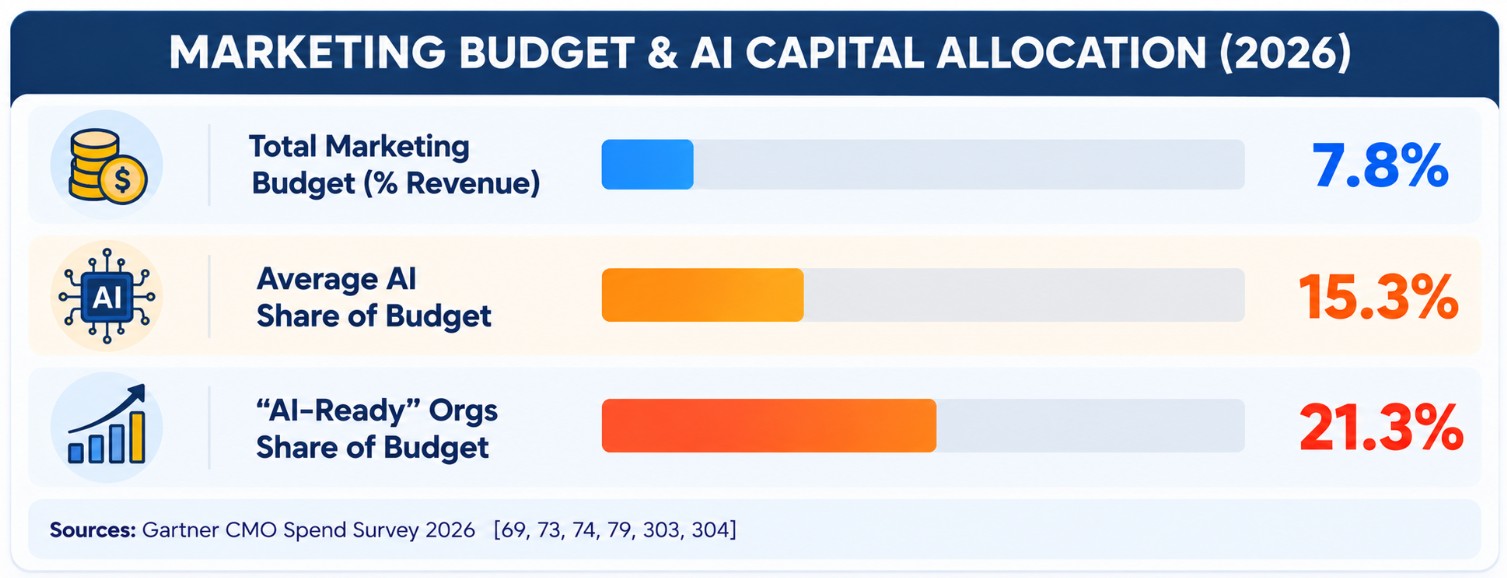
Chart: marketing budget and AI allocation, 2026. Source: Gartner CMO Spend Survey.
Teckgeekz field note: Across our engagements, teams that built AI into workflow orchestration saw more measurable gains than teams that used it only to generate content.
What ROI does AI deliver in marketing?
McKinsey Digital reports an average 35% ROI improvement from AI in marketing, equal to a 5.2x blended return on tooling investment. The return differs a lot by use case:
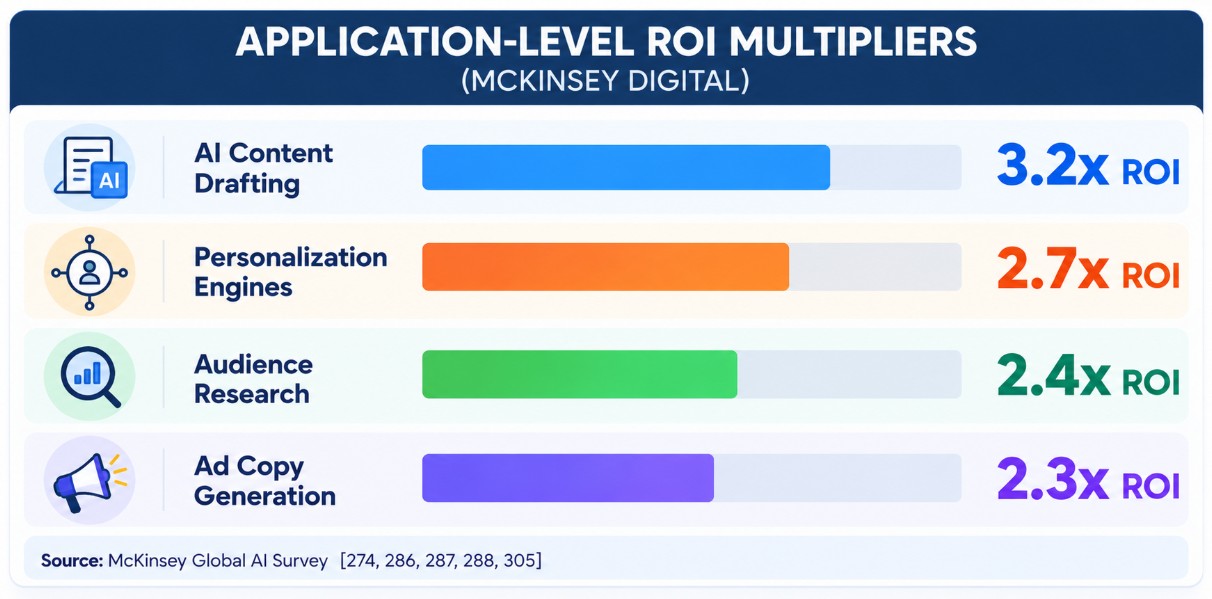
Chart: application-level ROI multipliers. Source: McKinsey Digital.
AI content drafting: 3.2x, the fastest commercial payback.
Personalization engines: 2.7x, for example tailoring website experiences and email touchpoints.
Audience research: 2.4x. Ad copy: 2.3x.
End-to-end AI campaigns: 22% higher ROI, 32% higher conversion rates and 29% lower customer acquisition cost.
Predictive lead scoring and commerce: 50% more sales-qualified leads, and a 26% higher average order value from AI product recommendations.
Other reported gains: CMOs attribute a 14.1% improvement in sales productivity to AI (8.6% in 2025), a 14.6% reduction in marketing overhead and a 10.8% increase in customer satisfaction. Gartner finds 68% of marketing leaders adopt AI mainly for time savings, followed by personalization at scale (54%) and data-driven decisions (49%).
If you run paid search, the same logic applies at campaign level. Our guide to travel PPC and pay-per-call marketing covers where automation helps and where it needs a human check.
Does AI improve content performance, or only output?
AI raises output far more reliably than it raises performance. The Content Marketing Institute found that 87% of B2B content creators say AI improved their productivity, but only 39% say it improved content performance. Another 34% saw no change and 12% reported lower quality. Semrush found only 19% of practitioners believe AI genuinely improves content quality.
The time savings are real. The average marketer saves 6.1 hours per week and heavy users save 11 to 13, and AI users publish 42% more content per month than non-users. Only 5% of marketers now avoid AI for blog creation, down from 65% in 2024. But Jasper found that only 41% of marketing teams can prove AI ROI to their boards, even though 91% use the tools.
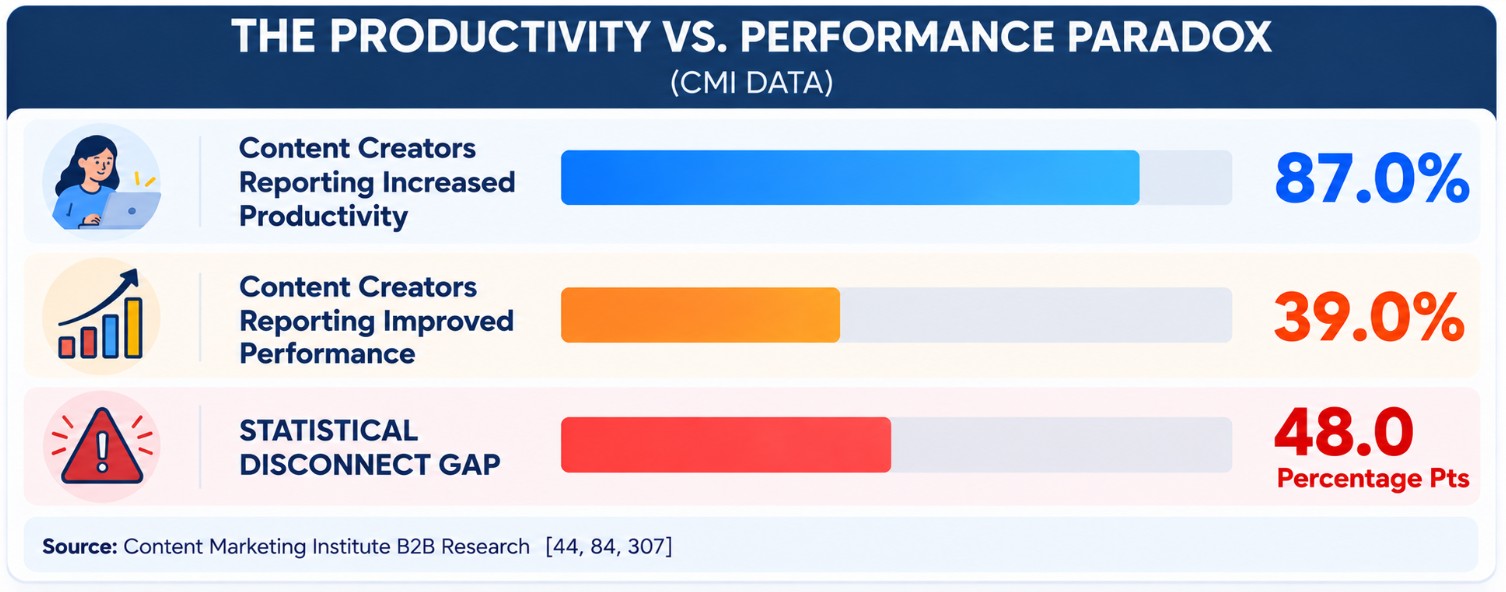
Chart: productivity versus performance. Source: Content Marketing Institute.
Which AI marketing tools do marketers use most?
ChatGPT is the most widely used AI tool among marketers at 72%, followed by Canva AI at 58% and Claude at 41%. Individual marketers use an average of 4.3 AI applications in their weekly workflows.
Tool | Share of marketers | Main use |
|---|---|---|
ChatGPT (OpenAI) | 72% | Drafting, ideation, research |
Canva AI | 58% | Visual assets and image editing |
Claude (Anthropic) | 41% | Editorial writing, code, complex synthesis |
Midjourney | 36% | Generative visuals |
Jasper AI | 24% | Brand-governed copy and templates |
Google Gemini | 22% | Multimodal research, Workspace integration |
HubSpot AI native tools | 19% | CRM copy, lead scoring, workflow rules |
Perplexity AI | 17% | Research verification, competitive analysis |
Table: AI tool usage among marketers, 2026.
The market is crowded. Chiefmartec counts more than 3,800 specialized AI marketing tools in 2026, up 3.2x from 1,200 in 2024, while the broader martech landscape grew only 0.79% to 15,505 products. That suggests AI tools are replacing older software rather than adding to it.
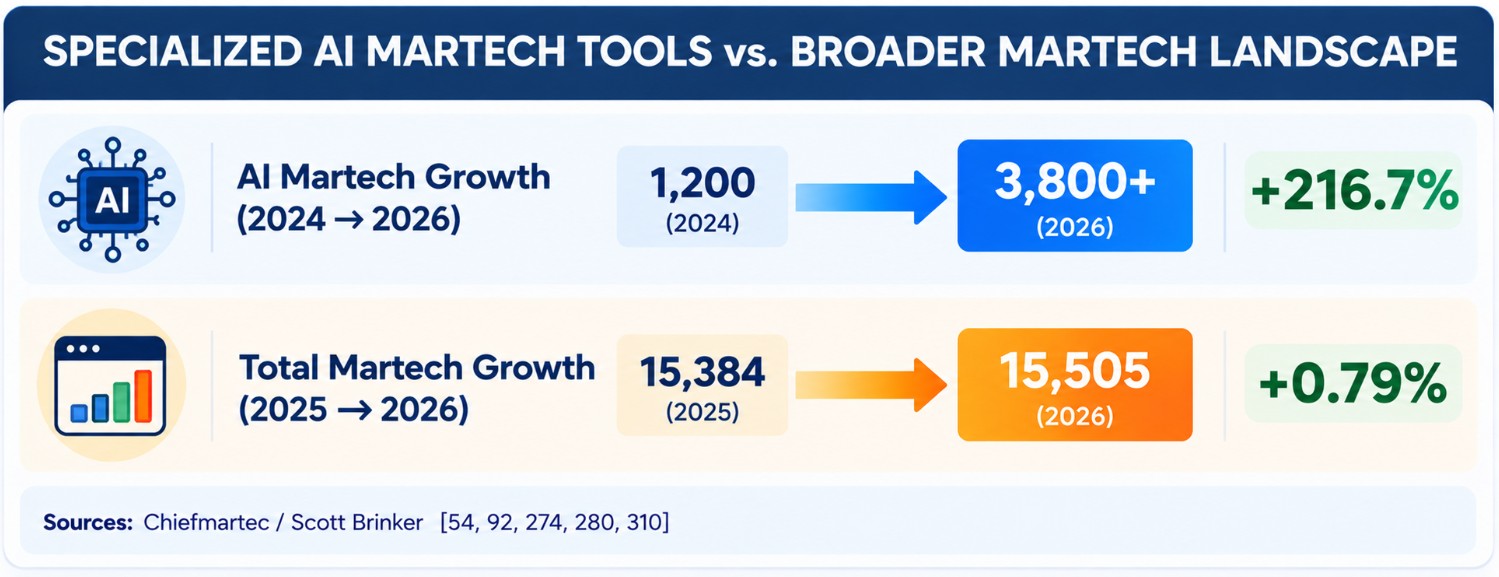
Chart: specialized AI martech tools versus the broader landscape. Source: Chiefmartec.
What do live website crawls show?
TechnologyChecker's crawl of more than 29.9 million business domains detected HubSpot on 602,953 domains, Mailchimp on 547,029, Klaviyo on 429,474 and direct OpenAI integrations on 230,932. Mailchimp alone appears on about 2.4 times as many domains as OpenAI integrations.
Two limits apply. The crawl detects platform installation, not whether a site uses that platform's AI features. It also sees only client-side code, so server-side API calls to OpenAI are undercounted. It still fits survey data: 89% of marketing leaders say they prefer AI built into their existing platforms (Salesforce, HubSpot, Adobe) over separate point tools.
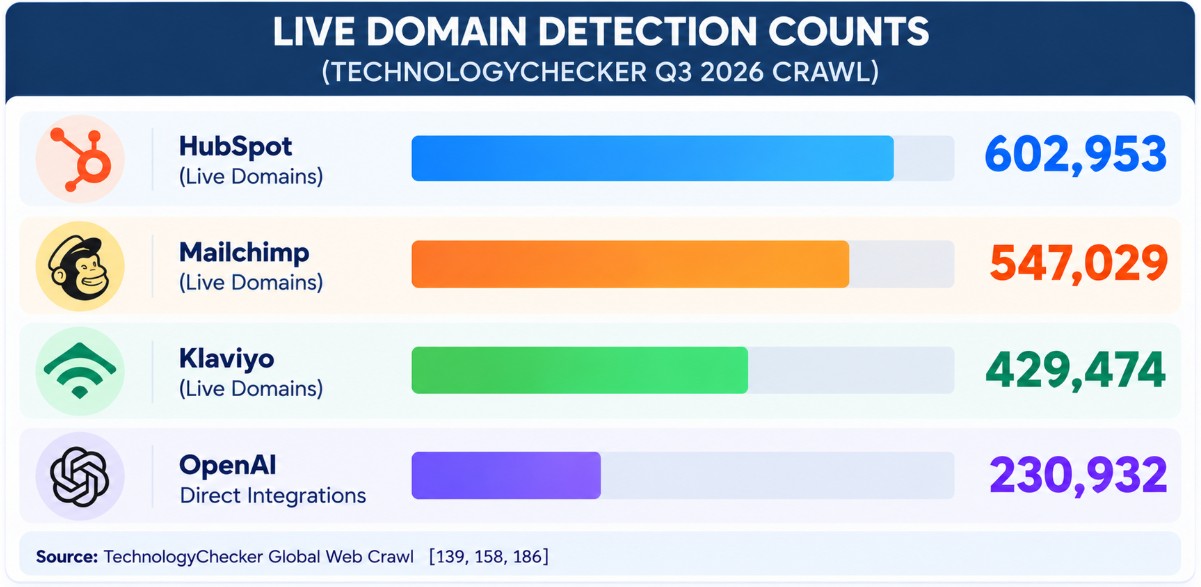
Chart: live domain detection counts, Q3 2026 crawl. Source: TechnologyChecker.
What share of marketing teams do GEO and AEO?
41.5% of companies actively execute Generative Engine Optimization (GEO), according to the Duke Fuqua CMO Survey, and 24% of marketing teams actively audit for Answer Engine Optimization (AEO), according to HubSpot. GEO means structuring entity references, structured data and authoritative passages so LLMs can retrieve and cite them. For the definitions and the differences, see our guide to SEO vs AEO vs GEO.
The driver is crawler behavior. Cloudflare Radar shows search-purpose AI crawling reached 8.26% of all AI crawler requests in Q3 2026, up from 1.32% in Q3 2025.
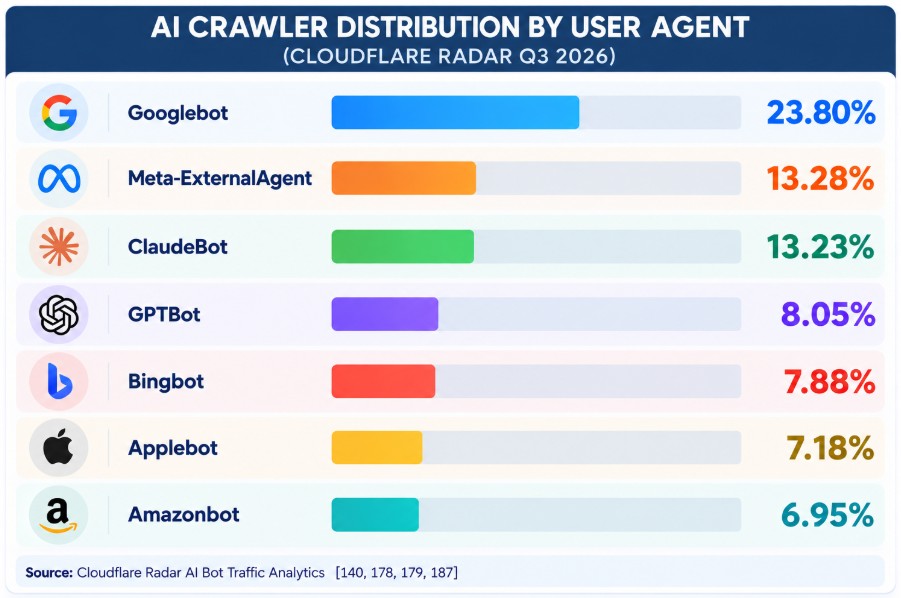
Chart: AI crawler distribution, Q3 2026. Source: Cloudflare Radar.
You will also see higher numbers: 88% of enterprise marketing organizations say they optimize content for conversational search engines, and 85% of marketing leaders say generative AI has reshaped their multi-year SEO strategy. In our reading, the gap comes from the question. "We are doing something for AI search" is a much lower bar than "we run a defined GEO program." Use 41.5% as the better estimate of structured practice.
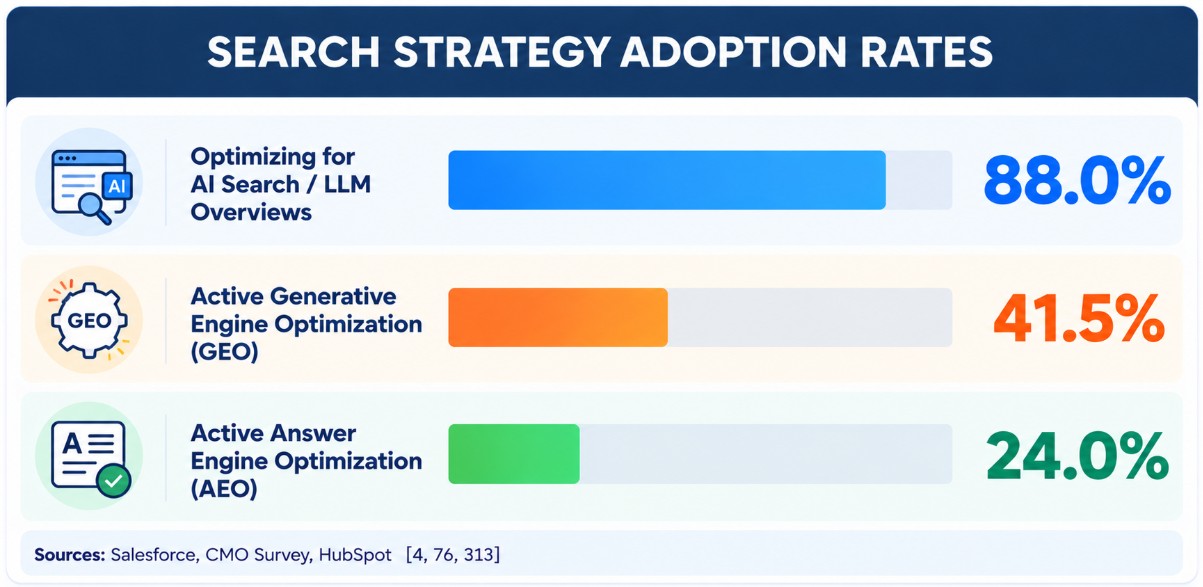
Chart: search strategy adoption rates. Sources: Duke Fuqua CMO Survey, HubSpot.
How does AI adoption vary by industry and region?
E-commerce and retail lead at 87%, followed by B2B SaaS at 82%, financial services at 76%, healthcare at 58% and government and nonprofits at 34%. Regulation and data-security constraints explain most of the slower sectors.
North America leads practitioner adoption at 84%, followed by the United Kingdom at 76%, Sweden at 71%, Denmark at 68%, the Netherlands at 64% and the EU average at 52%. On capital, KPMG's APAC AI Pulse survey finds Asia-Pacific enterprises averaging $245 million per firm in AI investment, led by South Korea at $358 million and Australia at $210 million.
What will happen to AI marketing budgets in 2027?
Forrester predicts rising technology costs will force B2C marketing leaders to scale back one-third (33%) of their active AI initiatives in 2027. The cause is pricing. As martech vendors move from flat licenses to usage-based pricing, every prompt, agent action and generated image becomes a billable event, and workflows that looked cheap in a pilot get expensive at millions of customer interactions.
Forrester's CMO Pulse Survey adds that 82% of US B2C marketing executives expect to justify AI spend more rigorously in 2027, 78% say the C-suite wants clearer evidence of business value, and 64% expect unmonitored AI use to cause a brand-damaging incident within 12 months.
Agentic AI and B2B buying
Salesforce reports 13% of marketing teams run agentic AI in live production. Another 81% of marketing leaders are piloting agents, 50% of martech leaders cite fragmented legacy data as the main barrier, and 45% say vendor-supplied agents miss their promised performance. Forrester forecasts that autonomous AI agents will influence 75% of B2B purchase decisions by 2027. It also expects B2B buyers to double their direct human contact with vendors to validate what their agents recommend.
Human content and technical hiring
Forrester projects 50% of enterprise brands will make human-generated content a core pillar of brand strategy in 2027, relying on subject-matter experts, original research and customer references. It also expects CX technical staffing to rise 20% in 2027 after two years of headcount cuts, with demand for NLP engineers, data scientists and AI experience designers. Consumer comfort with AI has fallen from 57% to 46%.
The Teckgeekz AI Maturity Curve
The Teckgeekz AI Maturity Curve is a five-level model for placing a marketing organization on the path from ad-hoc prompting to agent-run operations. The benchmarks below are an illustrative mapping of 2026 data onto each level. They are not a measured distribution of companies.
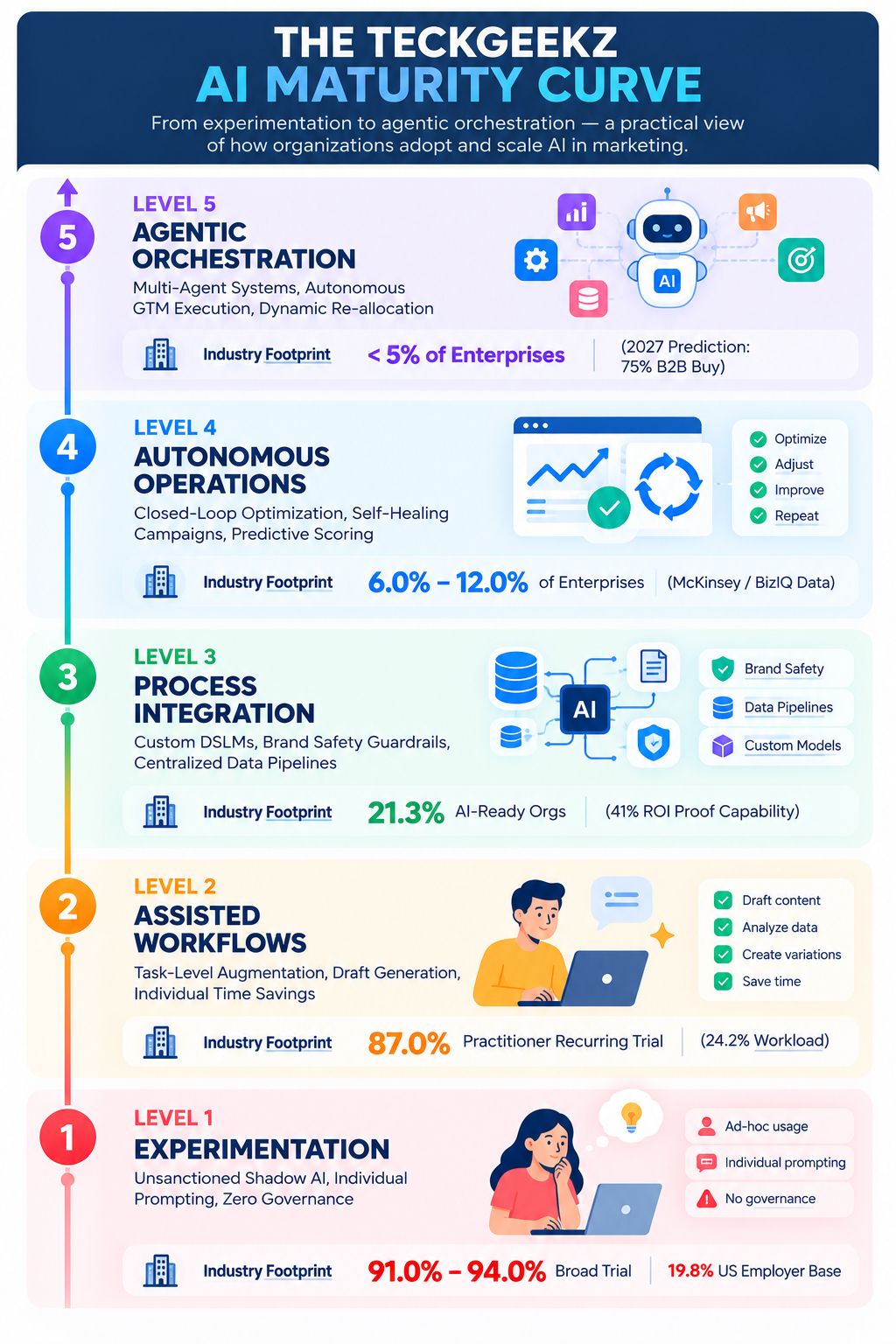
Chart: the Teckgeekz AI Maturity Curve.
Level | What it looks like | Benchmark that fits | Main bottleneck |
|---|---|---|---|
1. Experimentation | Individuals prompt public LLMs with no governance or integrations | 91–94% broad practitioner use (Jasper, Salesforce) | Uncontrolled shadow AI |
2. Assisted workflows | Copilots inside daily tools, human-in-the-loop drafting | 87% recurring-workflow use; 24.2% workload share; 6.1 hours saved per week | Output rises faster than performance (87% vs. 39%) |
3. Process integration | CRM data connected to domain models and RAG pipelines, with governance | 21.3% budget share at AI-ready firms; DSLM spend up 210%; 41.5% running GEO | Usage-based cost and board-level ROI proof (only 41% can show it) |
4. Autonomous operations | Closed-loop optimization for routine decisions: budgets, scoring, personalization | 6–30% fully scaled, depending on definition; 22% higher ROI and 29% lower CAC for integrated campaigns | Technical talent gaps and model drift |
5. Agentic orchestration | Multi-agent systems running GTM, interacting with buyer agents and AI search | 13% have agents in production (Salesforce); full multi-agent orchestration is rarer, which we estimate at under 5% | Consumer trust (comfort down from 57% to 46%) |
Teckgeekz note: Across travel, B2B SaaS and digital marketing accounts we managed in 2025–2026, AI adoption moved fastest in content production and PPC optimization. CRM integration and attribution were the most common bottlenecks.
What should marketing leaders do in 2027?
Audit usage-based software costs. List every variable-price AI subscription and set spend alerts before pilots scale. Prefer platforms with cost transparency and usage tracking.
Make your content readable by AI systems. Publish structured data, verifiable case studies and clear proof points that LLMs can parse. Our AI marketing automation work follows the same approach.
Use a hybrid content model. Use AI for research and data processing. Keep editorial voice and thought leadership with named human experts.
Clean your data before you add agents. Agents need a unified CRM and reliable data feeds. Our overview of AI business automation covers where to start.
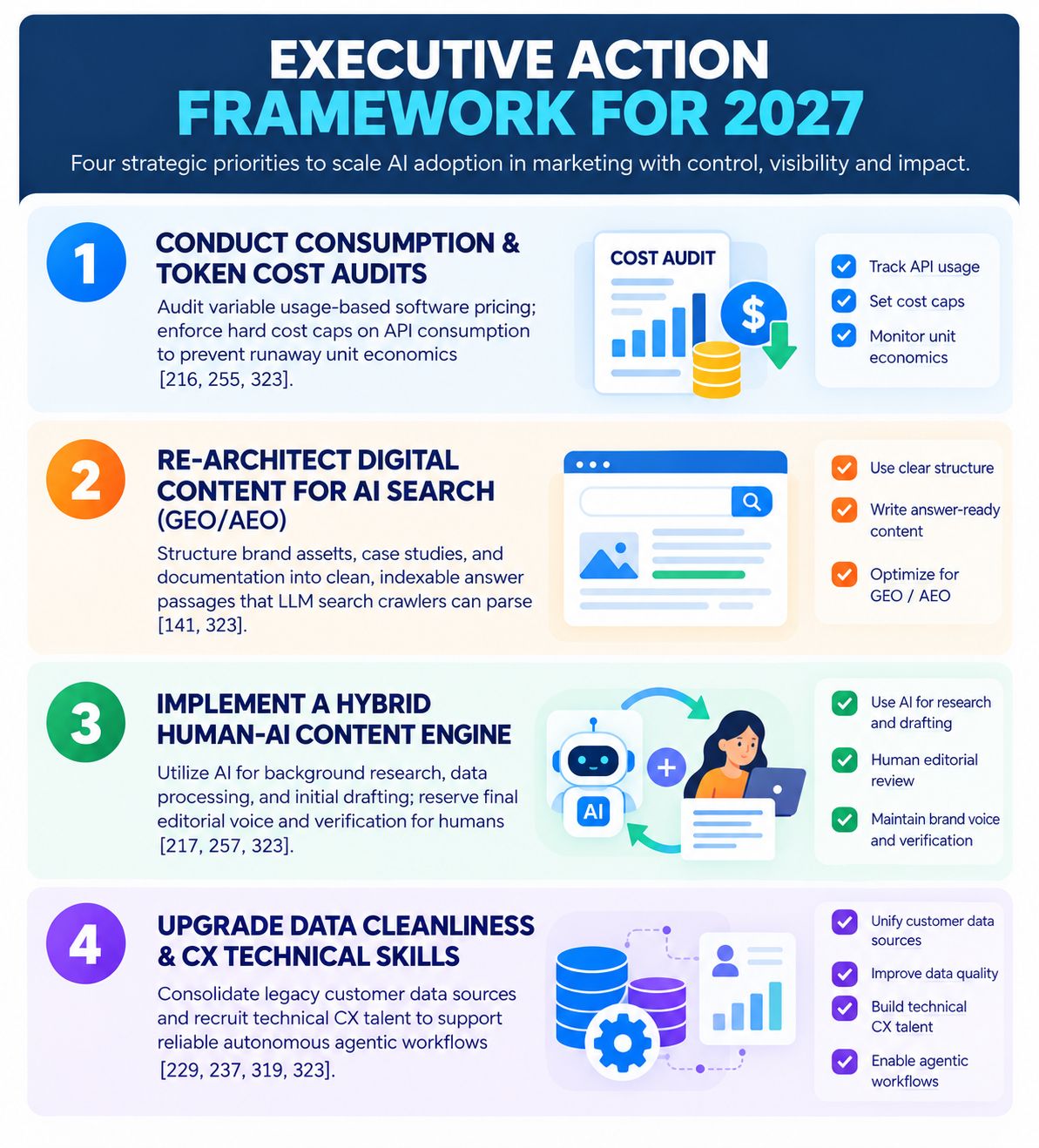
Chart: executive action framework for 2027.
Methodology and limitations
We compiled this page from published reports by the research firms, vendors, academic groups and government agencies listed below. Several sources, including Salesforce, HubSpot, Jasper and Canva, are software vendors with a commercial interest in AI adoption, so their surveys may overstate use. Sample frames differ between sources, which is why adoption figures cannot be averaged. The 18% market growth rate is our own calculation from two published endpoints, and the maturity-curve mapping is our own judgment. We re-check figures against the sources each quarter.
Sources
Salesforce Research, State of Marketing, 10th edition (fieldwork Oct–Nov 2025; published Feb 2026)
Gartner, Worldwide AI Platforms and Models forecast (July 2026); Gartner CMO Spend Survey 2026
Duke Fuqua School of Business / Deloitte / AMA, The CMO Survey 2026
Forrester, 2027 B2C and B2B predictions; Q3 2026 CMO Pulse Survey
Content Marketing Institute, B2B Content and Marketing Trends 2026
US Census Bureau, Business Trends and Outlook Survey (May 2026)
Real-Time Population Survey, GenAI Adoption Tracker (Deming et al., May 2026)
Cloudflare Radar, AI bot traffic and crawl purpose data (Q3 2026)
TechnologyChecker, global martech crawl and detection analysis
Chiefmartec (Scott Brinker), 2026 Marketing Technology Landscape
Precedence Research, Artificial Intelligence in Marketing Market, 2026–2034
Ahrefs, AI content classification and marketer workflow study
Semrush; Marketing AI Institute; Canva, 2026 Marketing and AI Report


Jeffrey Mathew
Founder & CEO • Travel Marketing Specialist
"With over 14 years of dominance in the travel and tech sectors, Jeffrey Mathew has engineered growth for hundreds of OTAs and airlines worldwide. He specializes in the intersection of Performance PPC and Agentic AI, building high-performance digital ecosystems for modern brands."
Start a Conversation
Ready to Elevate Your Business?
Fill out the form below and let's discuss how Teckgeekz can help you reach your goals.
Describe your project to unlock real-time AI service recommendations and matching portfolio cases.
Our Trusted Partners