AI Marketing Automation: Smarter Lead Generation, Nurturing & Conversion

Ask a marketing team what they actually spend their time on, and campaign strategy is rarely the honest answer. It's channel management. It's pulling data from six platforms into one report. It's manually segmenting an email list for the third time this month. It's deciding, lead by lead, what should happen next — and often getting to that decision hours or days after the moment it mattered most.
The problem modern marketing teams face is increasingly not a shortage of data. Most businesses now have more behavioral signal — website visits, content engagement, search behavior, ad interaction, email response — than any team could manually process and act on. The bottleneck has shifted from data collection to data interpretation, and from interpretation to timely action.
AI marketing automation, done well, is not about producing more content, more emails, or more campaigns. Marketing teams that measure success by volume of output are optimising the wrong variable. The businesses seeing genuine returns are using AI to close the gap between when a prospect signals intent and when the business responds to it — turning marketing from a system that executes predefined sequences into one that interprets behaviour, makes decisions, and acts, continuously and at a speed no manual team can sustain. A closely monitored AI business process automation framework is getting adapted in all forms of industry today, be it manufacturing or a service based industry.
This guide covers how AI is changing marketing automation across the entire funnel — from discovery and acquisition through nurturing, conversion, and retention — where it connects most powerfully with SEO and PPC operations, how to build an implementation that doesn't just produce more marketing activity but better marketing decisions, and where AI's judgment should stop and human strategy should take over.
What AI Marketing Automation Actually Is
Three distinct capability levels get referred to under the same "marketing automation" label, and the differences matter for setting realistic expectations about what each can do.
Traditional marketing automation executes fixed, rule-based sequences. If someone downloads a resource, send email one. If they don't open it within three days, send a reminder. This has been the standard marketing automation model for over a decade — reliable, well-understood, and completely blind to any signal it wasn't explicitly configured to watch for.
AI-assisted marketing layers analytical and generative capability onto this foundation without fundamentally restructuring how decisions get made. AI-generated content drafts, predictive lead scores, and personalization recommendations all fall here — genuinely useful additions, but still largely operating within human-defined rules about when and how they're applied.
AI-powered marketing automation represents a structural shift: the system combines data, intent signal, decision, action, and measurement into a continuous loop rather than a sequence of discrete, manually-triggered steps. Instead of a rule that says "if X happens, do Y," the system evaluates a much wider signal set — behavior, context, history, timing — and determines what response actually makes sense for that specific person in that specific moment.
The distinction that matters most: AI is becoming an intelligence layer that sits across existing marketing systems — the CRM, the ad platforms, the email tool, the CMS — rather than another isolated tool that requires its own separate data and produces its own separate output. Marketing automation that doesn't connect across these systems recreates the fragmentation problem it was meant to solve.
Why Marketing Automation Needs an AI Layer
The limitation of rule-based automation becomes clear the moment you try to account for genuine complexity in buyer behaviour.
A traditional workflow can say: if someone downloads an ebook, send email one three days later. What it cannot do is account for the fact that the person downloading that ebook already visited the pricing page twice this week, works at a company matching your ideal customer profile, arrived via a high-intent paid search campaign rather than organic content discovery, and has engaged with two previous emails but not a third. Each of those signals changes what the appropriate next action actually is — and a rule-based system, however elaborately configured, will eventually run out of rules to cover the combinations that real behaviour produces.
An AI-enabled system evaluates this fuller signal set continuously: what page they visited, what content they consumed and how deeply, their company profile, their previous interaction history, the channel and campaign that brought them in, their engagement trend over time, and the timing patterns that suggest when they're most likely to be receptive. From that combined picture, it determines what action genuinely makes sense — not from a rule someone wrote in advance, but from a model of what has worked for similar signal combinations historically.
This produces a marketing system that adapts to the individual rather than sorting everyone into a small number of predefined segments and treating everyone within a segment identically.
The AI-Powered Marketing Funnel
Understanding where AI applies across the full customer lifecycle — not just at one stage — is what separates a coherent AI marketing strategy from a collection of disconnected AI tools.
Discovery
Before acquisition begins, AI identifies where the opportunity actually is: which search terms represent genuine commercial opportunity, which audience segments are underserved by current content, which topics are emerging in a category before competitors have built authority around them, and where content gaps exist between what prospects are searching for and what currently exists to answer them.
Acquisition
Once opportunity is identified, AI optimises the mechanics of reaching it — PPC bid and audience optimization, SEO content and technical prioritisation, social campaign targeting refinement, and landing page testing that adapts based on performance data faster than manual A/B testing cycles typically allow.
Lead Capture
As prospects enter the funnel, AI evaluates the quality signal immediately — not waiting for a scoring batch process to run overnight, but assessing intent, source quality, and behavioural signal at the moment of capture, so that high-value leads can be prioritised for immediate attention rather than sitting in a queue alongside lower-quality volume.
Nurturing
For leads not yet sales-ready, AI determines what content genuinely moves them forward — not a fixed sequence everyone receives regardless of relevance, but content selection, timing, and channel determined by what has actually engaged this specific prospect and others with similar profiles.
Conversion
As prospects approach sales-readiness, AI supports the handoff — prioritising which leads sales should focus on first, informing personalised offers based on demonstrated interest, and identifying the specific friction points in the conversion path that are costing conversions.
Retention
After conversion, the same intelligence layer applies to existing customers — identifying segmentation opportunities for upsell and cross-sell based on usage and engagement patterns, and flagging re-engagement opportunities before a customer's declining engagement becomes churn.
This funnel view matters because AI marketing automation implemented in isolation at just one stage — lead scoring without connected nurturing, or content automation without conversion tracking — captures only a fraction of the available value. The compounding effect described in the campaign structure posts throughout this series applies here too: each stage done well strengthens the signal available to every subsequent stage.
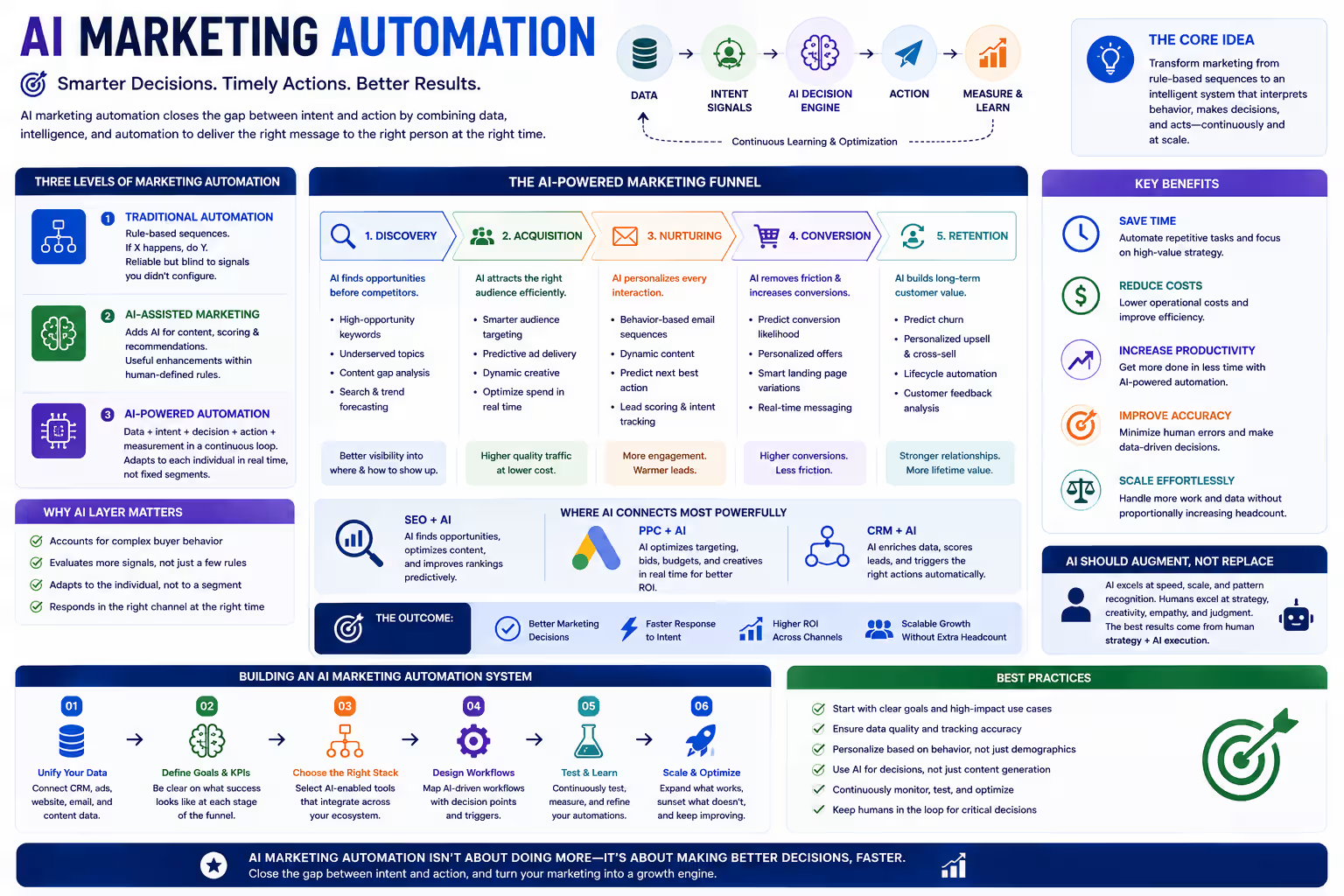
[AI Marketing Automation Workflows]
AI for Lead Generation
Predictive Audience Discovery
AI models trained on existing customer data — who converted, who became high-value, who churned early — can identify patterns in firmographic and behavioural characteristics that predict similar outcomes in net-new prospects. This moves audience targeting from broad demographic assumptions toward data-derived lookalike identification that improves as more conversion data accumulates.
Search and Intent Analysis
AI's ability to analyse search behaviour at scale and classify commercial intent — distinguishing a genuinely transactional query from an informational one, even when the surface keyword looks similar — is one of the more mature and immediately applicable AI marketing capabilities. This intent classification work sits directly alongside the high-intent keyword strategy work covered elsewhere in this content library.
Content Opportunity Identification
AI analysis of search demand, competitor content coverage, and gaps in existing content relative to what a topic cluster requires produces a more systematic content opportunity map than manual keyword research typically achieves. This is the same analytical foundation that underpins how large-scale programmatic content systems identify which pages are worth building — evaluating search demand and competitive gaps at a scale manual research cannot match.
AI-Powered Lead Scoring
Traditional lead scoring assigns fixed point values to specific actions — a download is worth ten points, a pricing page visit is worth fifteen, an email open is worth two. The scores accumulate, and a threshold determines when a lead is considered sales-ready. This approach is simple to implement and consistently produces mediocre accuracy, because it treats every action as carrying the same weight regardless of context.
AI-driven scoring instead evaluates the combined signal — behaviour, company profile, engagement pattern, intent indicators, and historical outcome patterns — to produce a predicted conversion probability rather than an accumulated points total. The distinction matters practically: a prospect who visited the pricing page once but matches the firmographic profile of your highest-value customers and arrived via a high-intent search campaign may warrant more immediate attention than one who has accumulated more total "points" through lower-value engagement.
The signals that typically feed AI lead scoring models:
Page visit patterns and depth of engagement with commercially significant pages
Content engagement — which pieces, how thoroughly, and in what sequence
Form submission history and the specificity of information provided
Email engagement trend — not just opens, but response and click patterns over time
Product or service page interest, indicating which specific offering is relevant
Geographic and firmographic signals matching or diverging from ideal customer profile
Previous interaction history, including any prior sales conversations or support contacts
Better lead scoring accuracy has a compounding effect beyond marketing's own efficiency — it directly improves the quality of what marketing hands to sales, which is precisely where AI-driven qualification in the sales function builds on the same underlying signal.
AI Lead Nurturing
Nurturing is where AI marketing automation's decision-making capability produces the most immediately visible improvement over rule-based systems, because nurturing decisions genuinely benefit from the individual-level judgment that fixed sequences cannot provide.
AI can determine, for each lead individually, which of several distinct situations applies: leads that need further education before they're ready for a sales conversation, leads that have crossed into genuine sales-readiness and should be prioritised for immediate handoff, prospects that have gone quiet and need a re-engagement touchpoint rather than continuation of a sequence that isn't working, and leads that show declining engagement signals suggesting they should be suppressed from further outreach rather than continuing to receive communication that isn't landing.
Dynamic Email Sequences
Rather than every lead entering the same fixed sequence regardless of behaviour, AI-driven nurturing adjusts messaging based on what each individual has actually engaged with — a prospect who's shown interest in a specific service line receives content relevant to that interest, rather than a generic sequence covering the full product range.
Content Recommendations
AI can recommend the specific next piece of content — the most relevant article, case study, service page, or offer — based on what has moved similar prospects forward previously, rather than marketing teams manually guessing at what content sequence makes sense for a given segment.
Timing Optimization
Beyond what to send, AI identifies when a given prospect is statistically most likely to engage — based on their own historical interaction patterns and broader patterns across similar prospects — improving open and response rates without requiring any change to the content itself.
AI Personalization Without Creating Thousands of Manual Campaigns
Traditional personalization runs into a scalability wall quickly. Every new segment a marketing team wants to address — by industry, by intent level, by geography, by funnel stage — multiplies the number of campaign variants that need to be built and maintained manually. A marketing team attempting genuine granular personalisation through manual segmentation eventually spends more time maintaining campaign variants than producing strategic work.
AI resolves this by enabling dynamic personalization rather than static segment-based campaigns. Instead of building forty separate campaign variants to cover combinations of industry, intent, and funnel stage, an AI-driven system can generate the appropriate variation for each individual at the point of send — pulling from a content and messaging framework rather than requiring every combination to be pre-built.
This applies personalisation across the dimensions that actually predict relevance: industry-specific messaging that reflects the prospect's sector, intent-calibrated content that matches where they are in their decision process, location-relevant examples and offers, behavior-informed sequencing based on what they've actually engaged with, and stage-appropriate calls to action that reflect whether they're still researching or actively evaluating.
AI Content Marketing Automation
Content operations benefit from AI across the full production workflow — research, planning, creation, optimisation, distribution, and measurement — though the appropriate level of AI involvement varies significantly across these stages.
AI Topic Research
AI-assisted research at scale identifies content opportunities by analysing search demand, competitive coverage, and topic relationships far faster than manual research — surfacing genuine gaps rather than requiring a researcher to manually cross-reference dozens of competitor sites and keyword tools.
Content Brief Generation
AI can compile a structured content brief — target keyword, search intent, competitive analysis, recommended structure, and internal linking opportunities — reducing the time between identifying a content opportunity and having a writer-ready brief.
Content Assistance
This is where the boundary between helpful and harmful AI use in content becomes important to state explicitly: AI should assist with production — drafting, structuring, suggesting angles — but human expertise, genuine original experience, and editorial judgment remain what makes content trustworthy and differentiated. Content produced entirely by AI without meaningful human input and review tends toward generic, undifferentiated output that struggles to build the kind of authority that earns rankings and trust over time.
Content Optimisation
AI analysis of existing content can identify missing topics that a comprehensive piece should cover, internal linking opportunities that strengthen topical authority, search intent mismatches where content doesn't actually address what the target query is asking for, and content gaps relative to what ranks well for a given topic cluster.
Content Distribution
Once produced, AI can automate the distribution sequence across email, social channels, and CRM-triggered workflows — ensuring content reaches the right segments through the right channels without requiring manual coordination for every piece published.
AI and SEO Automation
This is one of the areas where AI marketing automation and dedicated SEO strategy overlap most significantly — and where the connection between marketing automation and Teckgeekz's programmatic SEO work is most direct.
AI-assisted capability across SEO operations now spans keyword clustering that groups related terms by genuine topical and intent relationships rather than surface-level keyword matching, topic mapping that identifies how a content cluster should be structured to build comprehensive topical authority, content brief generation calibrated to search intent and competitive gaps, internal linking recommendations based on topical relationships and existing authority distribution across a site, content gap analysis at a scale that would be impractical manually, search intent analysis that classifies queries accurately even where the surface keyword is ambiguous, and — most directly relevant to how Teckgeekz builds scalable content systems — the workflows that make programmatic SEO viable at meaningful scale.
The principle worth stating clearly here, because it's the difference between AI-assisted SEO done well and done poorly: AI can make SEO workflows dramatically more scalable, but scale without quality control simply produces more pages that deserve less trust — from users and from search engines alike. The programmatic SEO work that produces genuine ranking results pairs AI-assisted scale with rigorous quality standards at every page, not scale as a substitute for quality.
AI and PPC Marketing Automation
The connection between AI marketing automation and PPC operations runs through several specific capabilities: audience analysis that identifies which segments are converting most efficiently, search intent classification that informs both keyword targeting and ad messaging, ad creative testing that identifies winning variations faster than manual A/B testing cycles, bid optimisation that adjusts in real time based on conversion probability signals, budget allocation that shifts spend toward performing segments continuously rather than through periodic manual review, conversion prediction that informs which traffic is worth pursuing before conversion data fully accumulates, landing page analysis that identifies friction points in the post-click experience, and campaign reporting that consolidates performance data across platforms without manual compilation.
This is directly the operational discipline covered throughout the travel and car rental PPC content on this site — the intent segmentation, budget allocation, and conversion tracking principles that make PPC campaigns efficient are the same principles that AI marketing automation applies at the broader marketing system level.
For businesses running seasonal or demand-driven campaigns — a pattern covered extensively in the travel PPC content on this site — AI's ability to detect demand shifts and adjust targeting and messaging faster than manual seasonal planning cycles is a direct efficiency gain that compounds during peak periods.
AI-Powered Campaign Personalisation
AI enables campaigns to adapt based on the combined context of who the prospect is, where they are, what device they're using, what intent signal they're showing, where they sit in the funnel, and how they've previously engaged — producing genuinely different experiences for genuinely different situations, rather than a single campaign experience applied uniformly.
A practical illustration: a user searching for a high-consideration, high-value service is in a fundamentally different decision state than someone still researching the category broadly. Serving both the same messaging — the same urgency, the same offer structure, the same call to action — ignores the intent difference the search behaviour itself revealed. AI-driven campaign personalisation adjusts messaging, offer, and next-step recommendation based on that intent signal rather than treating all traffic within a campaign as equivalent.
AI Marketing Automation and CRM Integration
AI marketing automation's effectiveness scales substantially when connected to CRM data rather than operating from marketing platform data alone.
CRM integration enables lead enrichment that combines marketing engagement data with sales interaction history for a complete prospect picture, lifecycle stage tracking that reflects actual sales pipeline status rather than marketing's own assumptions about readiness, sales handoff that carries full context rather than requiring sales to reconstruct a prospect's history from scratch, lead scoring that incorporates actual conversion outcomes from the sales process to continuously improve model accuracy, customer segmentation that reflects real revenue and relationship data rather than marketing engagement alone, and revenue attribution that connects marketing activity to actual closed revenue rather than proxy metrics like lead volume.
This is where marketing automation and the broader operational workflow automation covered elsewhere in this series genuinely converge — the same data connectivity that makes AI sales automation effective is what makes AI marketing automation effective, because they're drawing from and contributing to the same underlying customer intelligence.
AI Marketing Agents
Beyond discrete AI capabilities applied to specific tasks, specialized AI agents are emerging that manage sequences of marketing activity toward a defined outcome.
SEO Research Agents continuously scan for emerging topics, competitor content movements, and content gaps — surfacing opportunities proactively rather than requiring a scheduled manual research cycle.
Campaign Agents monitor performance across active campaigns, identify underperformance or opportunity signals, and recommend — or within defined guardrails, execute — adjustments to bidding, budget, or targeting.
Lead Nurturing Agents determine the next appropriate communication for each individual prospect continuously, rather than executing a fixed sequence, adapting as new behavioural signal arrives.
Content Agents assist with production and distribution — drafting, structuring, and coordinating publication and promotion across channels — within the human oversight boundaries discussed in the content assistance section above.
Reporting Agents transform raw marketing data into interpreted, actionable summaries — identifying what changed, why it likely changed, and what it suggests for the next decision, rather than simply presenting numbers.
The important caveat that applies to marketing agents as much as it does to the sales and workflow agents covered elsewhere in this series: businesses should not deploy autonomous agents simply because the capability exists. Agents need clearly defined scope, reliable underlying data, guardrails on what actions they can take autonomously versus what requires approval, and human oversight calibrated to the stakes of the decisions involved. A campaign agent adjusting bid strategy within a defined budget ceiling is a reasonable scope for autonomous action. A campaign agent with unrestricted authority to reallocate budget across the entire account without review is a governance gap waiting to produce an expensive surprise.
Building an AI Marketing Automation System
Step 1 — Map the Existing Marketing Funnel
Before selecting any AI tool, understand where leads currently enter the funnel, how they move through it, and where the handoffs between stages and between marketing and sales actually occur.
Step 2 — Identify Repetitive Marketing Tasks
Look specifically for manual reporting that consumes recurring time, lead routing handled manually, email segmentation rebuilt repeatedly for each campaign, and content distribution coordinated by hand across channels.
Step 3 — Identify Decision Bottlenecks
Beyond repetitive execution tasks, identify where the team spends time deciding what should happen next — which lead to prioritise, which content to send, which campaign needs adjustment. These decision points, where judgment is currently applied manually against data the team has to gather and interpret each time, are consistently the strongest AI opportunities, because AI's core strength is exactly this kind of pattern-based decision support.
Step 4 — Connect the Data
AI marketing automation's effectiveness is bounded by the completeness of the data it can access. Integrating website behaviour, CRM records, analytics platforms, PPC performance data, email engagement, and content system data into a connected picture is a prerequisite for AI to make genuinely informed decisions rather than operating on a fragment of the available signal.
Step 5 — Introduce Automation Gradually
Start with high-value, low-risk processes — lead scoring refinement, reporting automation, content recommendation — before extending into higher-stakes areas like autonomous campaign adjustment or fully AI-driven nurturing sequences.
Step 6 — Measure Results
Track business outcomes — qualified leads, conversion rate, revenue influenced — rather than AI activity metrics like the volume of AI-generated content or the number of automated touchpoints sent. Activity is not the same as impact, and measuring the wrong thing produces confidence in a system that isn't actually improving business results.
Signal-to-Action Framework
A practical way to evaluate whether a specific marketing process is a strong AI automation candidate is to map it against this framework — assessing how much signal is available, how much judgment the response requires, and how time-sensitive the appropriate action is.
Marketing Process | Signal Availability | Judgment Required | Time Sensitivity | AI Automation Fit |
|---|---|---|---|---|
Lead scoring | High — behavioural, firmographic, engagement data | Medium — pattern-based | High — delays cost conversion probability | Very High |
Nurture sequencing | High — behaviour and content engagement | Medium — content relevance judgment | Medium | High |
Ad bid optimisation | High — real-time performance data | Low — largely mechanical within strategy | Very High | Very High |
Content strategy direction | Medium — market and competitive data | High — requires business judgment | Low | Low–Medium (AI assists, doesn't decide) |
Brand positioning decisions | Low — largely qualitative | Very High | Low | Low (Human-led) |
Campaign reporting | High — data exists across platforms | Low — synthesis and pattern identification | Medium | Very High |
Autonomous budget reallocation | High — performance data available | Medium–High — strategic tradeoffs | High | Medium (needs guardrails) |
The processes in the top rows — high signal availability, moderate judgment requirement, high time sensitivity — are where AI marketing automation delivers the clearest, fastest returns. The processes toward the bottom — brand positioning, strategic direction — are where AI should inform human decision-making rather than make the decision itself.
Measuring the ROI of AI Marketing Automation
The temptation with any automation initiative is to measure hours saved and stop there. For marketing automation specifically, this understates the value significantly, because the strategic impact — better lead quality, faster response, higher conversion — typically exceeds the direct time savings.
The metrics that build a complete ROI picture:
Qualified lead growth — not just lead volume, but growth specifically in leads that meet genuine qualification criteria, reflecting improved targeting and scoring accuracy.
Cost per qualified lead — a more meaningful efficiency metric than cost per lead broadly, since it accounts for quality alongside volume.
Conversion rate — across each funnel stage, showing where AI-driven improvements are actually moving prospects forward rather than just generating more top-of-funnel activity.
Customer acquisition cost — the aggregate financial efficiency metric that reflects whether marketing automation investment is translating into more efficient customer acquisition overall.
Sales cycle length — faster qualification and more relevant nurturing should compress the time from initial contact to closed deal.
Marketing-generated revenue — the direct attribution of closed revenue back to marketing activity, which requires the CRM integration discussed earlier to measure accurately.
Lead response time — the interval between a lead signal and marketing or sales action, directly reflecting whether AI is closing the gap between signal and response that the introduction of this guide identifies as the central opportunity.
Campaign efficiency — spend efficiency across paid channels, reflecting AI-driven optimisation improvements.
Revenue per marketing employee — the ultimate measure of whether AI automation is expanding what the marketing function can accomplish without proportional headcount growth.
The distinction worth making explicit: marketing efficiency measures how much output the team produces per unit of time or cost. Marketing effectiveness measures how much of that output translates into qualified pipeline and closed revenue. AI marketing automation should be evaluated against effectiveness, not just efficiency — a system that produces marketing activity faster without improving conversion and revenue outcomes has automated the wrong thing.
Case Study: From Manual Marketing Workflows to AI-Assisted Growth
The figures below are details, reflecting patterns consistent with well-executed AI marketing automation implementations. They are not published results from a specific verified Teckgeekz client engagement.
The Situation
A mid-sized service business was generating leads through organic search, paid advertising, website enquiries, and email campaigns — a reasonably healthy volume of top-of-funnel activity. The problem sat downstream of acquisition: marketing operations were fragmented across disconnected systems, and the volume of leads had outpaced the team's manual capacity to process and act on them consistently.
The Problems
Lead scoring was manual and inconsistent — applied differently depending on which team member reviewed a given lead. Email sequences were generic, sent identically regardless of what specific behaviour or interest a lead had demonstrated. Lead handoff to sales was slow, often taking most of a business day before a qualified lead reached a sales conversation. Reporting was manually compiled across platforms, consuming significant time each month without providing timely visibility into what was actually working. Campaign data across paid, organic, and email channels was disconnected, making it difficult to understand the genuine cross-channel customer journey.
The AI Automation Layer
The implementation introduced AI lead scoring calibrated against historical conversion data, behaviour-based segmentation replacing the previous fixed-segment approach, automated nurturing sequences that adjusted based on individual engagement patterns, CRM integration connecting marketing and sales data into a shared view, AI-assisted reporting that consolidated cross-platform performance automatically, and content recommendation logic that surfaced the next most relevant piece of content to each nurtured lead based on demonstrated interest.
Before vs After
Metric | Before | After | Change |
|---|---|---|---|
Qualified Leads | 420/month | 618/month | +47% |
Lead Response Time | 7.2 hrs | 1.6 hrs | −78% |
Marketing-Qualified Lead Rate | 18% | 27% | +50% |
Manual Reporting Time | 32 hrs/month | 9 hrs/month | −72% |
Lead-to-Sale Conversion | 11.4% | 16.8% | +47% |
The improvement pattern here mirrors what appears consistently across the other case studies in this content series: no single change produced this result. Faster response time captured leads while intent was still high. Better scoring meant sales conversations happened with genuinely qualified prospects rather than a mix of quality levels. More relevant nurturing kept leads engaged through a longer consideration cycle rather than losing them to disengagement. The compounding effect across the connected system produced a larger result than any single automation would have in isolation.
US vs UK Considerations for AI Marketing Automation
United States:
Larger addressable markets support more aggressive paid acquisition strategies, and AI-driven optimization compounds faster at the volume typical of US campaign budgets
Faster experimentation culture — US marketing teams are generally quicker to test and iterate on AI-driven personalization and automation, accepting a higher tolerance for imperfect early results in exchange for faster learning
High value is placed on speed and scalability, aligning naturally with AI's core strength of processing volume and acting faster than manual teams can
United Kingdom:
Privacy and consent considerations are more prominent in how AI marketing automation is implemented, reflecting the UK's GDPR framework and generally more cautious approach to automated processing of personal data
Adoption in some UK SMEs is more measured — often starting with a single high-value application (lead scoring, or reporting automation) before expanding, rather than a comprehensive rollout
Strong emphasis on efficiency as the primary business case for AI marketing investment, consistent with the broader UK pattern seen across the sales and workflow automation content in this series
Localization and audience relevance carry particular weight — UK marketing teams operating across multiple regional markets (England, Scotland, Wales, and often Ireland) value AI's ability to personalise messaging by region without manually building separate campaigns for each
AI Marketing Automation, Privacy, and Human Oversight
The governance considerations that apply throughout AI business automation apply with particular weight in marketing, because marketing AI systems routinely process personal data at scale and make decisions that directly shape what messaging reaches real people.
— 25 AI Implementation Challenges in Web Development
Data quality and consent — AI marketing decisions are only as reliable as the data feeding them, and that data must be collected and processed in compliance with applicable consent requirements. A lead scoring model built on data collected without proper consent basis is both a compliance risk and, frequently, a data quality risk, since improperly collected data tends to be incomplete or inconsistently structured.
Human review of AI-generated content and messaging — particularly for anything customer-facing, AI-generated content and campaign messaging should pass through human review before publication or send, both to catch factual errors and to ensure the tone and positioning genuinely reflect the brand rather than a statistically plausible but subtly off approximation of it.
Model errors and hallucination risk — AI content generation systems can produce confident, plausible-sounding content that contains factual errors or unsupported claims. In marketing contexts, this risk extends to AI-generated performance claims, competitive comparisons, or product descriptions that could create legal or reputational exposure if published without verification.
Security and access controls — marketing AI systems with access to CRM data, campaign platforms, and customer communication channels represent a meaningful access point requiring the same security discipline applied to any system with that level of reach.
The governing principle worth stating directly: the more authority an AI marketing system has to act automatically — sending communications, adjusting spend, making targeting decisions — the more important the governance framework around it becomes. Low-stakes AI assistance (content drafting that a human reviews) warrants lighter oversight than high-stakes autonomous action (automated ad spend reallocation across an entire account).
Common AI Marketing Automation Mistakes
Automating a broken funnel. AI cannot fix fundamentally poor product-market fit, weak positioning, or a value proposition that doesn't resonate. Automating a funnel with these underlying problems produces a faster, more consistent version of underperformance.
Producing content at scale without quality control. More content does not automatically translate to more organic visibility or more qualified leads — and AI-generated content at volume without editorial rigor risks the opposite outcome, diluting site quality signals rather than building them.
Treating AI output as strategy. AI can execute instructions and generate recommendations with genuine sophistication, but it still requires business context, competitive understanding, and strategic direction that comes from human judgment. AI output should inform strategy, not substitute for it.
Creating too many automations. Complexity has a cost of its own. A marketing stack with dozens of disconnected automated workflows becomes difficult to understand, debug, and maintain — sometimes producing more operational burden than the manual process it replaced.
Ignoring attribution. Automation activity that can't be connected to actual revenue outcomes leaves businesses unable to answer the fundamental question: is this actually working? Attribution infrastructure should be built alongside automation, not treated as optional.
Removing humans from high-value decisions. Brand positioning, major campaign strategy, and significant budget commitments still benefit from human judgment, context, and accountability that AI systems — however sophisticated — do not yet reliably replicate.
"The real value of AI in marketing was never about generating more activity. It's about recognizing intent earlier and responding more intelligently once you've recognized it. A prospect signals interest, and the gap between that signal and your response is where deals are won or lost. AI's job is to close that gap — not to produce more emails, more content, or more campaigns for the sake of activity. Businesses that measure AI marketing success by output volume are optimizing the wrong number." — Jeffrey Mathew, Founder & CEO, Teckgeekz
Frequently Asked Questions
What is AI marketing automation? AI marketing automation uses artificial intelligence to interpret behavioural, firmographic, and engagement signals across the marketing funnel, and to make and execute decisions — content selection, timing, scoring, personalization — based on those signals, rather than executing only predefined, fixed rules. It differs from traditional marketing automation in its ability to handle the genuine complexity and variation in real buyer behavior, adapting its response to individual context rather than sorting everyone into a small number of static segments.
How does AI improve marketing automation? AI improves marketing automation primarily by expanding the signal a system can meaningfully act on and by making judgment-informed decisions rather than following fixed rules. Where traditional automation can only respond to explicitly configured triggers, AI-driven systems evaluate a much broader combination of behaviour, context, and history to determine the genuinely appropriate next action — producing more relevant nurturing, more accurate lead scoring, and faster response to the signals that actually predict conversion.
Can AI automate lead nurturing? Yes, and this is one of AI's strongest applications in marketing automation. AI can determine which leads need further education, which are sales-ready, which need re-engagement, and which should be suppressed — adjusting content, channel, and timing based on individual behaviour rather than applying a fixed sequence to everyone regardless of relevance. This produces meaningfully better engagement and conversion outcomes than static nurture sequences.
How does AI help with SEO and PPC? In SEO, AI assists with keyword clustering, topic mapping, content gap analysis, and internal linking recommendations — enabling the kind of scalable content strategy that underpins programmatic SEO systems. In PPC, AI supports audience analysis, bid optimisation, creative testing, budget allocation, and conversion prediction — the same operational principles covered throughout this site's travel and car rental PPC content. In both cases, AI's contribution is speed and scale of analysis; the strategic direction and quality standards still require human oversight.
Can AI personalise marketing campaigns? Yes — and AI's specific advantage here is enabling dynamic personalisation without requiring marketing teams to manually build and maintain a separate campaign variant for every audience segment combination. AI can adjust messaging, content, and offers based on industry, intent, location, behaviour, and funnel stage at the point of send, producing genuinely relevant experiences at a scale manual segmentation cannot sustain.
What marketing tasks should businesses automate first? Start with tasks that combine high signal availability, moderate judgment requirement, and high time sensitivity — lead scoring, nurture sequencing, and campaign reporting consistently produce the fastest and most measurable returns. Avoid starting with tasks requiring significant strategic or brand judgment — positioning decisions and major campaign strategy should remain human-led, with AI providing supporting analysis rather than making the decision.
Does AI marketing automation replace marketers? No. AI handles data interpretation, pattern-based decision-making, and execution at a scale and speed manual work cannot match — but strategic direction, brand judgment, creative differentiation, and the contextual understanding of what actually matters to a specific business and its customers remain fundamentally human contributions. The businesses seeing the strongest results are using AI to remove the manual execution burden from marketing teams, freeing their time for the strategic work that AI cannot do.
How do you measure the ROI of AI marketing automation? Measure marketing effectiveness, not just efficiency — qualified lead growth, cost per qualified lead, conversion rate improvement, customer acquisition cost, sales cycle length, and marketing-generated revenue, rather than simply hours saved or volume of automated activity produced. A system that generates more marketing output faster without improving these downstream outcomes has automated activity rather than improved results.
Key Takeaways
AI is becoming the intelligence layer of modern marketing — not a replacement for marketing strategy, but the mechanism that connects fragmented data, decisions, and actions into a system that responds to genuine buyer signal rather than executing fixed, generic sequences.
Automation should connect the entire funnel, from discovery through retention, rather than operating as isolated point solutions at individual stages. The compounding value of AI marketing automation comes from the connections between stages as much as from any single application.
Personalisation becomes genuinely scalable when AI handles the dynamic adaptation that manual segmentation cannot sustain — delivering relevant experiences without requiring a separate campaign variant for every audience combination.
SEO and PPC operations benefit substantially from AI-assisted workflows — but scale without quality control in either domain produces more output that earns less trust, not more genuine authority or performance.
Marketing and sales should operate from shared intelligence — the same connected data that makes AI marketing automation effective is what makes AI sales automation effective, and building these as connected systems rather than separate initiatives produces significantly more value than either alone.
Human strategy remains essential throughout. AI expands what marketing teams can process and how fast they can respond — it does not replace the judgment, creative differentiation, and business context that determine whether a marketing strategy is actually right for a specific business.
ROI must ultimately be measured in business outcomes — qualified pipeline, conversion, and revenue — not in the volume of AI-generated marketing activity.
In Summary
The future of marketing performance isn't about producing more campaigns, more content, or more emails. Every business now has access to tools that can increase output volume — that alone is no longer a competitive advantage.
What is a competitive advantage is building a marketing system that understands signals accurately, makes better decisions from them, and responds faster than competitors can. AI gives businesses the technical capability to connect previously fragmented marketing activities — acquisition, nurturing, conversion, retention — into a system that operates with genuine intelligence rather than a sequence of disconnected automated tasks.
But the competitive advantage will not come from simply adopting AI tools. Every competitor has access to broadly similar technology. It will come from designing the right processes, data connections, and governance around that technology — the strategic and operational discipline covered throughout this guide, and throughout this content series.
How Teckgeekz Builds AI-Powered Marketing Systems
The AI marketing systems we build for clients are positioned around implementation and business outcomes — not around AI as a feature to advertise, but as a capability applied precisely where it closes the gap between signal and response.
Our work spans CRM integration that connects marketing and sales data into a shared intelligence layer, lead qualification systems calibrated against real conversion outcomes, SEO automation that scales content strategy without sacrificing the quality standards that earn genuine authority, PPC optimization that applies the same intent-segmentation discipline covered throughout our travel and car rental PPC work, workflow automation that removes the manual coordination burden from marketing operations, and AI agents deployed with the scope and oversight that make autonomous marketing action trustworthy rather than a governance risk.
The outcome for clients is not a marketing function that produces more activity — it's one that recognizes intent earlier, connects that recognition across every relevant system, and responds with the speed and relevance that modern buyers expect. That is what building the right process around AI actually looks like in practice.
In this Series — AI & Business Automation:
AI Business Process Automation: Where AI Delivers the Highest ROI for Modern Businesses
AI Sales Automation: Using AI to Improve Lead Qualification and Close More Deals
AI Workflow Automation: How Businesses Eliminate Repetitive Work Without Hiring More Staff
AI Marketing Automation: Smarter Lead Generation, Nurturing & Conversion
AI for Customer Support: Building Intelligent Support Systems That Scale


Jeffrey Mathew
Founder & CEO • Travel Marketing Specialist
"With over 14 years of dominance in the travel and tech sectors, Jeffrey Mathew has engineered growth for hundreds of OTAs and airlines worldwide. He specializes in the intersection of Performance PPC and Agentic AI, building high-performance digital ecosystems for modern brands."
Start a Conversation
Ready to Elevate Your Business?
Fill out the form below and let's discuss how Teckgeekz can help you reach your goals.
Describe your project to unlock real-time AI service recommendations and matching portfolio cases.
Our Trusted Partners