AI for Customer Support: Building Intelligent Support Systems That Scale
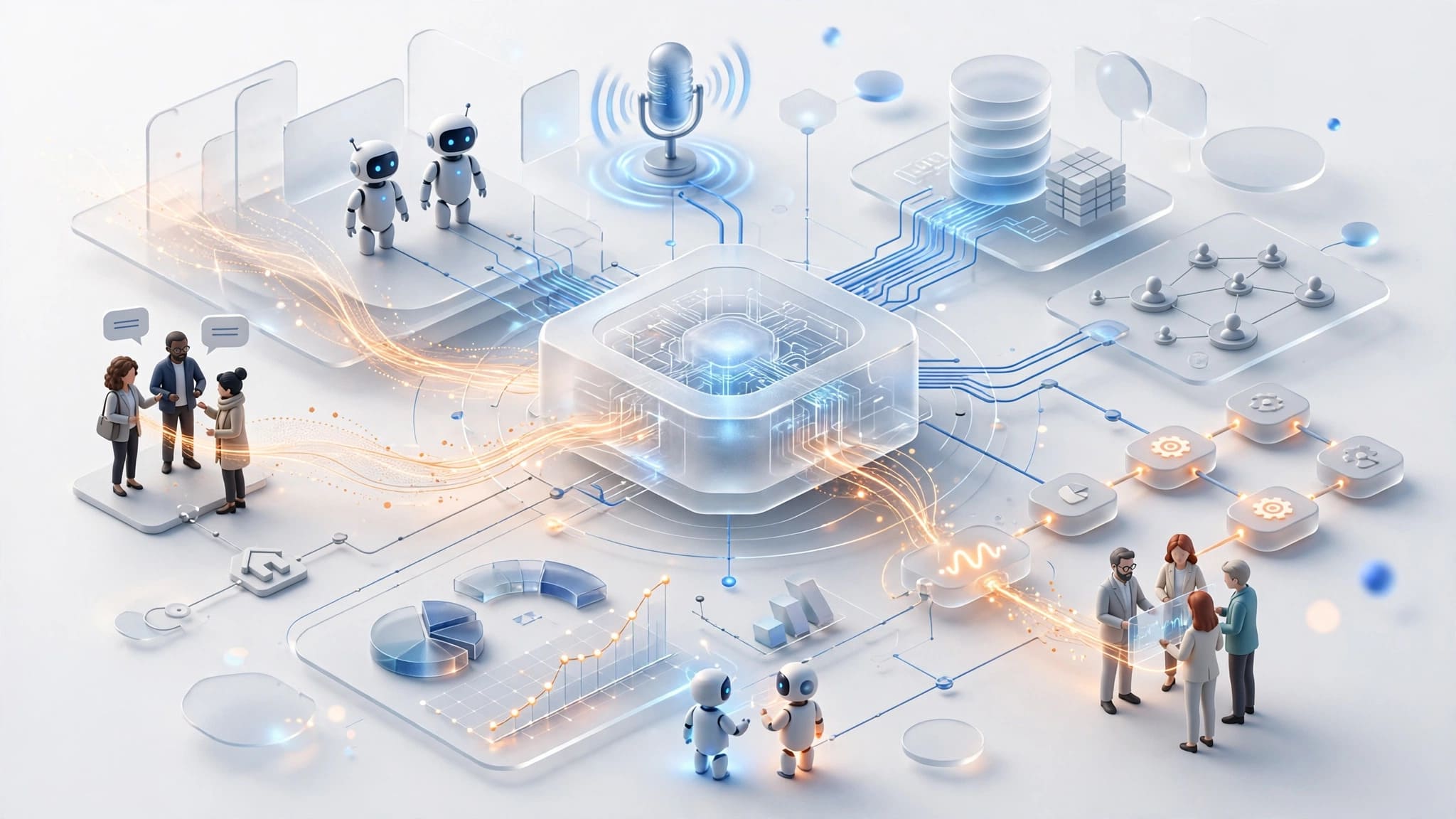
Customer expectations around support have shifted faster than most support teams have been able to keep up with. Customers now expect immediate responses, availability outside business hours, consistent answers regardless of which channel or agent they reach, and a level of personalization that assumes the business remembers who they are and what they've already told someone. This is where complete AI workflow automation setup comes in.
At the same time, the businesses providing that support are managing growing conversation volume, rising staffing costs, a high proportion of genuinely repetitive enquiries, knowledge scattered across systems that no single agent has complete visibility into, and the persistent challenge of maintaining consistent service quality as a team grows and turns over.
The goal of AI customer support was never to remove humans from customer service. It is to remove the repetitive work that prevents the humans on a support team from spending their time on the customers who genuinely need them — the complex issues, the frustrated customers, the situations that require judgment and empathy rather than information retrieval.
Support has moved through a clear evolution: from human-only support, through rule-based chatbots that could handle only exactly what they were scripted for, to AI-assisted support that gives human agents better tools, and now toward a hybrid model where AI agents independently handle defined categories of work while humans handle everything that requires genuine judgment. Understanding where a business currently sits in that evolution — and where the next step actually is — is the foundation of building a support system that scales without simply adding headcount indefinitely.
This guide covers what AI customer support actually is beyond chatbots, where it delivers the strongest ROI, how voice AI is opening a significant new automation channel — particularly relevant for travel businesses — and how to build a hybrid human-AI support model that improves customer experience rather than just reducing ticket volume.
What AI Customer Support Actually Is
Support capability has evolved through three distinct stages, and treating them as interchangeable produces poor expectations about what AI can actually deliver.
Traditional customer support — email, phone, live chat handled entirely by human agents, with manual ticket triage and routing. Reliable in quality, but bounded entirely by the number of agents available and the hours they're working.
Rule-based chatbots — the first generation of automated support, operating from predefined response scripts and decision trees. These handle a narrow, exactly-anticipated set of questions competently and fail — often visibly and frustratingly for the customer — the moment a query falls outside the scripted paths.
AI-powered customer support introduces genuine natural language understanding, allowing the system to interpret what a customer actually means rather than matching against fixed phrases. It can search across a knowledge base to find genuinely relevant information rather than returning a pre-written canned response, summarize a conversation for handoff, recommend a solution based on the specific context of the issue, route complex issues intelligently based on content and urgency rather than a simple category dropdown, and in an increasing number of cases, take defined actions — processing a straightforward refund, modifying a booking, scheduling an appointment — rather than only providing information.
The right mental model is the same one that's applied throughout this series: AI functions as an intelligence layer across the entire support operation, not as a single customer-facing chat widget. The chat interface a customer sees is only the visible surface. The value comes from the intelligence and system integration behind it.
Why Businesses Are Moving Toward AI Customer Support
The operational pressure driving AI adoption in support is structural, not a passing trend.
Support volumes are rising faster than teams can scale manually. More customers, more channels, and more touchpoints per customer relationship all compound into conversation volume that grows faster than most businesses want to grow support headcount proportionally.
Immediate response has become the baseline expectation, not a premium service. Customers who receive fast, competent answers from businesses in other categories bring that expectation into every interaction, including with businesses whose support operations weren't built for that speed.
A significant share of support volume is genuinely repetitive. Order status, booking confirmation, policy questions, basic troubleshooting — these represent a substantial proportion of total ticket volume in most support operations, and they are precisely the category of work where a human agent's expertise is underused relative to what the interaction actually requires.
Scaling human teams doesn't resolve the underlying workflow problem. Adding agents increases capacity, but if the workflow itself is inefficient — poor routing, scattered knowledge, manual triage — more agents working within that same inefficient workflow produces proportionally smaller gains than fixing the workflow itself.
Customers don't operate within business hours. A support operation that's only available nine-to-five is systematically failing every customer who has a question outside that window — and in global or travel-adjacent businesses specifically, that's frequently a substantial share of genuine demand.
AI Automations addresses each of these directly — not by attempting to automate every interaction, but by absorbing the volume and repetition that doesn't require human judgment, freeing human capacity for the interactions that genuinely do.
The Modern AI Customer Support Stack
A properly architected AI support system has five distinct layers, each with a specific role.
Customer Interaction Layer
The channels through which customers actually reach out — website chat, mobile app messaging, email, social media messaging, voice, and increasingly WhatsApp, particularly for businesses whose customers already default to it for personal communication. This layer is what the customer sees; it should feel consistent regardless of which channel they choose.
AI Intelligence Layer
The processing layer that makes the interaction genuinely intelligent — intent detection that understands what the customer is actually asking regardless of how they phrase it, natural language understanding that handles genuine conversational variation rather than requiring exact keyword matches, sentiment analysis that reads emotional tone alongside literal content, customer context awareness that incorporates who this customer is and what has happened before, and response generation that produces genuinely relevant answers rather than retrieving a fixed canned response.
Knowledge Layer
The information the AI draws from to produce accurate answers — FAQs, product documentation, internal policy documents, previous support resolutions, and any other source of truth the business maintains. This layer's quality is the single largest determinant of whether AI support produces accurate, useful answers or confident, plausible-sounding mistakes.
Business Systems Layer
The operational systems the AI needs access to in order to take genuine action rather than just provide information — CRM, helpdesk platform, order management, booking systems, and billing systems. This is what separates AI support that can only answer questions from AI support that can actually resolve them.
Human Escalation Layer
The pathway by which complex, sensitive, or high-stakes issues move to the appropriate human team — not as a failure state, but as a designed and expected part of the architecture.
The customer's interaction moves through this stack — from the interaction layer, through AI intelligence drawing on the knowledge layer, connecting to business systems where action is needed, and escalating to human agents when the situation genuinely requires it. A support system missing any of these layers — particularly the business systems integration or the human escalation layer — will underperform regardless of how sophisticated the customer-facing AI appears.
AI Chatbots vs AI Customer Support Systems
The terms get used interchangeably in casual conversation, but the distinction matters significantly for what a business should actually expect to implement.
Capability | Traditional Chatbot | AI Support System |
|---|---|---|
Fixed, scripted responses | Yes — limited to predefined paths | No — generates contextual responses |
Natural language understanding | Limited — requires close keyword matching | Strong — interprets genuine conversational variation |
Knowledge retrieval | Limited — fixed FAQ matching | Advanced — searches across full knowledge base contextually |
Customer context awareness | Limited — treats each conversation as isolated | Strong — incorporates history and account context |
CRM integration | Basic, if present at all | Advanced — reads and writes to CRM in real time |
Ticket routing | Basic — simple category rules | Intelligent — content and urgency-based routing |
Human escalation | Rule-based — fixed triggers only | Context-aware — considers sentiment, history, and stakes |
Multi-step actions | Very limited | Increasingly capable — booking changes, refunds, scheduling |
The chatbot is only the customer-facing interface. The genuine value of an AI support system comes from the intelligence and systems integration operating behind that interface — a business that implements a sophisticated-looking chat widget without the underlying knowledge quality, CRM integration, and intelligent routing has built the visible part without the part that actually determines whether customers get good answers.
AI-Powered Ticket Classification and Routing
Ticket classification and routing is one of the most immediately achievable, highest-ROI applications of AI in customer support — the automation equivalent of low-hanging fruit that's genuinely valuable rather than trivial.
AI can analyze an incoming ticket — regardless of channel — and determine its topic, urgency level, customer sentiment, the specific product or service it relates to, which department should handle it, and what level of expertise the resolution requires. It then routes accordingly, without the delay of manual triage.
The practical difference this makes: a billing complaint arriving through a general support inbox should not sit unrouted for hours before someone manually recognises it belongs to finance rather than general support. AI classification identifies this immediately — reading the content, recognising the billing-specific language and urgency signals, and routing directly to the team equipped to resolve it.
This improves first response time by removing the manual triage delay entirely, resolution time by ensuring tickets reach the right expertise on the first attempt rather than being reassigned after an agent realises it's outside their scope, agent productivity by reducing time spent on triage and reassignment, and customer experience by reducing the frustration of explaining an issue multiple times to different people before reaching someone who can actually help.
AI Knowledge Bases — Giving Support Teams the Right Answer Faster
Knowledge fragmentation is one of the most underrated bottlenecks in customer support. Information that should inform a fast, accurate answer is frequently scattered across PDFs, internal documents, CRM notes from previous interactions, help center articles, product manuals, policy documents, and the institutional memory of previous tickets that resolved similar issues — none of it easily searchable in the moment an agent or an AI system needs it.
AI can create a conversational knowledge layer across this fragmented information — allowing a query to search meaningfully across all of it simultaneously, rather than requiring someone to know which specific document contains the answer.
Customer-Facing Knowledge
AI uses this knowledge layer to answer common customer questions directly — providing accurate, specific answers drawn from actual policy and product documentation rather than generic responses that might not reflect the business's actual current policies.
Agent-Facing Knowledge
Equally important and frequently overlooked: AI can help human agents find answers during live conversations, surfacing the relevant policy, previous resolution, or product detail in real time rather than requiring the agent to search manually while a customer waits. This is the distinction worth making explicit: AI doesn't only support customers directly. It makes human support agents significantly more effective at supporting customers themselves — arguably one of the highest-value applications precisely because it improves every interaction the agent handles, not just the ones AI fully automates.
AI Voice Agents and the Next Generation of Customer Support
Voice AI represents one of the most significant emerging capabilities in customer support — and one with particular relevance for travel and booking-driven businesses specifically.
The applications extending beyond simple call routing now include appointment scheduling handled entirely by voice interaction, booking enquiries answered and processed without requiring a human agent for the full call, order and booking status provided instantly, basic qualification of a caller's needs before any human involvement, intelligent call routing based on the actual content of what the caller needs, frequently asked questions answered conversationally rather than through a rigid phone menu, and after-hours support that doesn't leave callers with only a voicemail option.
For travel businesses specifically, this connects directly to a category of interaction that happens constantly and at volume: a traveler calling about a flight, hotel, transfer, or car rental frequently doesn't need a human for every part of that interaction. AI voice agents can collect travel dates, destination, passenger or vehicle requirements, and booking reference information — the qualifying details every human agent would need to ask first regardless — before escalating the conversation to a human at exactly the point where genuine expertise or judgment becomes necessary.
This is directly relevant to the pay-per-call travel advertising ecosystem this site covers extensively — campaigns that drive inbound calls generate exactly this kind of qualification-then-escalation opportunity, where AI handles the initial information gathering and routing before a human closes the booking.
AI Customer Support for Travel Businesses
Given Teckgeekz's specialization in travel marketing, this application deserves specific treatment beyond the general voice AI discussion above.
Flight enquiries — AI can handle flight availability questions, provide booking information, process straightforward date or passenger changes, and answer baggage policy questions — the high-volume, generally predictable category of airline and OTA support interaction.
Hotel support — booking information retrieval, check-in and check-out process questions, and cancellation policy clarification represent a substantial share of hotel support volume that follows predictable patterns AI handles well.
Car rental support — vehicle availability, pickup location and process information, rental requirement clarification (age, license, insurance), and booking status questions are exactly the kind of high-volume, structured interaction that benefits from AI handling, freeing human agents for the genuinely complex situations — a damaged vehicle return, a dispute over charges, a booking gone wrong at pickup.
Travel lead qualification — before an enquiry reaches a sales agent, AI can collect the customer's specific requirements — destination, dates, budget range, group size, vehicle or accommodation preferences — producing a qualified, context-rich handoff rather than a sales agent starting the conversation from zero. This is where AI customer support and AI sales automation genuinely converge — a support interaction that surfaces genuine booking intent should flow directly into the qualification and prioritization logic that makes sales follow-up efficient.
AI-Powered Personalization in Customer Support
Generic answers are increasingly a poor customer experience regardless of how quickly they arrive. AI can incorporate genuine customer context — previous conversation history, purchase or booking history, account information, the specific issue currently being raised, and known customer preferences — to provide support that reflects an actual relationship rather than treating every interaction as the first one.
This matters practically: a customer who previously had a specific issue resolved a certain way, or who has stated a preference for a particular communication style or channel, receives support that reflects that history rather than requiring them to re-explain context every time.
The important caveat, consistent with the governance principles throughout this series: this level of personalisation depends on proper data permissions and access controls. AI systems drawing on customer history need clear boundaries around what data they can access and use, and customers should have visibility into and control over how their information informs the support they receive.
Sentiment Analysis and Escalation
AI's ability to detect emotional and situational signals — not just literal content — is what separates genuinely intelligent support automation from simple chatbot logic.
The signals worth detecting include frustration building across a conversation, urgency in language and phrasing, repeated complaints about the same issue (suggesting a previous resolution attempt failed), language suggesting cancellation or churn intent, and generally negative sentiment trend across an interaction.
A practical escalation trigger might combine multiple signals: three failed resolution attempts within a conversation, combined with detected negative sentiment, combined with the customer being identified as high-value — this combination should trigger immediate human escalation rather than continuing an automated interaction that's clearly not resolving the issue and is actively damaging the relationship the longer it continues.
This is precisely where intelligent automation becomes more valuable than simple chatbot logic: not just handling the easy cases well, but recognizing accurately when a case has stopped being easy and needs to reach a human before the situation deteriorates further.
AI Agents for Customer Support
The applications discussed so far describe AI providing information and support within a defined interaction. AI agents represent a further capability layer — systems that can independently perform defined tasks rather than only providing information or suggestions.
The distinction across three levels of AI involvement in support is worth being precise about:
AI Assistant helps the human support agent — surfacing relevant knowledge, summarizing previous interactions, and providing information the agent uses to help the customer directly.
AI Copilot goes further, suggesting specific actions and draft responses that the agent reviews and approves before they reach the customer — a more active role, but still with a human in the loop for every customer-facing output.
AI Agent can independently perform defined tasks within clearly bounded scope — processing a straightforward refund that meets defined criteria, modifying a booking within policy limits, scheduling an appointment, without requiring human review of each individual action.
The specific agent types emerging in support operations: a refund processing agent that handles straightforward refund requests meeting defined criteria automatically; a booking modification agent that can adjust dates, passenger details, or room types within policy boundaries; an appointment scheduling agent that manages calendar coordination without human involvement; a customer onboarding agent that guides new customers through account setup and initial configuration; and a support ticket resolution agent that can fully close out defined categories of tickets end to end.
The governance principle that applies here as it does throughout every agent discussion in this series: AI agents in customer support need clearly defined boundaries around exactly what they are permitted to do autonomously. A refund agent authorised to process refunds up to a defined value threshold without approval, but required to escalate anything above that threshold, has appropriate guardrails. An agent with unrestricted refund authority is a financial control gap, not an efficiency gain.
Human + AI: The Hybrid Support Model
This is the central argument of the entire guide, and it's worth stating plainly rather than implying: the future of customer support is not AI replacing support teams. It is AI handling the predictable, repetitive, information-retrieval-heavy work while humans handle complexity, empathy, negotiation, and exceptions — the categories of interaction where human judgment is not just preferable but genuinely necessary.
What AI should handle:
Repetitive, predictable questions with clear, factual answers
Data retrieval — order status, booking details, account information
Classification and routing of incoming requests
Conversation summarization for handoff or record-keeping
Basic transactions within clearly defined policy boundaries
What humans should handle:
Complaints, particularly where emotion and relationship repair are involved
Negotiation — refund exceptions, goodwill gestures, retention conversations
Sensitive situations requiring discretion and judgment
Complex decisions involving genuine trade-offs or policy interpretation
High-value customer relationships where the human relationship itself has strategic importance
This hybrid model consistently produces better customer experience outcomes than either extreme. Fully human support, however well-staffed, cannot match AI's speed and 24/7 availability for the predictable majority of interactions. Fully automated support, however sophisticated, fails customers whose situations genuinely require judgment, empathy, or discretion that current AI cannot reliably provide. The hybrid model gives customers the speed of automation where speed is what matters, and the judgment of a human where judgment is what matters — matched to the actual nature of each interaction rather than applied uniformly.
Support Automation Suitability Matrix
A practical framework for evaluating which categories of support interaction are strong AI automation candidates, consistent with the practical scoring tools used throughout this content series:
Interaction Type | Predictability | Emotional Stakes | Policy Complexity | AI Automation Fit |
|---|---|---|---|---|
Order/booking status | Very High | Low | Low | Very High — fully automatable |
FAQ / policy questions | Very High | Low | Low–Medium | Very High |
Simple booking modifications | High | Low | Medium | High |
Refund requests (within policy) | High | Medium | Medium | High (with defined thresholds) |
Technical troubleshooting | Medium | Medium | Medium | Medium — AI-assisted, human-reviewed |
Billing disputes | Medium | High | Medium–High | Low–Medium — AI supports, human decides |
Complaints and service failures | Low | Very High | Variable | Low — human-led, AI supports with context |
High-value account management | Low | High | High | Low — relationship-led, human-first |
The interactions in the top rows — high predictability, low emotional stakes, manageable policy complexity — are where AI delivers the fastest, most reliable automation value. The interactions toward the bottom require human leadership, with AI providing supporting context and information rather than driving the interaction.
Building an AI Customer Support System
Step 1 — Analyze Support Volume
Before selecting any technology, understand what's actually coming through the support channels — the most common enquiry types, their relative volume, and how they're currently being resolved.
Step 2 — Categorize Support Requests
Separate the volume into simple (predictable, low-stakes), moderate (some judgment required, moderate stakes), and complex (genuine judgment, high stakes, or high emotional content) categories, using the suitability matrix above as a starting framework.
Step 3 — Build the Knowledge Layer
Before any AI can provide accurate answers, the underlying knowledge needs to be consolidated into a reliable, current source of truth. This step is frequently underestimated in scope and is the single most important prerequisite for AI support accuracy.
Step 4 — Integrate Business Systems
Connect the AI layer to the CRM, helpdesk platform, and — for travel and booking-driven businesses specifically — the booking and order management systems that allow AI to actually retrieve real customer and booking data rather than operating from static knowledge alone.
Step 5 — Automate Low-Risk Requests First
Start with the categories identified as highest suitability in the matrix — predictable, low-stakes, low-complexity interactions — building organizational confidence and demonstrable results before extending scope.
Step 6 — Introduce Intelligent Escalation
Define explicitly when and how conversations should move to human agents — not as an afterthought, but as a deliberately designed part of the system from the outset.
Step 7 — Monitor and Improve
Continuously analyse failed AI responses, escalation patterns, customer feedback, and resolution rates to refine the system — AI support quality should improve over time as more interaction data accumulates and gaps in the knowledge layer or routing logic become visible.
Measuring the ROI of AI Customer Support
The temptation to measure success purely by the number of AI-handled conversations is a mistake worth naming explicitly — volume of automated interactions is an activity metric, not an outcome metric.
The metrics that build a genuine ROI picture:
First response time — the interval between a customer reaching out and receiving a substantive first response, one of the most directly measurable and customer-experience-relevant metrics.
Average resolution time — the full time from initial contact to resolved issue, reflecting both AI efficiency and the effectiveness of escalation when needed.
Cost per support interaction — the aggregate cost efficiency metric, incorporating both AI infrastructure cost and the human agent time still required.
First-contact resolution — the percentage of issues resolved without requiring the customer to follow up again, a strong proxy for genuine answer quality rather than just fast response.
Ticket deflection — the percentage of enquiries fully resolved by AI without human involvement, useful but incomplete as a metric on its own.
Customer satisfaction — the metric that ultimately validates whether the automation is genuinely improving the customer experience or just processing volume faster.
Agent productivity — the capacity gain for human agents once AI has absorbed the repetitive volume, reflecting the actual scaling benefit of the system.
Escalation rate — tracked not just as a raw number, but evaluated against whether escalations are happening at the right point — too few suggests AI is attempting to handle issues beyond its competence; too many suggests the automation scope is too conservative.
After-hours resolution — a specific and often dramatically improved metric, reflecting the availability gain from AI support operating outside traditional business hours.
Support cost per customer — the broadest financial efficiency metric, useful for understanding whether support scaling is keeping pace with customer growth without proportional cost growth.
The principle worth stating explicitly: reducing ticket volume isn't success if customer satisfaction declines alongside it. A support system that deflects large volumes of enquiries but leaves customers frustrated with inadequate automated answers has optimised the wrong outcome. Deflection and satisfaction should be measured and evaluated together, not deflection alone.
Case Study: Scaling Support Without Scaling Headcount
The company name and figures below are illustrative, reflecting patterns consistent with well-executed AI customer support implementations. They are not published results from a specific verified Teckgeekz client engagement.
The Situation
A growing service business — referred to here as a representative example rather than a named client — was receiving increasing support volume while its existing support team was already operating near full capacity. The specific problems were familiar ones: a high proportion of repetitive enquiries consuming disproportionate agent time, slow first response times as ticket volume outpaced triage capacity, manual ticket routing creating delay before issues reached the right team, agents needing to search across multiple disconnected systems to find the information needed to resolve a given issue, and after-hours enquiries going largely unanswered until the next business day.
Before AI implementation:
Metric | Value |
|---|---|
First response time | 4.8 hrs |
Tickets requiring manual triage | 100% |
Average resolution time | 19 hrs |
After-hours enquiries resolved | 8% |
Agent productivity | Baseline |
The AI System
The implementation built out the full stack described earlier in this guide: an AI website assistant handling customer-facing enquiries, intelligent ticket classification and routing removing manual triage, a consolidated knowledge retrieval layer giving both the AI and human agents accurate, searchable access to policy and product information, AI-generated response suggestions supporting agents on more complex tickets, automated routing based on content and urgency, defined human escalation triggers for sentiment and complexity signals, and automatic conversation summarization for agent handoff and record-keeping.
Before vs After
Metric | Before | After | Improvement |
|---|---|---|---|
First Response Time | 4.8 hrs | 18 min | −94% |
Tickets Requiring Manual Triage | 100% | 34% | −66% |
Average Resolution Time | 19 hrs | 7.1 hrs | −63% |
After-Hours Enquiries Resolved | 8% | 61% | +663% |
Agent Productivity | Baseline | +42% | Increased |
The after-hours resolution improvement is worth particular attention — a nearly seven-fold increase in issues resolved outside business hours represents genuine capacity that didn't exist previously, not just faster processing of existing capacity. The combination of faster first response and dramatically improved after-hours coverage reflects the specific advantage AI brings that headcount scaling alone cannot easily replicate — availability that doesn't depend on someone being on shift.
US vs UK Considerations for AI Customer Support
United States:
Customer expectations for immediate response are particularly high, reflecting the broader US consumer experience standard set by large-scale digital-first businesses across categories
Large customer volumes in US markets make AI's scalability advantage particularly pronounced — the efficiency gain compounds faster at US-typical support volumes
Strong adoption of both AI chat and AI voice channels, with US businesses generally more willing to deploy voice AI for a broader range of interaction types
Greater emphasis on scalability as the primary business case — US businesses frame AI support investment predominantly around handling growth without proportional headcount increase
United Kingdom:
Data privacy considerations are more prominent in how AI support systems are designed and communicated, consistent with the broader UK GDPR-conscious pattern seen throughout this series
Customer trust in automated support is generally built more gradually — UK businesses often introduce AI support incrementally and transparently rather than deploying broad automation immediately
SME adoption is strong but frequently starts with a single high-value application — often knowledge base and ticket routing — before extending into more autonomous AI agent capability
Clear human escalation pathways are particularly valued by UK customers, and businesses that make the "talk to a human" option obvious and easy tend to see better customer trust outcomes than those where AI support feels difficult to escape
Transparent AI usage — customers knowing when they're interacting with AI versus a human — is an increasingly expected standard rather than an optional disclosure
Privacy, Security, and AI Governance
Customer support AI systems handle sensitive personal and, in many cases, financial data — making governance a foundational requirement rather than an optional consideration.
Customer data handling — AI support systems need clear policies on what customer data they access, how it's used to inform responses, and how long it's retained, consistent with applicable data protection requirements.
Access controls — the systems an AI support layer connects to (CRM, booking systems, billing) should have access permissions scoped specifically to what the AI genuinely needs, not broad access granted for convenience.
Data retention — conversation logs, particularly those containing sensitive information, need defined retention policies rather than indefinite storage by default.
Sensitive information handling — AI systems need explicit boundaries around categories of information (payment details, health-related disclosures, other sensitive categories) that require additional protection or should trigger immediate human handling rather than AI processing.
Human review processes — particularly for AI agents with any autonomous action capability, periodic human review of AI decisions and actions provides an accountability check that pure automated operation lacks.
Audit trails — every AI action, particularly anything involving customer data changes, refunds, or booking modifications, should be logged in a way that supports accountability and troubleshooting.
AI hallucination risk — AI support systems can produce confident, plausible-sounding answers that are factually wrong, particularly where the knowledge base has gaps. This risk needs active management through knowledge base quality control and appropriate escalation when the AI's confidence in an answer should reasonably be low.
Knowledge base accuracy — the single most direct lever for reducing hallucination and error risk is ensuring the underlying knowledge the AI draws from is current, accurate, and complete. Outdated policy documentation feeding an AI support system produces confidently wrong answers at scale.
The governing principle, consistent with the theme throughout this series: the more access an AI system has to customer data and business systems — and the more autonomous action it's capable of taking — the stronger the governance framework around it needs to be. A read-only FAQ chatbot warrants lighter governance than an AI agent with autonomous refund authority.
Common AI Customer Support Mistakes
Automating too much too quickly. The businesses that struggle most with AI support implementation typically attempted to automate broad categories of interaction simultaneously, rather than starting with the low-risk, high-volume interactions the suitability matrix identifies and expanding scope as confidence and accuracy are demonstrated.
Using poor knowledge sources. AI cannot consistently provide accurate answers if the underlying information it draws from is outdated, incomplete, or inconsistent. Knowledge base quality is the prerequisite that most failed implementations skipped.
No clear human escalation path. Customers need an obvious, easy route to a human when AI isn't resolving their issue. Support systems that make escalation difficult to find or trigger produce frustrated customers regardless of how capable the AI is for the interactions it does handle well.
Treating AI as a standalone tool. The most significant gains come from integrating AI with existing business systems — CRM, booking platforms, order management — rather than deploying a chat widget that operates in isolation from the systems that hold the actual customer and account data needed for genuinely useful responses.
Measuring deflection instead of satisfaction. Reducing the number of tickets reaching human agents is meaningless, or actively harmful, if the customers being deflected are left frustrated with inadequate automated answers. Deflection should be tracked alongside satisfaction, never as a standalone success metric.
Allowing AI to take uncontrolled actions. AI agents with the capability to process refunds, modify bookings, or take other consequential actions need clearly defined permission boundaries and thresholds — unrestricted autonomous action capability is a governance failure waiting to produce a costly or reputationally damaging surprise.
"The best AI customer support doesn't make customers feel like they're talking to a machine. It makes getting help feel faster, easier, and more relevant than it used to — and often, the customer doesn't consciously register that AI was involved at all. They just experience a business that answers quickly, gets things right the first time, and gets them to a human immediately when that's genuinely what the situation needs. That invisibility is the goal. The moment a customer feels like they're fighting the system to reach a person, the automation has failed regardless of how sophisticated it is underneath." — Jeffrey Mathew, Founder & CEO, Teckgeekz
Frequently Asked Questions
What is AI customer support? AI customer support uses artificial intelligence to understand natural language, interpret customer intent, search knowledge bases, generate accurate responses, route complex issues intelligently, and in an increasing number of cases, take defined actions like processing refunds or modifying bookings — going well beyond rule-based chatbots that can only respond to exactly anticipated queries. It functions as an intelligence layer across the entire support operation, supporting both customers directly and the human agents handling more complex interactions.
Can AI replace customer support agents? No — and the businesses achieving the strongest results are explicit about this. AI handles the predictable, repetitive, information-retrieval-heavy portion of support volume — order status, FAQ answers, basic transactions — while humans handle complaints, negotiation, sensitive situations, and complex decisions that require genuine judgment and empathy. The practical effect of well-implemented AI support is expanded capacity and faster response for the majority of straightforward interactions, not a reduced need for skilled human agents handling the interactions that genuinely require them.
What customer support tasks should businesses automate first? Start with high-predictability, low-emotional-stakes interactions — order and booking status enquiries, FAQ and policy questions, and simple booking modifications within defined policy limits. These produce fast, measurable results with minimal risk of customer-facing error, building organizational and customer confidence before extending into higher-stakes applications like autonomous refund processing or more complex troubleshooting.
How do AI chatbots differ from AI customer support systems? A traditional chatbot operates from fixed, predefined response scripts with limited natural language understanding and minimal integration with business systems. An AI customer support system has genuine natural language understanding, searches across a full knowledge base contextually rather than matching fixed FAQs, integrates deeply with CRM and business systems to provide real account-specific information and take real action, and routes and escalates based on content and context rather than simple fixed rules. The chatbot is the visible interface; the AI support system is the intelligence and integration layer behind it.
Can AI handle customer support calls? Yes, increasingly capably through AI voice agents. Voice AI can handle appointment scheduling, booking enquiries, order and booking status, basic caller qualification, intelligent call routing, and frequently asked questions conversationally — collecting the qualifying information a human agent would typically ask for first, before escalating to a human at the point where genuine expertise or judgment becomes necessary. This is particularly relevant for travel and booking-driven businesses, where a substantial share of call volume follows predictable patterns well suited to AI handling.
How does AI improve ticket routing? AI analyses incoming tickets — regardless of channel — to determine topic, urgency, customer sentiment, the relevant product or service, and the department or expertise level required, then routes automatically without the delay of manual triage. This directly improves first response time, resolution time, and customer experience by ensuring issues reach the right team and expertise on the first attempt rather than being manually reassigned after initial misrouting.
What is an AI customer support agent? An AI agent in customer support is a system capable of independently performing defined tasks — processing straightforward refunds within policy limits, modifying bookings, scheduling appointments, or fully resolving defined categories of tickets — rather than only providing information or suggestions for a human to act on. This differs from an AI assistant (which helps a human agent) or an AI copilot (which suggests actions a human reviews and approves) in its capability to take action autonomously within clearly defined permission boundaries.
How do businesses measure the ROI of AI customer support? Measure business and customer outcomes together, not just automation activity volume. First response time, resolution time, first-contact resolution rate, customer satisfaction, agent productivity, and after-hours resolution capacity together build a genuine picture of whether AI support is improving the business. Ticket deflection alone is an incomplete and potentially misleading metric — reducing tickets reaching human agents is only a genuine success if customer satisfaction holds or improves alongside it.
Key Takeaways
AI customer support extends well beyond chatbots — the genuine value comes from an intelligence layer that understands natural language, integrates with real business systems, and increasingly takes defined action, not from a customer-facing chat widget alone.
Knowledge quality determines answer quality. The single most important prerequisite for AI support accuracy is a consolidated, current, accurate knowledge base — AI cannot reliably produce good answers from fragmented or outdated information, regardless of how sophisticated the underlying model is.
AI supports both customers and human agents. The agent-facing application — surfacing relevant knowledge and context during live conversations — is often as valuable as customer-facing automation, because it improves every interaction an agent handles, not just the ones fully automated.
Voice AI is opening a significant new automation channel, with particular relevance for travel and booking-driven businesses where a substantial share of call volume follows predictable, qualifiable patterns well suited to AI handling before human escalation.
AI agents will increasingly perform genuinely defined support tasks autonomously — but always within clearly bounded permission scope, with governance calibrated to the stakes of the actions involved.
Human escalation remains essential, not as a fallback for AI's limitations, but as a deliberately designed part of a well-architected support system — the interactions requiring genuine judgment, empathy, and negotiation should reach humans quickly and easily, not as a last resort after AI has exhausted its attempts.
ROI should be measured through combined customer and business outcomes — deflection and cost reduction mean little if measured without customer satisfaction alongside them.
[INTERNAL LINK: /ai-business-process-automation | Anchor: "AI business process automation"] — place on "AI business process automation" in Key Takeaways.
How Teckgeekz Builds AI Customer Support Systems
The AI customer support systems we build are positioned around genuine AI implementation — AI chatbot integration, AI voice agents, CRM integration, helpdesk automation, knowledge base architecture, workflow automation connecting support to the rest of the business, lead qualification that bridges support and sales, custom AI agents built with defined scope and permissions, and human escalation workflows designed as a core part of the system rather than an afterthought — not a chatbot widget sold as a complete solution.
For travel businesses specifically — the sector this site's content focuses on most extensively — this connects directly into the flight, hotel, and car rental enquiry handling covered throughout this guide, and into the travel lead qualification that feeds directly into the sales and booking conversion work covered in our travel and car rental PPC content.
The outcome for clients is a support operation that scales with genuine growth in customer volume — not by adding proportional headcount indefinitely, but by building the intelligence layer, system integration, and human escalation architecture that lets a support team handle dramatically more volume without customers experiencing slower, less personal, or less accurate support along the way.
In this Series — AI & Business Automation:
AI Business Process Automation: Where AI Delivers the Highest ROI for Modern Businesses
AI Sales Automation: Using AI to Improve Lead Qualification and Close More Deals
AI Workflow Automation: How Businesses Eliminate Repetitive Work Without Hiring More Staff
AI Marketing Automation: Smarter Lead Generation, Nurturing & Conversion
AI for Customer Support: Building Intelligent Support Systems That Scale


Jeffrey Mathew
Founder & CEO • Travel Marketing Specialist
"With over 14 years of dominance in the travel and tech sectors, Jeffrey Mathew has engineered growth for hundreds of OTAs and airlines worldwide. He specializes in the intersection of Performance PPC and Agentic AI, building high-performance digital ecosystems for modern brands."
Start a Conversation
Ready to Elevate Your Business?
Fill out the form below and let's discuss how Teckgeekz can help you reach your goals.
Describe your project to unlock real-time AI service recommendations and matching portfolio cases.
Our Trusted Partners