SEO vs AEO vs GEO: What's the Difference and Why You Need All Three

Quick answer: SEO (Search Engine Optimization) gets your website ranking in traditional search results. AEO (Answer Engine Optimization) gets your content extracted as the direct answer — featured snippets, People Also Ask, voice responses. GEO (Generative Engine Optimization) gets your brand cited by name inside AI-generated answers from ChatGPT, Perplexity, Google AI Overviews, and Claude. They're not competing strategies. They're three layers of the same discovery stack, and in 2026, a business that only does one of them is visible to a shrinking share of its actual audience.
That answer is deliberately structured the way this entire guide is about to explain — a direct, self-contained answer near the top of the page, in plain language, easy for both a human skimmer and an AI system to extract. Keep that in mind as you read; it's not an accident, and by the end of this guide you'll understand exactly why it's built that way.
SEO improves visibility in organic search, AEO structures content for direct-answer surfaces, and GEO improves the likelihood that AI systems retrieve, cite, or mention a brand in generated responses.
For additional technical context, review our in-depth analysis on The Complete Guide to Website Indexing.
Why This Distinction Matters Right Now
Search behavior has split into three genuinely different paths, and most businesses are still optimizing for only the first one.
A person researching a purchase decision today might type a query into Google and scroll ten blue links — the traditional SEO path. They might type a question and get their answer instantly, in a snippet box, without clicking anything at all — the AEO path. Or they might open ChatGPT, Perplexity, or Claude and ask conversationally, receiving a synthesized answer that names specific brands, products, or businesses as recommendations — the GEO path.
Over 40% of Google queries now trigger AI Overviews directly in the search results, and hundreds of millions of people use conversational AI tools as a primary research and discovery method rather than a novelty. A business ranking well in traditional search but invisible inside AI Overviews and LLM responses is losing a meaningful and growing share of the exact moment a customer is deciding who to trust.
Understanding where SEO ends and AEO and GEO begin — and how they reinforce each other rather than compete — is the first strategic decision that determines whether the rest of an optimization effort compounds or gets wasted on the wrong layer.
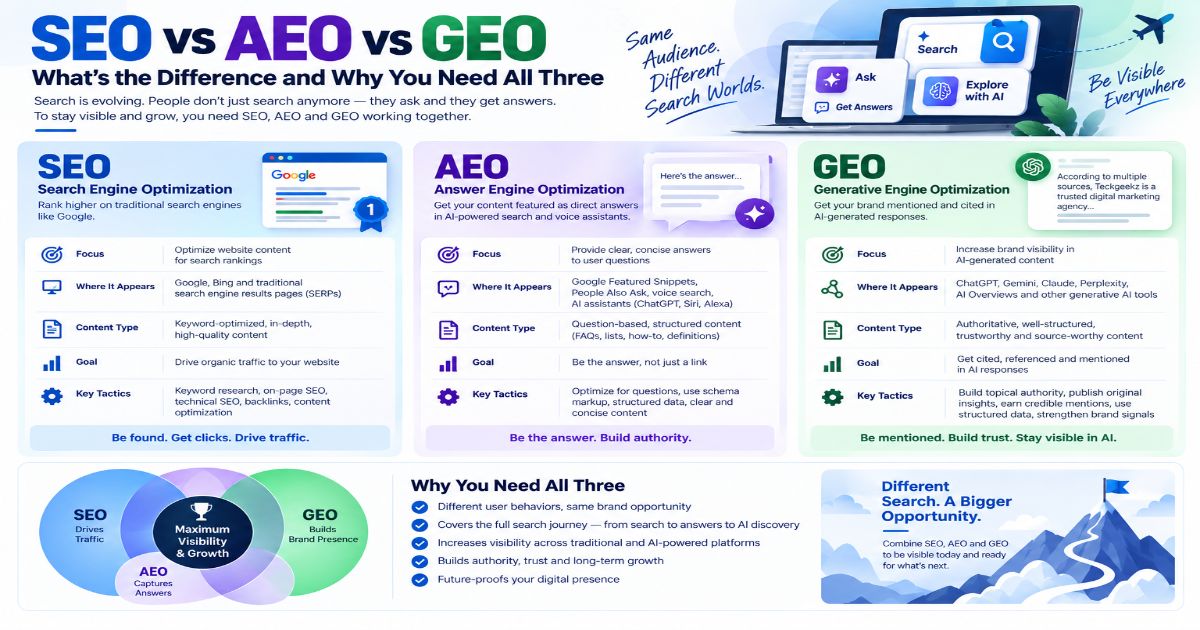
Difference between SEO AEO and GEO
What Is SEO? (Search Engine Optimization)
SEO is the practice of optimizing a website so it ranks in traditional organic search results — the ten blue links Google and Bing return for a given query, along with local map pack results. It remains the foundational layer everything else is built on, because AEO and GEO both depend on the same underlying signals SEO has always required: crawlability, page authority, technical health, and relevance to search intent.
The core disciplines within SEO include keyword mapping and search intent matching, Core Web Vitals and technical site health, high-authority backlink acquisition, and organic click-through rate optimization through metadata and title tag engineering. None of this has become obsolete with the rise of AI search — if anything, it's become more foundational, because a technically weak site that AI crawlers struggle to parse cleanly is disadvantaged at every subsequent layer, not just in traditional rankings.
Target outcome: ranking in the traditional ten blue links and local map packs for the keywords your customers actually search.
Also get detailed information on How to Excel in Local Search Ranking: A Complete In-Depth Guide
What Is AEO? (Answer Engine Optimization)
AEO is the practice of structuring content so search engines and voice assistants can extract it as a direct, standalone answer — featured snippets, the People Also Ask grid, and spoken responses from Siri, Alexa, and Google Assistant. Where SEO earns you a position on a results page, AEO earns you the answer itself, often without the user clicking through to your site at all.
This requires a genuinely different formatting discipline than traditional SEO content. Answers need to be self-contained — a paragraph, list, or table that makes complete sense extracted on its own, without requiring surrounding context to be understood. This is precisely why the "quick answer" format at the top of this guide exists: it's a direct answer to the query "what is the difference between SEO, AEO, and GEO," formatted specifically so it can be lifted whole into a snippet box or a voice response.
The core disciplines within AEO include featured snippet and position-zero formatting, systematic People Also Ask question mapping, comprehensive Schema.org JSON-LD markup (FAQ, HowTo, Speakable schemas), and concise, direct-answer phrasing calibrated for voice assistant readout — typically kept tight enough (around 25–30 words) to be spoken aloud naturally. When implementing structured data, choose the schema type that accurately describes the visible content. Speakable can be used for eligible news or content pages, but it should not be added merely to signal AEO intent.
Small Example of JSON-LD:
<script type="application/ld+json">
    {
     "@context": "https://schema.org/",
     "@type": "WebPage",
     "name": "Quick Brown Fox",
     "speakable":
     {
      "@type": "SpeakableSpecification",
      "xPath": [
        "/html/head/title",
        "/html/head/meta[@name='description']/@content"
        ]
      },
     "url": "https://www.example.com/quick-brown-fox"
     }
    </script>
Target outcome: capturing position zero, PAA boxes, and voice-assistant spoken answers — visibility that happens even when a user never clicks through to your site.
What Is GEO? (Generative Engine Optimization)
GEO is the practice of optimizing your brand's digital presence so Large Language Models — ChatGPT, Perplexity, Google AI Overviews, Claude, and Copilot — cite your business by name when synthesizing answers to user prompts. This is the newest and least understood of the three layers, and it works on fundamentally different mechanics than either SEO or AEO.
LLMs don't crawl and rank pages the way traditional search engines do. Most operate on Retrieval-Augmented Generation (RAG) pipelines — retrieving relevant information from indexed sources and knowledge bases, then synthesizing a conversational answer that may cite, paraphrase, or directly quote specific sources. What determines whether your brand gets pulled into that synthesis isn't keyword density — it's semantic factual density, information gain (do you say something genuinely new, not just repeated consensus), and entity co-occurrence — how consistently and credibly your brand name appears alongside the topic across the broader web, not just on your own site.
The core disciplines within GEO include entity knowledge graph authority (structured data and consistent brand signals that help AI systems recognize you as a distinct, credible entity), original data and proprietary insight that RAG systems prioritize over recycled content, conversational prompt alignment (structuring content to match how people actually phrase questions to AI, not just how they type into a search bar), and cross-model monitoring — tracking whether and how your brand actually gets cited across ChatGPT, Perplexity, Claude, and Google AI Overviews.
Target outcome: being the brand an AI system actually names when a user asks it for a recommendation, not just a source it silently drew from.
SEO vs AEO vs GEO: Side-by-Side Comparison
Dimension | SEO | AEO | GEO |
|---|---|---|---|
Primary target | Ranking position (10 blue links) | Direct answer extraction (snippets, PAA, voice) | Brand citation inside AI-generated answers |
Where it appears | Google/Bing search results pages | Featured snippet boxes, PAA, voice assistants | ChatGPT, Perplexity, Claude, Google AI Overviews |
Core mechanic | Crawling, indexing, backlink authority | Structured, self-contained direct-answer formatting | RAG retrieval, entity signals, information gain |
Content format | Comprehensive pages, keyword-mapped | Concise paragraphs, lists, tables, schema | Factually dense, original, entity-consistent content |
Success metric | Keyword rankings, organic traffic | Snippet captures, PAA wins, voice answer share | Citation rate, brand mentions in AI responses |
Click-through | User clicks to your site | Often zero-click (answer shown directly) | Often zero-click (answer synthesized, brand named) |
Foundational dependency | Technical SEO, Core Web Vitals | Depends on SEO foundation + schema | Depends on SEO + AEO signals + off-page entity authority |
The dependency running through the bottom row is the point most businesses miss: these are not three alternative strategies to choose between — they're layered, with each one building on the technical and content foundation the layer below it established. A site with weak technical SEO will struggle to earn AEO snippets, because the same crawlability and page-quality signals underpin both. A brand with no consistent entity signals or Digital PR footprint will struggle to earn GEO citations, regardless of how well-structured its on-page content is, because LLMs weigh external validation heavily.
How the Three Layers Work Together in Practice
A useful way to see the relationship: SEO gets your content discovered and crawled reliably. AEO takes well-optimized SEO content and reformats specific sections of it to be directly extractable as answers. GEO takes that same content foundation and extends it outward — building the entity authority, factual density, and external validation that determine whether an AI system trusts your brand enough to name it in a synthesized response.
In practice, this means a single well-built page can serve all three layers simultaneously — comprehensive enough to rank for its target keywords (SEO), structured with clear direct-answer sections and proper schema markup (AEO), and backed by original data, clear entity signals, and genuine expertise that makes it a credible source for an LLM to cite (GEO). This is exactly the kind of unified approach we build through our full SEO, AEO & GEO services, treating all three as one connected discipline rather than three separate projects with three separate content strategies.
Schema markup supports interpretation and eligibility for certain search features, but it does not guarantee inclusion.
SEO, AEO & GEO for Travel Agencies and OTAs
Travel search behavior splits across these three layers in ways that are worth understanding specifically, because the query patterns differ meaningfully from generic informational searches.
SEO for travel still means ranking for the transactional and comparison searches that drive bookings — "flights to [destination]," "best hotels in [city]," "[destination] holiday packages." This is the layer our programmatic SEO work generating destination and package pages at scale is built around, since content depth and breadth at this scale is exactly what SEO rewards.
AEO for travel captures a different, earlier-stage query pattern — "best time to visit [destination]," "how many days do you need in [destination]," "is [destination] worth visiting in [month]." These are exactly the direct-answer, snippet-friendly questions a well-structured destination guide should be formatted to capture, and they frequently appear well before a traveller is ready to search transactionally.
GEO for travel is becoming genuinely significant faster than most travel businesses have registered. A growing number of travellers now ask ChatGPT or Perplexity directly to plan a trip — "plan me a 5-day itinerary for [destination]," "what's a good family-friendly resort near [destination] under $200/night." When an AI system answers this conversationally, it's citing specific sources for those recommendations — and a travel agency or OTA with strong entity signals, structured destination content, and genuine original trip-planning expertise is positioned to be that cited source. A business with thin, templated destination pages is not.
The businesses best positioned to win across all three layers are the ones whose underlying content architecture supports it — which is precisely why our travel website development and the destination-page architecture behind it matter as much to AEO and GEO performance as they do to traditional SEO. A slow, poorly structured travel site — the kind of legacy WordPress setup we cover in our guide to migrating travel websites to Next.js — is disadvantaged at every one of these three layers simultaneously, not just in traditional rankings.
Common Mistakes When Approaching SEO, AEO & GEO
Treating GEO as a replacement for SEO rather than an extension of it. Some businesses, alarmed by AI Overviews reducing click-through rates, conclude traditional SEO no longer matters. It remains the foundation every other layer depends on — abandoning it doesn't solve the zero-click problem, it just removes the technical and content base GEO needs to function.
Chasing AEO snippets with thin, keyword-stuffed answers. A direct answer formatted for extraction still needs to be genuinely accurate and useful — a snippet capture that gives a user a poor or misleading answer damages trust the moment they click through to verify it, and search engines increasingly penalize this pattern over time.
Ignoring off-page entity signals while over-investing in on-page GEO tactics. GEO is disproportionately influenced by how your brand is referenced across the broader web — Digital PR, editorial mentions, and consistent entity signals — not just how well-structured your own site's content is. A business optimizing only its own pages while ignoring external brand authority is optimizing half the equation.
Assuming GEO results are measurable the same way SEO results are. Traditional rank tracking tools don't capture AI citation rates. Businesses need genuine cross-model monitoring — checking how and whether they actually get cited across ChatGPT, Perplexity, Claude, and Google AI Overviews — to know if GEO efforts are working at all.
"The businesses getting this wrong aren't ignoring AI search — most of them know it matters now. What they're getting wrong is treating it as a separate project from their existing SEO work, run by a different team with a different content strategy. It isn't separate. It's the same foundation, extended outward. Fix your technical SEO, structure your content for direct answers, and build genuine entity authority off-site — and you're not doing three things, you're doing one thing well, at three depths."
— Jeffrey Mathew, Founder & CEO, Teckgeekz
Frequently Asked Questions
What is the difference between SEO, AEO, and GEO?
SEO (Search Engine Optimization) optimizes a website to rank in traditional organic search results — the ten blue links on Google and Bing. AEO (Answer Engine Optimization) structures content to capture position zero, featured snippets, People Also Ask boxes, and direct voice assistant answers. GEO (Generative Engine Optimization) optimizes a brand's digital presence and entity authority so Large Language Models like ChatGPT, Perplexity, Google AI Overviews, and Claude cite that business as a definitive source when generating answers. In short: SEO wins rankings, AEO wins position zero, and GEO wins AI recommendations.
Do I need to choose between SEO, AEO, and GEO, or invest in all three?
All three, because they're layered rather than competing. AEO and GEO both depend on the technical and content foundation SEO establishes — a site with weak crawlability or thin content will struggle to earn AEO snippets or GEO citations regardless of how well those specific tactics are executed. Businesses that invest in only one layer are typically visible to a shrinking share of how people actually search today.
How is GEO different from traditional SEO ranking factors?
Traditional SEO ranking depends heavily on keyword relevance, backlink authority, and technical crawlability evaluated by search engine algorithms. GEO depends on how Large Language Models' retrieval systems evaluate content — factors like semantic factual density, information gain (original insight versus recycled consensus), and entity co-occurrence across the broader web, not just your own site. A page can rank well in traditional SEO while still being overlooked by an LLM's retrieval pipeline if it lacks the factual density or external validation GEO specifically rewards.
Can a small or mid-sized business compete for AI citations against larger competitors?
Yes, more realistically than in traditional SEO in some respects, because GEO rewards genuine information gain and original expertise over sheer domain authority or backlink volume. A smaller business publishing genuinely original data, detailed first-hand expertise, or a distinctive point of view can be cited by an LLM over a larger competitor whose content is comprehensive but generic. This is a meaningfully different competitive dynamic than traditional SEO, where domain authority accumulated over years is harder for smaller businesses to overcome directly.
How do travel agencies and OTAs specifically benefit from AEO and GEO?
Travel search increasingly happens across all three layers simultaneously — transactional SEO searches for bookings, AEO-friendly informational questions like "best time to visit," and a growing volume of conversational GEO queries where travellers ask AI tools directly to plan or recommend trips. A travel business with strong, structured destination content and genuine entity authority is positioned to be the cited source across all three; one relying on thin, templated content is increasingly invisible at the AEO and GEO layers even if its traditional SEO still performs adequately.
How long does it take to see results from AEO and GEO efforts?
AEO results, particularly featured snippet captures, can appear faster than traditional SEO ranking improvements because they depend more on content structure than accumulated domain authority — often within weeks of properly reformatting existing high-quality content. GEO results are typically slower to measure and stabilize, since they depend on both on-page factors and off-page entity signals (like Digital PR) building up over time, and cross-model citation tracking is still a newer, less standardized measurement practice than traditional rank tracking.
Key Takeaways
SEO, AEO, and GEO are layered, not competing — SEO establishes the technical and content foundation, AEO extracts direct answers from that foundation, and GEO extends brand authority outward so AI systems cite the business by name.
AEO succeeds through structure: self-contained, extractable answers, proper schema markup, and concise phrasing calibrated for both snippet boxes and voice assistant readout — exactly the format this guide has used throughout.
GEO succeeds through a combination of on-page factual density and off-page entity authority — a strong content foundation alone is not sufficient without the external validation, particularly Digital PR and consistent brand signals, that LLM retrieval systems weigh heavily.
Travel businesses face a genuinely distinct version of this challenge — transactional SEO queries, informational AEO questions, and an accelerating volume of conversational GEO trip-planning prompts — and the businesses positioned to win across all three are the ones whose underlying content and site architecture already support it.
Measuring success requires different tools at each layer — traditional rank tracking for SEO, snippet and PAA monitoring for AEO, and genuine cross-model citation tracking for GEO, since these are not interchangeable metrics.
How Teckgeekz Builds Unified SEO, AEO & GEO Strategy
Every engagement we run treats these three layers as one connected discipline, not three separate deliverables — because that's genuinely how the underlying mechanics work, as this guide has covered throughout. Our full SEO, AEO & GEO services cover the complete stack: technical SEO and Core Web Vitals engineering, semantic content structured for direct-answer extraction, comprehensive schema implementation, entity knowledge graph authority, and the Digital PR work that builds the off-page trust signals GEO depends on.
For travel businesses specifically, this connects directly into the platform and content architecture work covered across our travel website development, because a business's AEO and GEO performance is inseparable from the speed, structure, and content scalability of the platform it's built on. If your travel business is optimized for traditional search but invisible in AI Overviews and LLM responses, that gap is the starting point for the conversation.
Sources : Statistics
In this Series — SEO, AEO & GEO:
SEO vs AEO vs GEO: What's the Difference and Why You Need All Three
How to Optimize Content for Google AI Overviews: A Practical Guide
How to Get Cited by ChatGPT, Perplexity, and Claude: A Guide to LLM Citation Optimization
Schema Markup for AEO & GEO: The Complete JSON-LD Implementation Guide
Digital PR for AI Search: How Brand Mentions Build LLM Trust and Citations


Jeffrey Mathew
Founder & CEO • Travel Marketing Specialist
"With over 14 years of dominance in the travel and tech sectors, Jeffrey Mathew has engineered growth for hundreds of OTAs and airlines worldwide. He specializes in the intersection of Performance PPC and Agentic AI, building high-performance digital ecosystems for modern brands."
Start a Conversation
Ready to Elevate Your Business?
Fill out the form below and let's discuss how Teckgeekz can help you reach your goals.
Describe your project to unlock real-time AI service recommendations and matching portfolio cases.
Our Trusted Partners