How to Optimize Content for Google AI Overviews: A Practical Guide

Quick answer: Optimizing for Google AI Overviews means structuring content with clear, self-contained direct answers near the top of the page, backing those answers with credible data and original insight, using comprehensive schema markup, and maintaining strong technical SEO — because Google's AI Overviews pull primarily from pages that already rank well organically and can be cleanly parsed for a summarizable answer. There's no separate "AI Overview SEO" checklist distinct from strong AEO practice; it's the same discipline applied with Google's specific summarization behavior in mind.
If that sounds similar to how we defined AEO in our guide to SEO vs AEO vs GEO, that's because AI Overviews are Google's specific implementation of the AEO layer — the same underlying formatting and structuring principles apply, with a few Google-specific behaviors worth understanding in detail.
What Are Google AI Overviews, and Why They Changed Search
Google AI Overviews are AI-generated summaries that appear at the top of search results for a growing share of queries, synthesizing information from multiple sources into a single conversational answer, with citations linking out to the pages it drew from. Over 40% of Google queries now trigger an AI Overview, and that share continues climbing across most commercial and informational query categories.
This matters because an AI Overview occupies the space above the traditional ten blue links — meaning a page that ranks well organically but doesn't get pulled into the Overview can still see reduced click-through, because a meaningful share of users get their answer from the summary and never scroll further. Conversely, a page that does get cited inside the Overview earns visibility and click-through even from users who never would have scrolled to a lower organic position.
The practical implication: ranking well organically remains necessary — Google AI Overviews draw predominantly from pages already ranking on page one — but it's no longer sufficient on its own. A second layer of optimization, specific to how content gets pulled into and cited within the Overview itself, now determines whether that ranking actually translates into visibility.
How Google AI Overviews Actually Select and Summarize Content
Understanding the mechanics behind AI Overviews clarifies why some well-ranking pages get pulled in consistently while others, ranking similarly well, rarely appear.
Google's AI Overview system draws from a retrieval process closely tied to its existing organic ranking signals — it isn't pulling from a separate index, it's synthesizing an answer primarily from content already earning strong organic relevance for that query. From that eligible pool, the system favours content that answers the query directly and completely within a self-contained section, rather than requiring the reader to piece an answer together across a full article. It favours pages with clear structural signals — proper heading hierarchy, well-formatted lists and tables, and schema markup that makes the page's structure machine-parseable — because these reduce the ambiguity in extracting a clean summary. And it favours content carrying genuine specificity — concrete numbers, named entities, clear comparisons — over vague, generalized statements that are harder to summarize confidently and authoritatively.
This is why two pages can rank in similar organic positions for the same query, yet only one consistently appears inside the AI Overview — the ranking signal gets both pages into the eligible pool, but the structural and content-quality signals covered throughout this guide determine which one actually gets selected and cited.
The Content Structure That Wins AI Overview Citations
Lead With a Direct, Self-Contained Answer
The single highest-leverage structural change most pages need is placing a clear, complete answer to the target query within the first 100–150 words — not buried after several paragraphs of introduction. This answer should make sense read entirely on its own, without requiring the surrounding paragraphs for context, because that's effectively how Google's summarization system treats it: as an extractable unit.
This is precisely the format used at the top of this guide, and at the top of our SEO vs AEO vs GEO comparison — a direct "quick answer" block immediately following the title, written to be lifted whole into a summary without losing meaning.
Use Structural Formatting Deliberately, Not Decoratively
Lists, tables, and clear subheadings aren't stylistic choices at this point — they're machine-readability signals. A comparison between two options formatted as a table is dramatically easier for an AI Overview to extract accurately than the same comparison written as a paragraph, because the table's structure removes the ambiguity of which attribute belongs to which option. Numbered steps for a process, bulleted lists for discrete items, and tables for any genuine comparison should be the default formatting choice whenever the underlying content actually fits that shape — forcing content into these formats where it doesn't fit is counterproductive, but avoiding them where it clearly does fit leaves an easy structural win unclaimed.
Answer the Full Question Cluster, Not Just the Primary Query
AI Overviews frequently synthesize an answer that addresses several related sub-questions within a single summary — not just the exact phrase typed into the search box. A page targeting "best time to visit Bali" that also clearly answers "what's the rainy season," "which months are cheapest," and "is it crowded during peak season" within well-structured subsections is providing exactly the kind of comprehensive, multi-angle coverage an AI Overview draws from when constructing a fuller answer, rather than a single-fact snippet.
Content Quality Signals That Matter Specifically for AI Overviews
Specificity over generality. "Bali has a dry season and a wet season" is far weaker AI Overview material than "Bali's dry season runs April through October, with July and August seeing the least rainfall and the highest tourist volume." Concrete, checkable specifics are what a summarization system treats as confidently citable.
Original data and genuine expertise. Content that simply restates widely available consensus is easily replaceable in an AI Overview's eyes — if ten sources say the same generic thing, none of them is a uniquely necessary citation. Content offering something genuinely original — proprietary data, first-hand experience, a specific case study — is harder to substitute and more likely to earn the citation specifically.
Currency and accuracy. AI Overviews are particularly sensitive to outdated information, because presenting stale facts confidently is a visible, embarrassing failure mode Google actively works to avoid. Content with clear, visible freshness signals — recent dates, updated statistics, current pricing where relevant — is favoured over content that reads as potentially stale, even when the underlying facts haven't actually changed.
Balanced, non-promotional framing. Content that reads as an honest, informative answer rather than a sales pitch is more likely to be summarized and cited than content that's structured primarily to persuade. This doesn't mean commercial content can't earn AI Overview citations — it means the informational sections of commercial content need to genuinely prioritize answering the question over selling, with the commercial framing kept separate rather than woven through the answer itself.
Technical and Schema Requirements
AI Overviews depend on Google being able to crawl, render, and parse a page cleanly — the same technical SEO foundation that underpins traditional rankings and AEO snippet capture generally.
FAQ schema, HowTo schema, and clear article structuring via schema.org markup give Google explicit, machine-readable confirmation of what a page's content actually contains and how it's organized, reducing the ambiguity the summarization system otherwise has to resolve through content parsing alone. Fast, clean rendering matters specifically because Google's AI systems, like its traditional crawlers, have finite processing resources per page — a slow-loading or JavaScript-heavy page that takes longer to render fully is disadvantaged in exactly the same way it would be for traditional indexing, compounded by the additional processing an AI summarization pass requires.
Example Schema for Destinations(Place):
<script type="application/ld+json">
{
  "@context": "https://schema.org",
  "@type": "Place",
  "name": "Bologna, Italy",
  "description": "Historic city in Northern Italy known for its medieval architecture, cuisine, and cultural heritage.",
  "geo": {
    "@type": "GeoCoordinates",
    "latitude": "44.4949",
    "longitude": "11.3426"
  },
  "address": {
    "@type": "PostalAddress",
    "addressLocality": "Bologna",
    "addressCountry": "Italy"
  },
  "image": "https://example.com/images/bologna.jpg",
  "url": "https://example.com/destinations/bologna"
}
</script>
Example Schema for Holiday Package:
<script type="application/ld+json">
{
  "@context": "https://schema.org",
  "@type": "Offer",
  "name": "OTA - Bologna City Break Package",
  "description": "3-night Bologna city break including flights, hotel stay, and guided food tour.",
  "url": "https://example.com/packages/bologna-city-break",
  "priceCurrency": "EUR",
  "price": "499.00",
  "availability": "https://schema.org/InStock",
  "validFrom": "2026-09-01",
  "validThrough": "2026-12-31",
  "itemOffered": {
    "@type": "TouristTrip",
    "name": "Bologna City Break",
    "description": "Explore Bologna’s medieval architecture, authentic cuisine, and cultural heritage.",
    "touristType": "Couples, Food Lovers, Cultural Travelers",
    "itinerary": [
      {
        "@type": "TouristAttraction",
        "name": "Piazza Maggiore",
        "description": "Historic central square with Basilica of San Petronio."
      },
      {
        "@type": "TouristAttraction",
        "name": "Quadrilatero Market",
        "description": "Traditional food market showcasing Bologna’s culinary heritage."
      }
    ],
    "offers": {
      "@type": "Offer",
      "priceCurrency": "EUR",
      "price": "499.00",
      "availability": "https://schema.org/InStock"
    }
  },
  "provider": {
    "@type": "Organization",
    "name": "Travel Agency Name",
    "url": "https://example.com",
    "logo": "https://example.com/logo.png"
  }
}
</script>
This technical foundation is precisely why platform architecture matters as much to AI Overview performance as it does to conversion or traditional rankings — a page built on the kind of fast, cleanly-rendered architecture covered in our guide to migrating travel websites to Next.js starts from a structural advantage that a slow, plugin-heavy legacy site simply doesn't have, regardless of how well the content itself is written.
What to Avoid: Common AI Overview Optimization Mistakes
Burying the answer under lengthy preamble. A page that spends 400 words on introduction and backstory before actually answering the query is asking the summarization system to do extraction work it may simply skip in favour of a competitor page that answers immediately.
Formatting content as structure without matching structure to content. Wrapping a genuinely narrative or nuanced answer into an artificial bulleted list, purely because lists are "AEO-friendly," produces choppy, poorly reasoned content that both readers and AI summarization systems recognize as low quality — structure should follow what the content actually is, not be imposed regardless of fit.
Optimizing a single page while ignoring the broader site's authority. AI Overviews draw predominantly from pages that are already ranking well organically — a page with excellent AEO formatting sitting on a site with weak overall domain authority and technical health is still working from a significantly weaker starting position than the same content on a well-established, technically sound site.
Treating AI Overview optimization as separate from ongoing content maintenance. Because currency is a real signal, content that wins an AI Overview citation today can lose it months later if it isn't kept updated — this needs to be treated as an ongoing content discipline, not a one-time formatting pass.
Google AI Overviews for Travel Agencies and OTAs
Travel queries are disproportionately represented in Google AI Overview coverage, because so much travel search is genuinely informational before it becomes transactional — exactly the query pattern AI Overviews are built to summarize.
Destination and trip-planning queries — "best time to visit [destination]," "how many days do you need in [destination]," "what to pack for [destination] in [month]" — are consistently triggering AI Overviews, which means a travel business's destination guide content is competing directly for this visibility layer, not just for traditional organic rankings. A destination guide structured with clear, self-contained answers to these specific sub-questions — formatted as the direct-answer blocks and tables covered throughout this guide — is positioned to win these citations; a destination guide written as flowing narrative travel writing, however well-crafted, is much harder for an AI Overview to extract cleanly.
This is where content depth and structure genuinely compound. A travel business generating destination content at the scale covered in our guide to building 50+ programmatically generated city pages that actually rank has a structural advantage here specifically — a properly templated, structured destination page format makes it far easier to consistently apply the direct-answer, question-cluster formatting AI Overviews reward across dozens or hundreds of destinations, compared to manually formatting each destination page individually and inconsistently.
Comparison-heavy travel queries also deserve specific attention — "[Destination A] vs [Destination B] for families," "Hotelbeds vs booking direct," "is [package] worth it" — these are exactly the table-friendly comparison formats AI Overviews favour, and a travel platform's package and hotel content, as covered in our guide to multi-supplier hotel booking engine integration, generates precisely this kind of structured comparison data as a natural byproduct of how the platform itself is architected.
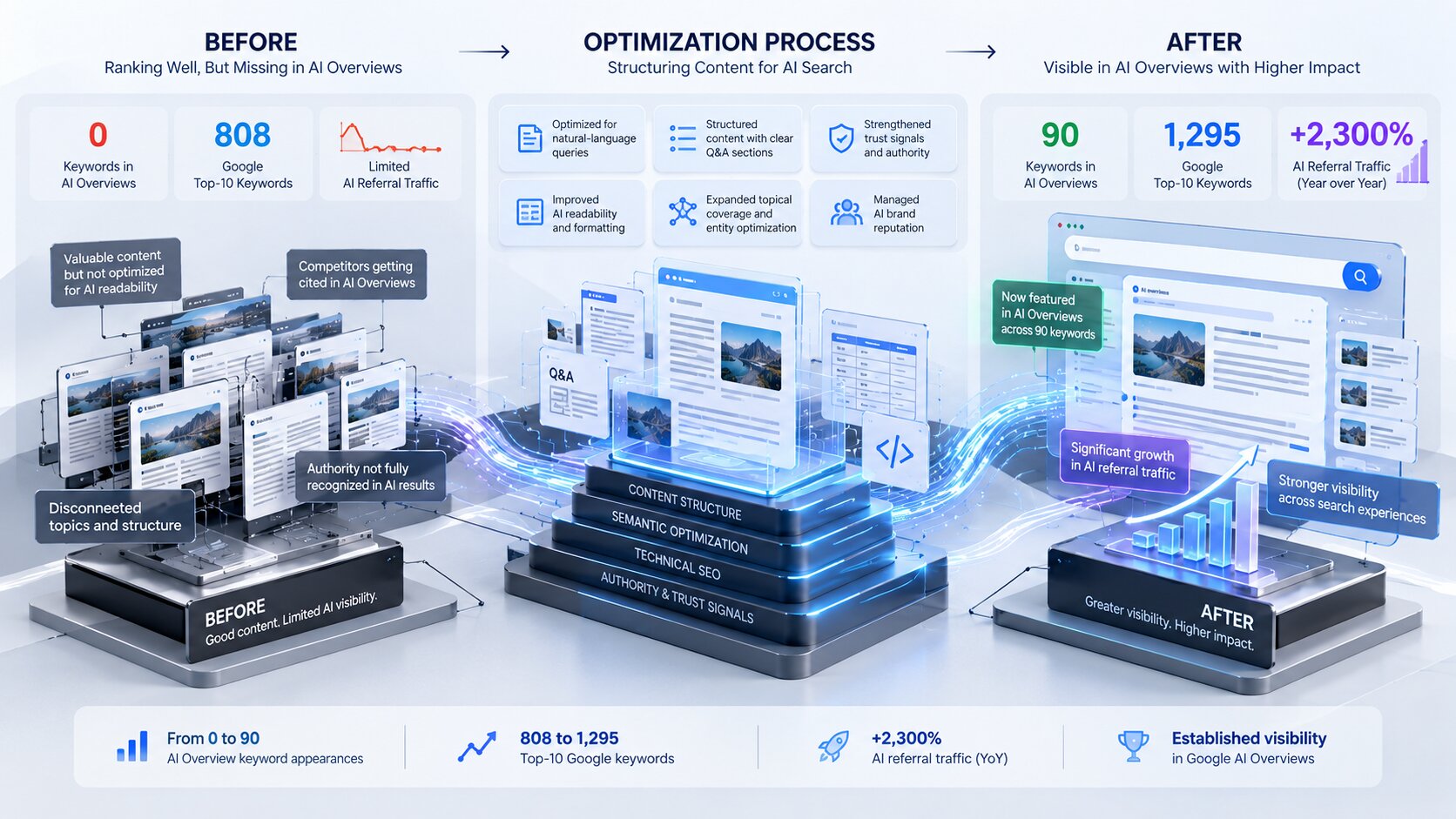
From 0 to 90 AI Overview keywords: how structured, authoritative content improved search visibility
Frequently Asked Questions
How do I get my content to appear in Google AI Overviews?
Structure content with a clear, self-contained direct answer to the target query within the first 100–150 words, use deliberate structural formatting — lists, tables, clear headings — where the content genuinely fits that shape, include comprehensive schema markup, and ensure the underlying page already ranks reasonably well organically, since AI Overviews draw predominantly from pages already earning strong organic relevance for that query.
Do AI Overviews only pull from pages that rank #1?
No, but they draw predominantly from the pool of pages ranking well on page one — typically the top several organic positions, not exclusively position one. Within that eligible pool, structural clarity, content specificity, and schema markup determine which page actually gets selected and cited, meaning a page ranking third or fourth with excellent AEO formatting can outperform a page ranking first with poor structure.
Will optimizing for AI Overviews hurt my traditional SEO rankings?
No — the practices that improve AI Overview citation likelihood (clear structure, specific and accurate content, strong schema markup, fast technical performance) are the same practices that support strong traditional rankings. There's no meaningful trade-off between the two; AI Overview optimization is an extension of good SEO and AEO practice, not a competing discipline.
How is optimizing for Google AI Overviews different from general AEO?
It isn't fundamentally different — AI Overviews are Google's specific implementation of the answer engine layer, so general AEO practice (self-contained direct answers, structural formatting, schema markup) applies directly. The Google-specific consideration is that AI Overviews draw heavily from existing organic ranking signals, meaning strong traditional SEO is a more direct prerequisite for AI Overview visibility than it necessarily is for winning a featured snippet, which can sometimes be captured by pages outside the very top organic positions.
Can e-commerce or travel booking pages appear in AI Overviews, or only informational content?
Both, though the query types differ. Purely transactional queries ("book flight to [destination]") are less likely to trigger an AI Overview at all, since the user intent is clearly navigational rather than informational. But the informational and comparison queries that surround a purchase decision — "best time to visit," "is [destination] worth it," "[option A] vs [option B]" — trigger AI Overviews frequently, and commercial travel content that answers these questions well, honestly, and with clear structure competes directly for this visibility alongside purely editorial content.
How often do I need to update content to maintain an AI Overview citation?
There's no fixed schedule, but content with time-sensitive facts — seasonal information, pricing, availability, statistics — should be reviewed and refreshed regularly, since currency is a real signal AI Overviews weigh, and stale information visible on a page can cause a previously-cited page to lose that citation over time even without any change in how the page is structured.
Key Takeaways
Google AI Overviews are Google's specific implementation of the AEO layer, drawing predominantly from pages that already rank well organically — meaning strong traditional SEO remains a prerequisite, not a replacement, for AI Overview visibility.
The highest-leverage structural change most pages need is placing a direct, self-contained answer within the first 100–150 words, formatted so it makes sense extracted entirely on its own.
Deliberate structural formatting — lists, tables, clear headings — should match what the content actually is, applied where genuinely appropriate rather than forced onto content that doesn't fit that shape.
Specificity, original data, and content currency are content-quality signals AI Overviews weigh particularly heavily, favouring concrete, checkable, up-to-date information over generic or potentially stale statements.
Travel businesses face a particularly strong opportunity here, since so much travel search is genuinely informational — destination guides and comparison content structured with the direct-answer, question-cluster formatting covered in this guide are well-positioned to capture this layer of search visibility.
How Teckgeekz Optimizes Content for Google AI Overviews
Every content strategy we build treats AI Overview visibility as a structural discipline applied from the outset, not a formatting pass applied after content is written — because, as this guide has covered throughout, the strongest AI Overview performance comes from content genuinely structured around direct, specific, well-organized answers, not content retrofitted with bullet points after the fact.
This is one layer within our full SEO, AEO & GEO services, where AI Overview optimization sits alongside the broader technical SEO, schema implementation, and entity authority work covered across this content series. For travel businesses specifically, this connects directly into how we structure destination and package content at scale — the same programmatic content architecture that supports traditional organic rankings is exactly what makes consistent, scalable AI Overview optimization possible across dozens or hundreds of pages, rather than a manual effort applied inconsistently page by page.
In this Series — SEO, AEO & GEO:
SEO vs AEO vs GEO: What's the Difference and Why You Need All Three
How to Optimize Content for Google AI Overviews: A Practical Guide
How to Get Cited by ChatGPT, Perplexity, and Claude: A Guide to LLM Citation Optimization
Schema Markup for AEO & GEO: The Complete JSON-LD Implementation Guide
Digital PR for AI Search: How Brand Mentions Build LLM Trust and Citations


Jeffrey Mathew
Founder & CEO • Travel Marketing Specialist
"With over 14 years of dominance in the travel and tech sectors, Jeffrey Mathew has engineered growth for hundreds of OTAs and airlines worldwide. He specializes in the intersection of Performance PPC and Agentic AI, building high-performance digital ecosystems for modern brands."
Start a Conversation
Ready to Elevate Your Business?
Fill out the form below and let's discuss how Teckgeekz can help you reach your goals.
Describe your project to unlock real-time AI service recommendations and matching portfolio cases.
Our Trusted Partners