Digital PR for AI Search: How Brand Mentions Build LLM Trust and Citations

Quick answer: Digital PR matters for AI search because AI systems don't take a brand's word for itself. They look for corroboration: who else is describing this company, in what context, and how consistently. Editorial coverage, expert commentary, reviews, and industry mentions on credible third-party sites give AI systems independent evidence that a brand is real, relevant, and worth naming. The channel you earn those mentions on matters as much as the mentions themselves, because a mention on a site AI platforms rarely cite in your category does far less than a mention on one they cite constantly. No one outside the AI labs knows the exact weightings, so treat this as informed practice, not guaranteed mechanics.
This is the off-page layer of the framework we've built across this series. Our guide to SEO vs AEO vs GEO introduced entity authority as the foundation GEO depends on. The guide to getting cited by ChatGPT, Perplexity, and Claude explained why external validation carries so much weight. The schema markup implementation guide covered how to declare your entity clearly on your own site. This post covers the part you can't control from your own site at all: what the rest of the web says about you, and how to influence it legitimately.
Why AI Systems Trust What Others Say About You More Than What You Say About Yourself
A company's own website is the least independent source of information about that company. Every claim on it, whether "market leader," "trusted by hundreds of clients," or "industry-leading platform," is self-reported. A retrieval system deciding which brand to name in a recommendation has no way to verify any of it from that page alone.
What it can do is look for the same claims, or consistent descriptions of the same entity, in sources that have no stake in promoting you: a trade publication that quoted your founder, a review platform where customers describe their experience, an industry body that lists you as a member, a journalist who cited your data. When independent sources agree with what a brand says about itself, confidence in the brand rises. When independent sources are silent, the brand's claims stay unverified, however well the site is written.
This is why two businesses with comparably strong websites can be treated very differently in AI-generated recommendations. The difference is often not the quality of their own content but the presence or absence of a corroborating footprint elsewhere.
There is a second reason. An AI system's understanding of "what is this company and what is it known for" is assembled from text across the web, not from any single page. If the only text associating your brand with a topic lives on your own domain, the association is thin. If dozens of independent sources place your brand name next to the same topic, the association is strong and specific.
How Brand Mentions Actually Reach an AI Answer
Third-party mentions can influence what an AI system says about a brand through two distinct routes, and it helps to keep them separate.
Through training data. Models learn associations, such as which companies are linked to which topics, from the text they were trained on. Mentions published before a model's training cutoff can shape those associations, but the effect is slow, indirect, and outside your control. It updates only when new models are released. You can't optimise for it precisely, but a sustained, consistent presence over time contributes to it.
Through live retrieval. Many AI answers, including Perplexity's by design, ChatGPT's when browsing is triggered, Google's AI Overviews, and Claude when search is enabled, are built by retrieving current web pages and synthesizing them. Here, third-party pages become candidate sources directly. For recommendation and comparison prompts ("best X for Y," "who should I use for Z"), retrieval often surfaces roundups, reviews, and editorial coverage, not brand homepages. If your brand appears on those pages, you're in the candidate pool. If it doesn't, you can't be named from them.
Retrieval is the more actionable route for most businesses, because the results appear within weeks or months instead of waiting on a model release cycle. It's also why choosing where to earn mentions matters so much: retrieval only helps if the page carrying your mention is one the system actually pulls for the prompts your buyers ask.
What Makes a Mention Valuable
Not all mentions contribute equally. These are the characteristics that, in our experience and consistent with how retrieval systems work, separate valuable mentions from noise:
Topical relevance. A mention in a publication covering your industry, next to language about the topics you want to be known for, builds a specific association. A mention in a general-interest outlet with no topical connection builds a weaker one.
Source credibility. Editorial independence, a track record, and real readership all matter. AI platforms tend to lean on sources that are themselves widely referenced and trusted.
Co-occurrence. The brand name appearing near the relevant topic terms, and near descriptive language about what the brand does, is what teaches a system that the two belong together. "Example Travel Tech, which builds flight API integrations for online travel agencies" is more useful than a passing name-drop in a list.
Specificity of the claim. A mention that says something concrete about you (a result, a capability, an original finding) is more useful than a generic reference. It also gives a retrieval system something specific to attribute.
Sentiment. Mentions aren't uniformly positive, and AI-generated summaries can reflect prevailing sentiment about a brand, including complaints. Reputation management is part of PR for AI search, not separate from it.
Recency. For prompts where currency matters, fresh coverage is favored over old coverage, for the same reason freshness matters in Google AI Overviews.
Consistency. The more consistently independent sources describe your business in similar terms, the more confidently a system can resolve them as the same entity.
On links: a backlink still carries traditional SEO value and drives referral traffic, and a linked mention on a credible site is the ideal outcome. But an unlinked brand mention in a credible context can still contribute to entity association. Pursue both, and don't discard a strong editorial mention just because it isn't linked.
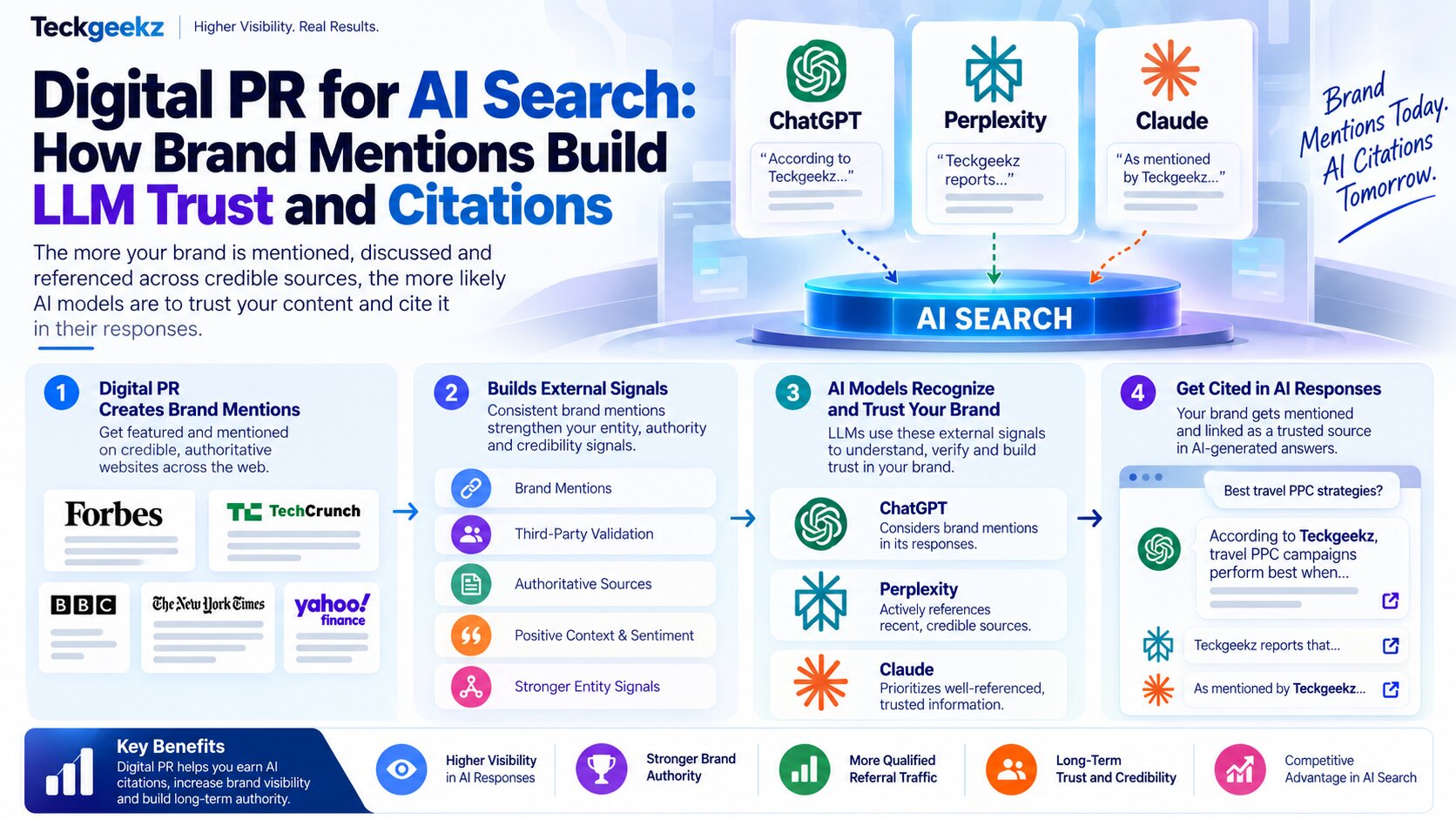
Digital PR builds brand trust and AI citations.
Choosing the Right Channel: The Decision That Determines Whether PR Works
Most Digital PR programmes fail to move AI visibility for one of two reasons. Either they generate few mentions, or they generate many mentions on channels that AI platforms rarely draw from for the prompts that matter. The second failure is more common, and it's harder to see, because a wall of coverage links can look like success in a monthly report.
Channel selection should follow five principles.
1. Relevance beats prestige. A mention in a large general-interest publication is impressive, but if that publication has no topical connection to your field, it contributes little to the association you're trying to build. A mention in a trade publication read and cited within your niche often does more.
2. Choose channels AI platforms actually cite in your category. Don't guess which sources matter. Measure them, using the citation source audit described below.
3. Match the channel to the type of prompt you want to win. Recommendation prompts ("best X") draw heavily on reviews, roundups, and comparison content. Educational prompts ("how does X work") draw on trade publications, documentation, and encyclopedic sources. "Who" prompts (who is an expert in X) draw on expert commentary, conference and podcast appearances, and bylined articles.
4. Favor durable, accessible, indexable pages. Coverage that sits behind a hard paywall, or lives in formats a retrieval system may not be able to read, is less likely to be usable as a source. Openly accessible, indexable pages are safer.
5. Protect editorial integrity. Paid placements should be clearly disclosed and, where they include links, marked appropriately (rel="sponsored" or nofollow, per Google's link guidelines). Link schemes, undisclosed sponsored posts, and low-quality networks are a liability, not an asset. They risk traditional search penalties and add nothing that a system built to weigh independent credibility would trust.
Channel Selection Matrix
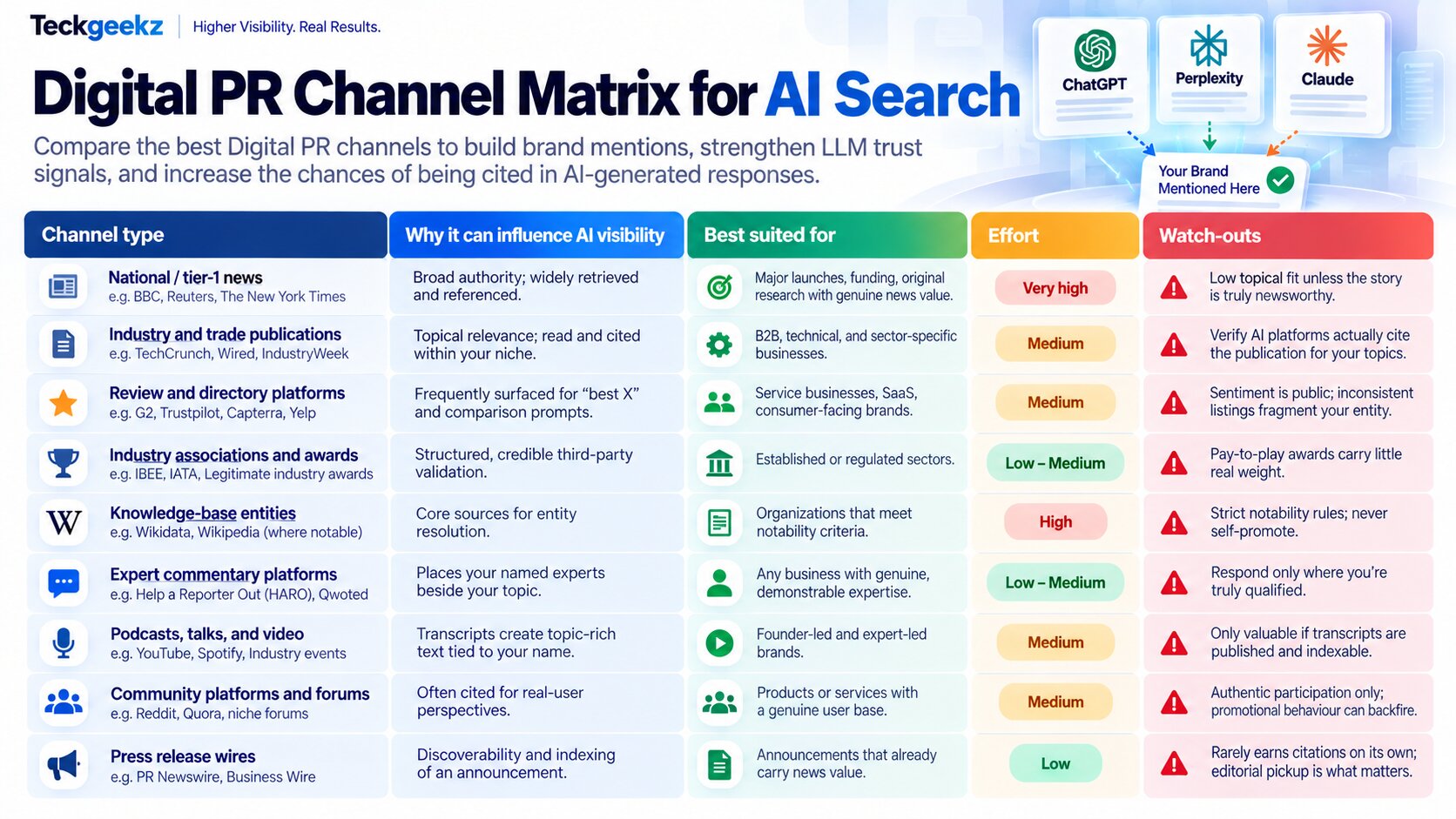
Digital PR channels compared by AI visibility, effort, and potential risks.
The Citation Source Audit: How to Find Your Channels
Rather than assuming which channels matter, measure them. This is the most useful and most under-used exercise in AI-era PR.
Build a prompt set. Write 20 to 40 prompts your buyers would genuinely ask an AI system: recommendation prompts, comparison prompts, "how do I" prompts, and "who provides" prompts in your category.
Run them across platforms. Test in Perplexity (which displays sources transparently), ChatGPT with search, Google AI Overviews, and Claude with search enabled.
Log every source. Record each domain that's cited or named in the answers, and note whether your brand and your competitors appear.
Cluster by type. Group the domains: trade press, review platforms, community sites, encyclopedic sources, competitor blogs.
Rank by frequency. The domains that appear repeatedly across prompts are your priority channels.
Find the gaps. Where a competitor is named on a source you're absent from, that's a concrete, high-value target.
This turns channel selection from opinion into evidence, and it keeps effort concentrated where the payoff exists. A domain authority score tells you how a site performs in traditional search. A citation audit tells you whether AI platforms actually draw from it for your topic.
Where PR Effort Is Commonly Wasted
Volume-based link building on sites with no editorial standards or topical connection to your field
Press release distribution used as the entire strategy, with no editorial pickup
Pursuing prestige outlets for stories that aren't genuinely newsworthy, then giving up when nothing lands
Awards and "top company" lists that anyone can buy
Treating a single one-off mention as a programme, when consistent, repeated presence is what builds association
Building PR Assets That Earn Coverage
Journalists and editors don't cover a company because it asked. They cover something useful to their audience. The strongest coverage tends to come from assets with genuine information gain, the same principle covered in our LLM citation optimization guide.
Original data and benchmarks. Aggregated, anonymized findings from your own work are the strongest asset a service business has, because no one else can publish them. Only publish figures you can stand behind and have permission to share.
Case studies with real numbers. Specific, verifiable results, published with client agreement, give journalists and comparison writers something concrete to cite. A documented before-and-after is far more quotable than a claim of "significant improvement."
A named, distinctive framework. An original way of structuring a problem, with a clear name and definition, is easy to reference and attribute.
Expert commentary tied to current events. Timely, substantive comment on developments in your industry gets your named experts quoted alongside your topic.
Free tools and calculators. Genuinely useful tools attract references and links from the sites that discuss them.
Trend and research reports. Annual or seasonal reports give editors a recurring reason to return to your data.
Each of these needs to be substantive. A mention earned by an empty announcement contributes little, whereas coverage of a real finding contributes association and credibility.
Reinforcing the Entity: Making Every Mention Count
Earned mentions are more valuable when the rest of your footprint helps AI systems tie them together as one entity.
Use a consistent brand description. Maintain one clear, factual boilerplate, a sentence or two on what you are and do, and use it wherever you control the wording: press kits, author bios, directory listings, and partner pages. Consistency across independent sources helps systems resolve them as the same entity.
Build expert profiles, not just a company profile. Named founders and specialists, with consistent bios and a clear topical focus, become the people journalists quote and AI systems associate with the field.
Keep external profiles accurate. LinkedIn, industry directories, review platforms, and partner listings should agree on the basics: name, description, location, and services.
Connect your declared identity to your real presence. The sameAs links in your Organization schema should point to genuine, consistent third-party profiles, which is where the schema markup guide and this guide meet. Schema declares the connections. Earned presence gives those connections something real to point to.
Approach Wikidata and Wikipedia carefully. These are core entity-resolution sources, but both have notability requirements and conflict-of-interest rules. A company that isn't notable by their standards shouldn't try to force an entry, and no one should write their own company's page. Where a company is genuinely notable, entries should be built on independent, published sources, not on promotional copy.
A Practical Digital PR Workflow for AI Visibility
Audit. Run the citation source audit and assess your current footprint: where you're mentioned, how, and with what sentiment.
Define the narrative. Decide the specific topics and descriptors you want your brand associated with, and keep them narrow. Association is built through consistency, not breadth.
Build the assets. Develop the data, case studies, frameworks, and expert positions that give coverage a reason to exist.
Select channels. Use the audit and the channel matrix to prioritize where your effort goes.
Pitch and place. Outreach should be relevant, specific, and useful to the editor's audience, and never a mass pitch.
Reinforce. Align boilerplate, profiles, and schema so mentions tie back to one clear entity.
Measure and iterate. Re-run the audit on a regular cadence and adjust channels accordingly.
Measuring Digital PR's Impact on AI Visibility
As with every GEO measurement, honesty about limits matters more than false precision. Attribution between a specific placement and a specific AI citation is rarely clean, and any provider promising exact, guaranteed citation lifts is overstating what can be measured today.
What's practical and useful:
Repeat citation audits on a fixed prompt set, tracking whether your brand's presence and the sources cited change over time
Share of voice across your prompt set relative to competitors
Mention monitoring for volume, source quality, and sentiment
AI-platform referral traffic in analytics, as a directional signal
Traditional PR and SEO metrics, including referral traffic, branded search growth, and backlink quality, which also benefit from the same work
Treat these as directional evidence, and expect the effect to build over months, not days.
Common Mistakes in Digital PR for AI Search
Optimizing for coverage volume instead of channel fit. A large number of mentions on channels AI platforms don't draw from is activity, not progress.
Treating PR as separate from the rest of the AI visibility programme. Off-page mentions, on-page content, and schema work reinforce each other. Run in isolation, each underperforms.
Publishing claims that can't be verified. Inflated figures or unverifiable results damage credibility with journalists and can surface as negative sentiment later.
Inconsistent brand description across sources. Different descriptions of the same company in different places make it harder for systems to treat them as one entity.
Ignoring sentiment. A brand with frequent mentions and poor reviews is teaching AI systems the wrong story about it.
Using undisclosed or manipulative tactics. Hidden paid placements and link schemes risk penalties and undermine the independence that gives coverage its value.
Expecting fast, precise attribution. Building a corroborating footprint is a compounding, months-long effort, and treating it as a one-off campaign leads to premature abandonment.
"AI systems don't take your word for it. They look for who else is saying it, and whether those people are worth believing. That's why chasing volume in PR doesn't work anymore, and why choosing the channel matters more than choosing the tactic. One well-placed piece of coverage in a publication your buyers and the AI platforms both rely on will do more than fifty mentions nobody retrieves. Find out where the answers are actually coming from, then earn your place there."
— Jeffrey Mathew, Founder & CEO, Teckgeekz
Digital PR for AI Search for Travel Agencies and OTAs
Travel is one of the categories where AI-assisted research is growing fastest, and one where third-party sources carry particular weight. Travelers ask AI tools for recommendations and comparisons precisely because they want independent judgment, so prompts like "best family resort in [destination]" or "which OTA is best for multi-city flights" tend to pull from reviews, editorial roundups, and travel media before they pull from a brand's own pages.
The right channels differ depending on what kind of travel business you run:
Channel | Best suited for | Why it fits |
|---|---|---|
Travel trade publications (such as Skift or PhocusWire) | Travel tech, OTAs, B2B platforms | Read by the buyers and partners you want; a common reference for industry analysis |
Industry associations and trade bodies (such as ASTA, ABTA, or IATA) | Agencies, tour operators, OTAs | Structured, credible third-party validation and listings |
Review platforms (such as Tripadvisor or Trustpilot) | Consumer-facing OTAs, agencies, hotels, tour providers | Frequently surfaced in recommendation and comparison prompts; sentiment is public |
Supplier and API partner directories | Travel technology and platform businesses | Associates your brand with recognized providers in the distribution ecosystem |
Tourism boards and destination marketing organizations | Destination-focused agencies and tour operators | Authoritative destination context and strong topical association |
Travel journalists, creators, and bloggers | B2C brands | Trip-planning prompts draw on first-hand travel content |
Developer and technical communities | Booking engine and integration builders | Technical credibility on integration and architecture topics |
The names above are illustrative. As with any category, verify through a citation audit which sources AI platforms actually use for your specific prompts before committing effort.
PR fuel is abundant in travel technology. Original data from platform work, such as page-speed and conversion findings, booking funnel benchmarks, and seasonal demand patterns, is exactly what trade press covers. The results documented in our WordPress to Next.js migration case study are an example of the kind of specific, verifiable evidence that earns citations, because it gives an editor or an AI system a concrete claim to attribute. Insight from flight API integration and multi-supplier hotel booking engine work gives technical commentators something to say beyond generalities.
Scaled destination content needs external validation. A business publishing destination content at the scale we covered in our guide to building 50+ city pages that actually rank has a strong on-site foundation. Digital PR is what gives that content the corroborating third-party presence that makes AI systems confident enough to cite it, rather than a competitor with a weaker site but a stronger reputation.
Platform credibility and content authority reinforce each other. A travel business built on the fast, well-structured architecture covered in our travel website development gives PR a strong asset to point to. Coverage without a credible platform behind it, or a strong platform with no external presence, each leave half the equation unbuilt.
Manage the review footprint. For consumer-facing travel brands, review platform sentiment feeds directly into how AI-generated recommendations describe you. Consistent, honest handling of feedback is part of the PR programme, not a separate customer-service task.
Frequently Asked Questions
Does digital PR actually influence whether AI models cite a brand?
In our experience, and consistent with how retrieval-based systems work, yes. AI systems weigh independent corroboration, and third-party pages are often the sources retrieved for recommendation and comparison prompts. However, no one outside the AI platforms knows the exact weightings, results vary by platform, and no provider can guarantee specific citations. Treat it as a strong, compounding contributor, not a switch.
Do brand mentions without backlinks help AI visibility?
They can. An unlinked mention in a credible context still associates your brand name with a topic in text that AI systems process, which contributes to entity association. Links remain valuable for traditional SEO and referral traffic, so the ideal outcome is a linked mention, but a strong unlinked mention is still worth having.
Which channels matter most for AI search visibility?
It depends on your category and the prompts you want to win, which is why we recommend a citation source audit instead of assuming. Broadly, trade publications, review platforms, industry associations, expert commentary, and community platforms tend to matter for different prompt types. Relevance and actual citation frequency matter more than general prestige.
Are press release distribution services worth it for GEO?
As a supporting tool for announcements that already have news value, they can help with discoverability. As the entire strategy, they rarely earn citations on their own, because syndicated copies of a release are low-value duplicate content. Editorial pickup by an independent publication is what carries weight.
How do I find out which sites AI platforms cite in my industry?
Run a citation source audit: write 20 to 40 prompts your buyers would ask, run them across Perplexity, ChatGPT with search, Google AI Overviews, and Claude with search enabled, and log every domain cited or named. The domains that appear repeatedly are your priority channels. Perplexity is the easiest starting point because it shows its sources openly.
How long does it take for digital PR to influence AI citations?
Retrieval-based effects can begin appearing within weeks to months of well-placed, indexable coverage, while influence through training data depends on model release cycles and is slower and less predictable. Meaningful, durable change in AI visibility typically builds over several months of consistent activity.
Can small businesses do digital PR for AI search without a large budget?
Yes. Expert commentary, original findings from your own work, review-platform presence, industry association listings, and genuine community participation are low-cost and often more relevant than expensive placements. A tightly focused niche and a distinctive point of view matter more than budget.
How should travel agencies and OTAs approach digital PR for AI search?
Prioritise the channels AI platforms use for trip-planning and comparison prompts: travel trade and consumer media, review platforms, tourism boards, industry associations, and, for travel tech businesses, partner directories and technical communities. Pair those with original data and specific case studies from real platform work, and keep review sentiment and brand descriptions consistent across every source.
Key Takeaways
AI systems weigh what independent sources say about a brand more than what the brand says about itself, which makes Digital PR a core part of GEO, not an optional extra.
Mentions reach AI answers through two routes: training data, which is slow and outside your control, and live retrieval, which is more actionable because third-party pages become candidate sources directly.
A mention's value depends on topical relevance, source credibility, co-occurrence, specificity, sentiment, recency, and consistency, so a smaller number of well-placed, relevant mentions usually beats a large volume of weak ones.
Choosing the right channel is the decision that determines whether PR moves AI visibility. Use a citation source audit to find which sources AI platforms actually draw from in your category, and prioritise relevance over prestige.
Strong PR assets, meaning original data, real case studies, distinctive frameworks, and genuine expert commentary, are what earn coverage. Consistent boilerplate, expert profiles, accurate external listings, and connected schema make that coverage count.
Measurement is directional, not exact. Repeat citation audits, share of voice, mention monitoring, and referral traffic show progress over months, and any promise of precise, guaranteed attribution should be treated with caution.
For travel agencies and OTAs, third-party sources carry particular weight in AI-assisted trip planning, and the strongest results come from pairing relevant travel channels with original platform data and a well-built site.
How Teckgeekz Approaches Digital PR for AI Search
Digital PR is one layer of our SEO, AEO & GEO services, and we treat it as connected to the on-page and technical work, not a separate deliverable. We aim placements at publications and platforms that AI systems actually cite in a client's category, verified through a citation source audit rather than domain authority scores alone, and we build the assets, meaning data, case studies, and expert positions, that give coverage a reason to exist.
For travel businesses, this sits alongside the platform and content work covered in our travel website development approach, because a credible external footprint and a fast, well-structured site strengthen each other. If your travel business has strong content but little presence beyond your own domain, that gap is usually where the conversation starts.
In this Series — SEO, AEO & GEO:
SEO vs AEO vs GEO: What's the Difference and Why You Need All Three
How to Optimize Content for Google AI Overviews: A Practical Guide
How to Get Cited by ChatGPT, Perplexity, and Claude: A Guide to LLM Citation Optimization
Schema Markup for AEO & GEO: The Complete JSON-LD Implementation Guide
Digital PR for AI Search: How Brand Mentions Build LLM Trust and Citations


Jeffrey Mathew
Founder & CEO • Travel Marketing Specialist
"With over 14 years of dominance in the travel and tech sectors, Jeffrey Mathew has engineered growth for hundreds of OTAs and airlines worldwide. He specializes in the intersection of Performance PPC and Agentic AI, building high-performance digital ecosystems for modern brands."
Start a Conversation
Ready to Elevate Your Business?
Fill out the form below and let's discuss how Teckgeekz can help you reach your goals.
Describe your project to unlock real-time AI service recommendations and matching portfolio cases.
Our Trusted Partners