How to Get Cited by ChatGPT, Perplexity, and Claude: A Guide to LLM Citation Optimization

Quick answer: Getting cited by ChatGPT, Perplexity, and Claude requires optimizing for how these systems actually retrieve and synthesize information — through Retrieval-Augmented Generation (RAG) pipelines that evaluate semantic factual density, information gain, and entity co-occurrence across the web, not through keyword matching or backlink volume alone. The specific levers are structured, factually dense content; genuinely original data or insight; consistent entity signals that identify your brand clearly across the web; and external validation through mentions on other credible sites, since LLMs weigh how often and how credibly a brand is referenced elsewhere, not just what a brand says about itself.
This is the practical, tactical companion to the GEO layer we introduced in our guide to SEO vs AEO vs GEO — that guide defined what GEO is and why it matters; this one covers exactly how to execute it against the three LLM platforms businesses are asking about most: ChatGPT, Perplexity, and Claude.
Why LLM Citations Work Differently From Search Rankings
Before covering specific tactics, it's worth being precise about the mechanical difference between earning a citation inside an LLM response and earning a ranking position in traditional search — because applying search-ranking intuition to LLM citation strategy consistently produces the wrong priorities.
Traditional search ranks a fixed universe of indexed pages against a query. The algorithm evaluates relevance and authority signals across its full index and orders results. An LLM answering a prompt is doing something structurally different: retrieving a limited set of relevant sources (often through a live web search integration or a pre-existing knowledge base), then synthesizing a conversational answer that draws from, paraphrases, or directly cites a subset of what it retrieved. The competition isn't for position 1 through 10 — it's for inclusion in whatever smaller set of sources the model decides is worth drawing from and naming at all.
This means volume of ranking signals matters less than being unambiguously the clearest, most citable answer to a specific question. A page that ranks position 6 in traditional search but answers a specific question with unusual clarity and specificity can still be the source an LLM cites, while a page ranking position 2 but written in vague, hedge-heavy language may be retrieved but never actually named, because the model has nothing distinctive enough to attribute.
LLMs also weigh external validation more heavily than traditional search algorithms typically do at the page level. Backlinks matter in traditional SEO primarily as a ranking signal computed algorithmically. For LLM citation, the relevant signal is closer to reputation — how consistently and credibly your brand or your specific claims are referenced across other sources the model has also encountered, which is why Digital PR and genuine third-party validation carry outsized weight in GEO compared to traditional SEO, a point we cover in full in our dedicated guide to Digital PR for AI search.
Understanding How Each Platform Actually Retrieves Information
ChatGPT, Perplexity, and Claude don't all work identically, and treating them as one undifferentiated "LLM citation" target misses meaningful differences worth understanding before building a strategy.
ChatGPT
ChatGPT operates with a training-data knowledge base with a defined cutoff, extended by a live web search capability (browsing) that activates for queries where current, real-time information is relevant. For queries it can answer confidently from training data alone, citation behaviour is less directly influenceable through fresh content, since the model is drawing on patterns learned during training rather than actively retrieving your specific page in that moment. For queries that trigger live browsing — current events, recent data, "best X right now" type questions — the retrieval behaves much more like the RAG-based citation dynamics covered throughout this guide, and this is where active GEO optimization has the most direct, measurable effect.
The practical implication: content optimized for ChatGPT citation should prioritize the query types genuinely likely to trigger live search — anything time-sensitive, comparative, or requiring current specifics — over queries a model might already answer confidently from static training knowledge, where a new page's marginal influence is much smaller.
Perplexity
Perplexity is built around live web retrieval as its core function rather than an occasional extension — every query typically triggers a genuine, current web search, with citations displayed directly and prominently alongside the synthesized answer. This makes Perplexity the most directly and immediately responsive of the three platforms to fresh content and active GEO optimization, since its entire mechanic is retrieval-then-synthesis rather than trained-knowledge-then-occasional-lookup.
Because Perplexity displays its sources so visibly, it also rewards a specific kind of content clarity — the platform tends to favour sources it can attribute a specific claim to unambiguously, which reinforces the importance of the direct, specific, checkable statements covered in the content structure section below.
Claude
Claude's web search and browsing capabilities have expanded significantly, and where enabled, the retrieval dynamics resemble the RAG-based pattern shared across all three platforms. Claude has also shown a distinct tendency, relative to the other two, toward synthesizing longer, more nuanced answers that weigh multiple sources' perspectives against each other — which means content that clearly signals its own limitations, caveats, or the specific conditions under which a claim holds true tends to be represented more faithfully and cited more confidently than content written in absolute, unqualified terms that don't hold up well against a more careful synthesis process.
The Content Characteristics LLMs Actually Cite
Semantic Factual Density
Content that packs a high ratio of genuine, checkable facts into each section — specific numbers, named entities, concrete comparisons — gives an LLM more distinct, attributable claims to draw from than content that's written in generalized, padded prose. A paragraph stating "Hotelbeds is a leading wholesale hotel supplier used by many travel platforms for package bookings" carries far less citable density than one stating "Hotelbeds is a wholesale bedbank supplier whose inventory is commonly used for dynamic packaging because it supports the net-rate-plus-markup pricing model most travel agencies need" — the second version gives a retrieval system something specific enough to actually cite as an answer to a specific question, rather than a vague characterization that could apply to dozens of sources.
Information Gain
This is arguably the single most important and most misunderstood concept in GEO. Information gain means your content says something that isn't already widely available in near-identical form across the rest of the indexed web. If ten other sources already say the same generic thing your content says, an LLM has no reason to specifically cite you over any of those ten — the model has already learned that fact as broad consensus and doesn't need to attribute it to anyone specifically.
Information gain comes from several genuine sources: proprietary data you've collected and no one else has (a specific benchmark, a client result, an internal study), first-hand experience described with enough specificity that it couldn't have been written by someone without that direct experience, a distinctive analytical framework or way of structuring a problem that isn't the generic industry-standard explanation, or a genuinely contrarian or nuanced position, clearly reasoned, that pushes back against oversimplified consensus. Content lacking any of these is, from an LLM's retrieval perspective, redundant — technically accurate, entirely uncitable specifically.
Entity Clarity and Consistency
LLMs, like search engines, build an internal representation of entities — recognizing "Teckgeekz" as a specific, distinct thing (a company, in a specific industry, associated with specific services) rather than an ambiguous string of characters. This entity recognition strengthens when a brand's name, description, and associated facts appear consistently across many sources — your own site, directory listings, press mentions, structured data — rather than being described differently in different places. Inconsistent entity signals (your business described one way on your site, differently in a press mention, differently again in a directory listing) make it harder for a model to confidently attribute a citation to a single, clearly-understood entity.
Structural Extractability
Everything covered in our guide to optimizing for Google AI Overviews about self-contained, clearly formatted direct answers applies with equal or greater force to LLM citation generally — content structured as clear, standalone answerable units, with specific claims clearly attributable to specific, well-labeled sections, is mechanically easier for a retrieval system to extract cleanly and cite accurately than content requiring the model to infer meaning across ambiguous, loosely structured prose.
Recency and Verifiable Currency
For any query where current information genuinely matters — pricing, availability, recent statistics, "as of" facts — content with clear, visible date signals and evidently current information is favoured strongly over content of ambiguous or outdated vintage, for the same reason covered in the AI Overviews guide: a model confidently citing stale information as current is a visible, damaging failure mode every one of these platforms actively works to avoid.
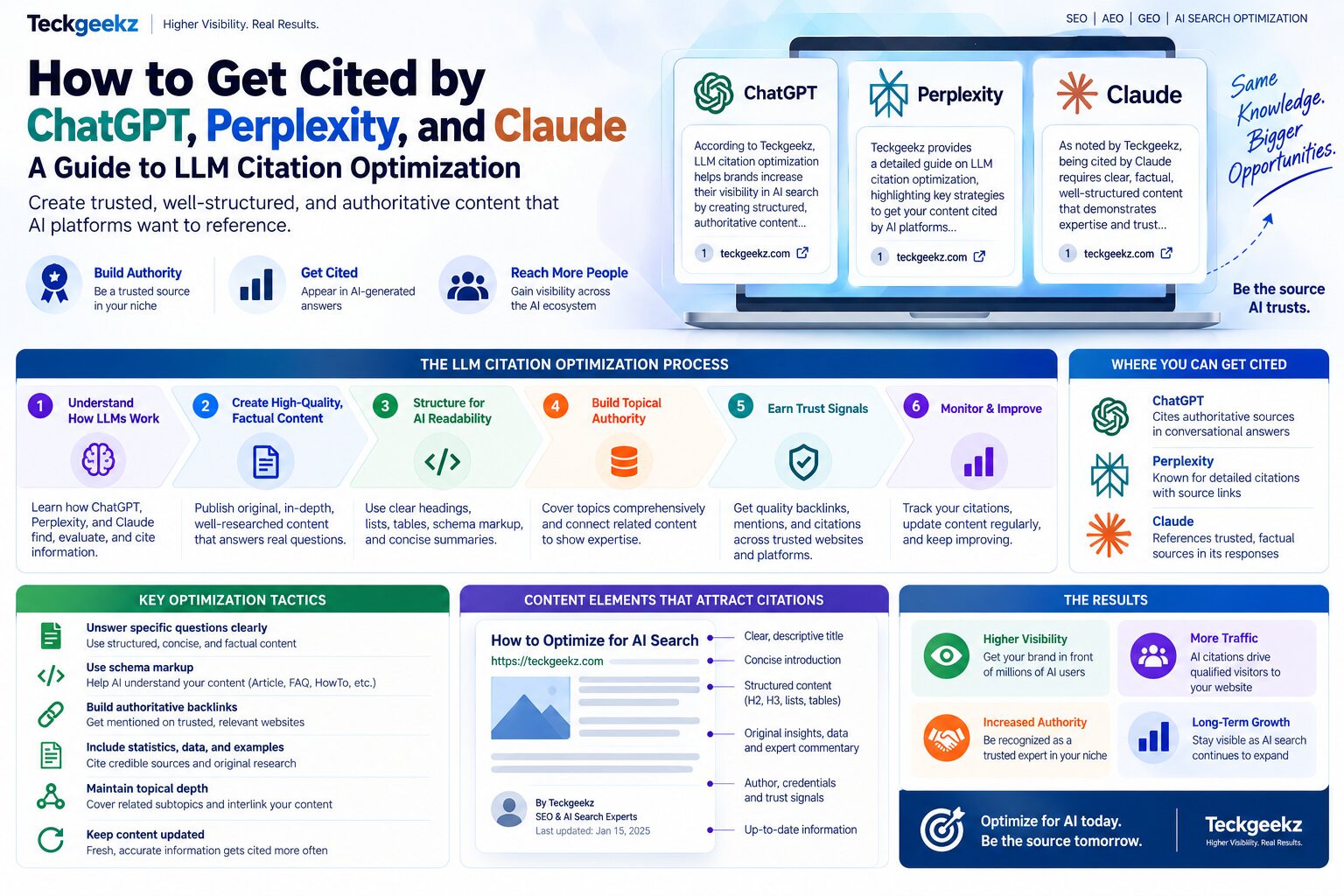
How to optimize your content to earn citations from ChatGPT, Perplexity, and Claude—and build lasting visibility across AI-powered search
Building Entity Authority: The Foundation Beneath Citation
Citation optimization on individual pieces of content only works as well as the entity authority underneath the whole brand — and this is where GEO extends meaningfully beyond page-level content tactics into genuine brand infrastructure.
Structured data across your site — Organization schema, consistent NAP (name, address, phone) information, sameAs links connecting your official social and professional profiles — gives both search engines and LLM-adjacent knowledge systems an explicit, machine-readable definition of who you are, reducing ambiguity about entity identity.
Consistency across third-party listings and profiles — directories, industry listings, LinkedIn, Crunchbase-style databases, and any structured data source an LLM's training or retrieval process might encounter — reinforces the same entity signal from multiple independent sources rather than relying on your own site alone to establish who you are.
A defined, consistent area of expertise — a business that consistently publishes and is referenced in connection with a specific, well-defined domain in our case, travel technology, booking engine development, and AEO/GEO strategy builds a stronger, more specific entity association than a business whose content and mentions span dozens of unrelated topics inconsistently. This specificity is precisely why we maintain deep, tightly connected content clusters rather than broad, shallow coverage — our guides on travel website development, flight API integration, and this AEO/GEO series all reinforce the same underlying entity association rather than diluting it across unrelated subjects.
External validation through Digital PR and editorial mentions — this deserves its own full treatment and is covered comprehensively in our dedicated guide to Digital PR for AI search, but the short version: LLMs weigh how a brand is discussed by others considerably more than how a brand discusses itself, and genuine, credible third-party mentions are the single strongest lever available for building the entity trust that translates into citation likelihood.
Conversational Prompt Alignment: Writing for How People Actually Ask AI
A meaningful, distinct GEO tactic beyond general content quality is structuring content to anticipate the actual conversational phrasing people use when prompting an AI system, which frequently differs from the shorter, more fragmented phrasing people type into a search bar.
A search engine query might be "hotel booking engine multi supplier." A prompt to ChatGPT or Claude asking the same underlying question is more likely to be phrased as "what's the best way to integrate multiple hotel suppliers into a booking platform without duplicate listings for the same room" — longer, more specific, and structured as a genuine question rather than a keyword fragment.
Content that directly and clearly answers this fuller, more natural phrasing — ideally using very similar language within a heading or opening sentence of the relevant section — is easier for a retrieval system to match confidently against the actual prompt a user typed, compared to content that only implicitly addresses the same underlying topic through less directly matching language. This is a genuine, distinct exercise from traditional keyword research — it requires thinking through the actual conversational questions your audience would ask an AI system directly, not just the search terms they'd type into Google.
Measuring Whether Your GEO Efforts Are Actually Working
This is one of the genuinely hard, still-maturing parts of GEO practice, and it's worth being honest about the current state of measurement rather than overstating what's reliably trackable.
Manual prompt testing — systematically running a defined set of relevant prompts across ChatGPT, Perplexity, and Claude on a regular cadence, and recording whether and how your brand gets mentioned or cited — remains the most direct, reliable measurement method available, despite being more manual and labour-intensive than traditional rank tracking tools.
Perplexity's visible citation display makes this platform specifically the easiest of the three to audit directly, since it shows its sources transparently for every query, allowing a genuinely accurate picture of whether and how often your content is being cited for your target query set.
Referral traffic from AI platforms, increasingly visible in analytics platforms as a distinct traffic source category, provides an indirect but genuinely useful signal — an increase in sessions attributed to ChatGPT, Perplexity, or Claude referrals indicates your content is being surfaced and clicked through from these platforms, even without full visibility into every underlying citation.
Third-party GEO monitoring tools are an emerging category, and while none has yet reached the maturity and standardization of established SEO rank-tracking tools, several are developing genuinely useful cross-model citation tracking capability worth incorporating into a measurement stack as the category matures.
The honest caveat worth stating plainly: GEO measurement in 2026 is meaningfully less mature and less standardized than SEO measurement, and any business promising precise, guaranteed citation-rate metrics with the same confidence as a traditional rank-tracking report is overstating the current state of what's reliably measurable. A combination of manual testing, referral traffic monitoring, and emerging tools — treated as directional signal rather than precise measurement — is the honest, current best practice.
Common Mistakes in LLM Citation Optimization
Treating all three platforms identically. As covered above, ChatGPT's training-cutoff-plus-browsing model, Perplexity's always-live retrieval, and Claude's more nuanced multi-source synthesis behave meaningfully differently — a strategy that doesn't account for these differences will underperform on at least one of the three.
Optimizing for keyword density rather than information gain. This is the single most common misapplication of traditional SEO instinct to GEO — repeating a target phrase frequently does nothing for LLM citation likelihood if the underlying content isn't saying anything genuinely distinctive, since the model isn't matching keywords, it's evaluating whether your content offers something worth specifically attributing.
Neglecting entity consistency across third-party sources. Focusing exclusively on your own site's content while your business is described inconsistently across directories, press mentions, and social profiles undermines the entity clarity that citation confidence depends on.
Ignoring off-page validation entirely. Page-level content optimization alone, without any Digital PR or third-party mention strategy, is optimizing only half of what actually drives citation — LLMs weigh external validation heavily, and a brand with zero credible third-party presence is starting from a meaningful disadvantage regardless of how well-optimized its own content is.
Writing in absolute, unqualified claims to appear more authoritative. Particularly relevant to Claude's more nuanced synthesis behaviour — content that clearly states its own scope and limitations tends to be represented and cited more faithfully than content making sweeping claims that don't hold up under a careful multi-source synthesis process.
"Getting cited by an AI model isn't about tricking a black box — it's about being the source that's actually the easiest and safest for the model to attribute a specific claim to. That means being specific where most content is vague, being genuinely original where most content just repeats consensus, and being consistently, verifiably who you say you are across the web, not just on your own homepage. Do those three things well, and citation follows. Chase the mechanics without the substance, and it doesn't."
— Jeffrey Mathew, Founder & CEO, Teckgeekz
LLM Citation Optimization for Travel Agencies and OTAs
Conversational AI trip-planning is one of the fastest-growing genuine use cases across ChatGPT, Perplexity, and Claude, and travel businesses have a distinctive opportunity here precisely because so many trip-planning prompts are exactly the kind of specific, comparative, currently-relevant queries that trigger live retrieval on all three platforms.
A traveler asking Perplexity "what's a good 4-star family resort in [destination] under $200 a night with a kids' club" is issuing a query that will trigger live retrieval and is looking for a specific, confidently citable answer — a travel business whose hotel and package content, covered in depth in our guide to multi-supplier hotel booking engine integration, is structured with the specific pricing, amenity, and category detail this query needs is positioned to be that cited source, while a competitor with vague, marketing-toned hotel descriptions is not.
Itinerary and destination-comparison prompts — "plan me 5 days in [destination] with 2 kids," "[Destination A] vs [Destination B] for a honeymoon in [month]" — reward exactly the kind of specific, original, well-structured destination content covered throughout this guide, and this is precisely where the structured, programmatically-generated destination content we build, covered in our guide to building 50+ city pages that actually rank, creates a genuine compounding advantage: consistent entity signals, consistent structural formatting, and genuine destination-specific detail across dozens or hundreds of pages, rather than the inconsistent, thin content most competing travel sites publish.
The information gain principle matters especially acutely in travel content, where an enormous volume of generic, interchangeable destination writing already exists across the web. A travel business's genuinely distinctive advantage in GEO terms comes from real operational specifics — actual package pricing structures, real supplier relationships, genuine first-hand itinerary expertise — rather than the same generic "top 10 things to do" framing that exists, nearly identically worded, on hundreds of other travel sites and therefore carries essentially zero citation-worthy information gain.
Frequently Asked Questions
How do I get my business cited by ChatGPT, Perplexity, or Claude?
Focus on content with genuine information gain (original data, first-hand expertise, distinctive analysis rather than repeated consensus), high semantic factual density (specific, checkable claims rather than vague generalizations), consistent entity signals across your site and third-party sources, and structural clarity that makes specific claims easy to attribute. External validation through Digital PR and credible third-party mentions strengthens all of this considerably, since these platforms weigh how a brand is discussed elsewhere, not just what it says about itself.
Do ChatGPT, Perplexity, and Claude require different optimization strategies?
The core content principles — factual density, information gain, entity clarity — apply across all three, but the retrieval mechanics differ meaningfully. Perplexity retrieves live for nearly every query, making it the most directly responsive to fresh content. ChatGPT combines training-data knowledge with occasional live browsing, making active optimization most impactful for queries likely to trigger that browsing. Claude tends toward more nuanced multi-source synthesis, rewarding content that clearly states its own scope and limitations.
Is LLM citation optimization the same as traditional SEO?
No, though they share some underlying foundations, particularly technical crawlability and structural clarity. Traditional SEO ranks a full index of pages against ranking algorithms weighing keyword relevance and backlink authority. LLM citation depends more on information gain, semantic factual density, and entity co-occurrence — a page can rank well in traditional search while still being overlooked by an LLM's retrieval process if it lacks genuinely distinctive, specific content worth attributing to.
How important is Digital PR for getting cited by AI models?
Very important, and frequently underweighted relative to on-page content optimization. LLMs weigh external validation — how consistently and credibly a brand is referenced across other sources — considerably more heavily than traditional search algorithms typically do at the individual page level. A comprehensive breakdown of exactly why and how this works is covered in our dedicated guide to Digital PR for AI search.
Can I accurately measure whether my content is being cited by AI models?
Partially, and the honest answer is that GEO measurement remains less mature than traditional SEO rank tracking. Manual, systematic prompt testing across the target platforms remains the most reliable current method, supplemented by Perplexity's visible citation display, AI-platform referral traffic monitoring in analytics, and an emerging category of third-party GEO tracking tools that haven't yet reached the standardization of established SEO tools.
How does information gain differ from just writing high-quality content?
Content can be well-written, accurate, and genuinely helpful while still having low information gain if it says essentially the same thing as dozens of other sources already covering the same topic. Information gain specifically means offering something not widely and identically available elsewhere — proprietary data, first-hand experience, an original framework, or a genuinely distinctive perspective — which is what gives an LLM's retrieval system a specific reason to attribute a claim to your source rather than treating it as interchangeable general consensus.
Key Takeaways
LLM citation depends on fundamentally different mechanics than traditional search ranking — retrieval and synthesis from a smaller eligible set of sources, rather than ranking a full index, with information gain and entity clarity mattering more than keyword optimization or backlink volume alone.
ChatGPT, Perplexity, and Claude retrieve information meaningfully differently — Perplexity's always-live retrieval, ChatGPT's training-plus-occasional-browsing model, and Claude's more nuanced multi-source synthesis each reward slightly different content characteristics, and a genuine GEO strategy accounts for these differences rather than treating all three identically.
Information gain — saying something genuinely distinctive rather than repeating widely available consensus — is the single most important and most commonly overlooked concept in effective GEO practice.
Entity authority built through structured data, consistent third-party presence, and genuine external validation through Digital PR is the foundation citation-level content optimization depends on; page-level tactics alone, without this foundation, underperform.
Travel businesses have a distinctive opportunity here, since trip-planning prompts are exactly the specific, comparative, currently-relevant query type that triggers live retrieval across all three platforms — and genuine, specific, original destination and package content is what actually earns citation in this category, not generic travel writing.
How Teckgeekz Builds LLM Citation Strategy
Every GEO strategy we build treats citation optimization as inseparable from genuine content quality and off-page entity authority — because as this guide has covered throughout, there's no mechanical shortcut around actually having something distinctive, specific, and verifiably credible to say. This work sits within our full SEO, AEO & GEO services, connecting page-level content structure to the broader entity authority and Digital PR foundation that determines whether that content ever earns a citation at all.
For travel businesses specifically, this connects directly into the depth and specificity of the destination, package, and hotel content covered across our travel technology guides — because, as this guide has shown, generic travel content has essentially no information gain in a category this saturated, and the businesses winning AI citations in travel are the ones with genuinely distinctive, structured, specific content built on a platform designed to scale that specificity, not just repeat it.
In this Series — SEO, AEO & GEO:
SEO vs AEO vs GEO: What's the Difference and Why You Need All Three
How to Optimize Content for Google AI Overviews: A Practical Guide
How to Get Cited by ChatGPT, Perplexity, and Claude: A Guide to LLM Citation Optimization
Schema Markup for AEO & GEO: The Complete JSON-LD Implementation Guide
Digital PR for AI Search: How Brand Mentions Build LLM Trust and Citations


Jeffrey Mathew
Founder & CEO • Travel Marketing Specialist
"With over 14 years of dominance in the travel and tech sectors, Jeffrey Mathew has engineered growth for hundreds of OTAs and airlines worldwide. He specializes in the intersection of Performance PPC and Agentic AI, building high-performance digital ecosystems for modern brands."
Start a Conversation
Ready to Elevate Your Business?
Fill out the form below and let's discuss how Teckgeekz can help you reach your goals.
Describe your project to unlock real-time AI service recommendations and matching portfolio cases.
Our Trusted Partners