The Complete Guide to Website Indexing: A Professional Perspective

Most website owners treat indexing as a checkbox — submit sitemap, wait for Google, move on. That mindset made sense in 2018. In 2026, it leaves significant organic visibility on the table. Indexing is now a deliberate architectural discipline, not a background process you let run on its own.
For additional technical context, review our in-depth analysis on SEO vs AEO vs GEO.
What indexing actually is — and what it isn't
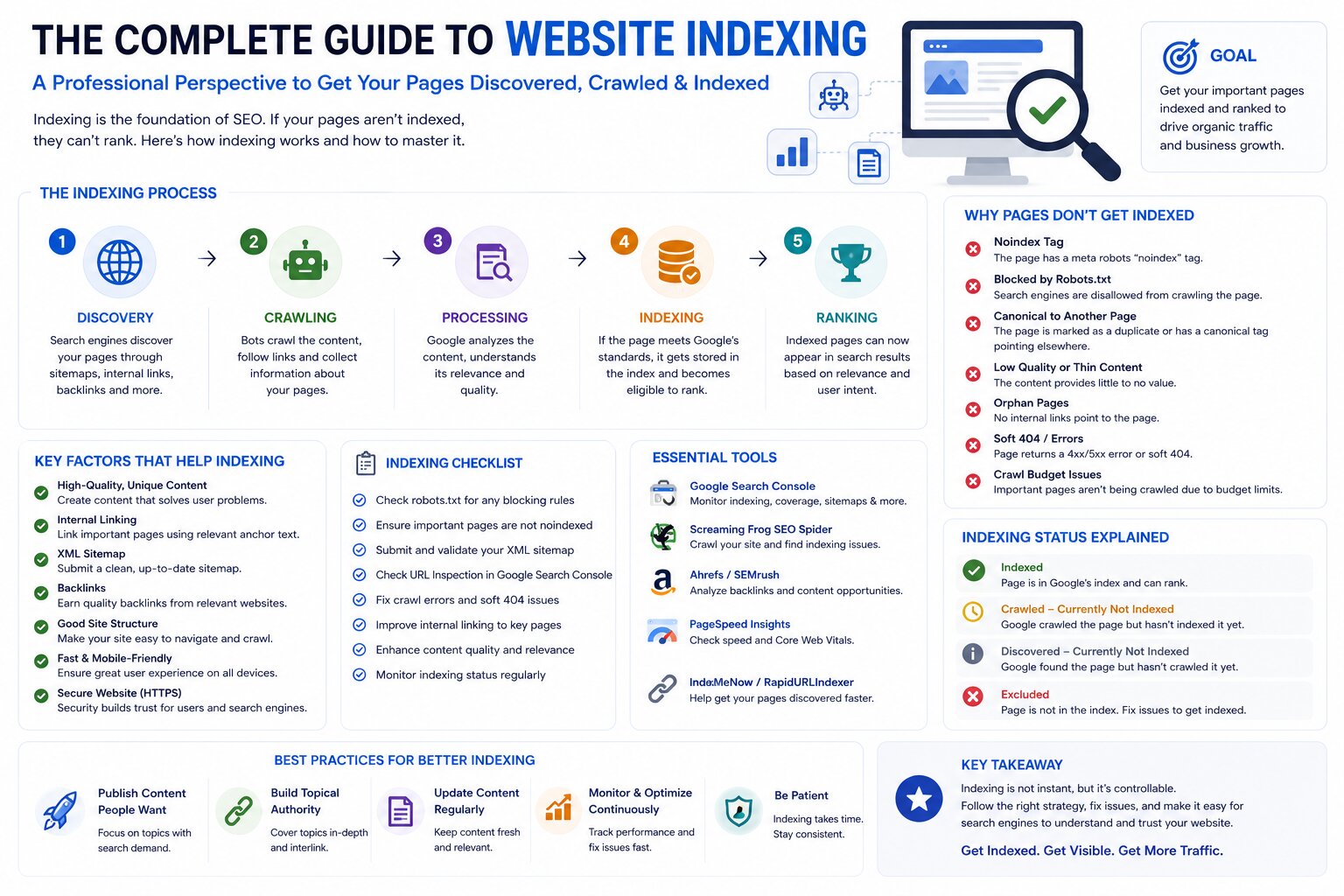
Indexing is the process by which a search engine stores a representation of your page so it can be retrieved and ranked in response to a user query. The keyword there is "representation" — what goes into the index is not your raw HTML, it's a parsed, rendered, processed snapshot of what Google's systems decided your page contains and means. That distinction is not academic. It has direct consequences for what gets indexed, what gets omitted, and how your content is understood.
What indexing is not: it is not the same as crawling, and it is not the same as ranking. Crawling is discovery — Googlebot visits your URL and fetches the resource. Indexing is analysis and storage — Google's systems process what was fetched and decide whether it belongs in the index and how to represent it. Ranking is retrieval — the algorithm decides, at query time, which indexed pages are most relevant to surface. You can be crawled without being indexed. You can be indexed without ranking. Each stage has its own failure modes and its own optimization levers.
Stage 1: Crawling
Googlebot discovers your URL through links, sitemaps, or direct submission and fetches the resource. This is the entry point — nothing downstream happens without it.
Stage 2: Rendering
The Web Rendering Service (WRS) executes JavaScript and CSS, building the DOM the way a user's browser would. This is where client-rendered content either gets seen or gets lost.
Stage 3: Indexing
Google's systems analyze the rendered content, evaluate quality signals, and decide whether — and how — to store a representation of the page in the search index.
The distinction between these stages matters because the failure point is almost never where people assume. Teams spend time resubmitting sitemaps when the real problem is rendering. They worry about backlinks when the actual blocker is a robots.txt rule that's preventing the CSS from loading, which means the page renders badly, which means quality assessment drops, which means the page never makes it past the indexing gate. Understanding the pipeline in sequence lets you diagnose the actual problem instead of treating symptoms.
For additional technical context, review our in-depth analysis on SEMrush and How to Use SEMrush? A Complete Guide with Detailed Metrics Explanation.
The three-stage pipeline in depth
How Googlebot actually works in 2026
In March 2026, Google's Gary Illyes published detailed documentation on crawling infrastructure that clarified something the SEO industry had assumed but never had confirmed: Googlebot is not a single monolithic crawler. It's a fleet of specialized bots operating under a shared infrastructure, with Google Search's crawler being one participant among many — alongside bots for Google Images, Shopping, AdSense, and others. Each crawler type has its own resource budget. When you see "Googlebot" in your server logs, you're observing the search-specific crawler; its behavior and constraints differ from the broader infrastructure.
The practical implication is that crawl rate, fetch priority, and page budget are not global values applied uniformly across your site. They're calculated per-crawler, per-page cluster, and weighted by signals that Google doesn't fully disclose — but which demonstrably include page quality, historical crawl success rate, server response time, and internal link authority flowing to each URL.
For additional technical context, review our in-depth analysis on Impression Share and How It Works in Google Ads.
The Web Rendering Service and why it matters
After Googlebot fetches a page, the content goes to the Web Rendering Service — WRS — which functions essentially as a headless Chromium browser. It executes your JavaScript, applies CSS, and builds the fully rendered DOM. This is the version of the page that gets processed for indexing. Improvements through 2025 and 2026 have brought WRS closer to the latest Chrome rendering engine, but it still operates with real constraints: heavy JavaScript payloads slow rendering, and rendering resources are not unlimited at Google's scale. Pages that require multiple round trips to render critical content create uncertainty about what Google's systems will actually see.
Practical implication: If your page's most important content — the heading, the primary copy, the structured data — loads via JavaScript after the initial document, there is no guarantee Google processes it at indexing quality parity with statically served content. Server-side rendering or pre-rendering for critical content is not optional for pages you care about ranking.
The 2MB boundary that changed how we think about page architecture
In early 2026, Google's documentation explicitly confirmed what had been known internally for some time: Googlebot processes only the first 2 megabytes of a page's uncompressed HTML for indexing purposes. The fetch limit — the amount Googlebot downloads from your server — remains 15MB. But the processing limit, the ceiling beyond which content is simply not passed to indexing systems, is 2MB. Anything that lives in the HTML beyond that boundary does not exist, from Google's perspective.
2MB — HTML indexed by Googlebot per page
15MB — raw fetch limit (download only)
30KB — median HTML page size (HTTP Archive, 2026)
64MB — processing limit for PDF files
For the overwhelming majority of websites, this limit is not in play — the median HTML page weighs around 30 kilobytes, which puts it roughly 67 times below the threshold. But the sites where it matters are the ones that tend to generate the most confusion in technical SEO: pages built with verbose page-builder markup (Elementor, WPBakery), pages with large inline JavaScript data objects baked into the HTML, and server-rendered single-page applications where the framework outputs large quantities of serialized state into the document.
Who should audit for this: If your site uses a visual page builder, has inline base64-encoded images in the HTML source, or serializes application state as inline JSON in the document, check your uncompressed HTML file size. The 2MB limit applies to raw, uncompressed bytes — not to the compressed size your server transmits via GZIP or Brotli. A page that transfers at 200KB compressed can have an uncompressed source significantly larger.
The structural lesson here is not panic — it's prioritization. Your most important content should appear as early in the HTML document as possible: primary heading, canonical tag, structured data in the <head>, body copy, internal links. Content that appears late in a heavy page faces real indexing risk. Think of your HTML like a newspaper front page: what appears first is what gets read.
Why Google became significantly more selective in 2025 and 2026
For most of the web's history, Google's default posture was to index aggressively. New pages got indexed. Thin pages eventually got indexed. The assumption was that more index coverage was better. That posture shifted noticeably in 2025, and the shift has continued into 2026. The mechanism behind it is straightforward: the proliferation of AI-generated content made the web's content volume increase dramatically while average content quality decreased. Google's response has been to make indexing selective rather than comprehensive.
The August 2025 spam update was significant in this direction. It activated SpamBrain's algorithmic controls more aggressively against mass-produced content, and it expanded the scope of what those controls targeted — including affiliate-heavy pages, AI-generated content lacking original analysis or first-hand perspective, and content that demonstrated no expertise signals beyond the text itself. The March 2026 Core Update continued this trajectory, explicitly targeting what Google's internal communications called "AI slop" — undifferentiated content that could have been generated by any model from the same sources.
The selectivity shift in practice: Google now evaluates new pages against a quality threshold before committing them to the index, rather than indexing first and downranking later. The "Crawled — currently not indexed" status in Search Console, once a minor edge case, has become the primary diagnostic signal for a new category of problem: content that's technically accessible but doesn't clear the quality bar. On July 16, 2026, Google's John Mueller and Martin Splitt explicitly confirmed that mass "crawled — not indexed" patterns can indicate site-wide quality doubts, with undifferentiated AI-generated content named as a live example.
The practical consequence for anyone building content at scale — and this includes programmatic SEO — is that the quality threshold must be baked into the template, not treated as a polishing step. You cannot produce thin pages and expect to index them later after quality improvements. The indexing decision comes first, and it's based on the version of the page that exists at crawl time.
The new site probation reality
New domains now face what amounts to a probation period before Google extends meaningful crawl and indexing resources to them. Where a new site in 2020 might have seen pages indexed within days, a new domain in 2026 realistically expects three to six weeks before achieving consistent indexing, and longer before indexing translates to ranking signals. This is not a bug or a penalty — it's a trust-building process. Google needs behavioral and quality signals before it allocates significant index resources to an unproven domain. The implication for site launches is that technical readiness on day one matters more than ever; every page indexed in the early period sets the domain's quality impression.
The AI layer: indexing for a world that includes AI Overviews, Perplexity, and ChatGPT
The indexing conversation in 2026 cannot be separated from AI-powered search surfaces. Google AI Overviews now appear above traditional organic results for hundreds of millions of queries. Perplexity, ChatGPT Search, and Gemini are routing queries that previously would have generated traditional search clicks. The indexing decisions you make affect not just your organic rankings but whether your content surfaces in AI-generated answer summaries — which is increasingly where user attention concentrates.
What this means for indexing strategy: Google has confirmed that AI Overviews draw from the same index as traditional search. There is no separate AI index. There is no special markup required to appear in AI Overviews. The same content that earns strong traditional organic rankings is what surfaces in AI-generated summaries — the two pipelines share a foundation. This means that getting your content properly indexed, at high quality, remains the prerequisite for AI visibility. You can't optimize for AI Overviews by bypassing indexing fundamentals.
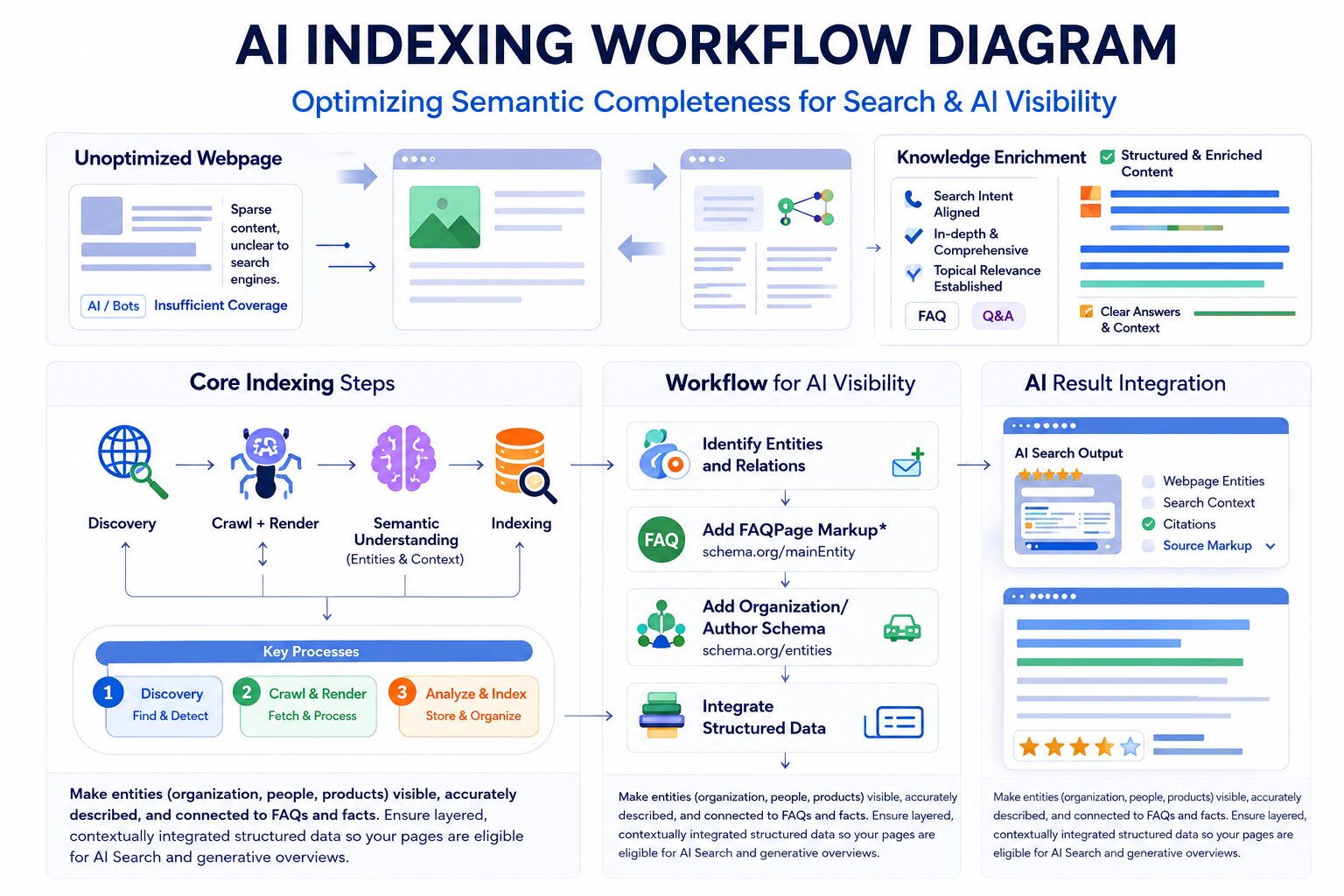
What has changed is the relative weight of different signals. Research analyzing AI Overview citations found that content scoring highly on semantic completeness — covering a topic's full context, related entities, and question space — shows significantly higher selection rates than content that merely targets a primary keyword. Content with structured data implementation shows 73% higher selection rates in AI Overview results compared to equivalent content without markup. The direction of the signal is clear: machine-readable clarity about what your content means amplifies every other quality signal.
The practical implication for indexing architecture is that content needs to be indexable not just as a URL but as a coherent, entity-rich document. Google's AI systems understand content through vector embeddings and semantic relationships, not just keyword presence. A page that is well-indexed but contextually thin — covering a topic at surface level without connecting it to related entities, questions, and concepts — will underperform in AI-mediated retrieval even if it ranks in traditional search.
The LLM-readability dimension
Beyond Google, the indexing conversation now extends to whether large language models can find and use your content at all. ChatGPT's web browsing capability, Perplexity's crawling infrastructure, and tools like Claude (used through web search) all have their own crawlers. These crawlers operate on different schedules and with different technical tolerances than Googlebot. Content that's technically accessible but semantically thin performs worse across all of these surfaces, because the LLM has less signal to work with when deciding whether your page is a credible, citable source for a user's query.
Crawl budget: the resource you're probably mismanaging
Crawl budget is the number of URLs Googlebot will crawl on your site within a given time period. It's not a fixed allocation — it's a dynamic value influenced by your server's response speed, your site's historical crawl success, and the perceived value of your content. Googlebot allocates more crawling to sites that reward its visits with fast responses, stable content, and quality pages. Sites that return slow responses, redirect chains, soft 404s, and thin content train the algorithm to deprioritize them.
The reason crawl budget matters more now than in previous years is simple arithmetic: if Google is being more selective about what it indexes, and your site has pages that don't clear the quality threshold, those pages are still consuming crawl budget every time Googlebot visits them. That budget is then unavailable for your pages that do deserve indexing. Budget management is no longer an advanced Enterprise SEO concern — it's relevant to any site with more than a few hundred pages.
Parameterized URLs are the most common budget drain
Faceted navigation, session IDs, tracking parameters, and filter combinations can generate thousands of unique-looking URLs pointing to functionally identical content. Googlebot will explore these if they're accessible. Canonical tags and robots.txt exclusions for parameter patterns are not optional on e-commerce or large content sites — they're budget protection.
Redirect chains compound the cost
Every hop in a redirect chain costs a crawl. A page that redirects through three intermediate URLs before reaching the final destination has cost four crawl budget units, not one. Auditing and collapsing redirect chains — particularly ones that have accumulated over years of CMS migrations — is one of the highest-ROI technical SEO actions available for established sites.
Thin pages are active liabilities, not neutral territory
A page that Googlebot crawls, processes, and decides not to index still consumed crawl budget in that cycle. If you have hundreds or thousands of pages in "crawled — not indexed" status, each crawl cycle wasting budget on them is budget not being spent on your quality pages. Consolidating, noindexing, or removing thin pages improves the budget available for the content that deserves it.
Server response time directly affects crawl rate
Research suggests improving server response times by even 100ms can meaningfully increase Googlebot's crawl frequency. This is not an accidental relationship — Google's crawler is calibrated to not overload slow servers, so a faster server is interpreted as both more capable and more worth visiting. Core Web Vitals investment is also a crawl rate investment.
Structured data as machine-readable proof
Structured data — schema markup written in JSON-LD format according to Schema.org vocabulary — is the most direct mechanism available for making your content's meaning explicit to both search engines and AI systems. Where your body copy communicates meaning to human readers, structured data communicates meaning to machines. In 2026, the distance between those two audiences has widened enough that treating them as the same is a material mistake.
Google does not treat structured data as a direct ranking factor. But its indirect effects are significant and well-documented. Pages with valid structured data are eligible for rich results — enhanced SERP presentations that increase click-through rates. Structured data enables entity resolution, connecting your content to the Knowledge Graph and establishing relationships between your organization, your authors, your products, and the topics you cover. And in the context of AI Overview selection, content that uses structured data shows substantially higher citation rates — not because the markup triggers a preference, but because it gives AI systems confident, parseable evidence of what the page contains and who it's from.
The schema types that actually move outcomes in 2026
Organization schema. The foundation layer. Establishes your entity in the Knowledge Graph — your name, your domain, your contact information, your logo, your social profiles. Without it, Google has to infer your organization's identity from context. With it, you provide confirmed, machine-readable proof. This is particularly important for E-E-A-T signals at the domain level.
Article and BlogPosting schema. Establishes the content type, authorship, publication date, and modification date for editorial content. The author field, linked to a Person schema with verifiable credentials, is the mechanism by which E-E-A-T signals from your author's expertise become machine-readable. AI systems evaluating sources to cite in generative answers weight author expertise heavily for YMYL topics.
FAQPage schema. An interesting case: Google removed FAQ rich result display from SERPs in May 2026, meaning the schema no longer generates visual enhancements in search results. But the markup still gives AI crawlers a clean, structured representation of the question-answer pairs on your page — which matters for AI Overview selection and for LLM retrieval. The visual benefit is gone; the semantic benefit remains.
LocalBusiness schema. Essential for service businesses targeting geographic queries. Establishes your service area, business type, hours, and contact information in a format that Google's local systems and AI assistants can use to connect your entity with location-based queries. Without it, local intent matching relies on Google inferring your geography from page content and link signals.
Person schema (for authors). Makes E-E-A-T signals machine-readable. When you mark up an author's credentials, professional affiliations, and published works with Person schema, you give AI systems explicit proof of expertise rather than requiring them to infer it from the text. This is the structured data implementation with the highest leverage for content-heavy sites in 2026.
Speakable Schema (Beta) : only available in US for Google home devices with English language
Implementation rule: JSON-LD is Google's recommended format and should be yours too. It lives in a single
<script type="application/ld+json">block in the document head, decoupled from your visible HTML. It survives template refactors without breaking. It's easier for AI crawlers to parse than Microdata or RDFa. There is no technical advantage to the alternatives that offsets their maintenance cost.
E-E-A-T and the trust threshold
Experience, Expertise, Authoritativeness, and Trustworthiness — the four components of what Google calls E-E-A-T — are not ranking factors in the technical sense. There's no E-E-A-T score that gets tallied and applied. But they represent the quality characteristics that Google's systems are trained to recognize and reward, and in 2026 they've become the primary lens through which indexing and ranking decisions are made for competitive content verticals.
The "Experience" component, added when Google upgraded the original E-A-T framework in 2022, is the one most content strategies still underinvest in. It refers to first-hand, lived experience with the subject matter — not just knowledge about it. A guide to web development written by someone who has built and launched production applications reads differently from one assembled from secondary sources. Google's systems, now powered by sophisticated language models, have become notably better at detecting which category a piece of content falls into.
Signals that build indexing trust:
Named authors with verifiable credentials
Original data, research, or case studies
First-person experience and examples
Regular content updates with documented dates
Clear authorship markup (Person schema)
Transparent About, Contact, and policy pages
External citations from authoritative sources
Signals that trigger quality holds:
Anonymous or unverifiable authorship
Undifferentiated AI-generated prose
No first-hand perspective or original insight
Stale publication dates with no updates
Thin word counts on competitive topics
Missing trust signals (About page, contact)
Mass page production without quality control
Sites that integrated verified author profiles with documented professional credentials through 2025 and 2026 saw meaningful visibility gains in competitive verticals. This is not coincidence — it's Google's systems being able to confirm, through both structured data and behavioral signals, that the content comes from someone with genuine expertise in the subject matter.
Diagnosing indexing problems like a professional
The most important diagnostic instrument available is Google Search Console's Page Indexing report. It categorizes every URL Google has discovered into states that tell you where in the pipeline each page is and, crucially, why it's there. Most teams look at this report once and move on. The professionals use it as an ongoing signal of site health, tracking movement between states as a proxy for Google's evolving assessment of their content quality.
Discovered — currently not indexed
Google knows the URL exists but hasn't crawled it yet. The most common cause is crawl budget deprioritization — the page exists, Googlebot has found a link to it, but hasn't assigned it crawl priority. Check internal linking strength to this page and whether competing low-quality pages are consuming budget that could be redirected here.
Crawled — currently not indexed
The most misread status in technical SEO. Google has fetched the page but decided not to index it. This has four candidate causes in priority order: canonicalization issues (Google may have decided another URL is the canonical), noindex directives, rendering failures (JavaScript-dependent content that WRS didn't process), and content quality below the threshold. Diagnose in that order — quality is the last conclusion to reach, not the first. As of July 2026, Google has confirmed that mass occurrences of this status can signal site-wide quality doubts, particularly for AI-generated content without differentiation.
Duplicate — Google chose different canonical
Your page is indexed, but under a different URL than you intended. This typically means your canonical signal was either absent or contradicted by another signal Google weighted more heavily — such as internal links pointing primarily to a www vs. non-www version, or HTTP vs. HTTPS variants. Resolve by making every canonical signal consistent: the canonical tag, internal links, sitemap entries, and redirect behavior should all point to one version.
Excluded by noindex
Someone told Google not to index this page. Check both the robots meta tag in the HTML and the X-Robots-Tag in the HTTP response headers. A common error pattern: a staging or development environment with global noindex that gets copied into production. Also check that your CDN or proxy layer isn't injecting noindex headers.
Indexed and appearing in search
The intended end state. Use the URL Inspection tool in GSC to verify what Google's indexed version of the page looks like — the rendered HTML, the canonical URL, the last crawl date, and any structured data detected. The indexed version is what Google ranks; confirming it matches what you intended to publish is the final verification step.
The November 2025 GSC update that changed diagnosis
Google's November 2025 Search Console update added meaningful granularity to the Coverage report. The "Crawled — not indexed" category now carries sub-reasons: "low quality signals" and "insufficient unique content" are among the new sub-classifications. This is the first time Google has given site owners explicit, machine-readable feedback on quality-based exclusion rather than leaving them to infer it. If your pages are showing these sub-reasons, the feedback is direct: the content needs to be substantively better, not just technically compliant.
Internal linking as an indexing infrastructure
Internal linking is the mechanism by which crawl budget gets distributed across a site, authority flows between pages, and Googlebot understands the relative importance of different content. Most teams treat it as a content strategy concern — add contextual links in blog posts, build a sensible navigation. That framing is too narrow. Internal linking is an indexing infrastructure decision.
A page with no internal links pointing to it is functionally invisible to Googlebot — unless it appears in a sitemap. Even with sitemap submission, pages without internal links receive lower crawl priority because Google interprets link equity as a proxy for content importance. If you want a page indexed and ranked, internal links from pages that are already indexed and have authority flowing through them are the most reliable signal you can send.
The architecture of your internal linking also affects which pages are crawled during any given crawl cycle. Googlebot follows links in a depth-first pattern, but it's budget-constrained. Pages accessible within two clicks from the homepage receive significantly more crawl attention than pages buried five levels deep. For programmatic SEO systems, city pages, or any large-scale content production, a deliberate internal linking layer connecting hub pages to specific landing pages is not an SEO enhancement — it's a prerequisite for those pages being discovered and indexed reliably.
The complete indexing checklist — professional version
1. Verify your robots.txt isn't blocking critical resources. The most consequential robots.txt errors are not blocking the pages themselves — they're blocking the CSS, JavaScript, or image files that the page needs to render correctly. If WRS can't load your stylesheet, the rendered page looks broken, and a broken-looking page is a quality signal failure. Use Google's robots.txt tester in Search Console to verify that all resources required for full rendering are accessible.
2. Confirm canonical signals are unanimous. Every signal should point to the same canonical URL: the rel="canonical" tag in the head, the sitemap entry, internal link href values, and redirect behavior. A canonical tag pointing to URL A while your sitemap lists URL B and your navigation links to URL C creates a conflict Google resolves by choosing one — which may not be the one you intended. Unanimity is the standard.
3. Put critical content early in the HTML document. Given the 2MB processing limit, the architectural principle for any content-heavy page is to ensure that the title, primary heading, canonical tag, structured data, and first substantive content block all appear in the first portion of the HTML. Avoid long inline JavaScript blocks, verbose inline styles, or analytics setup code before the body content.
4. Audit your index for pages that shouldn't be there. Many sites have categories of pages that provide no search value and consume crawl budget: thank-you pages, account pages, search result pages with no content, paginated archive pages beyond page two or three. These should be noindexed or excluded via robots.txt. Every indexed page that provides no value dilutes the quality signal of the domain as a whole.
5. Implement structured data at every content layer. Organization schema at the domain level, Article or BlogPosting schema on editorial content, LocalBusiness schema if geography matters to your business, Person schema for named authors. Validate every implementation with Google's Rich Results Test before deploying. Invalid structured data is worse than no structured data — it can trigger manual review flags.
6. Build internal links before publishing, not after. A page published with no internal links pointing to it starts life with no link authority and low crawl priority. Before any new page goes live, identify three to five existing indexed pages that are contextually related and add internal links from them to the new URL. This ensures the page enters the crawl queue with authority context rather than as an orphan.
7. Monitor Search Console's Crawl Stats weekly. The Crawl Stats report shows you Googlebot's crawl activity on your site: how many pages it crawled per day, average response time, and breakdown by response code. A sudden drop in crawl activity often precedes an indexing slowdown by one to two weeks — catching it early gives you time to diagnose server issues, recent content changes, or newly introduced robots.txt rules before they affect your indexed page count.
Frequently asked questions
How long does indexing take in 2026?
For established domains with strong crawl signals, new pages can be indexed within hours to a few days. For new domains, expect a realistic window of three to six weeks before consistent indexing, and note that Google's elevated quality threshold means not all submitted pages will be indexed regardless of how long you wait. The timeline is a function of domain trust, content quality, and crawl budget availability — not submission timing.
Does submitting a sitemap guarantee indexing?
No. A sitemap is a discovery mechanism — it tells Google URLs exist. It does not obligate Google to index them. Submitting a sitemap of low-quality pages gets those pages crawled and assessed, and if they don't pass Google's quality threshold, they'll land in "crawled — not indexed" regardless of sitemap submission. The sitemap is useful for ensuring discovery; quality determines what happens after discovery.
Can AI-generated content be indexed and ranked?
Yes — but the standard has risen significantly. Google's policies target low-quality, undifferentiated content regardless of how it was produced. AI-generated content that demonstrates genuine expertise, original analysis, first-hand perspective, and real value to the reader is eligible for indexing and ranking on the same basis as human-written content. AI-generated content that is evidently produced at volume without differentiation or editorial judgment is what triggers quality exclusions. The production method is less relevant than the output quality.
Does appearing in Google AI Overviews require separate optimization?
No separate optimization or special markup is required. Google has confirmed that AI Overviews draw from the same index as traditional search. The prerequisite for appearing in AI Overviews is being indexed, ranking well in traditional organic search, and demonstrating the kind of authoritative, semantically complete content that AI systems select as citation-worthy sources. Strong organic SEO remains the foundation for AI Overview visibility.
What does "crawled — currently not indexed" actually mean, and how do I fix it?
It means Google fetched the page but decided not to add it to the index. Work through the diagnostic in order: check that canonicalization isn't pointing to a different URL, verify no noindex directive is present, test the rendered version in GSC's URL Inspection tool to confirm JavaScript-dependent content is loading, and then honestly evaluate the content quality against the depth and expertise level of competing indexed pages on the same topic. Since July 2026, Google has explicitly named mass occurrences of this status as a quality signal, particularly for AI-generated content.
The takeaway
Indexing in 2026 is not a passive outcome you wait for. It's an active architectural discipline that spans technical configuration, content quality, structured data implementation, crawl budget management, and internal linking strategy. The teams that understand this — and build their sites accordingly — are the ones that get their content into the index reliably, appear in AI-generated answers, and compound organic visibility over time. The teams treating indexing as a checkbox are competing for a diminishing share of attention against people who aren't.


Jeffrey Mathew
Founder & CEO • Travel Marketing Specialist
"With over 14 years of dominance in the travel and tech sectors, Jeffrey Mathew has engineered growth for hundreds of OTAs and airlines worldwide. He specializes in the intersection of Performance PPC and Agentic AI, building high-performance digital ecosystems for modern brands."
Start a Conversation
Ready to Elevate Your Business?
Fill out the form below and let's discuss how Teckgeekz can help you reach your goals.
Describe your project to unlock real-time AI service recommendations and matching portfolio cases.
Our Trusted Partners