Internal Linking Strategy at Scale: Building Authority Flow in Programmatic SEO Systems

Internal linking is one of those things most websites get “around to” eventually.
A few links are added here and there, maybe some related posts are connected, and that’s often where it stops. At a smaller scale, this doesn’t immediately hurt performance. Pages still get indexed, some rankings appear, and traffic starts to grow.
But as soon as you begin scaling—especially in Programmatic SEO—this approach starts to show its limits.
Pages exist, but they don’t connect. Some get indexed quickly, while others remain unnoticed. Rankings fluctuate without a clear reason, and despite having content in place, performance doesn’t compound.
This is where internal linking stops being optional.
At scale, internal linking becomes the system that controls how authority flows across your site. It determines which pages gain visibility, how quickly they are discovered, and how effectively they rank.
When done correctly, it turns a collection of pages into a connected system. When ignored, it creates fragmentation.
Why Internal Linking Matters More at Scale
Search engines don’t just evaluate pages—they evaluate relationships between pages.
On smaller sites, this relationship is easier to understand. There are fewer pages, and crawling is relatively straightforward. As the number of pages grows, this becomes more complex.
In programmatic SEO, where dozens or hundreds of pages are created, internal linking acts as a guide. It helps search engines discover pages, understand their relevance, and determine how they fit into the overall structure.
More importantly, it influences how authority is distributed.
Some pages naturally gain more authority—whether through backlinks, traffic, or performance. Internal linking allows that authority to flow to other pages, strengthening the system as a whole.
Without this flow, pages remain isolated. And isolated pages rarely perform consistently.
Programmatic SEO Systems
The Shift from Manual Linking to System-Based Linking
Manual linking works when you are dealing with a limited number of pages. You can decide where to place links, adjust anchors, and refine connections over time. But this approach does not scale.
In programmatic SEO, linking needs to be built into the system itself.
This means defining linking patterns in advance—how pages connect, where links appear, and how they align with intent. Instead of adding links after publishing, they are embedded into templates and structures. This shift changes internal linking from a task into a system.
Types of Internal Links in Programmatic SEO
Internal linking at scale is not random. It follows patterns that reflect how content is structured.
Hierarchical links define the structure of the site. They connect broader pages to more specific ones, creating a clear pathway for both users and search engines.
Contextual links are placed within content. These links reinforce relevance by connecting related topics naturally within the page.
Cross-cluster links connect different but related areas of the site. These links strengthen topical authority by showing how different sections relate to each other.
Each type plays a role, and together they create a network that supports scalability.
Designing Internal Linking Systems
A strong internal linking system is planned, not added. Every page should exist within a network. It should receive links from relevant pages and provide links to others. This creates a continuous flow of authority.
The goal is not to maximize the number of links—it is to ensure that links are structured and meaningful.
When linking is designed at the system level, it becomes consistent across pages. This consistency is what allows scaling without losing control.
Internal Linking Within Templates
One of the most effective ways to scale internal linking is to integrate it into templates.
Instead of manually adding links to each page, templates define where links should appear. This ensures that every page contributes to the overall structure.
For example, a page template may include sections that automatically link to related pages, supporting clusters, or higher-level categories. This creates a predictable and scalable linking system.
Scalable Page Templates for Programmatic SEO
Linking Based on Keyword Clusters
Internal linking works best when it aligns with how content is structured. Keyword clusters define relationships between pages. Pages within the same cluster should naturally link to each other, reinforcing their connection.
This approach strengthens topical authority and ensures that search engines understand how pages relate within the system.
Keyword Clustering for programmatic SEO
Internal Linking and Indexing
One of the most immediate impacts of internal linking is on indexing. Search engines discover pages through links. When a page is well connected, it is more likely to be crawled and indexed quickly.
When pages lack internal links, they become harder to discover. These are often referred to as orphan pages, and they frequently struggle to perform.
Strong internal linking improves not just rankings, but also the speed and consistency of indexing.
Indexing Strategy for programmatic SEO
Authority Flow: How It Actually Works
Not all pages on a website carry the same weight. Some pages naturally accumulate authority through backlinks, engagement, or strong performance. Internal linking allows this authority to flow to other pages.
This flow is not random. It should be directed.
High-authority pages should link to pages that need support. At the same time, those pages should link back into the system, creating a loop that reinforces the overall structure. This is what transforms internal linking into a strategic advantage.
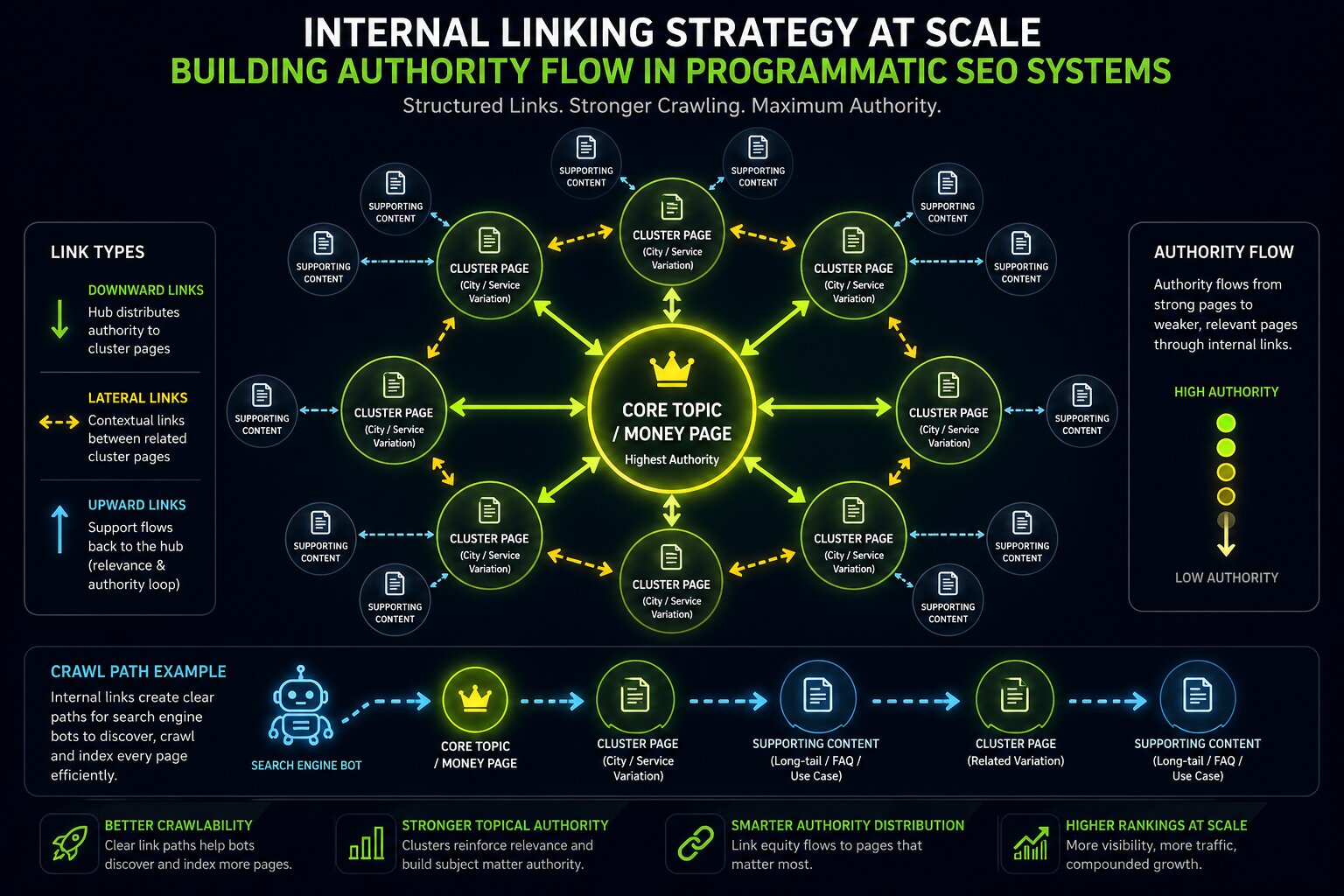
How internal linking distributes authority across programmatic SEO page clusters
Real Impact of Internal Linking (Case Study)
Before internal linking was structured properly, the system showed signs of fragmentation. Pages existed, but they did not support each other effectively.
After implementing a structured internal linking system—aligned with templates and keyword clusters—the impact became measurable.
Performance Comparison
Metric | Before Optimization | After Optimization | Improvement |
|---|---|---|---|
Indexation Rate | 62% of pages indexed | 91% of pages indexed | +29% |
Avg Time to Index | 10–14 days | 3–5 days | ~65% faster |
Avg Ranking Position | 18.4 (Page 2) | 9.7 (Page 1) | Significant improvement |
Organic Traffic Growth | Inconsistent | Stable upward trend | +48% increase |
Pages Ranking (Top 10) | 22% | 47% | +25% |
The most noticeable change was not just in rankings, but in consistency. Pages began to perform more predictably, and scaling became easier to manage.
US vs UK Considerations
While internal linking principles remain consistent, market differences influence scale.
In the US market, larger site structures require deeper linking systems. More pages mean more connections, and linking needs to be more extensive to maintain structure.
In the UK market, site structures are often more compact. Linking needs to be precise, ensuring that each connection adds value without unnecessary complexity.
Practical Insight
Internal linking is often underestimated because it is not as visible as content or keywords.
But at scale, it becomes one of the most important systems in SEO.
“You don’t scale SEO by creating more pages—you scale it by connecting them. Internal linking is what turns content into a system that actually performs.” — Jeffrey Mathew
Key Takeaways
Internal linking is not just about navigation—it is about structure and authority flow. At scale, it determines how pages are discovered, how they rank, and how effectively they support each other. When built into templates and aligned with clusters, internal linking becomes scalable and predictable.
Programmatic SEO is not complete without internal linking.
Content creates opportunities, but linking connects them. It transforms individual pages into a system that can grow, adapt, and perform consistently.
When internal linking is structured properly, scaling becomes more efficient, and performance becomes more stable.
How Teckgeekz Builds Internal Linking Systems
This is where Teckgeekz approaches SEO with a system-first mindset. Internal linking is not treated as an afterthought. It is designed as part of the overall structure, ensuring that every page contributes to authority flow and long-term performance.
By aligning linking with clusters, templates, and intent, the system remains scalable while maintaining clarity and consistency.


Jeffrey Mathew
Founder & CEO • Travel Marketing Specialist
"With over 14 years of dominance in the travel and tech sectors, Jeffrey Mathew has engineered growth for hundreds of OTAs and airlines worldwide. He specializes in the intersection of Performance PPC and Agentic AI, building high-performance digital ecosystems for modern brands."
Start a Conversation
Ready to Elevate Your Business?
Fill out the form below and let's discuss how Teckgeekz can help you reach your goals.
Describe your project to unlock real-time AI service recommendations and matching portfolio cases.
Our Trusted Partners