Scalable Page Templates for Programmatic SEO: Building Pages That Rank at Scale

Once Keyword Clustering and Topic Mapping are in place, the next challenge is execution.
At this stage, most SEO strategies start to slow down. Creating pages manually becomes time-consuming, and maintaining consistency across multiple pages becomes difficult. What worked for a handful of pages begins to break when scaled.
This is where many programmatic SEO efforts struggle—not because the strategy is wrong, but because the execution layer is weak. Scaling content is not just about producing more pages. It’s about building a system where pages can be created efficiently while still maintaining relevance, structure, and quality.
This is where scalable page templates come in. They are not shortcuts. They are frameworks that allow you to turn structured data and keyword clusters into pages that can rank, perform, and scale consistently.
Why Page Templates Matter in Programmatic SEO
In traditional SEO, pages are often created individually. Each page is written, structured, and optimized separately. In programmatic SEO, this approach doesn’t hold.
When you are working with dozens or hundreds of pages, consistency becomes critical. Without a defined structure, pages vary in quality, intent alignment weakens, and performance becomes unpredictable.
Page templates solve this by introducing structure into the system.
They define how content is organized, how information is presented, and how each page aligns with user intent. More importantly, they ensure that every page meets a baseline standard while still allowing for variation. This is what makes scaling possible without losing control.
Programmatic SEO system
The Shift from Manual Pages to Scalable Systems
One of the biggest mindset shifts in programmatic SEO is moving from creating pages to building systems. When pages are created manually, each one becomes a separate task. The process is linear—write, optimize, publish, repeat. This works at a small scale but becomes inefficient as volume increases.
Templates change this dynamic.
Instead of building pages individually, you build a framework once, and that framework supports multiple pages. The effort shifts from repetition to design. This doesn’t reduce the importance of quality—it changes how quality is maintained. Instead of relying on manual effort, quality is built into the system itself.
The Core Structure of a Scalable Page Template
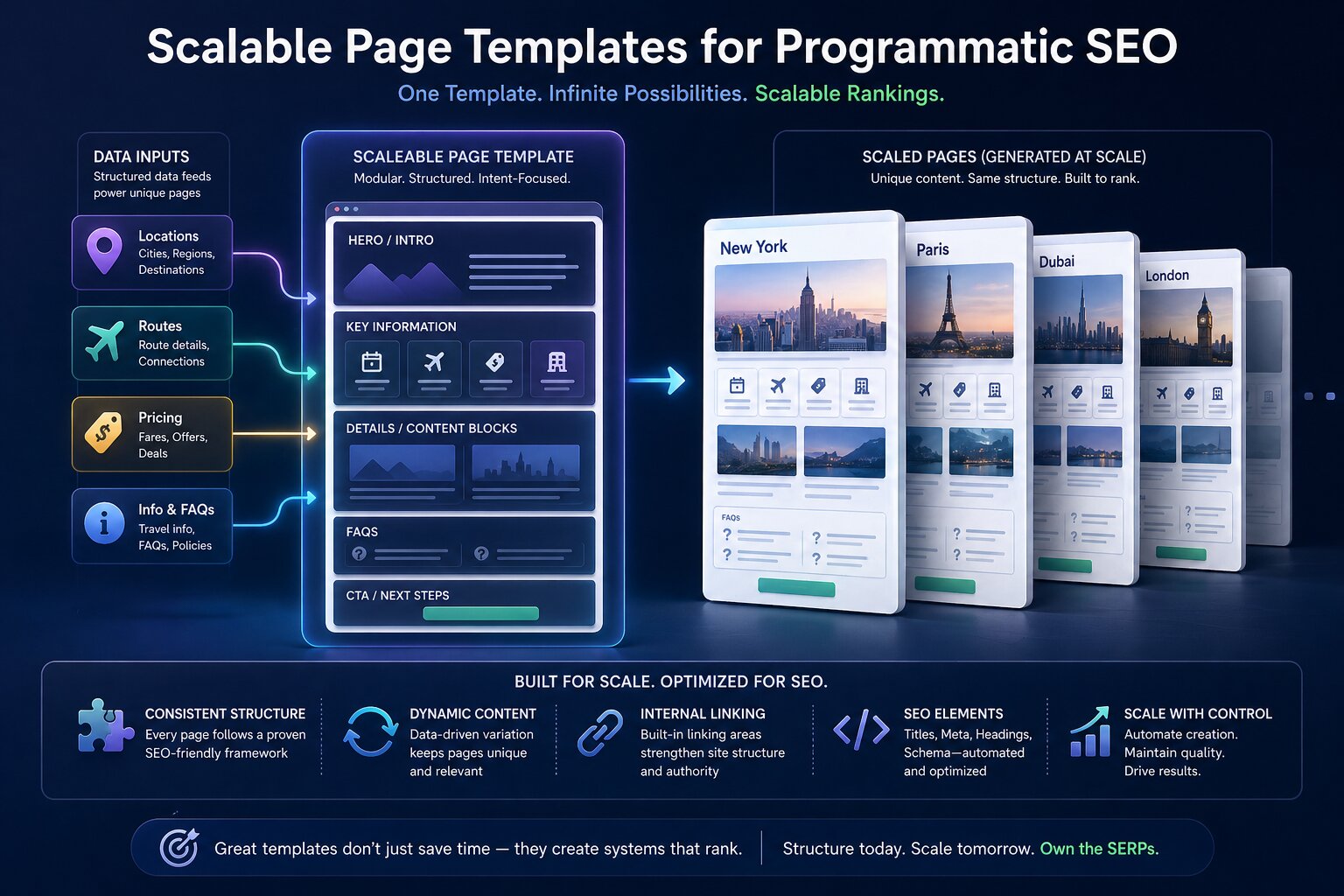
A scalable template is not just a layout—it is a combination of data, structure, and intent.
At the foundation, there is structured data. This includes the key elements that define each page—locations, routes, pricing signals, and contextual information. Without this layer, templates have nothing meaningful to work with.
On top of this sits the content structure. This is where the page is divided into sections, each serving a specific purpose. An introduction sets context, supporting sections provide details, and additional elements like FAQs help address user queries.
The final layer is dynamic content. This is what allows pages to adapt based on the data they are built on. It introduces variation while maintaining consistency, ensuring that pages do not feel repetitive.
When these layers work together, templates become more than reusable layouts—they become systems that support scalable SEO.
Designing Templates That Avoid Thin Content
One of the biggest concerns in programmatic SEO is thin content. When templates are used incorrectly, pages can end up looking similar, offering little value, and struggling to rank. This is often the result of over-reliance on static content.
A well-designed template avoids this by incorporating variation at the right levels.
Variation does not come from rewriting entire sections randomly. It comes from data-driven differences and contextual relevance. Each page should reflect its unique attributes—whether it’s a location, route, or category. The goal is not to make every page completely different. It is to make every page useful and relevant for the query it targets.
Scalable Page Templates for Programmatic SEO
A Practical Example: City-Based Page Templates
In travel, city-based pages are one of the most effective uses of programmatic SEO.
Each page follows a consistent structure—overview, key details, supporting sections, and FAQs—but the content adapts based on the location. Information such as attractions, travel insights, and contextual details change dynamically. This creates a system where pages are consistent in structure but unique in value.
This approach was applied in a real-world implementation where multiple location-based pages were created and optimized as part of a structured system. The success came not from content volume alone, but from how templates were designed and executed.
Programmatic SEO Case Study
Balancing Automation with Control
Automation is what enables scale, but it must be balanced with control. Templates should clearly define what is automated and what is controlled. Some elements—such as structured data and repetitive sections—can be automated efficiently. Others—such as intent alignment and validation—require oversight.
Without this balance, automation can lead to inconsistency and reduced quality. A strong template system ensures that automation supports the process without replacing critical decision-making.
Internal Linking Within Templates
Internal linking is often treated as a separate SEO task, but in programmatic systems, it should be built into the template itself.
By defining areas where internal links are placed, every page contributes to the overall structure of the site. This strengthens connections between pages and helps search engines understand relationships within the content. When internal linking is integrated into templates, it becomes scalable rather than manual.
Internal Linking Strategy at scale
SEO Elements Built into Templates
A scalable template must include core SEO elements as part of its structure. This includes title formats, meta descriptions, heading hierarchy, and schema. These elements should be standardized enough to maintain consistency but flexible enough to adapt to each page. When SEO elements are embedded into templates, optimization becomes part of the system rather than an afterthought.
US vs UK Considerations in Template Design
While the structure of templates remains consistent, market behavior introduces subtle differences.
In the US market, competition is higher and scale is larger. Templates need to support differentiation, ensuring that pages stand out even when targeting similar queries.
In the UK market, user behavior is often more precise and comparison-driven. Templates need to reflect this by focusing on clarity and relevance.
These differences don’t require separate systems, but they do influence how templates are refined.
The Real Impact of Template-Based Systems
Before templates are introduced, scaling often feels inconsistent. Pages are created at different times, with varying structures and levels of quality.
Once templates are implemented, the system stabilizes.
Page creation becomes faster, consistency improves, and performance becomes easier to manage. Rankings become more predictable because pages are no longer competing with each other or deviating from intent.
The shift is not just operational—it is strategic.
Practical Insight
Templates are often misunderstood as shortcuts.
In reality, they are systems that define how scaling happens.
“Templates don’t reduce effort—they redefine it. Instead of repeating the same work, you invest in building a structure that carries quality across every page you create.” — Jeffrey Mathew
Key Takeaways
Scalable page templates are the execution layer of programmatic SEO.
They allow you to transform structured data and keyword clusters into pages that can scale without losing consistency or relevance. The strength of a template lies in its ability to balance structure with variation, automation with control, and scale with quality.
Programmatic SEO is not built on content alone—it is built on systems. Templates are what turn strategy into execution. They provide the structure that allows pages to scale while maintaining alignment with user intent.
When templates are designed correctly, growth becomes predictable, and scaling becomes sustainable.
How Teckgeekz Builds Scalable Template Systems
This is where Teckgeekz approaches programmatic SEO with a system-first mindset.
Instead of treating templates as design elements, they are built as structured frameworks that align with data, intent, and scalability. Every element—from content blocks to internal linking—is designed to support long-term performance.
This ensures that as the system grows, quality remains consistent, and results remain stable.


Jeffrey Mathew
Founder & CEO • Travel Marketing Specialist
"With over 14 years of dominance in the travel and tech sectors, Jeffrey Mathew has engineered growth for hundreds of OTAs and airlines worldwide. He specializes in the intersection of Performance PPC and Agentic AI, building high-performance digital ecosystems for modern brands."
Start a Conversation
Ready to Elevate Your Business?
Fill out the form below and let's discuss how Teckgeekz can help you reach your goals.
Describe your project to unlock real-time AI service recommendations and matching portfolio cases.
Our Trusted Partners