Keyword Clustering & Topic Mapping for Programmatic SEO: Building Scalable Content Systems

Most SEO strategies begin with a list of keywords.
At first, that seems logical. You identify opportunities, create pages around them, and expect traffic to grow. And in the early stages, it often works. A few pages rank, some keywords perform, and results start to come in.
But as soon as you try to scale, something changes.
Pages begin to overlap. Multiple URLs target similar queries. Rankings fluctuate without a clear reason. Traffic grows in bursts, but not consistently. What looked like progress starts to feel unstable.
This is where the limitation of keyword-first thinking becomes clear. SEO at scale is not about targeting more keywords—it’s about structuring them properly. This is where keyword clustering and topic mapping come in. They shift the focus from isolated keywords to interconnected systems, where every page has a defined role and supports a larger structure.
In programmatic SEO, this foundation becomes even more important. When you’re creating tens or hundreds of pages, structure is not optional—it determines whether the system scales or breaks.
Why Keyword Clustering Matters in Programmatic SEO
At a smaller scale, it’s possible to manage pages individually. You can track performance, adjust content, and fix overlaps manually.
At scale, this approach stops working.
Programmatic SEO relies on creating multiple pages based on patterns—locations, routes, categories, or variations. Without proper clustering, these pages start competing with each other instead of strengthening the overall system.
This is where keyword clustering changes the approach.
Instead of assigning one keyword per page, clustering groups related queries based on search intent. Each group represents a single page or a clearly defined section of the site. This reduces overlap, improves clarity, and allows search engines to understand your structure more effectively.
The result is not just better rankings—it’s more stable growth.
Programmatic SEO systems
Moving from Keywords to Search Intent
The biggest shift in clustering is understanding that keywords are not the goal—intent is.
Two keywords may look different but represent the same intent. At the same time, similar keywords may require completely different pages.
For example, a user searching for “flights to Paris” and another searching for “cheap flights to Paris” may both be looking for booking options, but the second query has a stronger price-driven intent. The structure and messaging of the page should reflect that difference.
Without this distinction, pages become generic. They try to target multiple intents at once, which reduces their effectiveness.
Clustering works because it simplifies this complexity. It ensures that each page is aligned with a specific type of search behavior, rather than trying to cover everything at once.
Understanding Search Intent in Programmatic SEO
Search intent in programmatic SEO typically falls into patterns rather than isolated categories.
At the early stage, users are exploring. They are looking at destinations, ideas, or general options. These queries are broader and require pages that provide context rather than push conversions.
As users move forward, their searches become more specific. They start comparing routes, prices, and alternatives. Pages here need to provide clarity and differentiation.
At the final stage, intent becomes transactional. Users are ready to take action. They are evaluating final options and looking for the most efficient way to complete a booking.
Each of these stages requires a different type of page. When clustering aligns with intent, the entire system becomes more predictable and easier to optimize.
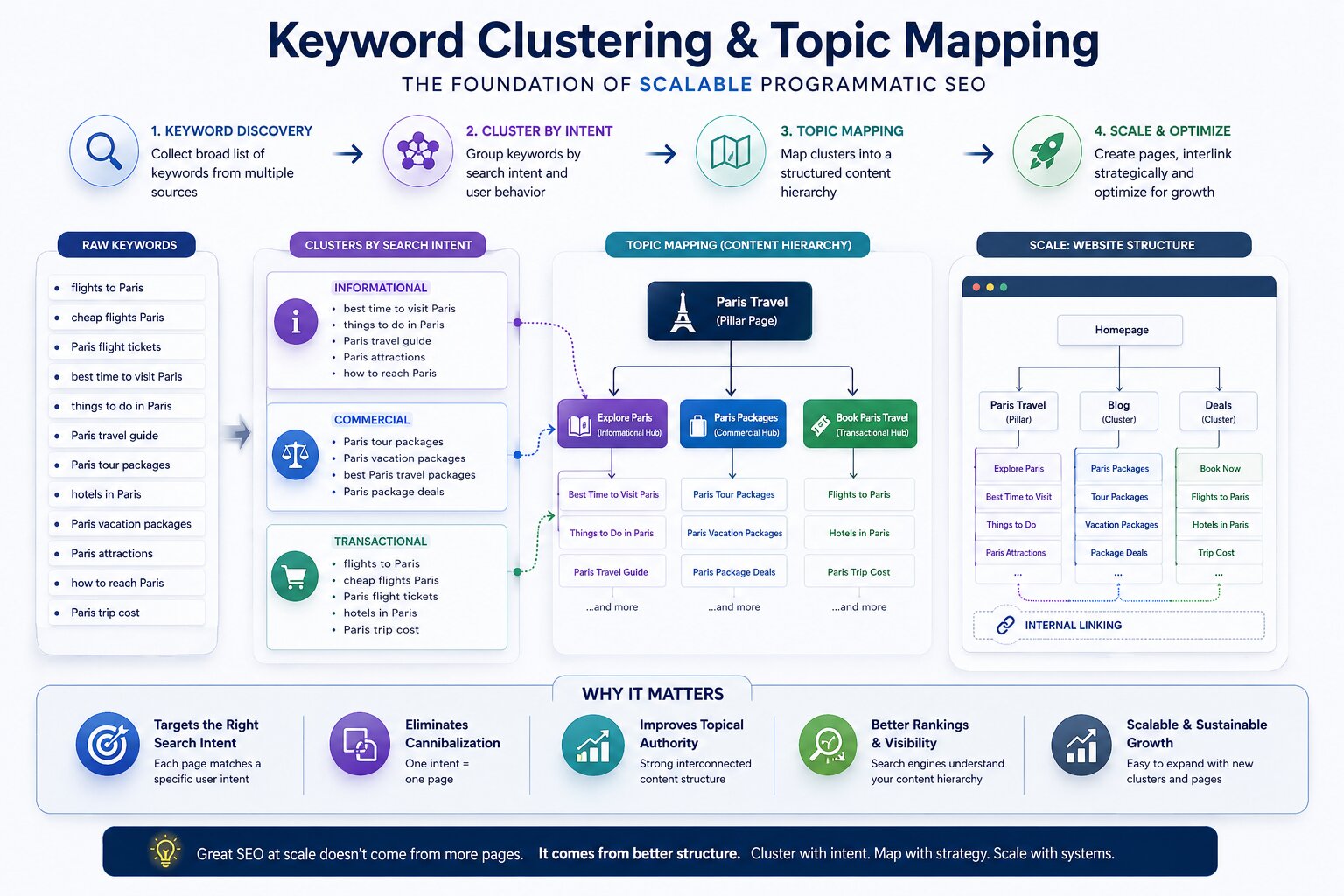
Keyword Clustering and Topic Mapping Illustration
What Keyword Clustering Actually Means
There is a common misconception that clustering is simply grouping similar keywords together.
In reality, keyword clustering is about defining page purpose.
A cluster represents a set of queries that can be served by a single page. It defines what that page should do, what information it should provide, and how it fits into the larger structure.
This is what makes clustering scalable. Instead of creating pages randomly, you create them based on defined roles within a system. Over time, this structure becomes the backbone of your SEO strategy. It allows you to expand without creating confusion or overlap.
Topic Mapping: Turning Clusters into a Scalable Structure
Once clusters are defined, the next step is topic mapping.
This is where clusters are turned into actual pages and connected within a hierarchy. Instead of a flat structure, your site begins to take shape as a system.
A core topic sits at the top. Supporting clusters branch out from it. Each cluster becomes a page, and internal links connect them in a way that reinforces their relationship.
This structure does more than organize content—it builds topical authority.
Search engines don’t just evaluate individual pages. They evaluate how those pages relate to each other. Topic mapping ensures that this relationship is clear and intentional.
Location-Based Clustering: A Practical Example
In travel, one of the most effective applications of clustering is location-based structure.
Instead of creating isolated pages, clusters are built around cities, destinations, or routes. Each location becomes a central node supported by relevant queries and variations.
This approach creates a system where pages reinforce each other. It also aligns naturally with how users search—by location, route, or destination.
This is exactly what was implemented in a real-world system of structured pages, where scalability was achieved without sacrificing quality.
Programmatic SEO Case Study
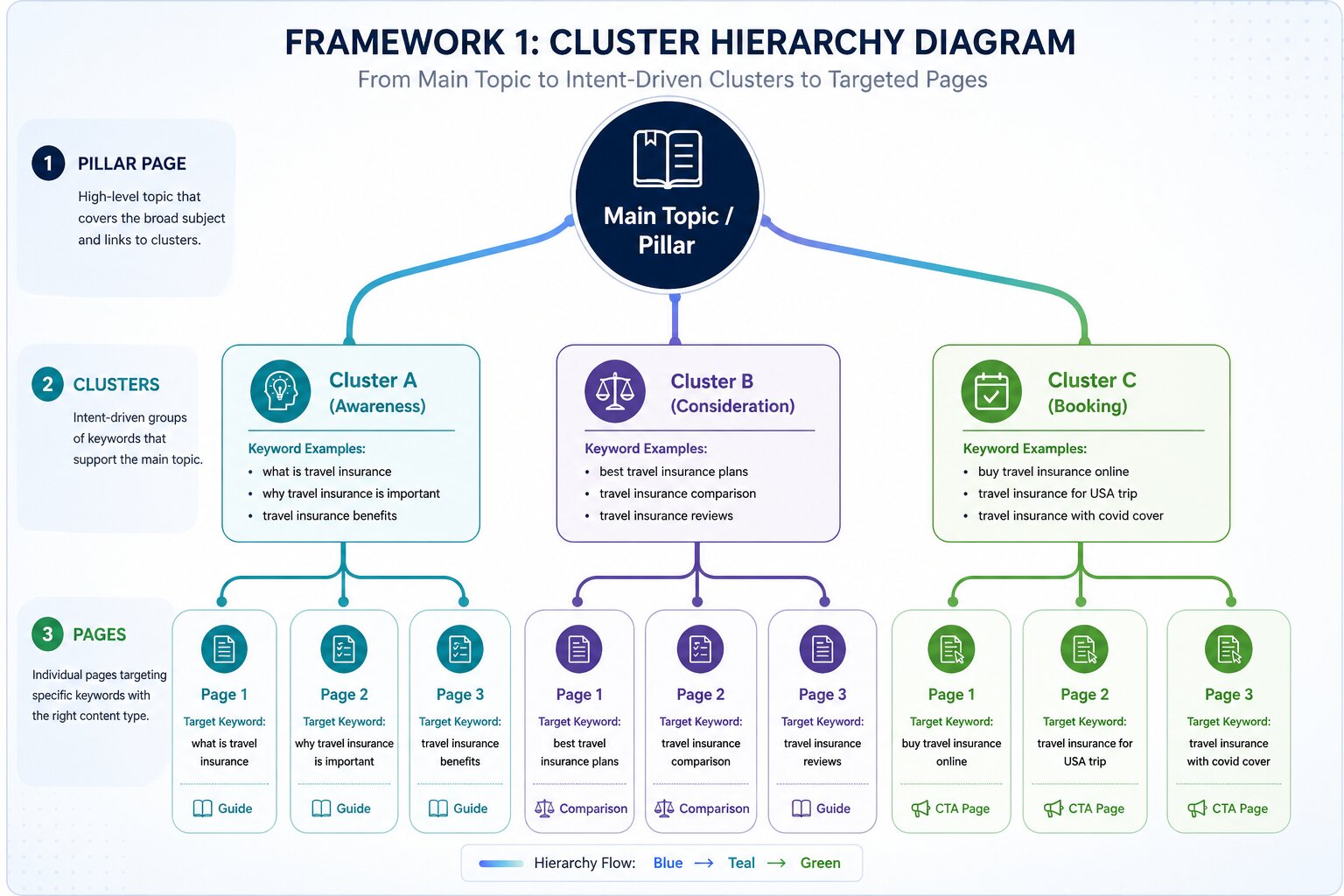
Cluster Hierarchy Diagram
Avoiding Keyword Cannibalization at Scale
One of the biggest risks in programmatic SEO is keyword cannibalization.
This happens when multiple pages target the same intent. Instead of strengthening your position, they compete against each other. Rankings fluctuate, and performance becomes inconsistent.
Clustering prevents this by ensuring that each intent is mapped to a single page.
It creates clarity—not just for search engines, but for your own system. When every page has a defined purpose, decisions become easier, and growth becomes more controlled.
Scaling Pages with Programmatic SEO
Building a Scalable Keyword Structure
A scalable SEO structure is not built on lists—it’s built on hierarchy.
At the top, you have core topics. Below that, clusters define specific areas of focus. Each cluster translates into a page, and internal links connect them into a cohesive system.
This structure allows you to expand without losing control. New pages fit into the system instead of creating new problems.
Over time, this is what transforms SEO from a collection of pages into a growth engine.
Tools vs Strategy
There are many tools available for keyword clustering, and they can be useful. But tools operate on patterns—they group keywords based on similarity, not intent.
Strategy is what defines intent. It determines which keywords belong together, which require separate pages, and how everything connects.
Tools support the process, but they don’t replace it. Without strategy, clustering becomes mechanical. With strategy, it becomes scalable.
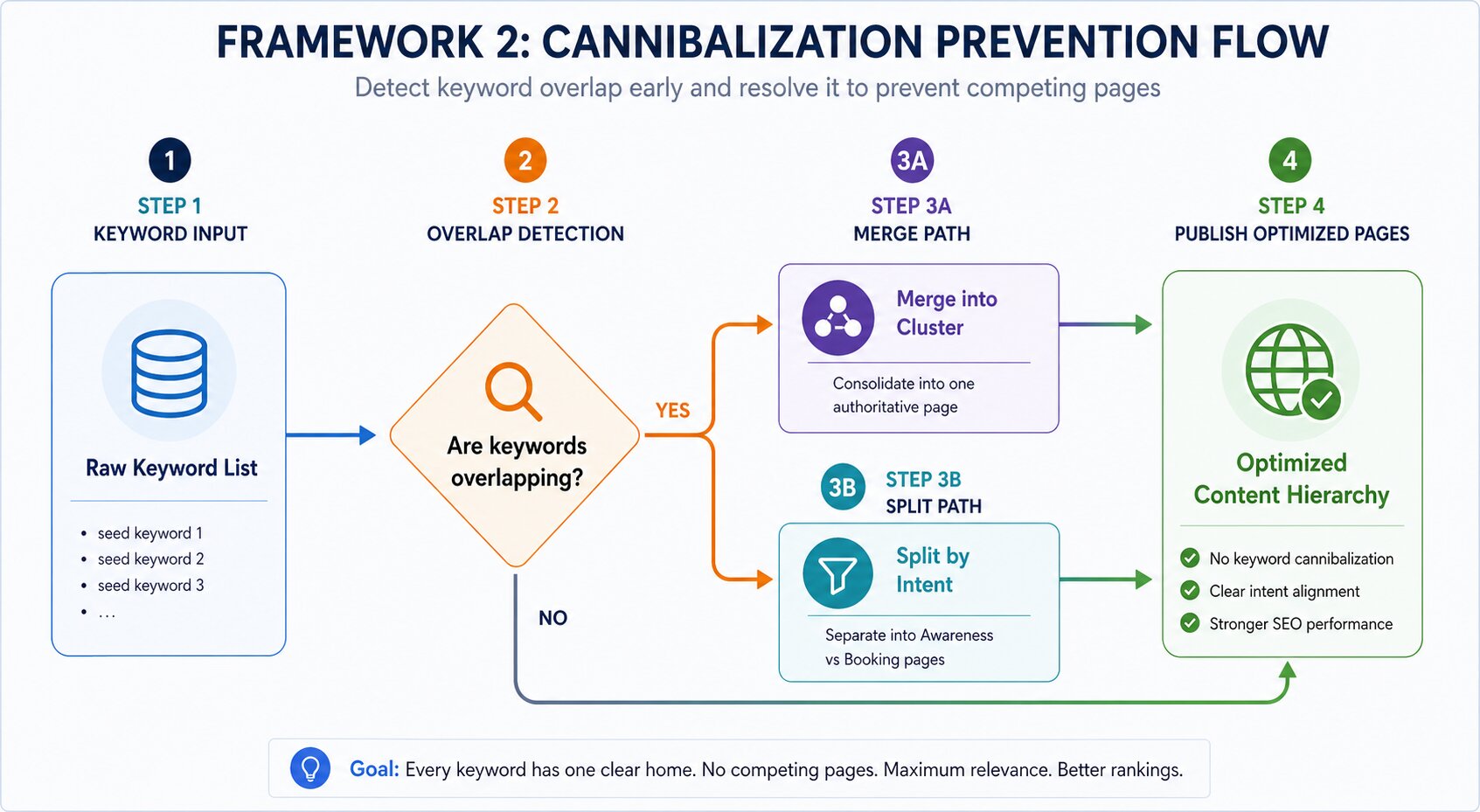
Cannibalization Prevention Flow
US vs UK Keyword Behavior
While clustering principles remain consistent, user behavior varies by market.
In the US market, search volumes are larger and keyword variations are broader. Clusters tend to be wider, and competition is higher. This requires stronger differentiation within each page.
In the UK market, queries are often more refined and comparison-driven. Users tend to evaluate options more carefully, which means clusters need to be more precise.
Understanding these differences helps refine clustering without changing the overall system.
Real Impact of Clustering: A Practical Shift
Before clustering is applied, SEO often feels unpredictable. Pages are created individually, overlap occurs, and rankings fluctuate.
Once clustering is introduced, the system stabilizes.
Pages begin to rank more consistently because they are no longer competing with each other. Traffic becomes more predictable, and growth becomes easier to manage. The shift is not immediate, but it is noticeable. Over time, the structure starts working in your favor instead of against you.
Practical Insight
Keyword clustering is not a one-time task—it’s the foundation of everything that follows.
When clustering is done correctly, scaling becomes easier. When it is ignored, scaling creates more problems than growth.
“SEO doesn’t scale when you add more pages—it scales when every page has a defined role within a system. Clustering is what makes that system possible.” — Jeffrey Mathew
Key Takeaways
Keyword clustering shifts SEO from isolated execution to structured growth. It ensures that pages are aligned with intent, reduces overlap, and creates a system that can scale efficiently.
Topic mapping builds on this by connecting pages into a cohesive structure, strengthening authority and improving performance.
Together, they form the foundation of programmatic SEO systems. Programmatic SEO does not begin with content—it begins with structure. Without clustering and mapping, scaling leads to fragmentation. With them, it leads to growth.
When keywords are organized around intent and pages are built within a defined system, SEO becomes more predictable, more efficient, and easier to expand.
How Teckgeekz Builds Scalable Keyword Systems
This is where Teckgeekz approaches SEO differently.
Instead of working with isolated keyword lists, the focus is on building structured systems where every page serves a defined purpose. Clustering and topic mapping form the foundation, ensuring that growth is aligned with user intent and long-term performance.
This approach allows SEO to scale without losing clarity—turning content into a connected system rather than a collection of pages.


Jeffrey Mathew
Founder & CEO • Travel Marketing Specialist
"With over 14 years of dominance in the travel and tech sectors, Jeffrey Mathew has engineered growth for hundreds of OTAs and airlines worldwide. He specializes in the intersection of Performance PPC and Agentic AI, building high-performance digital ecosystems for modern brands."
Start a Conversation
Ready to Elevate Your Business?
Fill out the form below and let's discuss how Teckgeekz can help you reach your goals.
Describe your project to unlock real-time AI service recommendations and matching portfolio cases.
Our Trusted Partners