AI + Programmatic SEO: How to Scale Content Without Losing Quality

Scaling SEO has always come with a trade-off.
On one side, you have manual content creation—high quality, but difficult to scale. On the other, you have automation—fast, but often shallow. For years, most teams had to choose between the two.
AI has changed that balance, but not in the way it’s often presented.
The conversation around AI in SEO is usually centered on content generation. Can it write articles? Can it create pages at scale? But that’s only a small part of the picture. The real question is whether AI can support a system that scales without losing quality.
This becomes even more important in programmatic SEO, where the goal is not to publish a few pages, but to build hundreds—or even thousands—of structured, intent-driven pages.
If quality drops at scale, the entire system weakens. Pages struggle to index, rankings become unstable, and long-term growth slows down. AI doesn’t solve this automatically. In fact, when used incorrectly, it can amplify the problem.
The difference comes down to how AI is used—not as a shortcut, but as part of a structured system.
The Role of AI in Programmatic SEO
AI is often positioned as a replacement for content creation, but in practice, its role is more nuanced.
In a well-structured programmatic SEO system, content is not created from scratch every time. It is built on a foundation of data, templates, and intent mapping. AI fits into this system as a supporting layer—helping scale output while maintaining consistency.
It can assist in expanding structured data into readable content, introducing variation across similar pages, and maintaining tone across large volumes of content. But it does not replace the core elements that drive performance.
Those elements—strategy, data structure, and intent alignment—still define whether a page will rank.
Programmatic SEO systems
Why Most AI-Generated Content Fails at Scale
The issue with AI-generated content is not the technology itself—it’s how it’s applied.
Many implementations rely on generating large volumes of content without a clear structure. Pages end up looking similar, offering little differentiation, and failing to address specific user intent. On the surface, the site appears to scale, but underneath, performance remains weak.
Search engines are increasingly effective at identifying this pattern. Pages that lack depth or uniqueness may still get indexed, but they struggle to rank consistently.
The problem is not that AI produces low-quality content by default. It’s that without a system guiding it, the output becomes disconnected from what users—and search engines—actually value.
Scalable Page Templates for Programmatic SEO
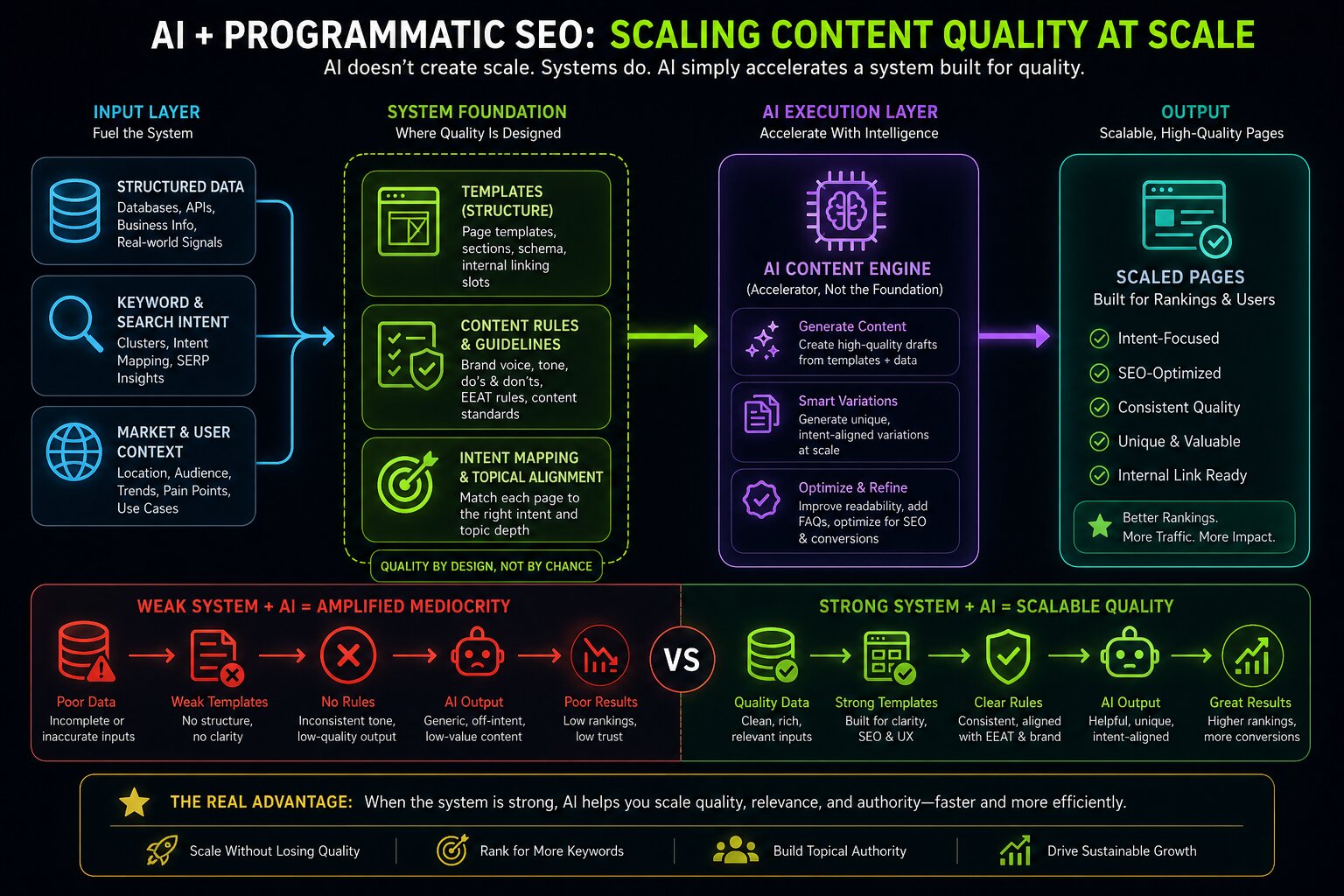
Weak systems + AI = scaled mediocrity. Strong systems + AI = scalable quality
Why Most AI-Generated Content Fails at Scale
The issue with AI-generated content is not the technology itself—it’s how it’s applied.
Many implementations rely on generating large volumes of content without a clear structure. Pages end up looking similar, offering little differentiation, and failing to address specific user intent. On the surface, the site appears to scale, but underneath, performance remains weak.
Search engines are increasingly effective at identifying this pattern. Pages that lack depth or uniqueness may still get indexed, but they struggle to rank consistently.
The problem is not that AI produces low-quality content by default. It’s that without a system guiding it, the output becomes disconnected from what users—and search engines—actually value.
Keyword Clustering and Topic Mapping in Programmatic SEO
Building a Quality-First Programmatic SEO System
The foundation of programmatic SEO is not content—it’s structure.
Before any content is generated, there needs to be a clear framework defining what each page represents, what data it uses, and what intent it serves. This is where most of the real work happens.
For example, in location-based pages, the value doesn’t come from rewriting generic text for each city. It comes from how the page is structured—what information is included, how it relates to user intent, and how it connects with the rest of the site.
AI works on top of this structure. It helps translate data into readable content, adds variation where needed, and ensures consistency across pages. But without that underlying structure, it has nothing meaningful to build on.
This is where the balance between templates and dynamic content becomes important. Templates provide consistency, ensuring that every page meets a baseline standard. Dynamic elements—supported by AI—introduce variation and relevance.
The goal is not to make every page completely unique. It’s to make every page useful within its context.
Scaling Page content using programmatic SEO
Where AI Actually Adds Value
AI becomes most effective when it is applied selectively.
It works well in areas where repetition exists but still requires variation. For example, expanding structured data into descriptive content, adjusting phrasing across similar pages, or maintaining tone consistency at scale.
It also helps reduce the time required to produce content, allowing teams to focus more on strategy and optimization rather than manual writing.
However, there are clear limits. AI does not define what pages should be created. It does not determine which keywords matter. It does not decide how pages should be structured. These decisions remain strategic.
When AI is used to replace these decisions, performance suffers. When it is used to support them, it becomes a powerful tool.
Maintaining Quality at Scale
Quality in programmatic SEO is often misunderstood.
It’s not about making every page feel like a standalone article. It’s about ensuring that each page delivers value relative to the query it targets.
This includes clarity, relevance, and usefulness. Users should be able to find what they are looking for quickly, without unnecessary friction.
At scale, this becomes a system challenge. Maintaining quality across hundreds of pages requires consistency in structure, alignment in intent, and control over variation.
AI can support this process, but it cannot define it. The system determines quality. AI helps execute it.
Indexing Strategy for Programmatic SEO
Real-World Application: What Actually Worked
In the case of building structured city pages, the success did not come from content volume alone.
The focus was on building a system where each page served a clear purpose. Data was structured carefully, templates were designed to support user intent, and content variation was introduced in a controlled way.
AI played a role, but not as the primary driver. It supported the system by helping scale content efficiently while maintaining consistency.
The results reflected this approach. Pages were able to index, rankings improved steadily, and performance remained stable as the system expanded.
The AI + Programmatic SEO Workflow
When viewed as a system, the workflow becomes clearer.
It begins with structured data—defining what pages exist and what they represent. This is followed by template creation, which ensures consistency across pages. AI then works within this structure to generate and refine content, introducing variation where needed.
Before publishing, validation plays a critical role. Pages need to be reviewed to ensure they meet quality standards and align with intent. Only then does the system scale effectively.
Skipping any part of this process creates gaps. And at scale, even small gaps become significant.
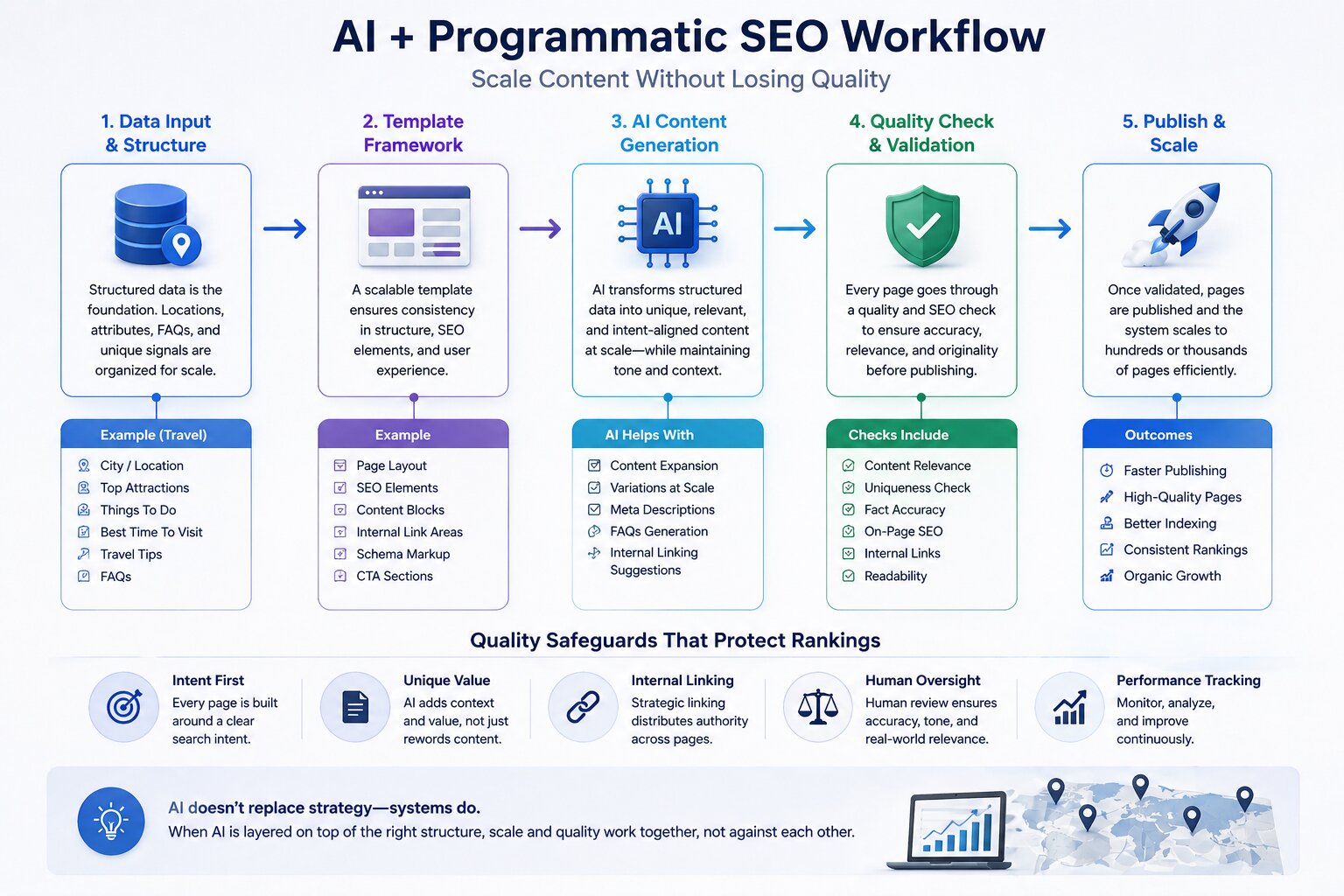
AI + Programmatic SEO Workflow
US vs UK Considerations in AI-Driven SEO Systems
While the core system remains the same, market behavior introduces subtle differences.
In the US market, scale is often larger, competition is stronger, and content needs to stand out more clearly. AI-supported systems need to focus on differentiation to avoid blending into similar pages.
In the UK market, user behavior tends to be more comparison-driven and detail-focused. Content needs to feel precise and relevant, even when generated at scale.
These differences don’t require entirely separate systems, but they do influence how content is structured and refined.
Practical Insight
The biggest misconception about AI in SEO is that it creates scale on its own.
In reality, scale comes from systems. AI simply accelerates what those systems are designed to do.
When the system is weak, AI amplifies the weaknesses. When the system is strong, AI enhances efficiency without compromising quality.
“AI doesn’t create authority—systems do. The moment you treat content generation as the goal instead of the outcome of a structured process, scale starts working against you instead of for you.” — Jeffrey Mathew
Key Takeaways
AI in programmatic SEO is not a replacement for strategy—it’s an extension of it.
Quality must be defined at the system level, not at the individual page level. Structure, intent alignment, and consistency determine long-term performance.
When these elements are in place, AI becomes a powerful tool for scaling. Without them, it becomes a source of inefficiency.
Programmatic SEO is not about producing more content. It’s about building systems that can scale sustainably.
AI plays an important role in that system, but it is not the foundation. The foundation remains strategy, structure, and understanding of user intent.
When these elements come together, scale stops being a challenge and becomes an advantage.
How Teckgeekz Builds Scalable AI-Driven SEO Systems
This is where Teckgeekz approaches programmatic SEO differently.
Instead of relying on automation alone, the focus is on building structured systems where AI supports execution without compromising quality. Data, templates, and intent mapping form the foundation, while AI helps scale output efficiently.
This approach ensures that growth is not just fast, but stable—allowing pages to rank, perform, and sustain visibility over time.


Jeffrey Mathew
Founder & CEO • Travel Marketing Specialist
"With over 14 years of dominance in the travel and tech sectors, Jeffrey Mathew has engineered growth for hundreds of OTAs and airlines worldwide. He specializes in the intersection of Performance PPC and Agentic AI, building high-performance digital ecosystems for modern brands."
Start a Conversation
Ready to Elevate Your Business?
Fill out the form below and let's discuss how Teckgeekz can help you reach your goals.
Describe your project to unlock real-time AI service recommendations and matching portfolio cases.
Our Trusted Partners