Programmatic SEO: How to Build Scalable Organic Traffic Systems That Actually Rank

There’s a point where traditional SEO starts to feel inefficient. In the beginning, it works well. You research keywords, publish content, optimize pages, and gradually see results. Each page feels like progress.
But as you try to scale, something changes.
You publish more, but growth doesn’t follow at the same pace. Some pages perform, others don’t. Rankings fluctuate. Traffic feels inconsistent. The effort keeps increasing, but the system doesn’t compound.
This is where most SEO strategies hit their ceiling.
Programmatic SEO is often introduced as the answer—but in reality, it’s frequently misunderstood. It’s not about generating pages in bulk. It’s not about automation for the sake of speed.
It’s about building a system where pages are created with structure, connected through logic, and supported by a framework that allows them to perform together.
When that system is missing, scale creates noise. When it’s in place, scale creates momentum.
What Programmatic SEO Really Means
Programmatic SEO is often explained in terms of automation, but that only captures a small part of it.
At its core, it is a shift in how SEO is approached.
Instead of building pages one at a time, you build a structure that defines how pages are created. Instead of focusing on individual keywords, you group them based on intent. Instead of optimizing isolated content, you design a system where pages support each other.
This changes the nature of the work.
You spend less time repeating tasks and more time designing how those tasks scale. The focus moves from execution to structure, and from output to consistency. That’s what makes programmatic SEO different. Not the volume—but the way that volume is managed.
Why Most Programmatic SEO Efforts Fail
The idea of programmatic SEO is appealing, which is why so many attempts fall short. The problem is not the concept—it’s how it’s implemented.
A common mistake is treating it as a content generation strategy. Pages are created in large numbers, but without a clear structure behind them. They look similar, serve overlapping purposes, and fail to differentiate themselves.
In other cases, templates are introduced, but they are too rigid. Every page follows the same pattern with minimal variation. Over time, this leads to thin content and weak indexing.
Another issue is the absence of internal linking. Pages exist, but they don’t connect. Authority doesn’t flow, and the system remains fragmented.
And then there’s indexing. Pages are published, but no consideration is given to whether they should be indexed or how they will be discovered.
Individually, these issues seem manageable. Together, they prevent the system from working. Programmatic SEO doesn’t fail because it scales. It fails because it scales without structure.
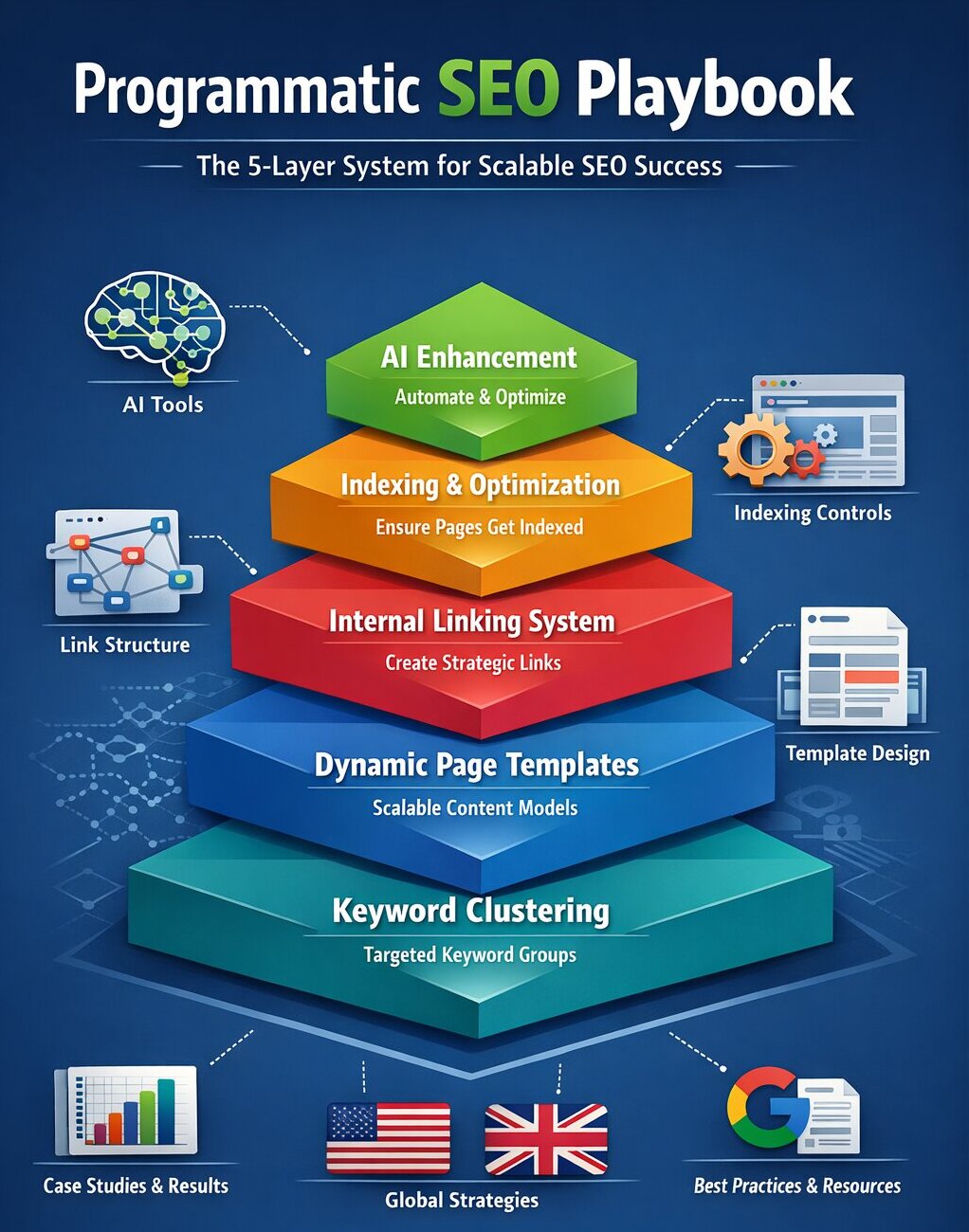
Programmatic SEO Playbook
The Core Components of a Scalable Programmatic SEO System
A functioning programmatic SEO system is not built on a single tactic. It’s built on layers that work together.
Each layer has a role. When they align, the system becomes stable. When one is missing, performance becomes inconsistent.
1. Keyword Clustering & Topic Mapping (Foundation)
Everything starts with structure.
Instead of treating keywords individually, they are grouped based on search intent. Each group represents a clear purpose and translates into a single page or a defined section.
This is what prevents overlap.
Without clustering, multiple pages end up targeting the same queries. With it, each page has a defined role within the system.
Keyword clustering for programmatic SEO
2. Scalable Page Templates (Execution Layer)
Once the structure is defined, it needs to be executed consistently.
This is where templates come in.
A template is not just a layout—it’s a framework that defines how information is presented, how sections are organized, and how content adapts based on data.
The challenge is balance.
Too much consistency leads to repetition. Too much variation leads to inconsistency. The template needs to hold both—structure and flexibility.
Scalable page templates for programmatic SEO
3. Internal Linking Strategy (Authority Flow)
Pages don’t perform in isolation.
Internal linking is what connects them into a system.
It defines how authority moves across the site, how pages reinforce each other, and how search engines understand relationships between different sections.
Without it, pages remain disconnected. With it, they become part of a network that strengthens over time.
Internal linking strategy at scale
4. Indexing Strategy (Visibility Control)
Publishing a page doesn’t mean it will be indexed.
At scale, search engines become selective. They evaluate which pages are worth including and which are not.
An indexing strategy ensures that the right pages are prioritized, that crawl resources are used efficiently, and that the system maintains a high level of perceived quality.
This is where many implementations fall short—because indexing is treated as an outcome rather than a controlled process.
Indexing strategy for programmatic SEO
5. AI + Programmatic SEO (Scaling Layer)
AI plays a role, but not the one it’s often assigned. It doesn’t replace strategy. It supports execution.
In a structured system, AI helps expand content, introduce variation, and maintain consistency across pages. But it works within the boundaries defined by clustering, templates, and intent.
When those boundaries are missing, AI amplifies the problem instead of solving it.
How These Components Work Together
These components are not independent. They form a sequence. Clustering defines what should exist. Templates determine how it is built. Internal linking connects it. Indexing controls its visibility. AI supports the process.
If one layer is weak, it affects everything else.
For example, without clustering, templates create overlap. Without templates, linking becomes inconsistent. Without linking, indexing slows down. Without indexing, none of the pages contribute to growth. This is why programmatic SEO is not about tactics—it’s about alignment.
A Real-World System in Practice
In a structured implementation focused on location-based pages, the shift from isolated pages to a connected system made a measurable difference.
Initially, pages were created individually. They followed similar patterns but lacked a cohesive structure. Some pages performed, but the system as a whole was inconsistent.
Once the structure was introduced, everything changed.
Keyword clusters defined what each page represented. Templates ensured consistency while allowing variation. Internal linking connected pages logically. Indexing was controlled instead of assumed.
The result was not just better performance—it was more predictable performance.
Before vs After: What Actually Changed
Metric | Before System | After System | Impact |
|---|---|---|---|
Indexation Rate | ~55–60% | ~85–90% | +30% |
Avg Ranking Position | Page 2–3 | Page 1 range | Clear improvement |
Organic Traffic Growth | Inconsistent spikes | Stable upward trend | +40–50% |
Pages Driving Traffic | ~30–35% | ~60–70% | Nearly doubled |
What stands out here is not just the improvement—it’s the stability. Performance stopped being unpredictable. The system began to support itself.
US vs UK: Same System, Different Behavior
The structure of programmatic SEO doesn’t change across markets, but user behavior does.
In the US, scale is larger and competition is stronger. Systems need to handle more variation and differentiate more clearly.
In the UK, queries tend to be more refined. Users compare more, and relevance becomes more important than breadth.
These differences don’t require separate systems, but they do influence how those systems are refined.
Where Most Systems Break
Even with the right components, systems can fail if they are not aligned. Sometimes clustering is done, but templates are weak. Sometimes templates exist, but linking is inconsistent. Sometimes everything is in place, but indexing is ignored.
The result is the same—partial performance. Programmatic SEO doesn’t reward partial systems. It works when everything connects. The shift from traditional SEO to programmatic SEO is not about doing more.
It’s about thinking differently.
“Programmatic SEO starts working the moment you stop treating pages as individual assets and start treating them as parts of a system. That’s where scale becomes an advantage, not a risk.” — Jeffrey Mathew
Frequently Asked Questions
What is programmatic SEO in simple terms?
Programmatic SEO is about building a system that allows you to create and manage multiple pages efficiently, rather than treating each page as a separate task. Instead of writing content one by one, you define structure, group keywords by intent, and use templates to scale without losing consistency.
How is programmatic SEO different from traditional SEO?
Traditional SEO focuses on optimizing individual pages. Programmatic SEO focuses on how those pages are created, connected, and scaled as a system. The difference is not just in execution—it’s in how the entire approach is structured.
Does programmatic SEO actually work?
It does—but only when it’s implemented as a complete system. Simply generating pages won’t produce results. Performance comes from how clustering, templates, internal linking, and indexing work together. When those elements align, growth becomes consistent.
Why do many programmatic SEO strategies fail?
Most failures come from trying to scale without structure. Pages are created in bulk, but they lack clear intent, proper linking, or indexing control. Without a system behind them, those pages don’t contribute to long-term growth.
Can programmatic SEO lead to thin or duplicate content?
It can, if templates are poorly designed. When variation is limited and pages don’t adapt based on context, content starts to feel repetitive. A well-structured system avoids this by using data and intent to create meaningful differences between pages.
Is programmatic SEO only useful for large websites?
It becomes more valuable as a site grows, but the principles apply at any stage. Even smaller sites benefit from structured clustering and scalable templates—it simply becomes more critical as volume increases.
What role does AI play in programmatic SEO?
AI helps with scaling execution, but it doesn’t define the strategy. It works best when used within a structured system—supporting content variation and consistency rather than replacing decision-making.
How long does it take to see results with programmatic SEO?
It depends on how well the system is built. When structure, linking, and indexing are aligned, improvements can be seen within weeks. However, the real benefit is long-term—consistent growth rather than short-term spikes.
Do all programmatic SEO pages get indexed?
No—and they shouldn’t. Search engines evaluate which pages provide value. A strong system focuses on quality and relevance, ensuring that the pages that matter are more likely to be indexed and ranked.
What is the most important part of programmatic SEO?
There isn’t a single most important part—it’s how everything connects. Clustering defines structure, templates enable execution, linking builds authority, and indexing controls visibility. The system works when all of these align.
Takeaways
Programmatic SEO is not a shortcut—it’s a framework. It replaces isolated execution with structured growth. It turns individual pages into connected systems. Clustering defines intent. Templates ensure consistency. Linking distributes authority. Indexing controls visibility. AI supports scale. When these elements work together, growth becomes predictable.
There’s nothing complicated about creating pages. The challenge is building something that can grow without breaking. Programmatic SEO works because it addresses that challenge directly. It doesn’t rely on effort alone—it relies on structure. When that structure is in place, scaling stops being a problem and starts becoming an advantage.
How Teckgeekz Builds Programmatic SEO Systems
This is where Teckgeekz approaches SEO differently.
The focus is not on producing more content, but on building systems where every page has a defined role, clear connections, and a higher chance of performing.
By aligning structure, execution, and visibility, the system becomes stable—and that’s what allows it to scale.
How Teckgeekz Builds Programmatic SEO Systems
This is where Teckgeekz approaches programmatic SEO differently—not as a content strategy, but as a structured growth system.
The focus is not on generating pages at scale. It’s on designing a framework where every page has a defined role, clear intent, and a place within a connected system.
It starts with keyword clustering and topic mapping, where search intent is broken down into structured groups. Instead of chasing individual keywords, the system is built around how users actually search—and how those searches translate into pages.
From there, scalable templates are designed to turn that structure into execution. These templates are not rigid layouts. They are built to balance consistency with variation, allowing pages to scale without becoming repetitive or losing relevance.
Internal linking is then treated as a core layer, not an afterthought. Pages are connected based on clusters and hierarchy, ensuring that authority flows naturally across the system. This creates a network where pages support each other instead of competing.
At the same time, indexing is controlled, not assumed. Not every page is pushed equally. The system is designed to prioritize high-value pages, improve crawl efficiency, and ensure that what gets indexed is aligned with performance potential.
AI is integrated carefully within this structure. It supports content expansion and variation, but always within defined boundaries. The goal is not automation—it’s consistency at scale.
What brings all of this together is alignment.
Each layer—clustering, templates, linking, indexing, and AI—works as part of the same system. This is what allows programmatic SEO to move beyond experimentation and become a reliable growth engine.
The result is not just more pages. It’s a system where pages are connected, discoverable, and capable of performing consistently over time.


Jeffrey Mathew
Founder & CEO • Travel Marketing Specialist
"With over 14 years of dominance in the travel and tech sectors, Jeffrey Mathew has engineered growth for hundreds of OTAs and airlines worldwide. He specializes in the intersection of Performance PPC and Agentic AI, building high-performance digital ecosystems for modern brands."
Start a Conversation
Ready to Elevate Your Business?
Fill out the form below and let's discuss how Teckgeekz can help you reach your goals.
Describe your project to unlock real-time AI service recommendations and matching portfolio cases.
Our Trusted Partners