Indexing Strategy for Programmatic SEO: How to Control What Gets Indexed at Scale

Creating pages is easy. Getting them indexed—and more importantly, getting them to contribute to traffic—is where things become complicated.
In the early stages of SEO, indexing feels automatic. You publish a page, and within a few days, it appears in search results. There’s a sense of predictability. Effort goes in, and visibility follows.
But as you begin to scale, that pattern starts to break.
You publish more pages. Some get indexed quickly, others take weeks, and some never appear at all. There’s no clear signal as to why. Everything looks right on the surface—content is there, structure is in place, links exist—but results remain inconsistent.
This is the point where most programmatic SEO systems hit friction. The issue is not the number of pages. It’s the absence of an indexing strategy.
Search engines don’t index everything. They filter. They prioritize. And at scale, they become selective about what deserves to be included.
This blog focuses on how to control that process—how to ensure that the pages you create are not just published, but actually seen.
Why Indexing Matters More in Programmatic SEO
At a small scale, indexing is forgiving. Search engines have fewer pages to evaluate, and most of them make it into the index. Even if the structure is not perfect, visibility still happens.
In programmatic SEO, this changes. When dozens or hundreds of pages are introduced, search engines begin to evaluate them differently. They are no longer looking at pages individually—they are assessing the system as a whole.
This is where indexing becomes selective.
Pages that appear similar, lack differentiation, or do not demonstrate clear value are often skipped. They may be crawled, but they are not indexed. And without indexing, they do not exist in search results.
This creates a gap between effort and outcome. Pages are created, but they do not contribute to growth. Understanding this shift is critical. Indexing is not guaranteed—it is earned.
Programmatic SEO Systems
Crawling, Indexing, and Ranking: Understanding the Difference
One of the most common misunderstandings in SEO is assuming that crawling, indexing, and ranking are the same.
They are not.
Crawling is discovery. Search engines find your pages through links, sitemaps, or other signals.
Indexing is inclusion. The page is evaluated and added to the search engine’s database.
Ranking is visibility. The page appears in search results for relevant queries.
At scale, many pages are crawled but not indexed. This is where most inefficiencies occur. A page that is not indexed cannot rank, regardless of how well it is optimized.
Why Pages Fail to Get Indexed
When pages fail to index, it is rarely due to a single issue. It is usually the result of how the system is perceived.
One of the most common reasons is low perceived value. Pages that appear repetitive or too similar do not provide enough reason to be included.
Another factor is weak internal linking. If a page is not connected well within the site, it becomes harder to discover and evaluate.
Structure also plays a role. Pages that are not aligned with clear intent or lack differentiation often struggle to pass the indexing threshold. At scale, these issues compound. What might not matter for a few pages becomes critical when applied to hundreds.
Building an Indexing-First Strategy
Most SEO workflows are content-first. Pages are created, published, and then optimized. In programmatic SEO, this approach needs to shift. Indexing should be considered from the beginning.
This means designing pages in a way that makes them easier to evaluate and include. Structure, content, and linking should all support indexing, not just ranking. When indexing becomes part of the system, results become more predictable.
The Role of Internal Linking in Indexing
Internal linking is one of the strongest signals for indexing.
Search engines rely on links to discover pages and understand how they relate to each other. A well-linked page is easier to find, easier to evaluate, and more likely to be indexed.
At scale, this becomes even more important.
When pages are connected through structured linking, they form a network. This network guides crawlers and reinforces relevance. Without this structure, pages become isolated. And isolated pages often remain unindexed.
Internal Linking Strategy at scale
Template Quality and Its Impact on Indexing
Templates influence how pages are perceived. When templates are too rigid or repetitive, pages begin to look similar. Even if the data changes, the overall structure feels duplicated.
Search engines detect this pattern.
Pages that do not show enough variation or context are less likely to be indexed consistently. This is why template design is directly connected to indexing.
A strong template introduces variation through data, context, and structure. It ensures that each page provides something distinct, even within a system.
Scalable Page Templates for programmatic SEO
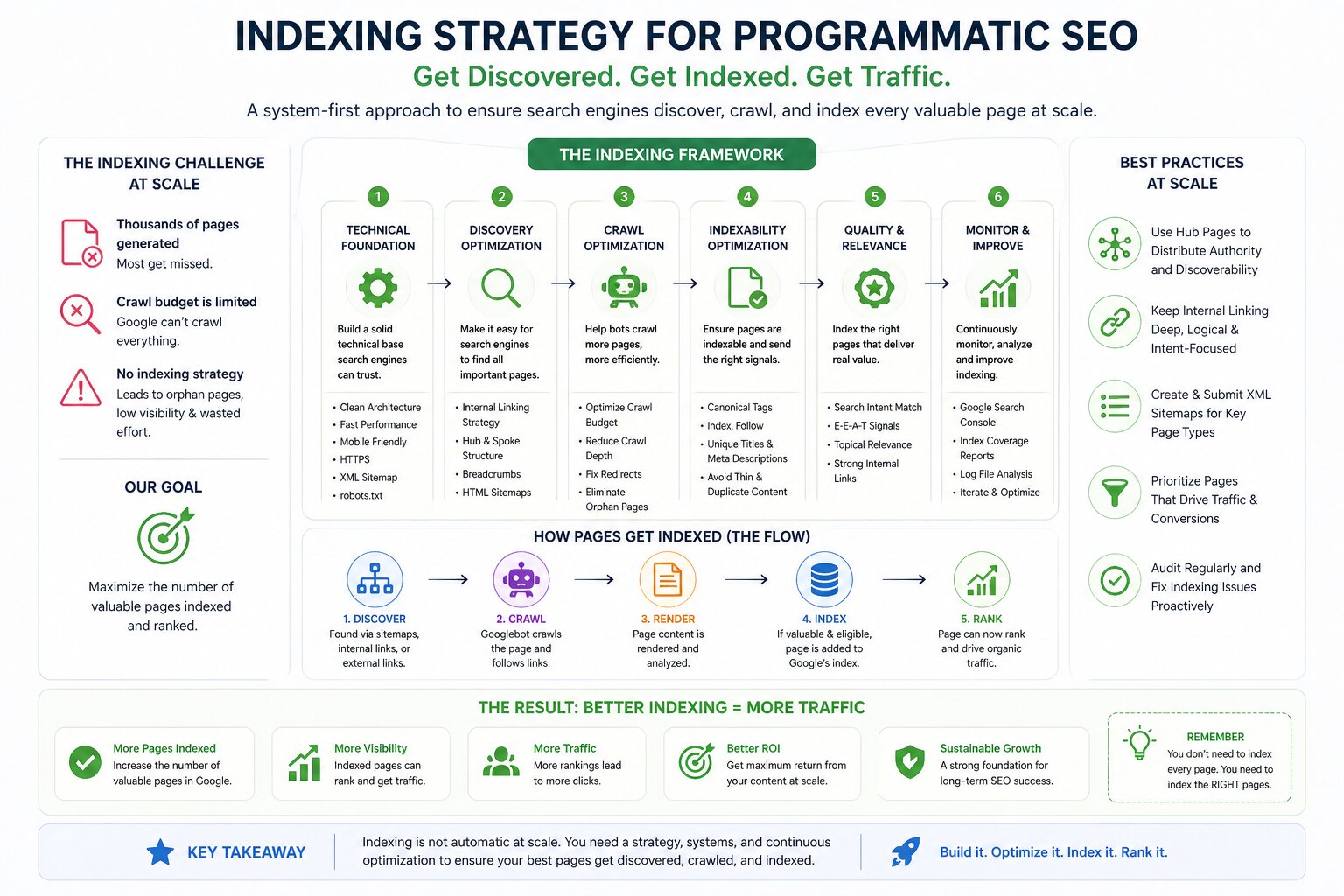
How programmatic SEO pages get discovered, crawled, and indexed at scale
Keyword Clustering and Indexing Efficiency
Keyword clustering plays a subtle but important role in indexing. When clusters are defined properly, each page targets a specific intent. This reduces overlap and ensures that pages are not competing with each other.
From an indexing perspective, this clarity matters.
Pages that have a clear purpose are easier to evaluate. Pages that overlap create confusion. Clustering does not just improve rankings—it improves the likelihood of pages being indexed in the first place.
Keyword Clustering for programmatic SEO
Managing Crawl Budget at Scale
Search engines do not crawl every page equally. They allocate resources based on how they perceive the site. At scale, this becomes important.
If too many pages are introduced without structure, crawl efficiency drops. Important pages may be delayed, while less valuable ones consume resources.
This is where crawl budget management comes in. The goal is not to control how much is crawled directly, but to influence it through structure. Strong linking, clear hierarchy, and focused publishing help ensure that important pages are prioritized.
Controlling What Gets Indexed
Not every page should be indexed. In large systems, some pages may not provide enough value to justify inclusion. Indexing everything can reduce overall quality signals.
This is where control becomes important.
Techniques such as selective indexing, structured publishing, and prioritization help ensure that only valuable pages are pushed into the index. This improves the overall perception of the site and strengthens performance.
Gradual Scaling vs Bulk Publishing
One of the common mistakes in programmatic SEO is publishing too many pages at once. While this may seem efficient, it often reduces indexing efficiency.
When a large number of pages appear suddenly, search engines take longer to evaluate them. Some pages may be delayed, and others may not be indexed at all.
Gradual scaling creates a different pattern.
Pages are introduced in stages, allowing search engines to crawl and evaluate them more effectively. This leads to more consistent indexing and better long-term results.
Real Impact of Indexing Strategy
Before implementing a structured indexing strategy, the system showed clear inefficiencies. Pages were being created, but a significant portion of them never made it into the index.
After restructuring the system—improving internal linking, refining templates, and controlling publishing—the impact became measurable.
Performance Comparison
Metric | Before Strategy | After Strategy | Improvement |
|---|---|---|---|
Indexation Rate | 58% of pages indexed | 89% of pages indexed | +31% |
Avg Time to Index | 12–18 days | 4–6 days | ~65% faster |
Crawl Efficiency | Irregular | Consistent crawl pattern | Significant improvement |
Organic Traffic Contribution | Limited | Expanded across more pages | +52% increase |
Pages Driving Traffic | 35% | 68% | Nearly doubled |
Content‑First vs Indexing‑First Workflows
Dimension | Content‑First Workflow | Indexing‑First Workflow |
|---|---|---|
Primary Goal | Publish maximum number of pages quickly | Ensure pages are crawled, indexed, and trusted before scaling |
Publishing Cadence | Bulk publishing in large batches | Gradual, controlled publishing aligned with crawl budget and system evaluation cycles |
Template Design | Uniform templates with minimal variation | Structured templates with deliberate variation to avoid duplication patterns |
Internal Linking | Often secondary, added post‑publication | Core driver of indexation; linking planned before publishing |
Keyword Strategy | Broad targeting, risk of overlap | Keyword clustering to reduce overlap and clarify intent |
Crawl Budget Impact | High risk of wasted crawl budget on duplicate/low‑value pages | Optimized crawl budget allocation to priority pages |
Indexation Rate | Lower, selective inclusion by search engines | Higher, consistent inclusion due to system clarity |
Time to Index | Slower, unpredictable | Faster, predictable due to structured signals |
Traffic Contribution | Many pages remain invisible, contributing little | Majority of published pages contribute measurable traffic |
System Signal | Ambiguous; search engines struggle to evaluate site reliability | Clear; site signals reliability and authority through structured workflows |
ROI Outcome | High content volume but diluted visibility | Scaled visibility with stronger ROI per page |
The key shift was not just higher indexing rates, but better distribution of performance across pages.
US vs UK Considerations
Market behavior influences indexing patterns.
In the US market, larger datasets and higher competition mean that search engines are more selective. Pages need stronger differentiation and clearer signals to be indexed consistently.
In the UK market, datasets are often smaller, and indexing cycles can be faster. However, relevance plays a stronger role, and pages need to align closely with user intent.
These differences do not require separate strategies, but they do influence how systems are refined.
Insight
Indexing is often treated as a technical outcome. In reality, it is a reflection of how your system is structured.
“Search engines don’t ignore pages randomly—they ignore what doesn’t fit. Indexing improves the moment your system becomes clear enough for them to trust it.” — Jeffrey Mathew
Takeaways
Indexing is not automatic—it is selective.
At scale, structure determines which pages are included and which are ignored.
Internal linking, templates, and clustering all influence indexing. Together, they create a system that supports visibility. When indexing is controlled, performance becomes more stable and scalable.
Programmatic SEO is not just about creating pages—it is about ensuring they are seen. Indexing is the layer that connects effort to visibility. Without it, even well-structured systems fail to deliver results.
When indexing is approached as a strategy rather than an outcome, SEO becomes more predictable, and growth becomes more sustainable.
How Teckgeekz Builds Indexing-Optimized Systems
This is where Teckgeekz focuses on system-level SEO.
Instead of relying on publishing volume, the approach is built around structured growth—ensuring that every page created has a clear purpose, strong connections, and a higher probability of being indexed.
By aligning structure, linking, and scaling strategy, indexing becomes consistent rather than unpredictable.


Jeffrey Mathew
Founder & CEO • Travel Marketing Specialist
"With over 14 years of dominance in the travel and tech sectors, Jeffrey Mathew has engineered growth for hundreds of OTAs and airlines worldwide. He specializes in the intersection of Performance PPC and Agentic AI, building high-performance digital ecosystems for modern brands."
Start a Conversation
Ready to Elevate Your Business?
Fill out the form below and let's discuss how Teckgeekz can help you reach your goals.
Describe your project to unlock real-time AI service recommendations and matching portfolio cases.
Our Trusted Partners