What is SEMrush and How to Use SEMrush? A Complete Guide with Detailed Metrics Explanation
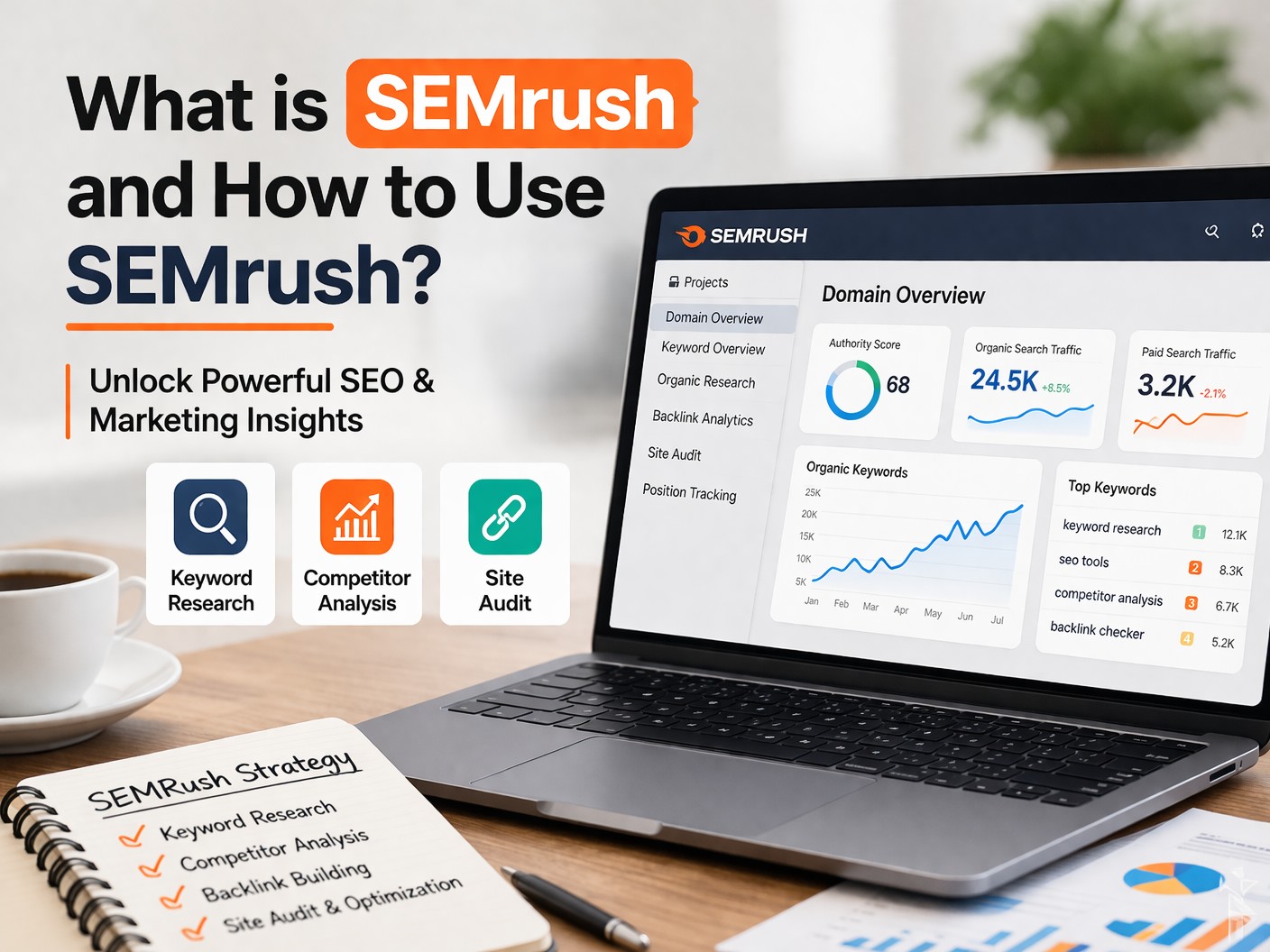
Every serious SEO decision eventually comes down to data — which keywords are worth chasing, which competitor is actually winning, and whether a website is technically healthy enough to rank in the first place. SEMrush has been the tool most agencies and in-house teams reach for to answer those questions for close to two decades, and it's changed shape more in the last year than in most of the years before it. This guide covers the platform in full depth, and specifically what's different about using it now.
What SEMrush actually is
SEMrush is a data platform first, and a software suite second — a distinction worth understanding before anything else, because it explains why the tool is valuable in the first place. Underneath the interface sits an enormous independent web index: tens of billions of tracked keywords and tens of trillions of backlinks, crawled and refreshed on its own schedule rather than borrowed from Google. Every feature built on top of that index — keyword research, competitor analysis, backlink auditing, technical site scanning — is really just a different lens on the same underlying dataset.
What started in 2008 as a fairly narrow keyword research tool has grown into one of the most complete marketing intelligence platforms available, used across SEO professionals, PPC managers, content teams, and full-service agencies. The most significant recent change to the business itself is corporate rather than technical: Adobe completed a $1.9 billion acquisition of SEMrush in 2026, folding it into the broader Adobe ecosystem. For day-to-day users, the practical effect so far has been minimal — pricing, features, and the core product experience have continued operating as before — but it's a signal worth being aware of, since a platform of this scale being absorbed into Adobe's marketing cloud tends to shape roadmap priorities over the following few years.
How the toolkit is actually organized now
One thing that trips up newer users, and even some who've used an older version of the platform, is that SEMrush no longer functions as a single, flat toolset. It's now organized into distinct toolkits — SEO, Local, Content, Social, Advertising, PR, and, most notably, an AI Visibility toolkit added in response to the shift toward AI-generated answers. Each toolkit draws on its own report allowance, and which ones are available depends on the specific plan and bundle a subscription includes, so it's worth checking which toolkits are actually active on an account before assuming a feature exists but is simply hidden somewhere in the interface.
The classic SEO toolkit — keyword research, competitor analysis, site auditing, backlink analysis, and rank tracking — remains the core of the product and the starting point for most users. But treating that as the whole platform now means missing a genuinely important addition, which the next section covers in detail.
The AI Visibility toolkit: tracking how AI systems represent your brand
This is the most consequential addition to the platform in years, and it exists because of a real shift in how people search. A meaningful and growing share of research now happens through AI assistants — ChatGPT, Gemini, Perplexity, and Google's own AI Overviews — rather than through a traditional list of ranked links. SEMrush's AI Visibility toolkit is built specifically to answer a question that traditional rank tracking simply can't: when someone asks an AI system a question relevant to your business, does your brand get mentioned, cited, or recommended at all?
The toolkit works from a continuously updated database of real prompts — tracking which specific questions surface your brand, which surface a competitor instead, and how consistently that pattern holds over time. It reports this as a visibility score alongside a share-of-voice comparison against named competitors, along with the exact pages being cited when your brand does get mentioned — which turns a fairly abstract worry ("are we visible in AI search?") into a concrete, actionable list of prompts and pages to work on. This sits squarely inside the discipline our own SEO vs AEO vs GEO breakdown covers in more depth — SEMrush's AI Visibility toolkit is, functionally, a measurement instrument for exactly that shift, not a replacement for doing the underlying GEO work well.
The honest caveat worth stating plainly: this toolkit measures how AI systems currently perceive your visibility — it doesn't directly influence that perception the way, say, fixing a technical SEO issue directly influences crawlability. Treat it as a diagnostic layer that tells you where your AI visibility gaps are, then apply the same content-quality and structured-data fundamentals covered elsewhere to actually close them.
Using SEMrush effectively: a working sequence
The platform has enough surface area that it's easy to open it, poke around several tools without a clear goal, and leave without having actually moved anything forward. A more disciplined sequence produces far better results than exploring the interface tool-by-tool.
Start by setting up a project for the specific domain you're working on. This is what unlocks the tools tied to ongoing monitoring rather than one-off lookups — Site Audit, Position Tracking, and the On-Page SEO Checker all require a project to be configured first, because they need a defined domain and keyword set to track consistently over time rather than answering a single query in isolation.
From there, keyword research through the Keyword Overview tool is usually the right next step, because it grounds everything that follows in actual search demand rather than assumption. Entering a candidate keyword surfaces its search volume, its difficulty score, and a set of related terms and questions worth considering alongside it — the goal at this stage isn't to find the single best keyword, it's to build a realistic picture of where genuine opportunity sits, balancing terms with meaningful volume against ones a newer or lower-authority site can actually compete for.
Competitor analysis through the Domain Overview tool is where a lot of the platform's real strategic value shows up. Entering a competitor's domain surfaces their top-performing keywords, where their traffic is actually coming from, and a view into their backlink sources — which, taken together, tends to reveal gaps in your own strategy far faster than trying to guess at what's working for them from the outside. This is also where SEMrush earns its reputation as a competitive intelligence tool as much as an SEO tool: seeing exactly which terms a competitor ranks for that you don't is often more useful than any amount of standalone keyword brainstorming.
Running a Site Audit surfaces the technical issues that can silently cap how well even strong content performs — broken links, duplicate content, crawl errors, and page speed problems all get flagged and rolled up into a single Site Health Score, giving a fast, at-a-glance read on overall technical condition without having to manually review every individual issue first.
And Position Tracking closes the loop by monitoring how your actual keyword rankings move over time, which is the only way to know whether the strategy built from the earlier steps is genuinely working or just looks reasonable on paper. Rankings should be reviewed as trends, not individual snapshots — a single day's ranking movement is frequently noise, while a sustained direction over several weeks is signal.
The metrics that actually matter — and what they tell you
SEMrush surfaces a large number of metrics, and the platform's real analytical power only shows up once you understand what each one is actually measuring and, more importantly, what decision it should influence.
Authority Score
Authority Score is SEMrush's composite measure of a domain's overall SEO strength, built from backlink quality and quantity, organic traffic levels, and spam signal detection combined into a single number. It's a useful shorthand for gauging how difficult it will be to compete with a given domain, and for benchmarking your own site's trajectory over time — but it should be read as a directional indicator of trust and strength, not treated as a precise, universal score that behaves identically across every industry or niche.
Also Check Moz : What Are Moz, MozRank, Domain Authority (DA), and Page Authority (PA)
Organic Search Traffic
This is SEMrush's estimate of how many visitors a site receives through unpaid search results. Its real value isn't the absolute number, which is always an estimate rather than a verified figure — it's the trend line and the comparison. Tracking your own organic traffic over time tells you whether your SEO investment is compounding, and comparing it against a competitor's estimated traffic tells you how much ground there genuinely is to make up, or how much of a lead you're actually protecting.
Keyword Difficulty
Keyword Difficulty is a 0–100 score estimating how hard a given keyword will be to rank for, generally read as easy below 30, possible between 30 and 49, difficult from 50 to 69, and very difficult above 70. For a newer site or one still building authority, targeting a realistic mix weighted toward the lower end of that range produces far faster, more confidence-building results than chasing high-difficulty terms a young domain has little realistic chance of winning in the near term.
Search Volume
Search Volume is the average number of monthly searches a keyword receives. High-volume terms carry obvious traffic potential but usually come bundled with high competition, while long-tail, lower-volume terms are typically easier to rank for and, because they reflect more specific intent, often convert at a meaningfully higher rate. A balanced keyword strategy leans on both — high-volume terms for visibility and brand reach, long-tail terms for efficient, intent-matched traffic that converts.
Traffic Cost
Traffic Cost estimates what it would cost to acquire the same volume of traffic a keyword generates organically if you were instead paying for it through ads. This is one of the more underused metrics on the platform — it's a direct signal of a keyword's commercial value, and it's genuinely useful for prioritizing which pages deserve SEO investment first, since a term with high estimated traffic cost is, by definition, one advertisers are actively paying real money to appear for. It's also a natural bridge into paid strategy — the same CPC data that informs this metric is exactly what feeds a well-built PPC campaign, and comparing the two side by side is one of the more reliable ways to decide whether a given keyword is worth pursuing organically, through paid search, or both simultaneously.
Backlinks and Referring Domains
Backlinks remain one of the strongest ranking signals in SEO despite years of algorithm updates aimed at devaluing manipulative link-building, and SEMrush's backlink reporting covers total link volume, the split between follow and nofollow links, and anchor text distribution in detail. Referring Domains — the count of distinct domains linking to a site, as opposed to the raw number of links — matters more than total backlink count in most cases, because ten links from ten different, genuinely relevant domains carries considerably more authority signal than a hundred links from a single site. Diversity of link sources is a stronger indicator of real-world authority than sheer volume.
Toxic Score
Toxic Score flags backlinks likely to be harmful rather than helpful — links from spammy directories, irrelevant sites with no topical connection, or known link farms. These are worth identifying and, where the pattern is clear and consistent rather than an isolated case, disavowing through Google's tools, since a backlink profile with a meaningful share of toxic links can suppress rankings that would otherwise be earned by genuinely strong, relevant links elsewhere in the profile.
Site Health Score
Site Health Score is a percentage-based summary of a domain's overall technical condition, built from the count and severity of errors, warnings, and notices found during a Site Audit crawl. It's best used as a trend to monitor rather than a one-time score to fix and forget — technical issues accumulate quietly as a site grows and changes, and a Site Health Score that was strong six months ago can degrade meaningfully without anyone noticing until a scheduled re-audit catches it.
Position Tracking metrics
Average Position tracks where your keywords actually rank in search results over time, Visibility Percentage summarizes how visible your site is across the entire set of keywords being tracked rather than any single term, and Estimated Traffic translates ranking position into a projected traffic figure. Read together rather than individually, these three give a far more complete picture of SEO health than any one of them alone — a rising average position with flat visibility, for instance, often means gains are concentrated in a narrow set of keywords rather than reflecting broad-based improvement.
SERP Features
SERP Features are the non-standard elements that can appear in search results alongside the traditional ten blue links — featured snippets, "People Also Ask" boxes, local packs, and similar enhanced result types. Ranking inside one of these features can meaningfully increase both visibility and click-through rate even without moving up in the standard organic ranking, which makes tracking which SERP features are live for your target keywords, and which competitors currently hold them, a worthwhile part of a complete SEO strategy rather than a secondary consideration.
Practical use cases across a marketing team
Building an actual SEO strategy is the most common use case, and SEMrush's real strength here is that keyword data, competitor intelligence, and backlink analysis all sit in one place rather than requiring several disconnected tools stitched together manually. Content optimization is a close second — identifying genuine content gaps, whether that's topics competitors cover that you don't or on-page elements a page is missing, is considerably faster with a tool surfacing those gaps directly than with manual competitor-by-competitor review. That same gap-finding logic scales further when applied to larger content systems — it's the same underlying discipline behind building programmatic SEO at scale, just applied to a handful of pages rather than dozens.
Link building benefits directly from the platform's backlink analysis — reverse-engineering where a competitor's strongest links actually come from is one of the more efficient ways to build a realistic outreach target list, rather than cold-prospecting without any evidence a given site would even be a plausible link source. And PPC campaign planning draws on the same CPC and keyword volume data covered above, giving paid search planning a shared data foundation with organic strategy rather than treating the two as entirely separate research processes.
What the platform does well, and where it genuinely falls short
SEMrush's core strength is breadth combined with depth — very few platforms manage to be this comprehensive across SEO, content, competitor intelligence, and now AI visibility, without becoming shallow in any one area. The underlying keyword and backlink database is large enough to trust for most competitive analysis, and the pace of feature updates has, if anything, accelerated as the platform has had to respond to how quickly AI-mediated search has changed the landscape it's measuring.
The honest limitations are worth naming rather than glossing over. It's a genuinely significant cost for a solo operator or a very early-stage business, and the multi-toolkit structure, useful as it is for larger teams working across disciplines, adds a real learning curve for someone expecting a single, flat toolset. Every metric on the platform — traffic estimates, keyword volume, Authority Score — is an estimate built from SEMrush's own independently crawled data, not a verified figure pulled directly from Google, and treating any of these numbers as exact rather than directionally accurate is a mistake that leads to overconfident decisions. And no tool, however comprehensive, replaces the judgment required to interpret what the data is actually saying — SEMrush surfaces the inputs; the strategy still has to come from the person using it.
Best practices for getting real value out of SEMrush
Trends matter far more than isolated numbers — a single data point, whether it's a ranking position, a traffic estimate, or an Authority Score, tells you almost nothing on its own. The same metric tracked consistently over weeks or months is what actually reveals whether a strategy is working. Pairing SEMrush with Google Analytics and Search Console rather than relying on it in isolation closes an important gap, since SEMrush's estimates are built from its own independent crawl and won't always match your actual, verified first-party traffic and conversion data — using both together gives a far more complete and trustworthy picture than either alone.
Regular monitoring beats occasional deep dives, because SEO conditions change continuously — a competitor's new content, an algorithm update, or a newly acquired toxic backlink can all shift a position that looked stable weeks earlier, and catching that early is only possible with a consistent monitoring cadence rather than periodic, ad hoc check-ins. And above everything else, the metrics should serve quality decisions rather than become the goal themselves — chasing a higher Authority Score or a lower Keyword Difficulty number as an end in itself, rather than as a signal pointing toward genuinely better content and a stronger backlink profile, is how teams end up optimizing for the dashboard instead of for actual search performance.
The Takeaway
SEMrush earned its position as one of the standard tools in professional SEO by combining genuinely deep data with a broad enough feature set to support an entire marketing team's research needs from one platform. What's changed is the scope of what "visibility" means in the first place — the addition of a dedicated AI Visibility toolkit is SEMrush's direct acknowledgment that search has expanded well beyond the traditional results page, and that measuring a brand's presence now means tracking AI-generated answers alongside classic rankings, not instead of them. Used with that fuller picture in mind — classic SEO fundamentals paired with genuine attention to how AI systems represent your brand — the platform remains one of the more complete single tools available for understanding where a business actually stands, and what's worth doing next.


Jeffrey Mathew
Founder & CEO • Travel Marketing Specialist
"With over 14 years of dominance in the travel and tech sectors, Jeffrey Mathew has engineered growth for hundreds of OTAs and airlines worldwide. He specializes in the intersection of Performance PPC and Agentic AI, building high-performance digital ecosystems for modern brands."
Start a Conversation
Ready to Elevate Your Business?
Fill out the form below and let's discuss how Teckgeekz can help you reach your goals.
Describe your project to unlock real-time AI service recommendations and matching portfolio cases.
Our Trusted Partners