Impression Share and How It Works in Google Ads: A Complete In-Depth Guide
In the competitive world of paid search advertising, understanding how often your ads appear compared to how often they could appear is critical to scaling profitably. This is where Impression Share becomes one of the most vital diagnostic and strategic metrics in Google Ads.
For businesses operating in high-velocity sectors (especially travel agencies, airline ticketing desks, and car rental operators where auction timing, competitive density, and immediate visibility directly dictate revenue), mastering Impression Share can transform campaign profitability and return on ad spend (ROAS).
This guide provides a comprehensive, practitioner-level breakdown of Impression Share: how the underlying Google Ads auction computes eligibility, the essential types of Impression Share, the core factors that determine visibility, proven optimization frameworks, and how performance agencies like Teckgeekz leverage Impression Share diagnostics to achieve measurable commercial growth.
What is Impression Share?
Definition and Core Concept
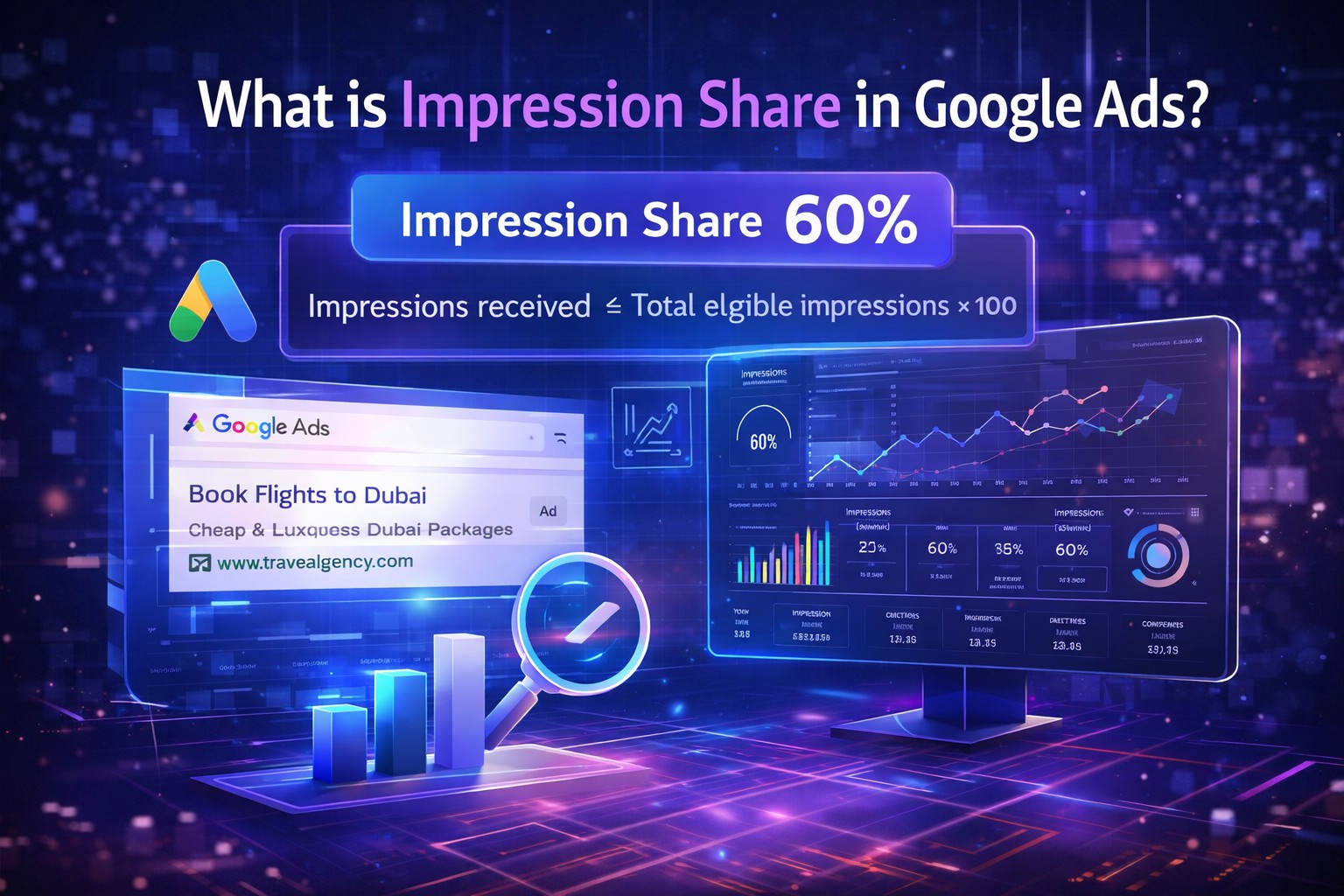
Impression Share (IS) is the percentage of impressions your ads actually receive divided by the total estimated number of impressions your ads were eligible to receive within a given timeframe and targeting parameter.
In simple terms, Impression Share represents your brand's true "share of voice" in Google search results. It reveals how thoroughly you are penetrating your addressable search market.
The Mathematical Formula
Impression Share (%) = (Impressions Received ÷ Total Eligible Impressions) × 100
Practical Calculation Example
Suppose your travel agency targets keywords for "business class flights to London." Based on search query volume, location targeting, quality parameters, and active auctions, Google calculates that your ads were eligible to appear 1,000 times over a seven-day period:
Impressions Received: 600
Total Eligible Impressions: 1,000
Impression Share: (600 ÷ 1,000) × 100 = 60%
This means your campaign captured 60% of available search visibility, while 40% of potential passenger impressions were missed due to either budget constraints or insufficient Ad Rank.
Understanding "Eligible Impressions"
Eligible impressions are not static. Google Ads calculates eligibility dynamically in real time for every individual auction based on:
Geographic Targeting: The physical location or location of interest of the searcher.
Device Targeting: Mobile, desktop, and tablet eligibility criteria.
Language Settings: User interface language matching campaign parameters.
Keyword Relevance & Match Types: Whether your exact, phrase, or broad match keywords qualify for the search query.
Negative Keywords: Queries filtered out before the auction takes place.
Approval Status and Policy Checks: Whether ad creative and landing pages satisfy Google's advertising policies.
Why Impression Share Matters in Modern PPC
Monitoring Impression Share provides competitive advantages that surface-level metrics like clicks and raw impressions cannot deliver:
1. Measures True Market Visibility and Share of Voice
Raw impression numbers can be misleading. Receiving 10,000 impressions sounds impressive, but if the total eligible market was 100,000 impressions, you only captured 10% of available demand. Impression Share contextualizes your presence within the wider market.
2. Identifies and Quantifies Missed Revenue Opportunities
A low Impression Share on top-converting commercial search terms indicates lost sales and wasted pipeline potential. Tracking lost impression share reveals exactly where potential customers are slipping away to competitor websites.
3. Diagnoses Auction Rank vs. Budget Deficits
Google Ads splits lost impression share into two clear categories: Budget and Rank. This diagnostic split eliminates guesswork, telling PPC managers whether a campaign needs more capital or better creative and technical optimization.
4. Improves Competitive Strategy and Benchmarking
By evaluating Impression Share alongside Google's Auction Insights reports, advertisers can benchmark their search presence directly against industry competitors, identifying which rivals are outranking them and during which specific hours of the day.
Types of Impression Share Metrics in Google Ads
Google Ads provides several specialized Impression Share metrics to evaluate performance across different networks, match types, and SERP positions:
1. Search Impression Share (Search IS)
The percentage of impressions your ads receive across Google search results compared to the total volume of search auctions your ads were eligible to enter. This is the cornerstone visibility metric for high-intent, lead-generation, and transactional eCommerce campaigns.
2. Display Impression Share (Display IS)
The percentage of impressions captured across the Google Display Network (GDN) relative to eligible placements. Primarily utilized for upper-funnel brand awareness, visual product promotions, and dynamic remarketing initiatives.
3. Search Lost Impression Share (Budget)
The estimated percentage of search impressions your ads failed to receive strictly due to insufficient daily budget. When your daily budget cap is reached, Google throttles your ad delivery or stops showing your ads entirely for the remainder of the day, forfeiting valuable search volume.
4. Search Lost Impression Share (Rank)
The estimated percentage of impressions missed due to poor Ad Rank. Ad Rank is Google's composite scoring system determined by your maximum bid, Quality Score (expected CTR, ad relevance, landing page experience), and the anticipated performance impact of your ad assets.
5. Exact Match Impression Share
The percentage of impressions your ads received for search queries that matched your keywords exactly (or close variants), divided by the total eligible exact match impressions. This metric provides a pure assessment of how effectively you are dominating your highest-value, core commercial terms without the dilution of broader search variations.
6. Search Top Impression Share (Top IS)
The percentage of impressions your ads receive in the top ad positions (above the organic search results) compared to the total eligible impressions in those top positions. Introduced to provide actionable positioning insights after Google deprecated average position in 2019.
7. Search Absolute Top Impression Share (Abs. Top IS)
The percentage of impressions your ads receive in the very first ad slot (the #1 position at the top of the search page) relative to total eligible top-spot auctions. This is the ultimate benchmark for brand dominance and urgent commercial search terms.
How Impression Share Works: The Google Ads Auction Architecture
Every time a user performs a search on Google, an instantaneous auction occurs. Understanding how Impression Share is calculated requires tracing this execution flow:
Search Query Trigger → Targeting & Eligibility Filter → Auction Ad Rank Calculation → Ad Display & SERP Placement → Impression Share Allocation
Step 1: Ad Eligibility and Targeting Qualification
When a user enters a search query, Google's algorithms query your account to determine whether any active ads qualify:
Are your keywords matched to the query?
Is the user within your targeted geographic boundaries?
Is the search happening within your scheduled ad hours (dayparting)?
Does your campaign have remaining daily budget?
If these conditions are satisfied, your ad is classified as eligible, adding +1 to your eligible impressions pool.
Step 2: The Real-Time Ad Auction
All eligible advertisers enter the auction. Google evaluates every participating ad simultaneously to determine which ads deserve to be displayed and which will be withheld.
Step 3: Ad Rank Calculation
Google calculates an Ad Rank score for each eligible advertiser in real time:
Ad Rank = Maximum CPC Bid × Quality Score (+ Expected Impact of Ad Assets & Auction Context)
Max CPC Bid: The maximum amount you are willing to pay for a click.
Quality Score: An algorithmic rating (1 to 10) evaluating Expected Click-Through Rate, Ad Relevance, and Landing Page Experience.
Ad Assets (Extensions): The expected performance boost generated by sitelinks, callouts, structured snippets, and call assets.
Auction Context: The searcher's physical location, device, time of query, and historical search behavior.
Step 4: Impression Allocation and Final Share Computation
If your Ad Rank exceeds Google's dynamic Ad Rank thresholds and outscores competing advertisers, your ad is displayed on the Search Engine Results Page (SERP). That appearance is logged as an impression received, raising your overall Impression Share metric.
Key Factors Affecting Impression Share
Six interconnected technical and commercial variables govern your campaign's Impression Share:
1. Campaign Budget and Pacing Limitations
When your campaign budget is constrained, Google's ad serving system uses pacing algorithms to distribute ad appearances throughout the day, intentionally skipping eligible auctions. If budget exhaustion occurs early in the day, your ads disappear entirely, drastically driving up Search Lost IS (Budget).
2. Bidding Strategy and Max CPC Limits
If your manual bids or automated target caps (such as Target CPA or Target ROAS) are set too conservatively, your Ad Rank will fall below the threshold required to enter premium auctions. Bids that cannot compete in high-volume auctions directly inflate Search Lost IS (Rank).
3. Quality Score and Underlying Components
Quality Score acts as a critical bid discount multiplier. An advertiser with a 10/10 Quality Score can achieve higher Ad Rank and greater Impression Share while bidding substantially less than a competitor with a 4/10 Quality Score. Quality Score is driven by:
Expected Click-Through Rate (eCTR): Google's projection of how likely searchers are to click your ad.
Ad Relevance: How closely your ad headlines and descriptions mirror the searcher's query intent.
Landing Page Experience: Page loading velocity, mobile responsiveness, transparent navigation, and content relevance.
4. Keyword Match Type Targeting and Search Intent
Targeting broad match keywords opens your ads to an immense pool of loosely related searches. While this expands potential reach, it often explodes your "eligible impressions" denominator with low-converting queries, lowering your overall Impression Share percentage. Conversely, disciplined phrase and exact match targeting concentrates impression share on high-converting searches.
5. Competitive Density and Market Bid Pressures
In highly competitive verticals (such as airline reservations, car rentals, insurance, and legal services), sudden aggressive bidding by major competitors can depress your Impression Share overnight without any changes to your own account.
6. Ad Scheduling (Dayparting)
If your campaigns are scheduled to shut off outside business hours, any search volume occurring during off-hours is excluded from eligible impressions. Aligning your scheduling with high-conversion operating windows prevents wasted auction entry.
Comprehensive Diagnostic Table: Impression Share Metrics and Tactical Action Matrix
Use this actionable matrix to diagnose auction leakage across your Google Ads campaigns:
Metric | What It Measures | Target Benchmark | Primary Cause of Deficit | Recommended Tactical Action |
|---|---|---|---|---|
Search Impression Share | Total captured search auction presence | 70% – 90% (Core Brand: 95%+) | Combined budget caps and low Ad Rank | Isolate whether loss is driven by Budget or Rank |
Search Lost IS (Budget) | Lost visibility due to insufficient daily funds | < 10% (Target: 0% on top ROAS) | Daily budget ceiling reached too early | Increase budget, tighten match types, or lower bids |
Search Lost IS (Rank) | Lost visibility due to low Ad Rank | < 20% | Low bids, weak Quality Score, poor ad assets | Improve Quality Score, boost bids, refine landing page |
Search Top IS | Impressions appearing in top 1–4 ad slots | 60% – 85% | Bids insufficient for top-of-page thresholds | Increase bid targets, improve expected CTR |
Search Abs. Top IS | Impressions appearing in the #1 position | 35% – 60% (Brand: 80%+) | Competitor outbidding for the top position | Deploy Target Impression Share bidding for absolute top |
Exact Match IS | Presence on exact keyword search queries | 80% – 95% | Auction loss on high-relevance searches | Prioritize exact match ad groups with dedicated budgets |
How to Improve Impression Share Strategically
Improving Impression Share requires targeted adjustments based on diagnostic data rather than blind budget expansion:
1. Increase Budgets Strategically on High-ROAS Campaigns
Never increase budgets indiscriminately across an entire account. Filter your campaigns by conversion rate, ROAS, and Search Lost IS (Budget). Allocate additional capital exclusively to campaigns that consistently demonstrate profitable customer acquisition.
2. Systematically Improve Quality Score Across Ad Groups
Boosting Quality Score lowers your effective cost-per-click while expanding your Impression Share:
Reorganize campaigns into tightly themed ad groups containing 5 to 15 closely related keywords.
Incorporate exact search terms directly into Headline 1, Headline 2, and the Display URL path.
Optimize landing page speed and mobile usability to ensure visitors immediately find the exact offer promised in the ad copy.
3. Optimize Bidding Strategies
Select the bidding model that matches your commercial objective:
Target Impression Share Bidding: Ideal for branded terms, core route monopolies, and aggressive competitive defense. You can instruct Google to target 90%+ Impression Share at the absolute top of the page.
Smart Bidding (tCPA / tROAS): Use when your primary objective is conversion volume or margin efficiency. In smart bidding, Google dynamically bids on auctions with the highest probability of conversion, naturally capturing higher Impression Share on high-converting queries.
4. Focus on High-Intent Commercial Keywords
Trim broad, ambiguous search queries that dilute your impression share without generating pipeline. Concentrate budget on high-intent phrases:
Replace generic searches like "flights" with commercial modifiers like "book flight tickets online" or "cheap flights to Dubai call."
Build robust negative keyword lists to prevent your ads from entering irrelevant auctions (e.g., excluding "free," "jobs," "login," "refund," or "complaints").
5. Enhance Ad Relevance Through Responsive Search Ads (RSAs)
Provide Google's machine learning models with up to 15 diverse headlines and 4 descriptions per ad group. Ensure headlines include clear value propositions, dynamic pricing, localized route details, and urgent call-to-actions.
6. Maximize Ad Assets and Extensions
Ad assets directly boost your Ad Rank calculation without increasing your maximum bid. Fully populate:
Sitelink Assets: Directing users to specific sub-destinations, special fare deals, and contact pages.
Call Assets: Enabling mobile searchers to dial your reservation desk directly.
Callout Assets: Highlighting trust signals like "24/7 Customer Support," "No Hidden Fees," and "Licensed Travel Agency."
Structured Snippets: Listing destinations, carrier alliances, and cabin amenities.
Impression Share in Travel and Airline Marketing Campaigns
In the travel, airline booking, and hospitality sectors, Impression Share dynamics are uniquely aggressive:
Why It Is Critical for Travel Agencies
Travel search behavior is characterized by:
Intense Competition: Online Travel Agencies (OTAs), global meta-search engines, and direct airline carriers bid fiercely on identical route terms.
High Time Sensitivity: Flight prices fluctuate constantly, meaning passengers searching for "last minute flights" make booking decisions in hours, not weeks.
High Transaction Value: A single itinerary or vacation package can yield substantial booking revenue, justifying aggressive pursuit of top SERP positioning.
In travel PPC, losing auction visibility directly translates to lost revenue:
High Impression Share → Dominant SERP Visibility → Higher CTR → Accelerated Inbound Inquiries → Increased Revenue
Low Impression Share → Market Invisibility → Diverted Passenger Traffic → Depressed Booking Volume
Practical Travel Example: Route Monopoly Economics
Consider an agency bidding on "Dubai holiday packages from New York":
If your campaign achieves 85% Search Impression Share with 70% Search Top IS, your agency captures the majority of high-intent vacationers actively researching that route.
If your Impression Share drops to 35% due to budget throttling, over 65% of potential travelers book with competing agencies simply because your ad was not present when they searched.
How Teckgeekz Maximizes Impression Share for Travel Businesses
With over years of specialized experience in travel niche, performance agency Teckgeekz engineers sophisticated Google Ads strategies that capture market share and maximize return for travel brands, flight desks, and tour operators.
Deep Understanding of Travel Keywords and Route Dynamics
Teckgeekz conducts exhaustive keyword modeling tailored to route pairs, origin-destination combinations, seasonal travel surges, and airline consolidation deals. We align keyword bidding with genuine passenger booking intent.
Advanced Smart Bidding and Real-Time Bid Management
Our team utilizes advanced bidding architectures that adjust bids dynamically based on device, geographic origin, and time-of-day conversion velocity, ensuring top-of-page presence during peak reservation hours.
Quality Score Optimization and Landing Page Experience
By crafting bespoke ad creatives and pairing them with high-speed, mobile-responsive landing pages, Teckgeekz consistently elevates Quality Scores to 8/10, 9/10, and 10/10, allowing travel clients to outrank larger competitors at a lower cost-per-click.
Surgical Budget Allocation and Waste Elimination
Rather than blindly increasing daily spend, Teckgeekz performs continuous negative keyword sculpting and auction pruning, reallocating wasted budget into high-performing route campaigns to eliminate Lost IS (Budget).
Continuous Multivariate Testing and Auction Insights Auditing
We continuously monitor Google's Auction Insights reports to track competitor overlap rates and outranking share, executing weekly A/B ad copy tests and asset optimizations to defend top SERP positioning.
Proven Performance and Commercial Scalability
Travel brands partnering with Teckgeekz experience sustained Impression Share expansion, reduced cost-per-acquisition (CPA), and scalable booking growth. Explore our full range of pay-per-click management services, travel PPC marketing guide, and our tactical breakdown on Calls Campaign and Web Search Campaigns.
Practical PPC Insight from Agency Leadership
"A high Impression Share is meaningless if you are dominating searches that do not convert. The true objective of Impression Share optimization isn't achieving 100% visibility across every generic query; it's securing near-monopoly visibility on the top 10% of high-intent search terms that drive 90% of your commercial profit. When you diagnose whether you are losing auctions to Budget or Rank, you stop burning capital on blind bid increases and start engineering surgical auction dominance." Jeffrey Mathew, Founder & CEO, Teckgeekz
Impression Share should never be evaluated as an isolated vanity metric. It is an operational diagnostic tool. When aligned with rigorous conversion tracking and business unit economics, it provides the precise blueprint for scaling profitable market share in competitive ad auctions.
Common Impression Share Mistakes to Avoid
Avoiding standard campaign pitfalls preserves ad capital and accelerates performance:
1. Ignoring Lost Impression Share (Budget vs. Rank) Breakdown
Viewing overall Impression Share without diagnosing whether loss stems from Budget or Rank leads to misdirected optimization. Increasing budget when loss is driven by poor Quality Score simply burns capital faster.
2. Overlooking Quality Score's Multiplier Effect on Costs
Advertisers who attempt to compensate for poor ad relevance by raising CPC bids end up paying massive premiums. Focusing on Quality Score expansion recovers Impression Share while lowering cost-per-click.
3. Budget Mismanagement and Blanket Spending Increases
Throwing money at campaigns that suffer from low conversion rates accelerates losses. Budget increases must be reserved exclusively for ad groups with proven ROAS and conversion track records.
4. Uncontrolled Broad Match Targeting Without Negative Keywords
Deploying broad match keywords without aggressive negative keyword filtering inflates your eligible impression denominator with junk queries, causing artificial drops in Impression Share.
5. Treating Impression Share as a Vanity Metric Rather Than a Profit Driver
Targeting 100% Impression Share on broad, top-of-funnel informational terms wastes budget. Maximize Impression Share where buyer intent is undeniable, and maintain moderate coverage elsewhere.
Advanced Strategies for Maximizing Auction Dominance
1. Deploying Target Impression Share Automated Bidding
Google's Target Impression Share smart bidding strategy automatically adjusts bids to hit a specified visibility goal (e.g., 85% Absolute Top of Page). Best deployed on:
Brand Protection Campaigns: Preventing competitors from conquesting your brand name.
Hero Product/Route Terms: Ensuring uninterrupted visibility on your highest-margin offerings.
2. Reverse-Engineering Competitor Pressure via Auction Insights
Regularly analyze Google's Auction Insights report to evaluate:
Overlap Rate: How often a competitor's ad appears when yours appears.
Outranking Share: How frequently your ad ranked higher than a specific competitor.
Top of Page Rate: How consistently your competitors secure top-slot visibility.
Use these insights to identify competitor budget exhaustion patterns and exploit aggressive dayparting opportunities.
3. Granular Geo-Targeting Optimization and Location Bid Modifiers
Evaluate Impression Share across specific geographic segments. If certain states or metropolitan areas deliver superior conversion value, apply positive bid adjustments (+15% to +35%) to capture higher local Impression Share while tapering bids in lower-converting regions.
4. Device-Level Bid Customization (Mobile vs. Desktop Dynamics)
Search intent and conversion behavior differ dramatically between mobile smartphones and desktop computers. In travel, mobile users often seek immediate phone assistance, while desktop users research complex vacation itineraries. Segment your ad groups and adjust device bid modifiers to capture dominant Impression Share on the primary converting platform.
Practical Campaign Example: Scaling a Tour Operator's Search Presence
Consider how an international travel agency running European vacation package campaigns applied Impression Share diagnostics to reverse declining lead volume:
Diagnostic Audit: The agency's core campaign for "Italy luxury tour packages" exhibited a modest 42% Search Impression Share. Data revealed Search Lost IS (Budget) was 12%, while Search Lost IS (Rank) was 46%.
Quality Score Restructuring: Rather than increasing the daily budget, the team restructured broad ad groups into tightly themed Single-Theme Ad Groups (STAGs), aligning tailored RSA ad copy with dedicated destination landing pages. Quality Scores improved from an average of 5/10 to 8/10.
Negative Keyword Scrubbing: The team added 350+ negative keywords, excluding queries related to budget backpacking, visa rules, and student hostels.
Bidding Optimization: With Quality Scores improved, the agency implemented Target Impression Share bidding focused on the Top of Page ad slot.
Commercial Result: Search Impression Share surged from 42% to 84%, Search Lost IS (Rank) plummeted to 11%, average Cost-Per-Click decreased by 22%, and qualified tour booking inquiries increased by 78% over 60 days.
Frequently Asked Questions
What is a good Impression Share in Google Ads?
A "good" Impression Share depends heavily on campaign objectives and keyword intent. For branded search campaigns, advertisers should target 90% to 98% Impression Share to defend brand equity. For high-converting, bottom-of-funnel non-brand search terms, an Impression Share of 70% to 85% is generally considered dominant and commercially optimal. For competitive, upper-funnel generic keywords, an Impression Share between 40% and 60% often represents the most cost-efficient balance between scale and margin.
What is the difference between Lost IS (Budget) and Lost IS (Rank)?
Search Lost IS (Budget) measures the percentage of eligible auctions missed because your daily campaign budget ran out, causing Google to stop or throttle ad delivery. Search Lost IS (Rank) measures the percentage of auctions missed because your Ad Rank (calculated as Max Bid × Quality Score × Ad Assets) was too low to qualify for display. Budget loss is solved by allocating more capital or refining targeting; Rank loss is solved by boosting bids or improving Quality Score.
How does Quality Score affect Impression Share?
Quality Score acts as a direct multiplier in Google's Ad Rank formula. A high Quality Score (8/10 to 10/10) enables your ads to achieve superior Ad Rank and win more auctions even with lower bids, directly expanding your Impression Share. Conversely, a poor Quality Score (1/10 to 4/10) disqualifies your ads from entering auctions or forces you to pay exorbitant CPCs, drastically driving up Lost IS (Rank).
Does 100% Impression Share mean you get all available clicks?
No. Impression Share measures how often your ad was displayed, not how often users clicked it. If your ad achieves 100% Impression Share with a 5% Click-Through Rate (CTR), you appeared in 100% of eligible auctions but captured 5% of total search traffic. Maximizing total clicks requires pairing dominant Impression Share with compelling ad copy and high CTR.
When should advertisers use Target Impression Share bidding?
Target Impression Share automated bidding should be used primarily on branded campaigns to prevent competitor conquesting, on flagship route/product queries where continuous market presence is strategically required, and in competitive defense scenarios. It should generally be avoided on broad, generic campaigns where conversion efficiency and CPA control are the primary performance goals.
How do Top Impression Share and Absolute Top Impression Share differ?
Search Top Impression Share measures the percentage of your impressions that appeared anywhere in the top ad block above the organic search results (positions 1 through 4). Search Absolute Top Impression Share measures the percentage of your impressions that appeared specifically in the very first ad slot (position 1) at the very top of the page. Absolute Top represents maximum SERP prominence.
Dominating Google Search with Strategic Impression Share
Impression Share is far more than a reporting metric: it is the ultimate compass for measuring your market presence and uncovering hidden revenue opportunities within Google Ads. By routinely diagnosing whether your auction losses stem from budget limits or Ad Rank deficits, your business can make disciplined, data-driven optimizations that compound over time.
In high-stakes industries like travel, airline ticketing, and car rental, securing dominant visibility on high-intent search terms is the foundation of market leadership. Partnering with an experienced performance marketing agency like Teckgeekz ensures your campaigns are engineered for auction dominance, combining deep travel niche expertise with continuous technical optimization to maximize your market share, reduce acquisition costs, and deliver consistent, scalable business growth.


Jeffrey Mathew
Founder & CEO • Travel Marketing Specialist
"With over 14 years of dominance in the travel and tech sectors, Jeffrey Mathew has engineered growth for hundreds of OTAs and airlines worldwide. He specializes in the intersection of Performance PPC and Agentic AI, building high-performance digital ecosystems for modern brands."
Start a Conversation
Ready to Elevate Your Business?
Fill out the form below and let's discuss how Teckgeekz can help you reach your goals.
Describe your project to unlock real-time AI service recommendations and matching portfolio cases.
Our Trusted Partners