Travel Booking Engine Conversion Optimization: Turning Search Traffic Into Confirmed Bookings

A travel booking engine can have flawless API integration, accurate real-time pricing, and comprehensive supplier coverage — and still convert at under 1%. Getting the technology right is the prerequisite. It isn't the same thing as getting people to actually complete a booking.
This is the gap most travel platforms fall into after a technically successful build. The search works. The pricing is accurate. The booking completes without errors when tested. And yet the conversion rate sits stubbornly low, because somewhere between a user landing on the site and confirming payment, friction is bleeding away intent that the platform worked hard to earn in the first place — often through paid acquisition that cost real money per click.
Conversion optimization for a travel booking engine is a genuinely different discipline from general e-commerce CRO, because travel bookings carry higher average value, longer consideration windows for some trip types, and specific trust barriers — will this price still be honored, what happens if I need to cancel, is this actually the room I think it is — that a straightforward retail checkout doesn't have to overcome in the same way.
This guide walks through the booking funnel stage by stage, covering where conversion is genuinely won or lost, the specific friction points that recur across travel platforms, and how the architecture decisions covered throughout this series — from the WordPress to Next.js migration that determines your baseline page speed, through to how B2B and B2C portals need to optimize for entirely different conversion behaviors — connect directly to whether traffic actually turns into revenue.
Why Travel Booking Conversion Behaves Differently From General E-Commerce
Standard e-commerce conversion optimization playbooks translate imperfectly to travel, and understanding why matters before applying generic CRO advice to a booking engine.
The average transaction value is higher, and so is the hesitation. A £40 retail purchase and a £2,000 family holiday booking carry fundamentally different psychological weight. Higher-value decisions naturally involve more deliberation, more comparison shopping across competitors, and more sensitivity to trust signals — meaning the checkout flow needs to actively build confidence at each step, not just remove friction.
Pricing is dynamic and can feel untrustworthy if handled poorly. Unlike most retail products with a fixed price, flight and hotel pricing genuinely changes — sometimes within the same session. A customer who sees one price on the search results page and a different price at checkout, without a clear explanation, experiences this as a bait-and-switch even when the platform's pricing verification is working exactly as it should. Managing this perception is a travel-specific conversion challenge with no direct retail equivalent.
The purchase is often irreversible or costly to reverse. Cancellation policies, change fees, and non-refundable fare rules mean the commitment a customer makes at checkout carries real financial risk if their plans change. This elevates the importance of cancellation policy clarity and flexible-fare options as genuine conversion levers, not just legal disclosures buried in the terms.
Comparison shopping happens across multiple tabs, in real time. A travel booker frequently has three or four competing sites open simultaneously, comparing the same route or hotel across platforms before committing. This means speed and clarity at the comparison stage — not just at final checkout — directly determine whether a user stays on your platform or closes the tab.
The Travel Booking Funnel: Where Conversion Is Actually Won or Lost
Breaking the booking journey into distinct stages makes it possible to diagnose conversion problems precisely, rather than treating "low conversion rate" as a single undifferentiated problem to solve.
Stage | What the User Is Doing | Primary Conversion Risk |
|---|---|---|
Landing/Search Entry | Arriving from an ad, organic search, or direct visit; entering search parameters | Slow load, confusing search interface, unclear value proposition |
Search Results | Comparing available options (flights, hotels, packages) | Slow results loading, overwhelming or poorly differentiated choices |
Selection/Detail View | Evaluating a specific option in depth | Missing information, unclear pricing breakdown, weak trust signals |
Checkout Initiation | Beginning the booking/payment process | Excessive form fields, unexpected fees appearing, login walls |
Payment | Completing the transaction | Limited payment options, security concerns, session timeouts |
Confirmation | Receiving booking confirmation | Unclear confirmation, no immediate next-step guidance |
Each stage has a different job to do and a different reason conversion leaks. A platform with a fast, well-designed search results page but a checkout flow demanding twelve form fields before showing a final price is losing conversion at a completely different point than a platform with a confusing search interface but a genuinely excellent checkout. Diagnosing which stage is actually the problem — through funnel analytics, not assumption — is the necessary first step before optimizing anything.
Landing and Search: The First Conversion Test
The landing experience sets the conversion ceiling for everything that follows — no amount of checkout optimization recovers a user who never got a fast, relevant search result in the first place.
Page speed at this stage isn't a nice-to-have; it's the single largest lever most travel platforms have available. The architecture underlying the platform directly determines this ceiling — a booking engine built on a plugin-dependent CMS with multi-second load times is fighting an uphill battle before a user even sees a search result, regardless of how well the checkout flow is designed downstream. This is precisely why the performance gains from a proper migration translate so directly into conversion gains: faster search results mean fewer users abandoning before they've even seen what's available.
Search parameter design matters more than it's often given credit for. A search form that assumes too much — requiring exact dates when a user is still exploring, or forcing a rigid destination field when the user genuinely wants inspiration — creates friction at the very first interaction. The most effective travel search interfaces balance structure (enough fields to return relevant results) against flexibility (not forcing premature precision from a user who's still deciding).
For platforms driving significant traffic through paid acquisition specifically, the landing experience needs particularly tight alignment between what the ad promised and what the page delivers. This is covered in detail in our guide to landing page optimization for travel PPC campaigns, which addresses exactly this message-match problem from the acquisition side — a booking engine's conversion rate is only ever as good as the alignment between the traffic arriving and the experience that traffic lands on.
Search Results: Presenting Comparison Without Overwhelming
Once a search executes, the results page has a narrow window — realistically a few seconds — to demonstrate that the platform has relevant, competitively priced options worth exploring further.
Result loading speed compounds every second of delay into lost patience. Because travel searches genuinely take time to execute against live supplier APIs, perceived speed matters as much as actual speed — showing a skeleton loading state or progressively rendering results as suppliers respond, rather than a blank screen until every source has returned, meaningfully improves the experience even when total load time is identical.
Sort and filter options need to match how travelers actually decide, not how the data happens to be structured. Price and duration sorting for flights, star rating and distance-from-landmark filtering for hotels, board basis and refundability filters for packages — these aren't arbitrary feature additions, they're the specific decision criteria travelers use, and search results that don't support filtering on them push users toward abandoning the search entirely rather than manually scanning dozens of undifferentiated options.
Differentiation between similar options needs to be immediately visible, not buried in a detail page. If two flights differ meaningfully by baggage allowance, or two hotel rates differ by cancellation flexibility, that distinction needs to be scannable at the results level — a user forced to open five separate detail pages just to compare cancellation terms across otherwise similar options is a user likely to give up and book elsewhere.
Detail Pages and Selection: Building the Trust That Justifies the Price
The point where a user moves from browsing results to seriously considering a specific booking is where trust-building does its heaviest lifting.
Price transparency at this stage is a genuine conversion lever, not just an ethical nicety. Showing the total price — including taxes and mandatory fees — as early as possible, rather than revealing additional charges progressively through the checkout flow, prevents the sense of a bait-and-switch that erodes trust precisely when a user is closest to committing. Platforms that reveal fees late in the flow consistently see higher abandonment at the exact point those fees appear, because the user experiences it as the price changing on them.
Cancellation and change policy visibility deserves prominent placement, not a link buried in the footer. A user deciding between a slightly cheaper non-refundable rate and a more flexible option needs this information visible at the point of decision, not after they've already selected an option and moved toward checkout — surfacing it late means the user either backtracks (friction) or books without fully understanding the terms (a support and trust problem that surfaces later).
Specific, credible trust signals outperform generic ones. A named review platform with a visible aggregate score reads as credible in a way a generic "verified secure" badge does not. For hotel-specific content, this connects directly to the content quality challenges covered in our guide to multi-supplier hotel booking engine integration — a detail page assembled from inconsistent or thin supplier content actively undermines the trust-building this stage depends on, regardless of how well the surrounding page is designed.
Checkout: Where Most Conversion Is Actually Lost
Checkout abandonment is, across most travel platforms we've analyzed, the single largest point of conversion loss in the entire funnel — and it's also the stage with the most concrete, fixable friction points.
Every additional form field is a small tax on completion. Checkout flows that request information not genuinely needed until later — full passport details before payment is even confirmed, for instance — should defer that collection to a post-booking stage wherever the booking type allows it. The principle worth holding onto: ask for the minimum required to confirm and pay, and collect the rest afterward.
Guest checkout should be the default, not an afterthought behind a login wall. Forcing account creation before completing a booking is one of the most reliably conversion-damaging patterns in travel checkout design — it adds a step, at exactly the point where friction is most costly, in exchange for a marginal data-capture benefit that email capture at confirmation could achieve just as well without the cost.
Unexpected fees appearing at this stage are the single most damaging trust break available. This connects directly back to the price transparency point made earlier — if total pricing wasn't shown clearly upstream, checkout is where that omission becomes a conversion-killing surprise rather than a minor inconvenience.
Session and inventory hold timing needs to feel fair, not punitive. A booking engine that holds inventory for too short a window risks losing the booking to a timeout mid-checkout; one that communicates urgency poorly (an aggressive countdown timer with no clear explanation) risks feeling manipulative rather than helpful. The right balance gives users enough time to complete the process comfortably while being transparent about why a hold exists at all.
Payment: Removing the Final Barrier
Payment is the last conversion checkpoint, and it's where security anxiety peaks even for users who've been comfortable throughout the rest of the journey.
Payment method variety matters more in travel than in many retail categories, because travel bookers span a genuinely international, diverse customer base — supporting multiple card networks, regional payment methods, and, for higher-value bookings, options like installment or deposit-based payment can be the difference between a completed booking and an abandoned one for customers who aren't ready to pay the full amount upfront.
Visible security signals at the exact moment of card entry — not earlier in the flow, where they're less relevant, but specifically at the point of payment — provide reassurance precisely when anxiety is highest. This is a small design detail with a disproportionate effect on completion rates for higher-value bookings specifically.
Payment failure handling needs to preserve the user's progress, not discard it. A declined card or a timeout that forces a user to re-enter their entire booking from scratch converts what should be a recoverable error into an abandoned booking. Preserving selection and form data through a payment retry is a technical detail with a direct, measurable effect on completed transactions.
Mobile-Specific Conversion Considerations
Mobile now accounts for a substantial and growing share of travel research and booking activity, and a booking engine that treats mobile as a secondary, adapted experience rather than a primary design target is leaving conversion on the table at scale.
Touch target sizing throughout the booking flow — date pickers especially, which are notoriously difficult to adapt well from desktop patterns — needs genuine mobile-first design rather than a responsive resize of a desktop-first layout. Form field types should trigger the correct mobile keyboard (numeric for card numbers, email-optimized for email fields) rather than defaulting to a generic text keyboard that adds friction to every entry.
Page weight and load time matter even more on mobile than desktop, given the more variable network conditions mobile users often book under — a search results page that loads acceptably on office wifi but takes eight seconds on a 4G connection at an airport is losing exactly the high-intent, time-pressured mobile searches that should be converting best.
A/B Testing and Continuous Optimization
Conversion optimization for a booking engine is not a project with an end date — it's an ongoing discipline, and the platforms that sustain strong conversion rates over time are the ones that keep testing rather than treating an initial optimization pass as finished work.
The elements most worth testing systematically include checkout flow field count and sequencing, trust signal placement and specificity, pricing display format (itemized versus lump sum, per-person versus total), and call-to-action copy and placement at each funnel stage. Testing should prioritize the stages where funnel analytics show the steepest drop-off, rather than spreading testing effort evenly across a funnel where some stages are already performing well.
Meaningful testing requires sufficient traffic volume to reach statistical significance within a reasonable timeframe — a low-traffic platform testing minor checkout variations may need months to draw a reliable conclusion, and testing effort is often better spent on larger, higher-confidence changes (removing an entire unnecessary form field, rather than testing button colour) until traffic volume supports more granular experimentation.
How Architecture Decisions Made Earlier Determine the Conversion Ceiling
It's worth being explicit about something implicit throughout this guide: conversion optimization can only work within the ceiling the underlying platform architecture allows.
A booking engine built on the kind of plugin-dependent, slow-loading foundation covered in our WordPress to Next.js migration guide has a hard performance ceiling that no amount of checkout copywriting or trust-badge placement will overcome — this is exactly why the Wanderlust Voyages migration produced a booking conversion increase from 0.8% to 4.2%, a jump driven substantially by the architectural and speed improvements described in that guide, not by conversion-copy tweaks layered onto the old platform.
Similarly, whether a platform is built for B2C consumers, B2B agents, or both changes what "conversion optimization" even means — a consumer checkout flow optimizes for speed and trust in a single session, while an agent-facing booking flow optimizes for efficiency across multiple concurrent client bookings, and applying consumer CRO principles wholesale to an agent portal misses what actually drives completion for that different audience.
And for platforms selling hotels and packages specifically, the content quality and pricing clarity issues covered in our hotel booking engine guide directly determine how much trust-building work the detail page stage of the funnel is starting from — a platform aggregating thin, inconsistent supplier content is fighting a conversion battle that better content sourcing would have made meaningfully easier before a single CRO test was ever run.
Common Mistakes in Travel Booking Engine Conversion Optimization
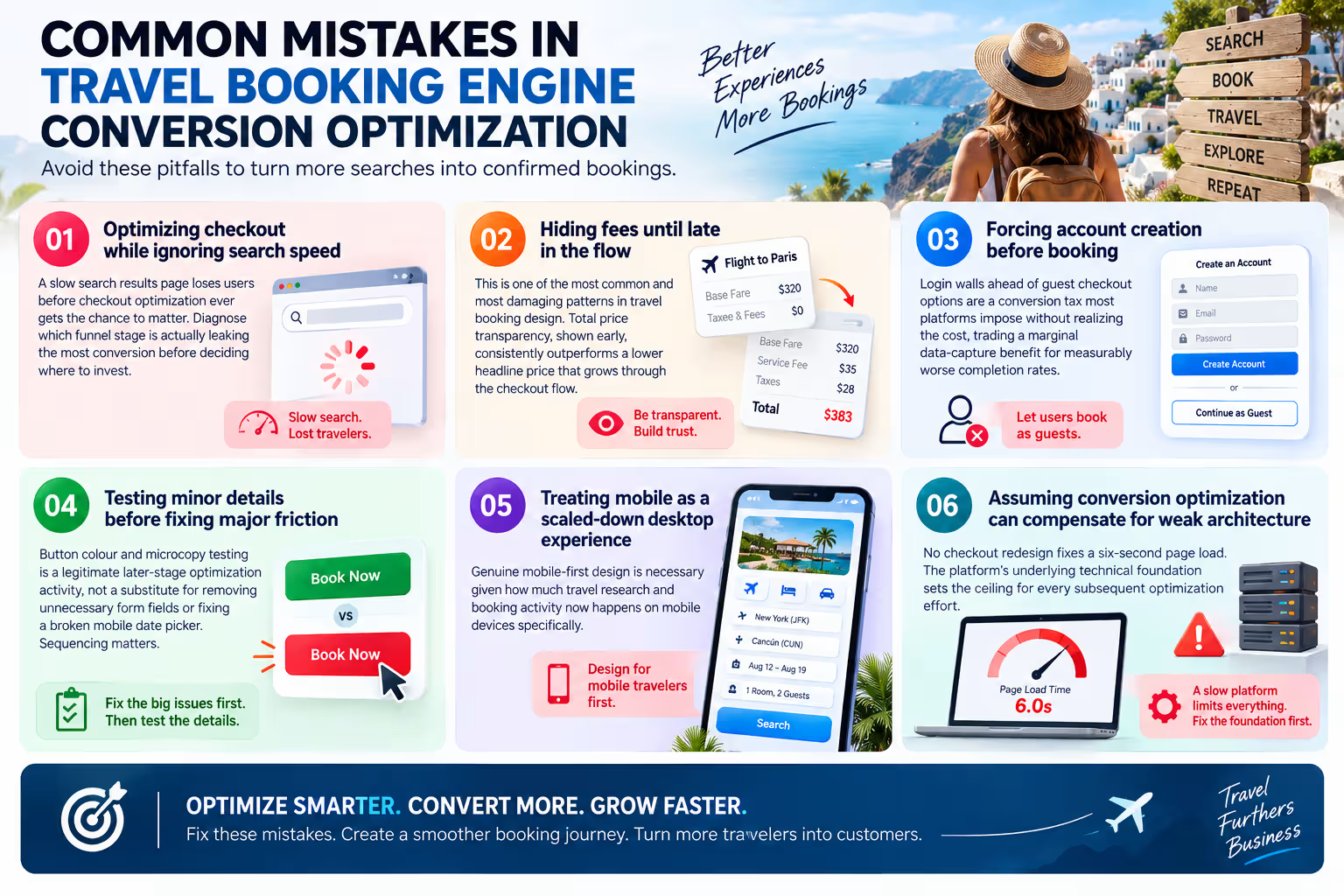
Optimizing checkout while ignoring search speed. A slow search results page loses users before checkout optimization ever gets the chance to matter — diagnosing which funnel stage is actually leaking the most conversion should always precede deciding where to invest optimization effort.
Hiding fees until late in the flow. This remains one of the most common and most damaging patterns in travel booking design, and it's entirely self-inflicted — total price transparency, shown early, consistently outperforms a lower headline price that grows through the checkout flow.
Forcing account creation before booking. Login walls ahead of guest checkout options are a conversion tax most platforms impose without realizing the cost, trading a marginal data-capture benefit for measurably worse completion rates.
Testing minor details before fixing major friction. Button colour and microcopy testing is a legitimate later-stage optimization activity, not a substitute for removing unnecessary form fields or fixing a broken mobile date picker — sequencing matters.
Treating mobile as a scaled-down desktop experience. Genuine mobile-first design — not a responsive adaptation of a desktop-first layout — is necessary given how much travel research and booking activity now happens on mobile devices specifically.
Assuming conversion optimization can compensate for weak architecture. No checkout redesign fixes a six-second page load. The platform's underlying technical foundation sets the ceiling every subsequent optimization effort operates beneath.
"The travel platforms with the strongest conversion rates aren't necessarily the ones that have run the most A/B tests. They're the ones that got the architecture right first — fast, reliable, honest about pricing from the start — and then optimized within a ceiling that was already high. Conversion optimization on a slow, untrustworthy platform is polishing the wrong end of the problem. Fix the foundation, then optimize the details. That order matters more than most CRO advice acknowledges." — Jeffrey Mathew, Founder & CEO, Teckgeekz
Common Mistakes in Travel Booking Engine for Conversion rate Optimization
Frequently Asked Questions
What's a good conversion rate for a travel booking engine? Conversion rates vary significantly by vertical and traffic source, but well-optimized travel platforms typically see booking conversion rates in the 3–5% range for direct and organic traffic, with paid traffic often converting somewhat lower depending on campaign targeting quality. A platform converting under 1.5% despite adequate traffic volume, as covered in our WordPress to Next.js migration guide, is a strong signal that architectural or funnel friction — not just marketing quality — is limiting results.
What's the biggest cause of checkout abandonment in travel bookings? Unexpected fees appearing late in the checkout flow, after a user has already invested time comparing and selecting an option, is consistently one of the most damaging and most common causes. This is closely followed by excessive form field requirements and forced account creation ahead of a guest checkout option — all three are fixable through checkout flow redesign rather than requiring new technology.
How does page speed affect travel booking conversion rates? Directly and substantially. Slower page loads increase abandonment at every funnel stage, but the effect compounds particularly at search results, where users are actively comparing options across multiple platforms simultaneously and will abandon a slow-loading search for a faster competitor. The architectural decisions covered in our guide to migrating a travel platform from WordPress to Next.js directly address this, since page speed is fundamentally a technology and architecture question before it's a design question.
Should travel booking engines require account creation before checkout? No, in almost every case. Requiring account creation ahead of a guest checkout option is one of the most reliably conversion-damaging patterns in travel booking design. Offering guest checkout as the default, with account creation as an optional post-booking step, consistently produces higher completion rates without meaningfully sacrificing the ability to capture customer data for future marketing.
How do B2C and B2B booking engines differ in conversion optimization approach? Significantly. Consumer-facing B2C conversion optimization focuses on speed, trust-building, and reducing checkout friction within a single session. As covered in our guide to B2B and B2C travel portal architecture, agent-facing B2B platforms optimize for a different goal entirely — efficiency across multiple concurrent client bookings, fast quote generation, and clear visibility into credit and commission — meaning the specific conversion tactics that work for consumer checkout don't transfer directly to agent-facing tools.
How often should a travel booking engine run conversion tests? Continuously, as an ongoing operational discipline rather than a one-time project. The right cadence depends on traffic volume — platforms with high traffic can run more frequent, more granular tests, while lower-traffic platforms should prioritize fewer, higher-confidence changes to reach meaningful statistical significance within a reasonable timeframe, rather than testing minor variations that would take months to validate reliably.
Key Takeaways
Conversion optimization for a travel booking engine only works within the ceiling the underlying platform architecture allows — no amount of checkout redesign compensates for a slow, plugin-dependent foundation, which is precisely why the architecture decisions covered in our WordPress to Next.js migration guide are inseparable from conversion performance, not a separate technical concern.
The booking funnel has distinct stages — search, results, selection, checkout, payment, confirmation — each with different friction points, and diagnosing which stage is actually losing conversion should precede any optimization effort, rather than applying generic fixes across the whole funnel indiscriminately.
Price transparency shown early, consistently, prevents the single most damaging trust break in travel checkout: fees appearing unexpectedly late in the flow, at exactly the point a user is closest to committing.
Guest checkout as the default, minimal required form fields, and preserved progress through payment failures are concrete, fixable checkout improvements that consistently outperform cosmetic optimization efforts.
Different platform types require different conversion approaches — the B2C and B2B conversion priorities differ substantially, and hotel and package platforms carry additional trust-building requirements tied to supplier content quality that flight-only booking flows don't face in the same way.
How Teckgeekz Builds Booking Engines Optimized for Conversion
Every booking engine we build treats conversion as an architectural concern from the first planning session, not a design pass applied after launch. This is the same principle running through every guide in this series — the travel website development work we do covers the full stack, from the API integration and platform architecture that set the performance ceiling, through to the checkout flow and trust-signal design that determines whether that architecture actually converts.
For businesses already running a booking platform and seeing conversion rates below what their traffic quality should support, the diagnostic framework in this guide — working stage by stage through the funnel rather than guessing at a single fix — is exactly where we start every conversion audit. And for platforms driving that traffic through paid campaigns, this connects directly to the landing page and campaign work covered in our travel PPC marketing guide, since acquisition quality and booking engine conversion are two halves of the same revenue equation.
In this Series — Travel Website Development & OTA Technology:
WordPress vs Next.js for Travel Websites: When to Migrate Your Booking Platform
B2B vs B2C Travel Portal Development: Choosing the Right Architecture for Your Travel Business
Hotel Booking Engine Development: Multi-Supplier Integration for Travel Portals
Travel Booking Engine Conversion Optimization: Turning Search Traffic Into Confirmed Bookings


Jeffrey Mathew
Founder & CEO • Travel Marketing Specialist
"With over 14 years of dominance in the travel and tech sectors, Jeffrey Mathew has engineered growth for hundreds of OTAs and airlines worldwide. He specializes in the intersection of Performance PPC and Agentic AI, building high-performance digital ecosystems for modern brands."
Start a Conversation
Ready to Elevate Your Business?
Fill out the form below and let's discuss how Teckgeekz can help you reach your goals.
Describe your project to unlock real-time AI service recommendations and matching portfolio cases.
Our Trusted Partners