B2B vs B2C Travel Portal Development: Choosing the Right Architecture for Your Travel Business

The single most consequential decision in a travel portal project happens before a single wireframe gets drawn — and it's rarely the one founders spend the most time on. It's not the choice of framework, or the visual design, or even which flight API to integrate. It's whether the platform is being built for consumers, for travel agents, or genuinely for both.
This decision shapes almost everything downstream. The data model is different. The user permission structure is different. The pricing logic is different — a consumer sees one fare, an agent sees a net rate with a markup layer on top, and a sub-agent might see something different again depending on their tier. Get this architectural decision wrong, or treat it as an afterthought bolted onto a platform designed for the other model, and the resulting system fights against its own users for the life of the platform.
We see this mistake constantly: a business builds a clean, well-designed B2C consumer booking site, then tries to retrofit an agent portal onto it eighteen months later — discovering that credit management, commission tracking, and markup tiers don't graft cleanly onto an architecture that was never designed to hold them. Or the reverse: a B2B-focused agent platform gets a consumer-facing skin added, and the result feels like exactly what it is — a trade tool wearing a retail costume.
This guide breaks down the genuine architectural differences between B2B and B2C travel portals, what a properly built agent panel actually requires, how markup and commission systems work, and how to decide — honestly, before development starts — which model your business actually needs.
B2B and B2C Are Not the Same Product With a Different Skin
The temptation to treat B2B and B2C as a design decision — same booking engine, different colour scheme and copy — is understandable and consistently wrong. The differences run through the data model and business logic, not just the interface.
Pricing is structurally different. A B2C platform shows one price: what the customer pays, inclusive of whatever margin the business has built in. A B2B platform needs to hold and display multiple price layers simultaneously — the net rate from the supplier, the markup applied for that specific agent or agent tier, and potentially a further layer if that agent has their own sub-agents reselling through them. This isn't a display difference; it's a fundamentally different pricing engine.
Identity and permissions are structurally different. A B2C platform typically has one user type: the consumer, with an account for booking history and preferences. A B2B platform needs role-based access spanning agency owners, individual agents within an agency, and potentially sub-agents beneath them — each with different visibility into pricing, different booking limits, and different administrative capabilities.
The unit of trust is different. Consumers pay at the point of booking, typically by card, and trust is built through UX polish, reviews, and brand signals. Agents frequently operate on credit — booking now, settling later — which means the platform needs genuine financial infrastructure: credit limits, running balances, payment terms, and the reporting that lets an agency track its exposure.
The booking behavior is different. Consumers typically book for themselves or their immediate travel party, in a single session, driven by inspiration or a specific trip need. Agents book on behalf of multiple clients across a working day, need to manage several in-progress itineraries simultaneously, and need tools — saved searches, quote generation, itinerary comparison — that a consumer booking flow has no reason to include.
Treating these as interface variations rather than architectural differences is exactly how platforms end up needing a rebuild rather than an extension when the business model shifts or expands.
What a Genuine B2C Travel Portal Requires
A consumer-facing travel booking platform is optimized around a single goal: converting a visitor's search into a completed, paid booking with as little friction as possible.
The architecture needs to support fast, intuitive search across whatever inventory the business sells — flights, hotels, packages, or a combination — with results presented for easy comparison rather than raw data dumps. Checkout needs to be short, trustworthy, and forgiving of interruption — a user who abandons a booking partway through should be able to return and pick up where they left off, not start over. Payment processing needs multiple gateway options and needs to feel secure at every step, since this is where hesitation costs conversions most directly.
Post-booking, the consumer experience continues — booking management, itinerary access, the ability to make changes or request cancellations without needing to call a support line for routine requests. Personalization increasingly matters here too: recommendations based on previous searches or bookings, saved preferences, and the kind of individually tailored experience that a templated, one-size-fits-all platform structurally cannot deliver.
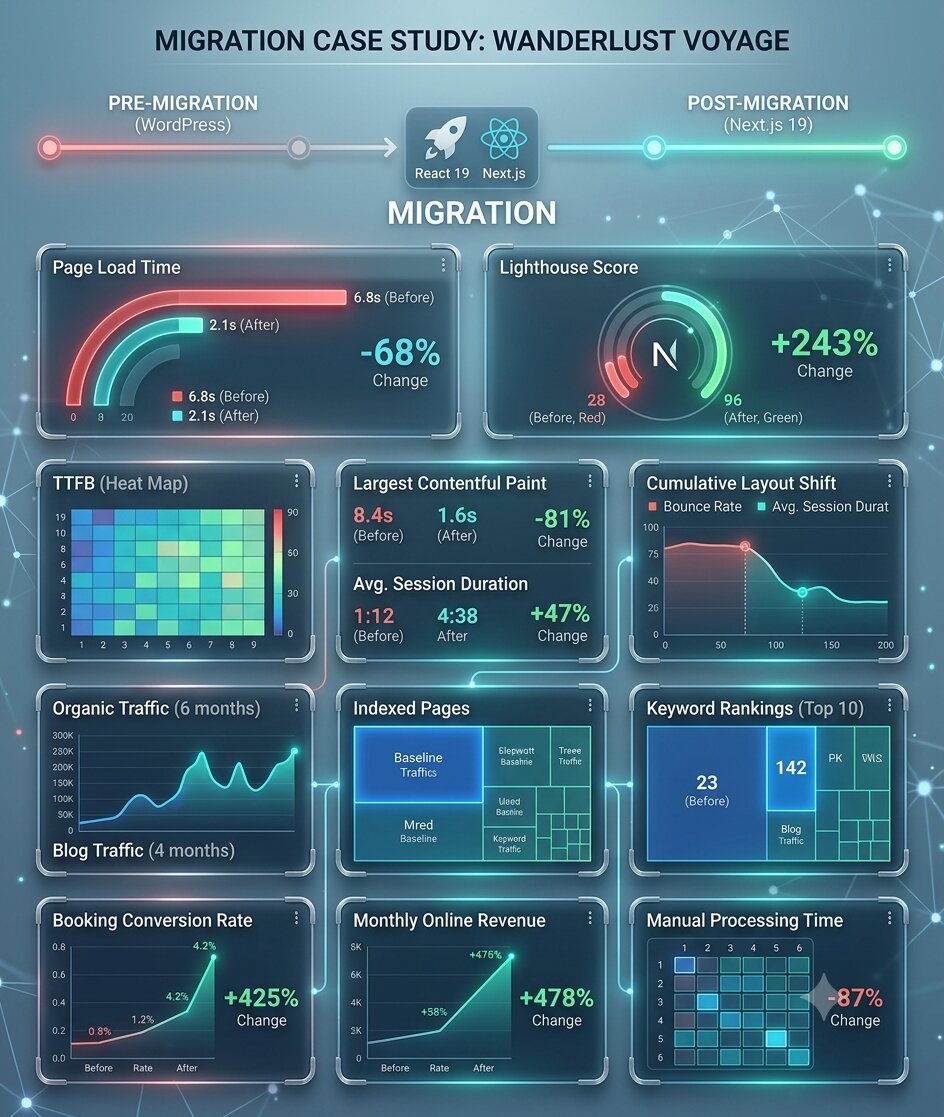
This last point is worth being direct about. A B2C travel portal built on a generic, templated foundation — the kind of platform where every client gets a near-identical experience with a different logo — cannot compete on conversion with a genuinely custom-built platform, because conversion optimization depends on tailoring exactly these details to the specific audience and inventory a business is selling. This is precisely the gap the Wanderlust Voyages platform closed — moving from a generic, plugin-dependent booking experience to one custom-built around their specific packages, cruise offerings, and audience produced a booking conversion increase from 0.8% to 4.2%.
What a Genuine B2B Travel Portal Requires
A B2B, or agent-facing, travel portal is solving a fundamentally different problem: giving travel trade professionals the tools to search, quote, and book efficiently on behalf of their clients, within a financial and administrative structure the agency and the platform owner both need visibility into.
Agent Dashboards and Role Hierarchies
A properly built B2B portal including flights supports multiple user roles with genuinely different permissions and visibility — not just different landing pages. An agency owner or administrator typically needs full visibility into their agency's bookings, credit position, and staff activity, along with the ability to onboard and manage sub-agents. Individual agents need booking and quoting tools scoped to their own client work, potentially with booking limits set by their agency administrator. Sub-agents, where an agency structure supports them, need a further-restricted view — able to book within the parameters their parent agency has configured, without visibility into the parent agency's own commercial terms with the platform.
This hierarchy needs to be a genuine data model, not a set of UI toggles — because the pricing, credit, and reporting logic all depend on knowing precisely who is booking, on whose behalf, and under which commercial terms.
Credit Management
Agents frequently need to book without paying at the point of transaction — operating instead against a credit line the platform extends, settled on agreed terms. A genuine credit management system tracks running balance against an approved credit limit in real time, flags or blocks bookings that would exceed that limit, generates the statements and invoicing an agency needs for reconciliation, and gives the platform owner the reporting needed to manage credit risk across the entire agent network.
This is meaningfully more complex than a simple "pay later" toggle — it's financial infrastructure that needs to be accurate, auditable, and reliable under real transaction volume.
Markup and Commission Controls
This is the pricing engine complexity referenced earlier, and it deserves specific detail because it's frequently underestimated in project scoping. The platform needs to store net supplier rates separately from what's displayed to any given agent, apply markup rules that can vary by agent, agent tier, supplier, product type, or even specific route or destination, and — where sub-agent hierarchies exist — support markup layered on markup, with each tier only seeing the rate relevant to their position in the hierarchy.
Commission tracking runs in parallel: recording what each agent has earned across their bookings, supporting different commission structures for different product types or supplier agreements, and feeding into the reporting an agency needs to reconcile earnings with the platform owner.
Agent-Specific Tools
Beyond the financial infrastructure, a genuine B2B portal typically includes tools that a consumer booking flow has no equivalent for: quote generation that lets an agent build a priced itinerary to send a client before booking, saved and comparable searches for agents managing multiple client conversations simultaneously, bulk or group booking capability for tour groups or corporate travel, and detailed booking and financial reporting — exportable, since agencies frequently need this data in their own accounting systems.
Comparison: B2C vs B2B Portal Requirements
Dimension | B2C Portal | B2B Portal |
|---|---|---|
Primary user | Individual consumer | Travel agent / agency staff |
Pricing model | Single retail price | Net rate + tiered markup, potentially multi-layer |
User roles | Single role (consumer account) | Multi-tier (admin, agent, sub-agent) |
Payment model | Point-of-sale, card/gateway | Credit line, deferred settlement common |
Booking behaviour | Single trip, single session | Multiple concurrent client bookings |
Key tools | Search, compare, book, manage | Quote generation, credit tracking, commission reporting |
Design priority | Conversion, trust, inspiration | Efficiency, data density, speed of task completion |
Reporting needs | Personal booking history | Agency-wide financial and booking reporting |
Onboarding | Self-service account creation | Vetted agency onboarding, credit approval |
When a Business Genuinely Needs Both
Some travel businesses do legitimately need to serve both consumers and agents from the same underlying platform — a tour operator selling directly to travelers while also distributing through a network of retail travel agents, for example. This is a real and common business model, and it's worth being precise about what building it well actually means, since it's easy to get wrong in either direction.
The right approach is not a single generic front end trying to serve both audiences with conditional logic scattered throughout — that produces exactly the "trade tool wearing a retail costume" problem, or the reverse, referenced earlier. Nor is it a white-label, templated agent portal bolted onto a separate consumer site — that approach trades away the tailored design and conversion optimization that makes a custom B2C experience actually convert, and produces two disconnected systems that don't share a unified data or booking foundation.
The approach that works is a single, unified backend — shared inventory, shared booking engine, shared supplier integrations — serving two genuinely distinct, custom-built front-end experiences: a consumer-facing booking flow designed entirely around conversion and inspiration, and a separate, authenticated agent-facing panel designed entirely around efficiency, credit, and multi-client management. Both draw from the same underlying data and booking infrastructure, so a change to supplier rates or inventory updates once and reflects correctly everywhere — but the experiences themselves are purpose-built for the audience using them, not a shared compromise between two different jobs to be done.
This is meaningfully different from platforms marketed as "B2B2C-ready" out of the box, which typically means a single templated interface with role-based visibility toggles — functional, but not designed specifically for either audience, and rarely competitive on conversion or on agent efficiency against a purpose-built alternative.
Deciding Which Architecture Your Business Needs
The honest starting question isn't "which is better" — it's what your actual revenue model and distribution strategy require, today and over a realistic planning horizon.
Question | Points Toward B2C | Points Toward B2B | Points Toward Both |
|---|---|---|---|
Who books through your platform? | Individual travelers directly | Travel agents on behalf of clients | Both, in meaningful volume |
How is revenue generated? | Retail markup at point of sale | Net rate + agent commission/markup | Both models simultaneously |
Do you have or plan an agent network? | No | Yes, this is the core business | Yes, alongside direct sales |
What's your primary growth channel? | Marketing-driven direct traffic | Agency relationships and trade partnerships | A genuine mix, not incidental overlap |
Do you need credit/deferred payment logic? | No | Yes | Yes, for the agent side specifically |
What does conversion optimization need to prioritize? | Consumer trust, speed, inspiration | Agent efficiency, data density | Both, served by distinct interfaces |
A business with a small number of incoming agent enquiries handled manually doesn't need a full B2B portal build — that volume doesn't yet justify the credit and commission infrastructure described above, and manual handling remains genuinely more efficient at low volume. The point where B2B infrastructure investment pays off is when agent-driven volume, or the ambition to grow it deliberately, is significant enough that manual quote-and-book handling is creating a real operational bottleneck.
Programmatic SEO Considerations for B2B and B2C Portals
The content and SEO strategy differs meaningfully between these two models, and it's worth planning for from the architecture stage rather than retrofitting later.
A B2C portal's organic growth typically depends heavily on destination and package content — exactly the kind of programmatic content generation covered in our guide to building large-scale destination pages, where a single templated system generated 138 individually optimized, indexable destination pages rather than requiring manual builds for each one. This content strategy is aimed at consumer search intent — "flights to [destination]," "holiday packages [destination]" — and benefits enormously from the fast, statically-generated pages a properly architected Next.js platform makes possible.
A B2B portal's organic and content strategy looks different — the authenticated agent panel itself typically shouldn't be indexed at all, but the public-facing marketing pages around it (agency onboarding information, partnership terms, trade-facing content explaining the platform's supplier coverage and commission structure) still benefit from the same structured content and programmatic approach, targeting search intent like "become a travel agent partner" or route/supplier-specific trade content, rather than consumer booking intent.
For a hybrid platform serving both audiences, this means the content and SEO architecture needs to cleanly separate what's built for organic consumer acquisition from what supports agent-facing trade content — both benefiting from the same structured, scalable content approach, but targeting genuinely different search intent and audience.
Common Mistakes in B2B/B2C Portal Architecture
Retrofitting an agent panel onto a consumer-first architecture. As described in the opening of this guide, this is the single most common and most expensive mistake — discovering, often 18 months into a platform's life, that credit management and multi-tier markup logic don't graft cleanly onto a data model that never anticipated them.
Building a generic B2B2C template rather than purpose-built experiences. A single interface with role-based visibility toggles is functional but doesn't compete — on conversion for the consumer side, or on efficiency for the agent side — against genuinely purpose-built alternatives.
Underestimating credit and commission complexity in project scoping. Markup rules that vary by agent tier, product type, and supplier, layered with sub-agent hierarchies, is genuinely complex financial logic — projects scoped as if this were a simple percentage field consistently run over budget and behind schedule once the real requirements surface.
Building B2B infrastructure before there's genuine agent volume to justify it. The inverse mistake — investing in full credit management and commission tracking infrastructure for a handful of agent relationships that could still be handled manually — ties up development budget that would be better spent elsewhere until volume genuinely warrants the investment.
Treating the decision as permanent and irreversible. A B2C-only platform built on a properly structured, custom architecture — rather than a generic template — can extend into agent-facing functionality later without a full rebuild, provided the underlying data model was built with that separation of pricing, identity, and booking logic in mind from the start, even if the agent-facing layer isn't built immediately.
"The businesses that get this decision wrong almost always made it too early, based on where they hoped to be rather than where they actually were — building expensive B2B infrastructure before they had the agent relationships to justify it, or bolting agent functionality onto a consumer platform that was never designed to hold it. Build for what your business genuinely is today, on an architecture that doesn't box you in if that changes. That's the difference between a platform that grows with the business and one you end up rebuilding from scratch." — Jeffrey Mathew, Founder & CEO, Teckgeekz
Frequently Asked Questions
What's the difference between a B2B and B2C travel portal? A B2C travel portal serves individual consumers booking travel for themselves, with a single retail price and point-of-sale payment. A B2B travel portal serves travel agents booking on behalf of their clients, requiring multi-tier pricing (net rates plus agent markup), credit and deferred payment infrastructure, role-based access across agency hierarchies, and tools like quote generation and commission tracking that a consumer platform has no need for. The two require genuinely different data models and business logic, not just different interfaces.
Can one platform serve both B2B and B2C customers? Yes, and many travel businesses legitimately need this — a tour operator selling directly to consumers while also distributing through a retail agent network, for example. The right approach is a single, unified backend and shared booking infrastructure serving two genuinely distinct, custom-built front-end experiences — a consumer-facing booking flow optimized for conversion, and a separate, authenticated agent portal optimized for efficiency and multi-client management — rather than one generic interface trying to serve both audiences.
Do I need a B2B agent portal if I only have a few agent partners? Not necessarily. Full credit management and commission tracking infrastructure is a meaningful development investment, and for a small number of agent relationships, manual quote-and-book handling often remains genuinely more efficient than building dedicated infrastructure. The point where B2B portal investment pays off is when agent-driven volume — or a deliberate plan to grow it — is significant enough that manual handling is creating a real operational bottleneck.
How does markup and commission tracking work in a B2B travel portal? The platform stores net supplier rates separately from what's displayed to any given agent, then applies configurable markup rules that can vary by individual agent, agent tier, supplier, or product type. Where sub-agent hierarchies exist, markup can layer across tiers, with each level only seeing the rate relevant to their position. Commission tracking runs alongside this, recording what each agent has earned across bookings and feeding into reporting agencies use for reconciliation.
Is a white-label travel portal a good option for B2B distribution? It depends on priorities. A white-label or templated platform can reduce upfront cost and speed initial deployment, but it typically means every business on that platform gets a similar underlying experience with limited differentiation — which trades away conversion optimization and brand-specific design on the consumer side, and often limits how precisely the agent-facing tools can be tailored to a specific business's commission structures and workflows. A fully custom-built platform costs more upfront but is built specifically around a business's actual pricing model, supplier relationships, and audience — which is the approach we build at Teckgeekz rather than offering templated white-label deployment.
How do I decide whether my travel business needs a B2C, B2B, or combined portal? Start with your actual revenue and distribution model rather than aspiration: who books through your platform today, how revenue is actually generated, whether you have or are actively building an agent network, and whether credit or deferred payment logic is a genuine current requirement. The decision framework covered in this guide is designed to make this assessment concrete rather than theoretical — building for where your business genuinely is, on an architecture that doesn't prevent expansion later.
Key Takeaways
B2B and B2C travel portals are not the same product with different branding — the pricing model, user permission structure, payment logic, and core tooling are genuinely different, and treating them as interface variations produces platforms that need rebuilding rather than extending as a business grows.
A genuine B2B portal requires real financial infrastructure — credit management, multi-tier markup, commission tracking — not a simplified "agent mode" bolted onto consumer architecture. This complexity is consistently underestimated in project scoping and is where B2B builds most commonly run over budget.
A genuine B2C portal succeeds or fails on conversion, and conversion depends on tailored, custom-built design rather than a generic templated experience — exactly the gap that produced Wanderlust Voyages' conversion increase from 0.8% to 4.2% after moving to a custom-built platform.
Businesses that genuinely need both audiences should build a unified backend with two purpose-built front-end experiences, not one generic interface serving both, and not a white-label agent layer bolted onto a separately-built consumer site. That is why Teckgeekz offers Custom Travel Web Development.
The architecture decision should reflect where a business genuinely is today — not where it hopes to be — built on a foundation flexible enough to extend later without requiring a full rebuild.
How Teckgeekz Builds B2B and B2C Travel Portals
Every travel portal we build starts with the same question this guide opens with: who is actually going to use this platform, and what does their workflow genuinely require? That question shapes the data model before a single interface screen gets designed — because retrofitting the answer later is exactly the expensive mistake this guide is written to help you avoid.
We build fully custom platforms for each client — not templated or white-label deployments — because the conversion gains on the B2C side and the operational efficiency gains on the B2B side both depend on a platform built specifically around a business's actual pricing model, supplier relationships, and audience. Our work covers agent panel architecture with genuine credit and multi-tier commission logic, consumer booking experiences engineered for conversion, and — where a business genuinely needs both — the unified backend architecture that serves distinct, purpose-built experiences to each audience without compromise.
If you're evaluating whether your travel business needs a B2C platform, a B2B agent portal, or both, the decision framework in this guide is exactly where that conversation should start.
In this Series — Travel Website Development & OTA Technology:
WordPress vs Next.js for Travel Websites: When to Migrate Your Booking Platform
B2B vs B2C Travel Portal Development: Choosing the Right Architecture for Your Travel Business
Hotel Booking Engine Development: Multi-Supplier Integration for Travel Portals
Travel Booking Engine Conversion Optimization: Turning Search Traffic Into Confirmed Bookings


Jeffrey Mathew
Founder & CEO • Travel Marketing Specialist
"With over 14 years of dominance in the travel and tech sectors, Jeffrey Mathew has engineered growth for hundreds of OTAs and airlines worldwide. He specializes in the intersection of Performance PPC and Agentic AI, building high-performance digital ecosystems for modern brands."
Start a Conversation
Ready to Elevate Your Business?
Fill out the form below and let's discuss how Teckgeekz can help you reach your goals.
Describe your project to unlock real-time AI service recommendations and matching portfolio cases.
Our Trusted Partners