High-Intent Keywords for Car Rental PPC: Targeting Searches That Actually Convert
One of the fastest ways to waste money in PPC is to confuse traffic with intent.
In car rental advertising, it’s surprisingly easy to generate clicks. Search volume is large, demand exists year-round, and users are constantly searching for vehicles, airport pickups, weekend rentals, and last-minute bookings.
But clicks alone don’t build profitable campaigns.
A campaign can generate thousands of visits and still struggle to produce consistent bookings if the targeting is too broad. This is where many car rental PPC campaigns lose efficiency. The focus stays on traffic volume instead of understanding how people actually search when they are ready to rent a vehicle.
The difference between a user searching “best cars for road trips” and someone searching “SUV rental JFK airport today” is not subtle—it’s commercial intent.
The second search signals urgency, location awareness, and a likely booking decision. The first is informational.
This is why high-intent keyword targeting matters so much in car rental PPC. It filters out casual interest and focuses budget on searches that are more likely to convert into actual bookings.
When campaigns are built around intent instead of volume, performance changes. Conversion rates improve, wasted spend drops, and scaling becomes more predictable.
Why Intent Matters More Than Search Volume
Large keyword volume looks attractive on paper.
It creates the impression of opportunity, especially in industries like travel and transportation where search demand is naturally high. But volume alone does not indicate profitability.
Broad terms often attract users at completely different stages of the buying journey. Some are researching destinations. Others are comparing prices casually. Many are not ready to book at all.
This becomes expensive very quickly.
High-intent keywords work differently because they reflect a stronger level of commitment. These searches usually contain signals tied to action:
Specific locations
Airport references
Vehicle preferences
Date urgency
Pricing intent
A user searching for “luxury SUV rental Miami airport” is behaving very differently from someone searching “best SUVs.”
One is close to making a booking decision. The other is exploring.
This distinction is what separates campaigns that generate traffic from campaigns that generate revenue.
Car Rental PPC Service
Understanding Search Intent in Car Rental PPC
Search behavior in car rental campaigns usually follows patterns.
At the top level, users are still exploring. They may not know where they want to rent from or what type of vehicle they need. These searches are broad and often informational.
As intent becomes clearer, searches become more refined. Users begin comparing locations, prices, and vehicle types. At this stage, commercial signals become stronger.
Finally, booking-intent searches appear. These are the terms that usually drive the highest conversion rates because the user has already moved through much of the decision-making process.
The language changes noticeably:
“Cheap car rental Chicago airport”
“7 seater rental near Heathrow”
“same day SUV rental Dallas”
These are not discovery searches. They indicate urgency and transactional intent.
Understanding this progression is important because campaigns should align with how users move through the booking journey—not just with isolated keywords.
Car Rental PPC services
Airport-Based Keywords: One of the Strongest Conversion Signals
Airport searches are consistently among the highest-converting keyword groups in car rental PPC.
The reason is simple: airport users are already planning logistics. They know where they are arriving, they know they need transportation, and they are usually operating within a specific timeframe.
This creates urgency.
Searches such as:
“car rental JFK airport”
“Heathrow airport car hire”
“SUV rental LAX airport”
often perform better than broader city-level terms because the intent is more immediate.
These keywords are also commercially valuable because they align closely with how users book in real life. Someone arriving at an airport is not casually browsing—they are solving a transportation problem.
The competition for these keywords is naturally higher, which increases CPCs, but conversion rates are usually stronger as well. In many campaigns, this balance still produces better overall profitability.
Location + Vehicle Type Keywords
One of the most effective ways to refine intent is by combining location targeting with vehicle-specific searches.
A user searching for “car rental Miami” may still be exploring. A user searching for “luxury convertible rental Miami Beach” has already narrowed their decision significantly.
These searches reveal more than just destination intent—they reveal expectations.
Vehicle-specific keywords help campaigns align ads and landing pages with user goals. Someone searching for a van rental likely has different needs from someone searching for a luxury sports car.
This is where targeting becomes more strategic.
Instead of sending every user into the same generic funnel, campaigns become segmented based on what people are actually trying to book.
That alignment improves both user experience and conversion efficiency.
Same-Day and Urgency Keywords
Urgency-driven searches behave differently from standard booking queries.
Users searching for:
“same day car rental”
“last minute car hire London”
“rent SUV today near me”
are typically acting under time pressure.
These searches often have higher CPCs because competition increases around urgent demand. However, they can still be highly profitable because conversion intent is extremely strong.
The key challenge with urgency keywords is landing page alignment.
If users searching for immediate rentals land on slow, unclear, or overly generic pages, drop-offs happen quickly. Campaigns targeting urgency need fast-loading pages, strong CTAs, and clear availability signals.
Price-Driven Keywords and Commercial Intent
Price-focused searches are common in car rental PPC, especially in competitive markets.
Terms such as:
“cheap car rental Dallas”
“affordable car hire London”
“budget SUV rental Orlando”
attract users who are actively comparing options.
These users are highly transactional, but they are also more sensitive to trust signals and transparency. Hidden pricing, confusing checkout flows, or unclear policies can reduce conversion rates significantly.
Price-intent traffic works best when campaigns maintain clarity between the ad, landing page, and final offer.
Consistency matters here more than aggressive messaging.
Keywords That Quietly Waste Budget
Not every relevant-looking keyword deserves budget allocation. This is where many campaigns become inefficient.
Broad informational searches often generate clicks without producing bookings. Queries related to travel inspiration, car reviews, or general automotive content may appear relevant, but they usually attract users outside the booking funnel.
Examples include:
“best road trips in California”
“top SUV brands”
“travel driving tips”
The problem is not traffic—it’s intent mismatch.
Campaigns become stronger when they are selective about what they exclude, not just what they target.
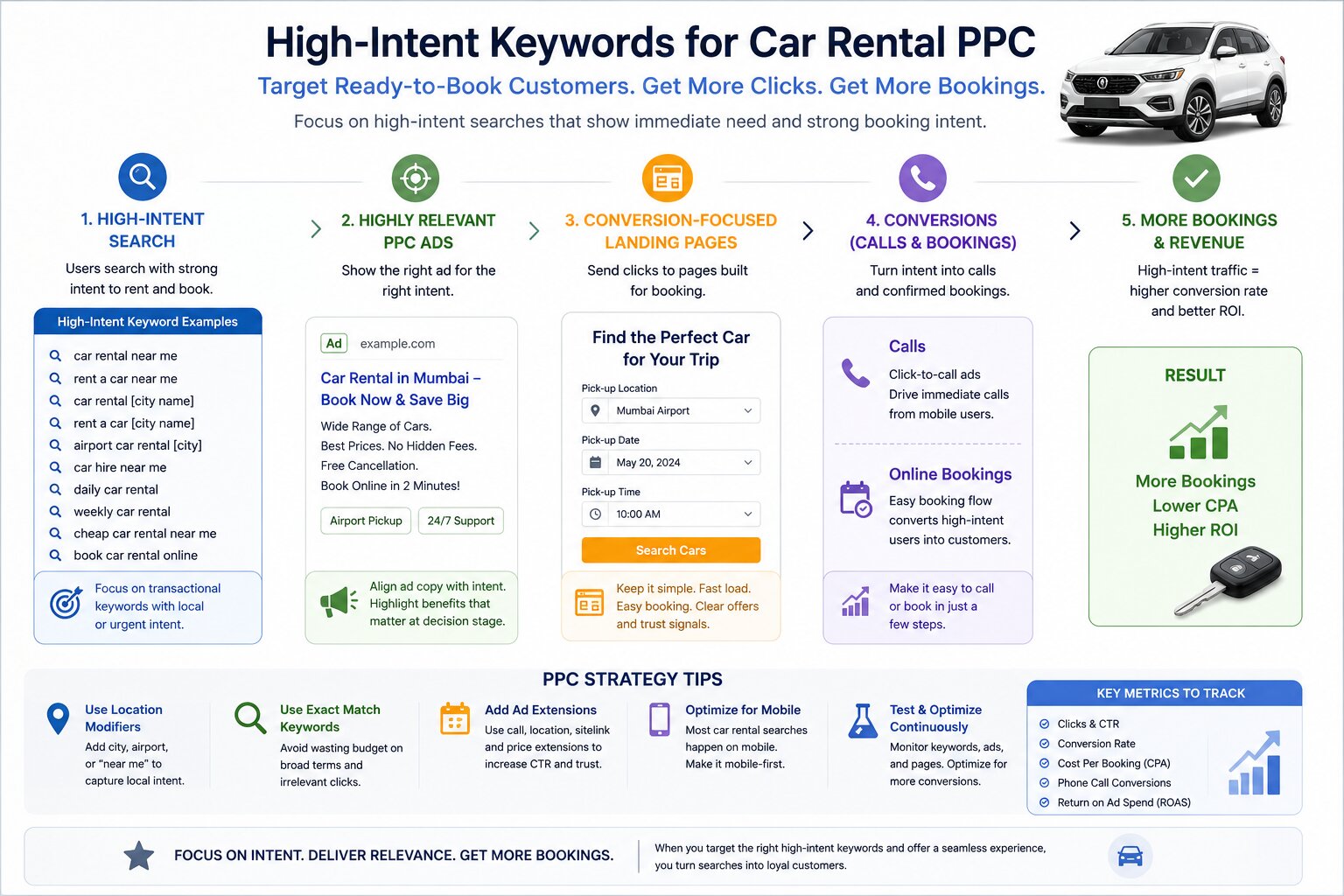
How high-intent car rental keywords move users from search to calls and confirmed bookings through PPC campaigns
Structuring Keywords by Intent
One of the most common PPC mistakes is grouping all keywords into the same structure.
Different intent levels require different strategies.
High-intent airport searches behave differently from exploratory discovery searches. Vehicle-specific keywords behave differently from pricing-focused keywords.
When all of these are mixed together:
Ad relevance drops
Budget control weakens
Conversion tracking becomes less meaningful
Segmenting campaigns by intent creates clarity.
It allows:
Different ad messaging
Better bidding control
More relevant landing pages
This is what makes scaling easier over time.
Car Rental PPC campaign Structure
Match Types and Intent Control
Match types influence how precisely campaigns align with user intent.
Exact match works best for strong booking-intent keywords because it gives tighter control over spend and relevance.
Phrase match expands reach while still maintaining contextual alignment.
Broad match can be useful for discovery, but only when supported by strong negative keyword management. Without controls, broad match campaigns can drift into low-intent traffic very quickly.
The objective is not maximum reach—it is efficient reach.
The Importance of Negative Keywords
Negative keywords are often underestimated, especially in high-volume industries.
They are not just cleanup tools—they are budget protection mechanisms.
Strong negative keyword lists help filter out:
Informational searches
Job seekers
Freebie-related traffic
Irrelevant automotive searches
Examples include:
free
jobs
careers
manual PDF
repair
Over time, negative keyword optimization becomes one of the biggest contributors to campaign efficiency.
US vs UK Keyword Behavior
Search behavior differs noticeably between the US and UK markets.
In the US, airport searches dominate a large portion of commercial intent traffic. Search volume is higher, competition is stronger, and CPCs are generally more aggressive.
Users also tend to search with broader geographic intent, especially around major travel hubs.
In the UK, search behavior is more localized and comparison-driven. The term “car hire” is used more frequently than “car rental,” and users are often more price-sensitive during the booking process.
These differences influence:
Keyword wording
Ad messaging
Landing page positioning
Understanding them helps campaigns feel more aligned with user expectations.
Real Impact of Intent-Based Keyword Optimization
Before restructuring campaigns around intent, performance often looks busy but inefficient.
Traffic comes in, clicks increase, but bookings remain inconsistent.
Once campaigns are reorganized around high-intent search behavior, the difference becomes measurable.
Performance Comparison
Metric | Before Optimization | After Optimization | Impact |
|---|---|---|---|
Conversion Rate | 2.4% | 5.1% | +112% |
Avg CPA | $64 | $38 | -40% |
Booking Volume | Baseline | +46% increase | Significant growth |
Wasted Spend | High | Reduced substantially | Better efficiency |
CTR | 4.2% | 6.3% | Improved relevance |
The biggest improvement usually comes from alignment.
When keywords reflect actual booking behavior, every other part of the campaign performs better as well.
Practical Insight
Strong PPC campaigns are rarely built around the biggest keywords.
They are built around the searches that reveal the clearest intent.
“The difference between profitable PPC and expensive PPC usually comes down to intent. The moment campaigns start targeting booking behavior instead of broad traffic, performance becomes far more predictable.” — Jeffrey Mathew
AI-Driven PPC Trends Shaping the Future of Car Rental Advertising
AI is rapidly changing how car rental PPC campaigns are managed and optimized. Modern advertising platforms now use machine learning to predict booking intent, adjust bids in real time, and personalize ads based on user behavior, location, device, and travel patterns. Features like AI-powered audience targeting, predictive bidding, conversational search, and automated ad asset generation are helping advertisers reduce wasted spend while improving conversion rates. As search engines continue integrating AI into search experiences, car rental businesses that combine high-intent keywords with strong first-party data, smart automation, and intent-focused landing pages will be better positioned to maintain visibility, increase bookings, and stay competitive in an increasingly AI-driven advertising ecosystem.
Takeaways
High-intent keywords are the foundation of profitable car rental PPC campaigns.
They improve:
Booking quality
Conversion rates
Budget efficiency
Campaign scalability
Intent-based targeting also creates stronger alignment between ads, landing pages, and user expectations.
The result is not just more clicks—but better commercial outcomes.
In car rental PPC, profitability usually begins before the ad is even shown.
It starts with the keyword strategy behind the campaign.
When targeting is built around real booking intent instead of broad traffic, campaigns become more efficient, easier to optimize, and more consistent over time.
Clicks become more valuable because they come from users who are already moving toward a decision.
How Teckgeekz Builds High-Intent Car Rental PPC Campaigns
This is where Teckgeekz focuses on precision rather than volume.
Campaigns are structured around how users actually search when they are ready to book—whether that involves airport pickups, vehicle-specific intent, or urgency-driven rentals.
Car Rental PPC Calls
Instead of chasing broad traffic, the focus stays on building campaigns where keywords, ads, and landing pages align with booking behavior. This creates stronger conversion efficiency, lower wasted spend, and campaigns that scale more predictably over time.
Frequently Asked Questions
What are high-intent keywords for Car Rental PPC?
High-intent keywords are search terms that indicate a user is close to taking action, such as booking a service or making a purchase. In car rental PPC, these often include airport locations, vehicle types, and urgency-based searches.
Why are airport keywords important in car rental PPC?
Airport searches usually reflect immediate transportation needs. Users searching for airport rentals are often closer to booking, which typically leads to stronger conversion rates.
Do high-volume keywords always perform better?
No. High-volume keywords can attract broad or informational traffic that doesn’t convert well. Intent matters more than volume when the goal is profitability.
What role do negative keywords play?
Negative keywords help prevent ads from appearing for irrelevant searches. This reduces wasted spend and improves overall campaign efficiency.
Should campaigns be segmented by keyword intent?
Yes. Different intent levels require different ad messaging, bidding strategies, and landing pages. Segmentation improves relevance and conversion performance.


Jeffrey Mathew
Founder & CEO • Travel Marketing Specialist
"With over 14 years of dominance in the travel and tech sectors, Jeffrey Mathew has engineered growth for hundreds of OTAs and airlines worldwide. He specializes in the intersection of Performance PPC and Agentic AI, building high-performance digital ecosystems for modern brands."
Start a Conversation
Ready to Elevate Your Business?
Fill out the form below and let's discuss how Teckgeekz can help you reach your goals.
Describe your project to unlock real-time AI service recommendations and matching portfolio cases.
Our Trusted Partners