Ad Copy & Creative Strategy for Car Rental PPC: Writing Ads That Actually Drive Bookings
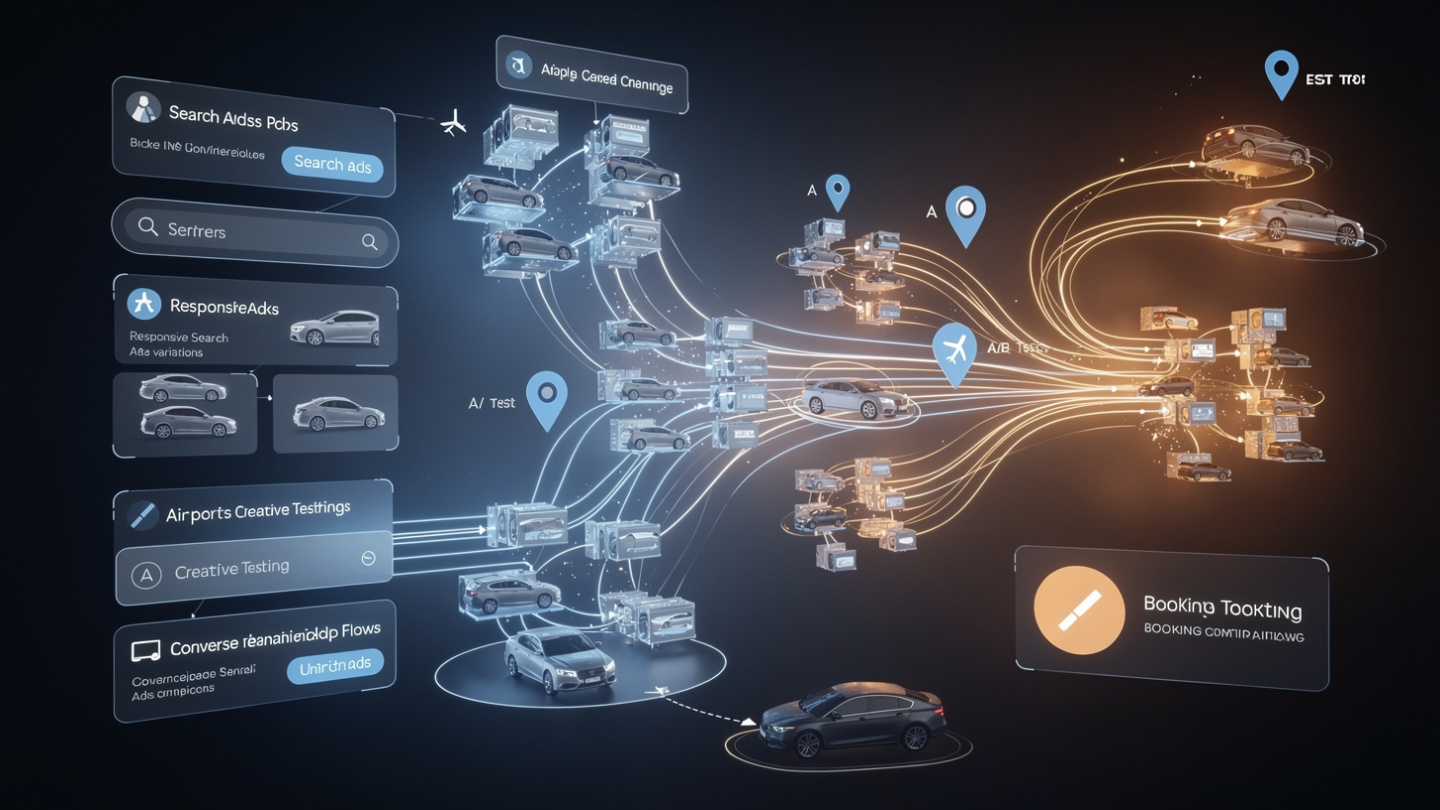
In Car Rental PPC, the ad is often the first interaction a user has with your brand. Before they see your landing page, your vehicle fleet, your pricing structure, or your booking flow — they see a headline and two lines of description text. In a search results page crowded with competing rental companies, aggregators, and OTA listings, that message is what determines whether they click or scroll straight past.
Most campaigns understand this in theory but underinvest in it in practice. Bidding strategy and keyword architecture receive detailed attention, while ad copy gets written once during setup and rarely revisited. The result is generic messaging — "Affordable Car Rentals. Book Now." — that blends seamlessly into the competitive noise and gives users no particular reason to choose one listing over another.
Strong ad copy does more than improve click-through rate. It shapes expectations before the click happens, filters for the right kind of user intent, reinforces trust signals that reduce hesitation, and directly influences the quality of traffic entering the booking funnel. A campaign with excellent targeting but weak creative is consistently outperformed by one where the targeting is merely good but the messaging is genuinely relevant. This guide covers how to build ad creative strategies that earn those clicks — and the bookings that follow.
Why Ad Copy Matters More Than Most PPC Campaigns Realize
Keywords determine which searches trigger your ads. Ad copy determines whether the users who see those ads actually engage with them. These are related but distinct problems, and conflating them is one of the most common sources of underperformance in car rental PPC accounts.
The commercial logic is straightforward. A higher click-through rate on the same keyword spend means more traffic without more budget. But the downstream effects are more significant than the traffic volume alone. CTR is a component of Quality Score — Google's assessment of the relevance and quality of your ads — which directly influences your Ad Rank and your cost per click. Ads with strong Quality Scores achieve better positions in the auction at lower CPCs, which means better creative generates a compounding efficiency advantage across every auction your campaign participates in.
Beyond the auction mechanics, ad copy acts as a pre-qualification filter. An ad that leads with pricing transparency attracts users who are ready to compare and book. An ad that leads with airport convenience attracts users who specifically care about airport pickup. When the ad's message closely matches the user's intent, the traffic arriving at your landing page is more aligned with your offer — which means better conversion rates, lower cost per booking, and a higher return on the media spend invested upstream. For businesses running Car rental PPC services, this upstream alignment is where lasting campaign efficiency is built.
Understanding User Psychology in Car Rental Searches
Car rental searches are rarely casual. Users searching for rental vehicles are typically operating under a combination of time pressure, pricing sensitivity, and trust concerns — and the way they phrase their searches reflects exactly what is on their mind at that moment.
Urgency is a defining characteristic of the category. A significant proportion of car rental searches happen within 48 hours of a planned trip, and many happen on the day of travel. Users in this state are not in a research mindset — they need a car, they need it confirmed quickly, and they need to trust that the process will work. Ads that acknowledge this urgency — through language around immediate availability, fast pickup, or instant confirmation — speak directly to the emotional register of these users in a way that generic messaging simply does not.
Pricing sensitivity is the other dominant driver. Car rental is a highly commoditized category in the eyes of most users — a vehicle that gets them from A to B is functionally identical across providers. This makes price comparison a natural default behavior, and it means ads that lead with vague value claims ("Great Rates!") are quickly filtered out in favor of ads that give users an actual signal about what they will pay. Transparent pricing messaging, even without specific numbers, communicates a willingness to be straightforward that reduces the friction users feel about clicking.
Car Rental PPC Marketing: Turning Clicks and Calls into Confirmed Bookings
Trust concerns operate more quietly but are commercially significant. Car rental has a complicated reputation — hidden fees, unexpected charges, and confusing insurance products are common complaints. Ads that surface trust signals early — "No Hidden Fees," "Free Cancellation," "Verified Reviews" — address this background anxiety directly and improve both CTR and the conversion quality of the traffic that arrives.
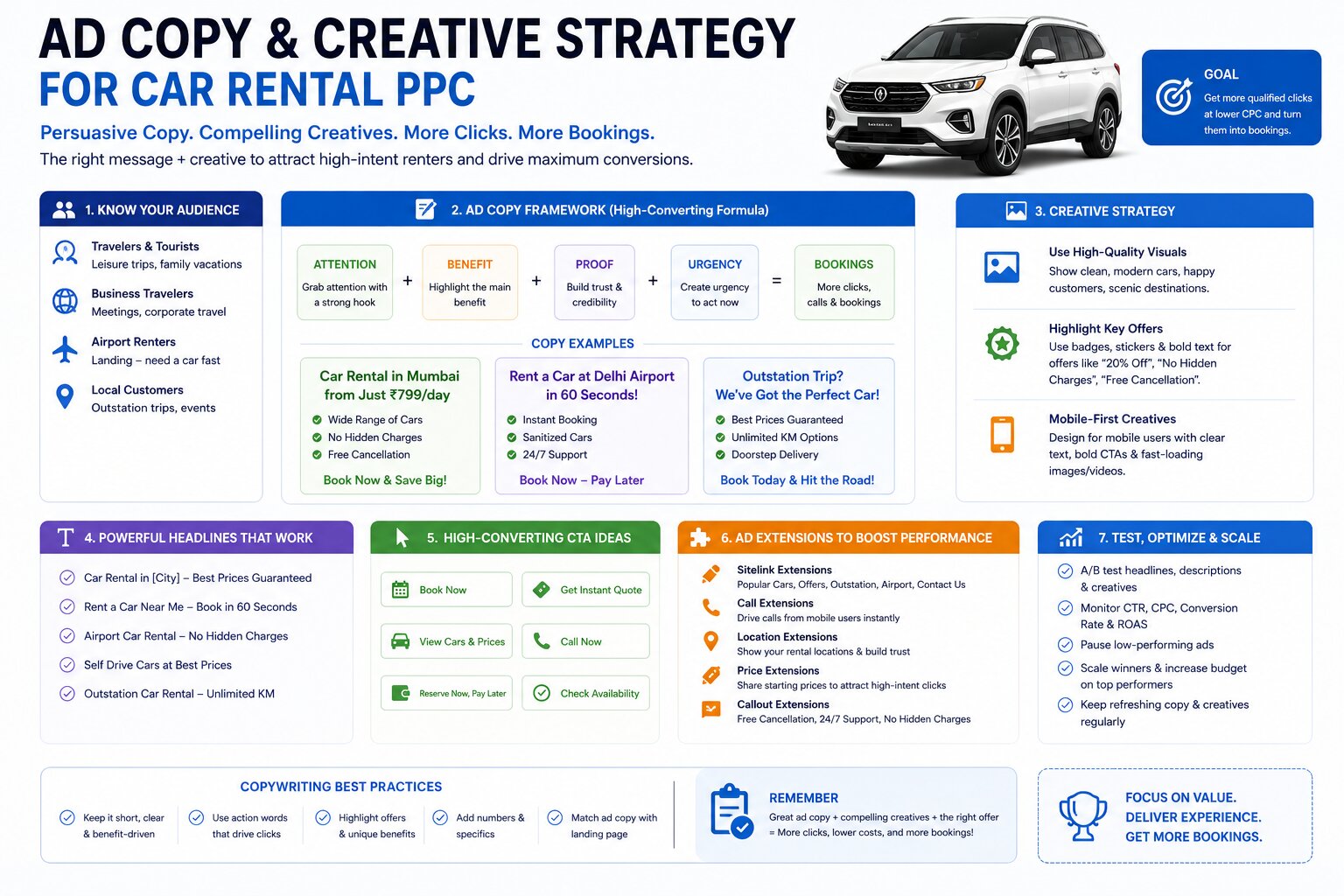
Ad Copy and Creative strategy for Car Rental PPC
What Makes a High-Performing Car Rental PPC Ad
There are four structural elements that consistently separate high-performing car rental ads from mediocre ones. These are not copywriting principles in the abstract — they are operational criteria that can be applied to every headline and description written for any campaign.
Clear Relevance
The most fundamental requirement of an effective PPC ad is that it closely mirrors the intent behind the query that triggered it. Users should read the ad and feel, immediately, that it is addressing exactly what they searched for.
Airport searches require airport-focused messaging — users searching "car rental at LAX" are not looking for a general car rental brand; they are looking for confirmation that you have a presence at the specific airport they need, that pickup is straightforward, and that the experience has been designed for arriving travellers. Luxury rental searches require premium positioning — language, vehicle references, and tone should signal exclusivity and quality rather than value and convenience. Budget rental searches require price clarity — users who type "cheap car hire" have made their priority explicit, and ads that respond with anything other than pricing transparency are misreading the intent.
Strong Value Proposition
Beyond relevance, users need a reason to click your ad over the adjacent listings competing for the same query. In a densely contested search results page, the value proposition is what differentiates one ad from another at the moment of decision. It should be specific enough to be meaningful and credible enough to be believed.
The value propositions that perform most consistently in car rental PPC are those that address the category's known pain points directly: free cancellation removes the risk of booking before plans are confirmed; unlimited mileage removes the anxiety of road trips or open-ended journeys; no hidden fees addresses the industry's reputation for unexpected charges; fast airport pickup addresses the stress of arriving with luggage and no clear plan. Any one of these, stated specifically rather than vaguely, gives users a concrete reason to engage with your ad over a competitor's generic listing.
Clear CTA
The call-to-action is the moment the ad converts curiosity into engagement. "Book Now" works for users with high intent who are ready to commit. "Reserve Today" works for users who want the booking confirmed but prefer a slightly softer framing. "Check Availability" works for users one step earlier in the process who need to verify before committing. "Compare Vehicles" is appropriate for campaigns targeting users still evaluating their options.
The choice of CTA should be informed by the intent level of the keyword triggering the ad. High-intent queries — "airport car rental tonight" — justify direct, commitment-oriented CTAs. Research-stage queries — "car rental options for road trip" — perform better with lower-commitment CTAs that invite exploration rather than demanding a booking decision before the user is ready to make one.
Trust Reinforcement
Trust signals embedded in ad copy reduce the mental friction users feel before clicking. In car rental specifically, where the category has accumulated significant consumer scepticism around billing practices and booking processes, even small credibility signals in the ad text can meaningfully improve click quality. Verified reviews, transparent pricing language, flexible cancellation policies, and clear rental terms all serve this function — and their presence communicates that the business is confident enough in its offering to be direct about what users can expect.
Ad Copy Strategy by Intent Type
Different user intents require materially different ad copy strategies. Writing the same message for all car rental queries is the most common and most costly copy mistake in this category.
Airport Intent Ads
Airport car rental searches are among the highest-converting query types in the category. Users have a confirmed travel plan, a specific location requirement, and often a pressing timeline. The messaging priority is convenience and readiness — users need to know that pickup is seamless, the process is fast, and there will be no complications between landing and collecting their vehicle.
Effective airport intent ad copy leads with location-specific confirmation ("At Terminal 2, Ready When You Land"), surfaces the speed of the process ("15-Minute Pickup Guaranteed"), and removes friction with trust language ("Instant Booking, No Queues"). The tone should be calm and confident — the ad is communicating that the logistics have been handled, not selling a feature.
Budget-Focused Ads
Budget searches operate on a different motivational register entirely. Users searching "cheap car hire" or "best car rental deals" have made their decision criteria explicit — price is the primary filter. Ads that respond with vague value messaging or premium positioning are fundamentally misreading these users.
Budget intent ads should lead with pricing transparency, surface any active promotions prominently, and use savings-oriented language that validates the user's decision criteria. Specific numbers perform better than relative claims: "From £19/Day" outperforms "Unbeatable Rates" because it gives users an actual reference point rather than an assertion they cannot evaluate. The trust signal that matters most for this intent type is fee transparency — users searching on price are particularly sensitive to the possibility of hidden charges undermining the headline rate.
Luxury Rental Ads
Luxury car rental searches attract a user who is experience-sensitive rather than price-sensitive. These users are evaluating vehicle quality, brand prestige, and whether the experience will meet the standard they are paying for. Generic car rental ad copy is actively counterproductive in this context, because it signals a commodity mindset that undermines the premium positioning the user is looking for.
Luxury rental ads should use language that signals exclusivity and a curated experience: "Premium Fleet. Concierge Service." or "Drive the Car You Actually Want." References to specific vehicle classes perform well when the fleet justifies them. CTAs should be refined rather than transactional — "Reserve Your Vehicle" is more appropriate for this intent type than "Book Now."
Same-Day and Urgency Ads
Urgency-based searches — "car rental available today," "same-day car hire near me" — come from users operating under genuine time pressure. These users need immediate reassurance that a vehicle is available and that the booking process will not introduce delays they cannot afford. The fear being managed is not primarily about price — it is about whether they will be able to get a vehicle at all. Urgency ads should lead with availability confirmation, surface the speed of the booking and pickup process, and use CTAs that create momentum: "Available Now — Reserve in 2 Minutes."
Landing Page Optimization for Car Rental PPC: Turning Clicks Into Actual Bookings
Responsive Search Ads (RSA) Strategy
Google's shift toward Responsive Search Ads as the primary ad format has fundamentally changed how car rental ad copy needs to be structured. RSAs require advertisers to provide up to 15 headlines and 4 descriptions, from which Google assembles combinations dynamically based on its predictions about which combination will perform best for each individual query and user context.
This format creates significant leverage — when RSA assets are well-constructed, Google's machine learning surfaces the most relevant combinations for each search, improving both CTR and conversion rate compared to static expanded text ads. But when RSA assets are generic, repetitive, or structurally similar, Google assembles weak, redundant combinations that underperform even basic static ads.
Effective RSA strategy for car rental requires deliberate asset diversity. Headlines should span multiple intent categories — airport convenience, pricing transparency, vehicle quality, booking speed, trust signals — so that the system has genuinely distinct messaging to assemble for different query types. Descriptions should alternate between feature-led and benefit-led framings, mixing practical information ("Free Cancellation, No Fees") with emotional resonance ("Your Journey Starts Here"). CTAs should vary between commitment levels — "Book Now," "Check Availability," "Reserve Today" — to match different intent depths. The most common RSA mistake in car rental PPC is writing 15 variations of the same core message with slightly different wording — a problem that no amount of machine learning can compensate for.
Creative Fatigue and Ad Refresh Cycles
Ad creative performance follows a predictable arc. Initial performance is typically strong as the audience encounters the messaging for the first time. Over time, as the same users are repeatedly exposed to the same ads, CTR declines, CPC rises, and the campaign's overall efficiency deteriorates. This is ad fatigue — and it is one of the most consistent sources of gradual performance decay in car rental PPC accounts.
The warning signs are measurable before the decay becomes severe: a week-over-week CTR decline not explained by seasonality or competition changes, a gradual rise in CPC without any corresponding increase in bid levels, and declining conversion rates from historically strong ad groups. When these signals appear together, the creative is almost always the primary cause.
The practical standard for managing fatigue is a refresh cycle of every 4–6 weeks for high-frequency campaigns running to narrow, well-defined audiences. Broader campaigns targeting larger audiences can sustain creative longer, but a monthly review of creative performance metrics is the minimum responsible practice regardless of campaign scale. Refresh strategy should not mean discarding everything and starting from scratch — effective refreshes typically involve rotating the hook element while retaining the underlying value proposition and CTA structure that have been proven by performance data.
AI and the Evolution of PPC Creative Strategy
AI's role in PPC creative has expanded significantly, and in car rental campaigns specifically it is changing the speed and precision with which messaging can be tested and optimized. Modern AI systems contribute meaningfully to headline generation at volume, identifying messaging patterns and variations that human copywriters might not explore systematically. They can process performance data across hundreds of ad combinations simultaneously and surface statistical signals that would take weeks to interpret manually. Predictive performance modelling — estimating the likely CTR and conversion potential of untested creative combinations based on historical signals — is also becoming increasingly useful as a first-pass filter before committing budget to live testing.
However, AI in its current form does not understand brand positioning, competitive context, or the psychological drivers of specific user intent segments. It can generate variations of existing copy directions efficiently, but it cannot define the strategic positioning those directions should serve. A system that uses AI to generate headlines without first establishing clear intent segmentation and competitive differentiation will produce a high volume of mediocre variations rather than fewer, sharper ones that genuinely move performance metrics. The practical application is a division of labour: human strategy defines the intent segments and messaging architecture; AI-assisted tools accelerate the generation and testing of variations within that framework.
AI-Powered Creative Optimization in Car Rental PPC
Dynamic Headline Testing
Google's RSA system is itself an AI-powered creative testing engine. It rotates headline combinations based on predicted performance for each user context and accumulates data on which combinations drive the strongest engagement across different query types, devices, locations, and times of day. Within RSA asset management, AI-assisted headline generation tools can accelerate the process of developing diverse headline variations across intent categories — generating 30 candidate headlines so the best 15 can be selected and tested, rather than writing 15 sequentially and accepting them as final.
Audience-Based Messaging Adaptation
AI-assisted bidding and audience management tools can route different users toward different RSA asset combinations based on audience signals — prior website behavior, device type, location, and demographic data. For car rental campaigns, this creates the possibility of a system where airport users see predominantly convenience and pickup-focused headline combinations, budget-intent users see pricing-forward messaging, and returning visitors see reassurance and booking-completion messaging. The foundation is always asset diversity — the system cannot serve personalized messaging if the underlying assets do not provide meaningfully different options to select from.
Predictive Creative Performance
Third-party AI tools and Google's own Ad Strength indicators provide predictive signals about likely creative performance before a campaign goes live. While Ad Strength scores are an imperfect proxy for actual conversion performance, they provide a useful early signal about asset diversity and structural quality. More sophisticated tools can analyze historical performance data from comparable campaigns to estimate the likely CTR impact of specific headline combinations, enabling pre-launch filtering that concentrates initial testing budget on the most promising creative directions.
Human Strategy vs. AI Automation
The dynamic between human strategy and AI automation in PPC creative is not a competition — it is a dependency relationship. AI tools improve the speed and efficiency of creative iteration; human strategy determines what the creative should communicate and to whom. Future-proof car rental PPC campaigns require both: strategic intent segmentation and positioning that only experienced practitioners can define, and AI-assisted testing infrastructure that scales the application of that strategy across large keyword sets and audience pools.
AI services
Ad Extensions That Improve Booking Performance
Sitelink Extensions
Sitelinks are additional links beneath the main ad that route users to specific pages within the site. For car rental campaigns, sitelinks should serve the most common sub-intent variations within a query category. A campaign running on airport rental keywords might carry sitelinks for specific airport locations, luxury fleet options, and the booking policy page. The commercial value is that sitelinks resolve intent ambiguity at the ad level — rather than forcing every user through the same landing page, sitelinks let users self-select toward the most relevant destination, improving both user experience and conversion rate.
Call Extensions
In car rental specifically, call extensions serve an important role for urgent and same-day bookings. Users who need a vehicle immediately and want to confirm availability before committing to an online booking flow are a commercially significant segment — they have high intent but prefer human confirmation over digital self-service. Call extensions put a phone number directly into the ad, enabling these users to act on their intent without navigating the site first. Call extensions should be scheduled to align with staffing hours, and call tracking should be configured to attribute resulting bookings back to the campaign.
Promotion Extensions
Promotion extensions surface active offers — seasonal discounts, weekend deals, early booking rates — directly in the ad without consuming headline or description character allocations. For budget-focused car rental queries where pricing is the primary decision driver, a promotion extension displaying a specific discount or seasonal rate can meaningfully improve CTR by making the value proposition tangible before the user has even read the ad body. Promotion extensions should be updated to reflect current offers and removed promptly when promotions expire.
Structured Snippets
Structured snippets allow you to display specific attributes of your service — vehicle types, rental features, pickup options — in a list format beneath the main ad. A structured snippet listing vehicle categories ("Compact, SUV, Luxury, Electric, Van") communicates fleet diversity efficiently. A snippet listing service features ("Airport Pickup, Free Cancellation, Unlimited Mileage, 24/7 Support") surfaces the value proposition elements that most influence car rental booking decisions. These additions work at the impression level — improving the ad's overall relevance signal and giving users more reasons to engage without requiring a click.
Ad Copy Strategy for Travel PPC
Aligning Ads with Landing Pages
The relationship between an ad and its landing page is a promise and its fulfilment. The ad makes a specific commitment — about pricing, availability, convenience, or vehicle quality — and the landing page either delivers on that commitment immediately or fails to, which determines whether the user completes the booking or bounces.
Message match between ad and landing page is one of the highest-leverage optimization levers in car rental PPC. When an airport convenience ad routes users to a generic homepage where they must search for the airport pickup section, the disconnect between expectation and experience costs conversions at a measurable rate. When the same ad routes users to a landing page that opens with airport-specific messaging, the airport fleet prominently displayed, and the pickup process clearly explained, the user's journey is coherent and conversion follows naturally.
The practical requirements for message match are specific: the same value proposition language that drove the click should appear in the page headline; the offer or urgency element from the ad should be visibly present without requiring the user to scroll; and the CTA on the page should continue the direction of the CTA in the ad rather than introducing new asks that create decision paralysis. The landing page optimization for car rental PPC decisions made at this stage directly determine the conversion value of every click your ad creative earns.
US vs UK Messaging Differences
Car rental PPC campaigns targeting the US and UK markets require distinct creative approaches that reflect real differences in search behavior, terminology, and user expectations. Running the same creative across both markets is a reliable way to underperform in both.
US Market: US car rental searches are characterized by direct CTA behavior, strong airport urgency signals, and a convenience-first decision framework. American travelers have high expectations for speed and immediacy — airport pickup ads that emphasize "Ready When You Land" or "Skip the Queue" perform strongly. CTAs in US market ads tend to be direct and action-oriented: "Book Now," "Reserve Your Car," "Get Your Rate." The messaging register is confident and transactional — users are ready to commit and respond well to ads that match that energy.
UK Market: The UK market introduces several distinctions that require creative adjustment. Terminology is the most visible: "car hire" is the standard phrase rather than "car rental," and ads that use the wrong terminology signal inauthenticity. Price comparison sensitivity is higher — UK users are more likely to compare across multiple providers before booking, which means ads that lead with pricing clarity and transparency outperform those leading with brand or experience messaging. "No Hidden Fees" and "Price Match Promise" are stronger motivators in UK market creative. The tone is also more measured — high-pressure urgency language tends to underperform relative to trustworthiness and transparency signals.
Market Insights: Ad Performance by Type
Ad Type | CTR Potential | Conversion Impact | Best Context |
|---|---|---|---|
Airport Convenience Ads | High | High | Airport-specific keywords, day-of travel queries |
Budget Pricing Ads | Medium–High | Strong | "Cheap" and "deals" intent keywords |
Luxury Experience Ads | Medium | Premium conversion quality | Premium vehicle and brand queries |
Urgency-Based Ads | Very High | Strong short-term conversion | Same-day, available-now intent searches |
Trust-Led Ads (No Hidden Fees) | Medium–High | Improved conversion quality | Broad rental queries with mixed intent |
Case Study: Creative Optimization Impact
Before Creative Optimization
A regional car rental operator running Google Ads in a competitive airport market had campaigns structured around strong keywords and well-configured bidding, but ad creative that had not been substantially updated in over 12 months. Three ad variants were running in each ad group — all variations of the same core message ("Affordable Car Rentals. Great Service. Book Today.") with minimal intent differentiation. CTR had declined steadily over the preceding quarter, Quality Scores were averaging 4–5 across high-priority ad groups, and cost-per-booking had risen significantly despite stable keyword bids.
Strategy Implemented
A full creative audit identified the primary problems: no intent-based segmentation, no airport-specific messaging despite the airport being the account's highest-value traffic source, RSA assets with low diversity leading to weak headline combinations, and landing page messaging that did not continue the ad's value proposition. The creative rebuild involved separate intent-specific ad copy frameworks for airport queries, budget searches, and advance planning keywords. RSA assets were rebuilt with 15 genuinely diverse headlines spanning all major intent and value proposition categories. Sitelink and callout extensions were restructured, and landing pages were updated to match the specific value proposition of each major ad group rather than routing all traffic to a single homepage.
Results
Metric | Before | After | Improvement |
|---|---|---|---|
Average CTR (Airport Ad Groups) | 3.1% | 6.8% | +119% |
Average Quality Score | 4.2 | 7.6 | +81% |
CPC (Airport Keywords) | £3.40 | £2.10 | –38% |
Conversion Rate (Landing Page) | 4.2% | 7.9% | +88% |
Cost Per Booking | £81 | £27 | –67% |
The improvement in Quality Score had the largest downstream impact — by improving the relevance signal, CPC fell significantly, which in combination with the improved conversion rate produced a cost-per-booking reduction that more than justified the creative rebuild investment.
Common Ad Copy Mistakes
Generic messaging. "Affordable Car Rentals. Book Now." is not a differentiator — it is what every rental ad says. Generic copy wins no auctions on relevance, attracts no attention in crowded search results, and gives users no reason to choose one listing over another. If your ad could run identically for any car rental business anywhere, it is not doing the job it needs to do.
Weak CTAs. A CTA that does not match the intent level of the keyword degrades conversion. "Learn More" on a same-day rental query sends users to an information page when they wanted a booking flow. "Book Now" on a research-stage query creates premature commitment pressure that drives bounces. CTAs need to be calibrated to where users actually are in the decision journey.
Too many competing offers. Ads that attempt to communicate unlimited mileage, free cancellation, airport pickup, lowest prices, and a loyalty program simultaneously communicate nothing clearly. The limited character space of a PPC ad demands prioritization — one or two strong, specific value propositions consistently outperform five weak ones competing for the same attention.
Misaligned landing pages. An ad that converts clicks at a strong CTR but routes to a landing page that does not continue the message is a system that is efficient at the top and broken at the bottom. Every click that does not convert because of message mismatch is wasted media spend.
Over-reliance on AI-generated copy without oversight. AI tools accelerate headline generation and creative variation, but they do not have strategic context. AI-generated copy not filtered through the lens of intent segmentation, competitive positioning, and brand voice produces high volumes of variations that are technically grammatical but strategically undifferentiated.
Insights
The best-performing PPC ads in car rental almost never feel clever. They feel relevant — as if the ad was written specifically for the query, the user, and the moment. That sense of relevance is not accidental. It is the product of deliberate intent segmentation, specific value proposition development, and messaging that respects what the user actually wants rather than what the advertiser wants to say.
"We see this consistently across car rental accounts. The campaigns that outperform their peers are not the ones with the highest budgets or the most sophisticated bidding strategies — they are the ones where someone actually thought carefully about who is reading the ad and what they need to hear at that specific moment. That clarity of intent, applied at the ad level, improves everything downstream: Quality Score, CPC, conversion rate, and ultimately cost per booking. It is also the part of PPC management that automation cannot replicate, because it requires genuine understanding of the customer." — Jeffrey Mathew, Founder, Teckgeekz
In this Series — Car Rental PPC:
Car Rental PPC Marketing: Turning Clicks and Calls into Confirmed Bookings
Car Rental PPC Campaign Structure: Building Google Ads Systems That Actually Convert
Landing Page Optimization for Car Rental PPC: Turning Clicks Into Actual Bookings
Takeaways
Ad copy is not a secondary task in car rental PPC management — it is a primary performance lever that influences Quality Score, CPC efficiency, conversion rate, and booking quality simultaneously. Campaigns that treat creative as a one-time setup activity leave significant performance on the table across every subsequent auction.
Intent alignment is the foundational principle. Airport queries, budget searches, luxury rentals, and urgency-based bookings require distinct messaging frameworks that address the specific motivations and concerns of each user segment. Generic copy that treats all car rental intent as equivalent consistently underperforms segmented creative, even when targeting and bidding are otherwise equal.
AI supports creative optimization meaningfully — through dynamic headline testing, audience-responsive messaging, and predictive performance signals — but it does not replace strategic positioning. Strong messaging improves the entire funnel: it attracts the right users, sets accurate expectations, and converts traffic at a higher rate than generic creative ever achieves.
In car rental PPC, ad copy influences performance long before the booking page is reached. Every element of creative — the headline, the value proposition, the CTA, the extensions — shapes the quality of users who click, the expectations they arrive with, and the conversion efficiency of the funnel they enter. Treating creative as a secondary concern in a well-structured campaign is consistently leaving performance on the table.
Strong ad copy that is segmented by intent, aligned with landing page messaging, and continuously tested and refreshed is one of the highest-return optimization investments in car rental PPC. Combined with the right car rental PPC campaign structure, high-intent keyword strategy, landing page optimization, and retargeting architecture, it creates a full-funnel system where each component amplifies the performance of the others. For businesses running Car rental PPC services who want to move beyond generic creative and build ad systems that earn the click and close the booking, the creative strategy framework in this guide provides the foundation — and Teckgeekz builds the systems that put it into practice.
Frequently Asked Questions
What makes a good car rental PPC ad?
A good car rental PPC ad closely mirrors the intent behind the search that triggered it, offers a specific and credible value proposition that differentiates the advertiser from competitors, and includes a call-to-action that matches the user's readiness to commit. Generic messaging, vague value claims, and mismatched CTAs are the three most common causes of underperformance. The best ads feel like they were written specifically for the query — because they were, through careful intent segmentation and ad group structure.
How important are CTAs in car rental ads?
CTAs are more important than most advertisers realize, because they determine whether a user who has read and been persuaded by the ad actually takes the next step. A CTA that is too aggressive for the user's stage in the decision journey creates hesitation. A CTA that is too passive for a high-intent user delays action they were ready to take. The CTA should match the intent level of the keyword — "Book Now" for same-day and high-intent queries, "Check Availability" or "Compare Vehicles" for earlier-stage searches.
Do responsive search ads perform better than standard ads?
RSAs outperform static ads when the underlying assets are genuinely diverse and well-constructed. Google's combination engine tests thousands of asset combinations to find what performs best for each user context — but only when the asset library provides meaningfully different options to assemble. RSAs with homogeneous assets perform worse than well-written static ads because the combination engine has nothing distinctive to work with.
Can AI write effective PPC ads for car rental campaigns?
AI tools can accelerate headline generation and produce useful variations at scale, but they cannot define the strategic intent segmentation and competitive positioning that makes ad copy effective. The most effective approach uses AI to accelerate variation generation within a framework defined by experienced human strategists — not as a replacement for that strategic thinking.
How often should car rental ad creatives be refreshed?
For high-frequency campaigns targeting narrow, well-defined audiences — particularly airport and same-day rental queries in competitive markets — creative should be reviewed every 4–6 weeks and refreshed when CTR decline or CPC increase signals fatigue. Broader campaigns targeting larger audiences can sustain creative longer, but a monthly performance review of creative metrics is the minimum responsible practice. Running three or more ad variants per ad group simultaneously provides continuous rotation and slows the rate at which any single message fatigues the audience.
How Teckgeekz Builds High-Performing PPC Creative Systems
Creative strategy at Teckgeekz is not treated as a copywriting task that happens once during campaign setup. It is an ongoing system — one that connects intent segmentation, competitive positioning, AI-assisted variation testing, and continuous performance analysis into a process that gets stronger the longer it runs.
Every car rental PPC account begins with an intent audit: mapping the keyword portfolio to distinct user intent categories and defining the specific messaging framework each category requires. RSA asset libraries are built with genuine diversity across headlines and descriptions — structured to give Google's combination engine the raw material it needs to serve relevant messaging across the full range of query types the campaign targets. Ad creative is reviewed on a regular cycle informed by performance data — when fatigue signals appear, refreshes are targeted and systematic, rotating hooks while retaining proven structural elements rather than rebuilding from scratch.
AI tools are integrated into the creative workflow where they genuinely add efficiency: generating candidate headline variations at scale, flagging asset combination weaknesses in RSA performance reports, and surfacing predictive signals about creative direction before budget is committed to live testing. Strategic positioning decisions — what the ads should say, to whom, and why — remain in human hands. The result is a creative system designed for long-term scalability: one that improves over time as performance data accumulates, responds to market changes without requiring full rebuilds, and consistently delivers the intent alignment and message quality that separates high-performing car rental PPC campaigns from the generic noise competing for the same auctions.


Jeffrey Mathew
Founder & CEO • Travel Marketing Specialist
"With over 14 years of dominance in the travel and tech sectors, Jeffrey Mathew has engineered growth for hundreds of OTAs and airlines worldwide. He specializes in the intersection of Performance PPC and Agentic AI, building high-performance digital ecosystems for modern brands."
Start a Conversation
Ready to Elevate Your Business?
Fill out the form below and let's discuss how Teckgeekz can help you reach your goals.
Describe your project to unlock real-time AI service recommendations and matching portfolio cases.
Our Trusted Partners