Car Rental PPC Campaign Structure: Building Google Ads Systems That Actually Convert

Most car rental PPC campaigns don't fail because the ads are bad.
The ads are usually fine. The keywords are reasonable. The budget exists. And yet performance is inconsistent — strong one week, expensive the next, with no clear explanation for why a campaign that worked in March is bleeding money in May.
The problem is almost always structural. Keywords with completely different intent competing inside the same ad group. Airport traffic mixed with general city searches. Brand queries absorbing budget meant for high-intent non-brand. One campaign trying to do five jobs simultaneously and doing none of them well.
Structure is not the glamorous part of PPC. It doesn't generate the case study headline. But it is the part that determines whether every other element — bidding, creatives, landing pages, AI optimization — actually functions as intended. A well-built structure doesn't just improve performance. It makes performance legible. You can see what's working, why it's working, and what to do next.
Car Rental PPC
This guide covers how to build a scalable Google Ads campaign structure for car rental PPC — including how to segment intent, allocate budget, manage match types, and integrate AI-driven optimization without losing strategic control. It covers both the US and UK markets, which behave differently in ways that matter.
Why Campaign Structure Matters More Than Most Advertisers Realize
There's a version of PPC management that treats the campaign layer as administrative — a container for keywords and ads, not a strategic decision in itself. That version produces accounts where everything is technically present but nothing performs well, because the signals feeding Google's optimization systems are contradictory.
Google's algorithms learn from conversion data. When that data comes from a campaign mixing high-intent airport searches with broad exploratory traffic and competitor queries, the system can't distinguish which signals are valuable. It optimizes toward an average — which means it under-serves your best intent and over-spends on your weakest.
Poor structure creates four compounding problems. Budget inefficiency — spend concentrates in the wrong places because there's no mechanism to direct it. Weak optimization signals — mixed intent produces mixed conversion data that smart bidding can't calibrate from. Relevance gaps — ad copy written for one intent type running against a different one lowers Quality Score and raises CPC. And limited scalability — when campaigns aren't segmented, scaling means spending more on everything, including what doesn't work.
The fix is not more sophisticated bidding or better ad copy. It's segmentation. Separate intent clearly, and everything downstream — bidding, relevance, budget control — improves because it's working with clean signals rather than noise.
High-Intent Keywords for car Rental PPC
The Core Campaign Layers in Car Rental PPC
A scalable car rental PPC account is built from five distinct campaign layers. Each serves a different purpose and should never share budget or keyword territory with the others.
Campaign Layer | Primary Intent | US Example Keywords | UK Example Keywords | Typical CPC Range |
|---|---|---|---|---|
Brand | Branded searches, protect own traffic | "Hertz rental", "Enterprise car hire" | "Arnold Clark hire", "Europcar UK" | Low ($0.80–$2.00) |
High-Intent Non-Brand | Airport, same-day, specific vehicle | "LAX car rental", "SUV rental Chicago" | "Heathrow car hire", "7 seater hire Manchester" | High ($3.50–$8.00) |
Location-Based | City, radius, local intent | "car rental downtown Denver" | "car hire Leeds city centre" | Medium ($2.00–$5.00) |
Competitor | Named competitor alternatives | "cheaper than Enterprise", "Hertz alternative" | "cheaper than Avis UK", "Budget car hire alternative" | High ($4.00–$9.00) |
Retargeting | Previous visitors, non-converters | Audience-based, no new keyword territory | Audience-based, no new keyword territory | Low–Medium ($0.60–$2.50) |
Each layer has a distinct job. Brand campaigns protect existing demand at low cost — they should never be the primary acquisition driver, but letting competitors capture your branded searches is an expensive mistake. High-intent non-brand is where the majority of new customer acquisition happens and where budget should be heaviest. Location-based campaigns capture the local and mobile intent that airport campaigns miss. Competitor campaigns are aggressive and expensive — useful for specific market share goals but not for efficient CPA at scale. Retargeting recovers users who showed intent but didn't convert, typically at a fraction of the acquisition CPA.
Retargeting Strategy of car Rental PPC
Brand Campaigns
Brand campaigns are the most efficient in any car rental account — high conversion rate, low CPC, minimal competition from irrelevant traffic. The mistake most accounts make is either ignoring them entirely (leaving branded traffic to organic, which works until a competitor bids on your name) or over-investing in them relative to non-brand acquisition.
In the US market, branded car rental searches tend to include the company name alongside service modifiers — "Hertz one-way rental", "Enterprise weekly rate". In the UK, "hire" replaces "rental" consistently — a terminology difference that affects match behaviour if campaigns are simply duplicated across markets rather than rebuilt for local intent.
High-Intent Non-Brand Campaigns
This is the acquisition engine. Airport searches drive the highest conversion rates in car rental PPC because intent is explicit — the user has a flight, a date, and a destination. They are not browsing. They are booking.
In the US, the top-performing airport keyword structures follow a consistent pattern: [AIRPORT CODE/NAME] + car rental + [modifier]. "LAX car rental same day", "JFK airport car rental weekly rate", "O'Hare SUV rental". Bid aggressively here. Missing impression share on these terms during peak travel periods is the most expensive structural mistake in car rental PPC.
In the UK, the pattern is [AIRPORT NAME] + car hire: "Heathrow car hire", "Gatwick car hire one way", "Manchester airport 7 seater hire". UK users also show stronger price comparison behaviour — search terms frequently include "cheapest", "best price", and "deals", which requires a different ad message emphasis than the US market's stronger brand-loyalty patterns.
Location-Based Campaigns
City and radius campaigns capture a different user — someone planning ahead, not at the airport yet, or renting locally rather than for travel. These searches convert at lower rates than airport campaigns but at significantly lower CPCs, making them an efficient part of the portfolio when structured separately.
The critical discipline here is radius targeting precision. A location campaign targeting "London car hire" without radius constraints will capture searches from across the UK. Layering in a 10–15 mile radius around specific city centres — and separate campaigns for each major city — keeps intent clean and allows budget to track actual local demand.
Structuring Ad Groups by Intent
Within each campaign layer, ad group structure determines ad relevance and Quality Score. The default mistake is creating one or two ad groups per campaign and loading them with all related keywords. The result is an ad that tries to speak to every intent simultaneously and connects with none of them clearly.
Ad groups should be segmented by four intent dimensions:
Vehicle type — compact, SUV, luxury, minivan, van. A user searching "7 seater hire Heathrow" and a user searching "sports car rental London" have completely different expectations. The same ad copy cannot serve both.
Booking urgency — same-day and last-minute keywords carry different intent than advance planning searches. "Car rental today LAX" needs urgency-led copy and a landing page that minimises friction. "Car rental New York June" needs availability reassurance and early booking value.
Price signal — keywords containing "cheap", "budget", "deals", or "best price" attract a specific user type. Mixing these with premium vehicle searches in the same ad group produces relevance mismatch that hurts both CTR and conversion quality.
Location specificity — airport-specific, city-centre, and radius-based searches should be in separate ad groups. Each requires different ad copy and, ideally, different landing page destinations.
Better ad group segmentation directly improves Quality Score, which reduces CPC — a compounding structural benefit that pays forward for the lifetime of the campaign.
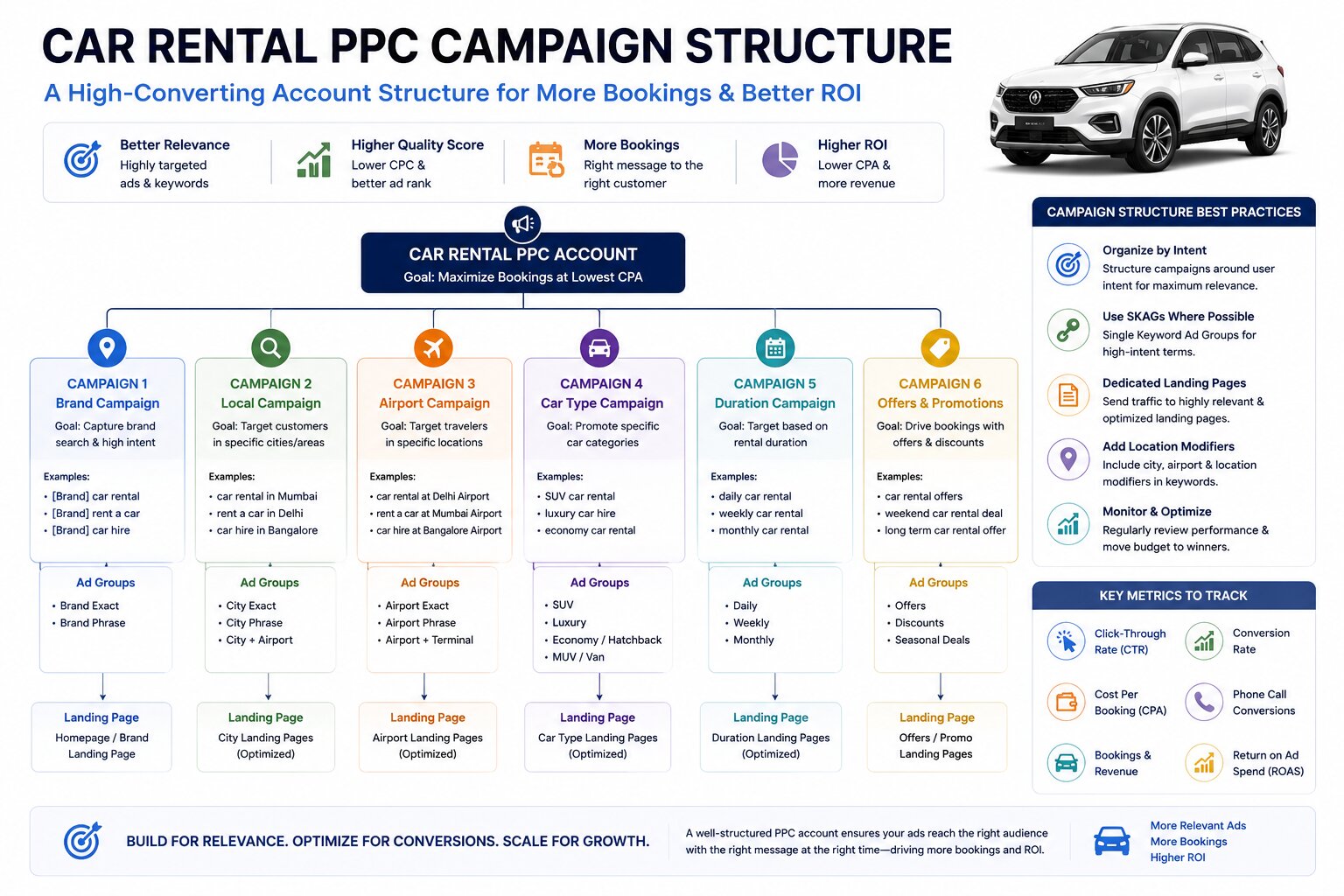
Car Rental PPC Structure
Budget Allocation Strategy
Budget should be distributed by conversion performance, not evenly across campaigns.
Budget Allocation & ROI Optimization for Car Rental PPC
A practical starting framework for a car rental account with a $5,000–$10,000 monthly budget:
Campaign Layer | Suggested Budget Share | Rationale |
|---|---|---|
High-Intent Non-Brand (Airport) | 45–50% | Highest conversion rate, strongest acquisition ROI |
High-Intent Non-Brand (Location) | 20–25% | Efficient CPA, strong local intent |
Retargeting | 15–20% | Low CPC, recovers warm audiences efficiently |
Brand | 8–10% | Protect branded traffic at low cost |
Competitor | 5–8% | Aggressive, expensive — keep contained |
The instinct to give competitor campaigns more budget than this is common and usually wrong. Competitor campaigns in car rental PPC typically have the highest CPC and the lowest conversion rate of any campaign type — users searching for a competitor by name are already brand-loyal and are expensive to convert. Keep the budget ceiling tight and review ROAS monthly.
Budget Allocation & ROI Optimization for Car Rental PPC
Match Types and Structural Control
Match type strategy has changed significantly since Google's 2021–2023 match type consolidation. Broad match today behaves very differently from broad match five years ago — it now incorporates audience signals, search history, and landing page context in ways that make it viable in structured accounts where it would previously have been wasteful.
Exact match remains the foundation of any high-intent campaign. For car rental, the keywords that drive the strongest CPA — specific airport searches, specific vehicle type queries, same-day rental terms — should be held in exact match and protected with tight negative lists.
Phrase match provides the right balance of control and scale for location-based and vehicle-type campaigns. It captures the natural variation in how users phrase the same intent ("car hire Manchester airport" vs "Manchester airport car hire") without opening to irrelevant traffic.
Broad match is viable in car rental PPC only when three conditions are met: smart bidding is active with sufficient conversion data (minimum 30 conversions per month per campaign), a robust negative keyword list is in place, and the campaign has been running long enough to have established audience signals. Without these, broad match in a competitive car rental market will burn budget on irrelevant traffic faster than any other structural mistake.
Negative Keywords — The Hidden Structural Layer
Negative keywords are as important to campaign structure as positive ones, and most car rental accounts are severely under-negated. A starter negative list for car rental PPC:
Add as campaign-level negatives across all non-brand campaigns: "free", "jobs", "careers", "hire staff", "van hire" (if not offering vans), "moving truck", "lorry", "driving lessons", "lease", "buy", "purchase", "used cars", "second hand", "insurance only", "breakdown cover"
Add as ad group-level negatives based on intent segmentation: In airport campaigns: negate city-center terms to prevent overlap with location campaigns In location campaigns: negate airport codes to prevent overlap with airport campaigns In competitor campaigns: negate your own brand terms to prevent internal cannibalization
Landing Page Alignment with Campaign Structure
Campaign structure without landing page alignment is incomplete. The conversion rate gains from proper intent segmentation are partially reversed if every campaign sends traffic to the same generic homepage.
Different campaign layers require different landing experiences:
Airport campaigns need a booking flow that loads fast, confirms the airport location immediately, and minimizes the steps between landing and reservation. Every additional click between arrival and booking costs conversion rate. The user is often on mobile, often time-pressured, and already decided — remove friction, don't add it.
Luxury and premium vehicle campaigns need a landing page that reflects premium positioning. Price-first layouts that work well for budget campaigns create immediate disconnect for a user who searched "luxury car hire London". The page should lead with the vehicle, the experience, and the brand — not the price comparison widget.
Budget and deal-focused campaigns need price clarity above the fold. Users who searched "cheapest car hire Heathrow" want to see a price immediately. If the first thing they see is a lifestyle image and a brand statement, they're gone in three seconds.
Landing Page Optimization for Car Rental PPC
AI in Modern Car Rental PPC — Amplifier, Not Replacement
AI-driven campaign features — smart bidding, Performance Max, dynamic search ads, responsive search ad rotation — have changed how car rental PPC campaigns are managed. But there is a persistent misunderstanding about what AI actually does in these systems.
AI optimizes within the structure it's given. It does not fix a weak structure. It amplifies whatever signals it receives — which means a poorly segmented account with mixed intent signals gets those mixed signals optimized more aggressively, producing faster and more expensive versions of the same problems.
The four AI features that matter most in car rental PPC, and how structure affects each:
Smart Bidding (Target ROAS / Target CPA): Requires clean conversion data from well-segmented campaigns to function correctly. A campaign mixing airport searches (high CVR, high booking value) with broad discovery traffic (low CVR, low booking value) produces an averaged signal that Smart Bidding calibrates to — meaning it over-bids on weak intent and under-bids on strong intent simultaneously.
Performance Max: Highly effective for car rental when asset groups are segmented by vehicle type and location, and when audience signals are built from first-party data (past bookers, high-value visitors). Without that segmentation, PMax treats all inventory as equivalent and optimises toward volume rather than booking quality.
Dynamic Search Ads: Useful for capturing long-tail rental queries the keyword list misses, but must be contained within tightly controlled campaign structures with robust negative lists. DSA campaigns in car rental without aggressive negation will serve against irrelevant queries at scale.
Responsive Search Ads: Ad strength scores are a useful signal, but "Excellent" ad strength does not guarantee conversion performance. The asset combinations Google favours for CTR are not always the combinations that convert. Human review of which headline and description combinations are actually appearing and performing remains essential.
"AI in PPC is genuinely powerful — but it's a force multiplier, not a foundation. Give it a weak structure and it will efficiently waste your budget. Give it clean intent segmentation and strong conversion signals, and it compounds the gains you've already built. The strategy still has to be yours." — Jeffrey Mathew
US vs UK Campaign Structure — Key Differences
Car rental PPC behaves differently across the two markets in ways that go beyond terminology. Building the same account structure and translating keywords is a common mistake that costs performance in both directions.
Dimension | US Market | UK Market |
|---|---|---|
Core terminology | "car rental" | "car hire" |
Airport intent | Extremely high — drives majority of bookings | High — but rail and coach alternatives create split intent |
Geographic scale | Large — state-level and city-level campaigns needed | Smaller — regional campaigns often sufficient |
Price comparison behaviour | Moderate — brand loyalty stronger | High — users frequently cross-reference aggregators (Kayak, Skyscanner, comparison sites) |
Dominant platforms | Google Search, Performance Max | Google Search + stronger Microsoft Ads presence |
Peak demand triggers | Memorial Day, July 4th, Thanksgiving, Spring Break | School half-terms, August summer holidays, Bank Holiday weekends |
Average CPC (airport terms) | $4.50–$8.00 | £3.00–£6.50 |
Competitor landscape | Enterprise, Hertz, Avis, Budget, National | Enterprise, Europcar, Avis, Arnold Clark, Sixt |
The structural implication for dual-market accounts: Do not share campaigns across markets. US and UK campaigns should be entirely separate — different keyword sets, different ad copy, different landing pages, different bidding targets. Shared campaigns produce averaged performance data that misrepresents both markets and makes optimization decisions unreliable.
Case Study: Campaign Restructure for a Mid-Size Car Rental Operator
The Situation: A mid-size car rental operator with locations across three US airport hubs and two UK city locations was running four campaigns total — one branded, one non-brand, one retargeting, and one "other". All non-brand traffic — airport searches, city searches, vehicle-specific queries, competitor terms — was consolidated into a single campaign with twelve ad groups. Budget was split evenly across all four campaigns regardless of performance.
Before restructure:
Metric | Value |
|---|---|
Average CPC | $7.20 |
Conversion Rate | 2.4% |
Cost Per Booking | $82 |
ROAS | 1.9x |
Impression Share (airport terms) | 38% |
Wasted spend (irrelevant queries) | Est. 28% of total budget |
What Was Built
The account was rebuilt across nine campaigns: three high-intent airport campaigns (one per US hub), one UK city hire campaign, one vehicle-specific campaign (SUV and premium segments), one location-based campaign, one competitor campaign, one brand campaign, and one retargeting campaign.
Ad groups were restructured from twelve mixed-intent groups to thirty-one segmented groups, each with a tightly matched ad and corresponding landing page destination. Smart Bidding was applied to campaigns with sufficient conversion volume. Manual CPC was retained for new campaigns until 30-day conversion history was established. A 140-term negative keyword list was built and applied at both campaign and ad group level.
Results After 90 Days
Metric | Before | After | Change |
|---|---|---|---|
Average CPC | $7.20 | $5.10 | −29% |
Conversion Rate | 2.4% | 4.8% | +100% |
Cost Per Booking | $82 | $44 | −46% |
ROAS | 1.9x | 4.1x | +116% |
Impression Share (airport terms) | 38% | 71% | +33pts |
Wasted spend | Est. 28% | Est. 7% | −75% |
The CPC reduction came primarily from improved Quality Score across newly segmented ad groups. The conversion rate improvement was driven by intent-matched landing pages — airport campaign traffic landing on airport-specific booking pages rather than the generic homepage. The impression share gain on airport terms came from budget freed by reducing allocation to poorly performing segments.
Common Campaign Structure Mistakes
Mixing all intent into one campaign. The most common and most damaging structural error. Airport intent and city intent and vehicle intent all require different bids, different ads, and different landing pages. Mixing them forces every decision to be a compromise.
No negative keyword management. Car rental accounts without structured negative lists bleed budget on "car hire jobs", "car insurance", "lease deals", and dozens of other irrelevant queries. This is not a setup task — it's an ongoing discipline. Search term reports should be reviewed weekly and negatives added continuously.
Treating US and UK as one market. Different terminology, different competitive landscape, different seasonal triggers, different price sensitivity. Campaigns that span both markets without separation produce data that accurately represents neither.
Over-relying on automation without structural foundation. Performance Max and Smart Bidding are powerful. They are not substitutes for account structure. Turning on automation in an unstructured account accelerates spend without improving results.
Ignoring impression share on high-value terms. Most car rental accounts monitor overall CPC and conversion rate but not impression share on specific airport terms. Missing 60% of impressions on "JFK car rental" during peak travel season is an invisible but expensive failure.
Key Takeaways
Campaign structure is the part of car rental PPC that nobody sees — and the part that determines whether everything else works.
Intent segmentation is not about creating more campaigns for its own sake. It's about giving every element of the account — bids, ads, landing pages, AI optimization — clean, consistent signals to work from. When structure is right, optimization becomes compound. Improvements in one layer reinforce improvements in others.
AI makes well-structured campaigns significantly more efficient. It does not make poorly structured campaigns acceptable. The combination of strategic segmentation and machine learning optimization is what produces the kind of results the case study above demonstrates — not one or the other alone.
US and UK markets require separate treatment. Terminology, seasonal triggers, competitive dynamics, and price sensitivity differ enough that shared campaigns consistently underperform dedicated ones.
How Teckgeekz Builds Car Rental PPC Structures That Scale
The accounts we build for car rental clients start with one question: what does each campaign need to know about the user before it decides what to bid and what to show?
That question drives the segmentation decisions — which intent layers to separate, how to structure ad groups, which landing pages each traffic type needs to reach. The campaign architecture is built before a single keyword is added, because structure determines what the account can learn and how fast it can optimize.
Car Rental PPC Services
AI optimization is introduced systematically — not switched on across the entire account from day one, but applied campaign by campaign as conversion volume reaches the threshold where machine learning produces reliable signals rather than erratic ones. Smart Bidding on a campaign with eight conversions in thirty days is not optimization. It's noise.
The result for clients is an account structure that doesn't need to be rebuilt when it scales. Adding new locations, new vehicle segments, or new markets means adding structured layers — not starting over. That's what scalable looks like in practice.


Jeffrey Mathew
Founder & CEO • Travel Marketing Specialist
"With over 14 years of dominance in the travel and tech sectors, Jeffrey Mathew has engineered growth for hundreds of OTAs and airlines worldwide. He specializes in the intersection of Performance PPC and Agentic AI, building high-performance digital ecosystems for modern brands."
Start a Conversation
Ready to Elevate Your Business?
Fill out the form below and let's discuss how Teckgeekz can help you reach your goals.
Describe your project to unlock real-time AI service recommendations and matching portfolio cases.
Our Trusted Partners