Budget Allocation & ROI Optimization for Car Rental PPC: Scaling Profitability Without Wasting Spend

The most common PPC problem in car rental is not a budget problem. It's a distribution problem.
The budget exists. The campaigns are running. The keywords are reasonable. And yet CPA keeps creeping upward, ROAS is inconsistent month to month, and every attempt to scale by increasing spend produces more traffic without proportional improvement in bookings. The instinct is to look at keywords, bids, and ad copy for the answer. The actual answer is almost always in how the budget is distributed across campaigns — and specifically, in the gap between where the money is going and where the bookings are actually coming from.
In car rental PPC campaigns, the conversion value of different traffic types varies enormously. A user searching "JFK airport car rental" on a mobile device at 4pm on a Thursday is worth ten times the CPC of a user searching "cheap car rental" from a residential address on a Sunday morning — not because the keyword is better phrased, but because the intent is more concentrated, the decision is more imminent, and the probability of a completed booking within 24 hours is dramatically higher.
Budget allocation is the mechanism that reflects this reality — or fails to. Campaigns that distribute spend based on keyword volume, account history, or inertia rather than intent-weighted conversion performance are systematically overfunding their least valuable traffic and underfunding their most valuable. The result is a portfolio that averages mediocrity across everything rather than compounding excellence where it matters.
This guide covers how to build a budget allocation framework for car rental PPC that prioritizes by conversion intent, adjusts for geography and device behavior, scales sustainably without destroying efficiency, and uses AI optimization correctly — as an amplifier of well-structured decisions, not a substitute for making them. Both US and UK market specifics are covered throughout.
Car Rental PPC Campaigns
Why Budget Allocation Matters More Than Bid Strategy
There's a hierarchy to PPC optimization that most guides get backwards. Bid strategy is discussed first because it's visible — Smart Bidding, Target ROAS, Manual CPC are active decisions with immediate measurable effects. Budget allocation is discussed later, or not at all, because it feels administrative.
In car rental PPC calls, this hierarchy is exactly wrong. Bid strategy determines how efficiently you compete within a campaign. Budget allocation determines which campaigns compete at all, and with how much firepower. A campaign with perfect bid strategy and insufficient budget will run out of money at 2pm and miss the highest-conversion evening window. A campaign with a generous budget and no conversion signal will spend efficiently toward the wrong outcomes.
The practical evidence for prioritizing allocation over bid optimization: accounts where budget is restructured before bids are touched consistently show larger performance improvements than accounts where bids are refined within an unchanged budget distribution. Allocation defines the ceiling of what bid optimization can achieve.
Three specific allocation failures that appear repeatedly in car rental accounts:
Discovery campaigns consuming airport budget. When all campaigns share a total account budget managed at the campaign level, high-CPC airport campaigns can exhaust their allocation before peak conversion windows while lower-CPC discovery campaigns continue spending into the evening. The mechanism is subtle — both campaigns appear to be running — but the airport campaign is capped when demand is highest.
Retargeting underfunded relative to ROAS. Retargeting consistently produces the strongest ROAS in car rental accounts — booking abandoners convert at three to four times the rate of cold acquisition traffic, at lower CPCs. Yet most accounts allocate 10–15% of budget to retargeting. The historical average, not the performance data, drives the allocation.
Geographic budget distributed by market size rather than conversion performance. Larger cities get larger budgets because they have larger populations — not because they produce better bookings. LAX might generate twice the bookings per dollar spent compared to a broad LA metro campaign, but if budget is allocated by metro population, the efficient traffic gets the same per-capita spend as the inefficient traffic.
CPA vs ROAS — Choosing the Right Optimization Target
Before building a budget framework, the optimization objective needs to be defined correctly. Car rental has a specific characteristic that makes this choice more consequential than in most categories: booking value varies significantly across vehicle types, rental durations, and booking channels.
A same-day economy car rental at LAX might generate $180 in revenue. A two-week luxury SUV rental at the same airport might generate $2,400. If both bookings are counted as equal conversions optimized toward a flat CPA target, the campaign is being instructed to treat a $180 outcome the same as a $2,400 one — and will do exactly that, optimizing toward the cheapest conversions regardless of their value.
When to use Target CPA:
When booking values are relatively consistent across the campaign's traffic (economy fleet, short rental durations, single vehicle category)
When conversion volume is insufficient for Target ROAS to calibrate reliably (under 30 conversions per month per campaign)
During new campaign launch when there isn't yet enough data for value-based bidding
When to use Target ROAS:
When booking values vary significantly across the campaign's traffic — vehicle type mix, duration mix, or channel mix
When conversion tracking captures actual booking value (not just a fixed conversion value per booking)
When the campaign has generated at least 30–50 conversions in the past 30 days and booking value data is reliable
When to use Maximize Conversion Value:
As a transition strategy when moving from CPA to ROAS — it optimizes toward booking value without requiring a target ROAS to be specified, which allows the system to calibrate before a ROAS target is introduced
The implication for campaign setup: booking value must be passed to Google Ads with each conversion for ROAS-based bidding to work correctly. If every completed booking fires a conversion with the same static value regardless of what was actually booked, Target ROAS degrades to Target CPA with extra steps. The tracking setup determines which bidding strategy is actually viable.
Conversion Tracking — The Foundation Budget Optimization Requires
Budget allocation decisions are only as good as the data they're based on. In car rental PPC, conversion tracking is more complex than in most categories because the path to a confirmed booking often spans multiple touchpoints, multiple devices, and sometimes includes a phone call rather than an online form submission.
The conversion actions that should be tracked in any car rental PPC account:
Completed online bookings — the primary conversion, tracked via thank-you page or booking confirmation event in GA4. Should pass booking value dynamically, not as a static placeholder.
Phone call conversions — a significant share of high-value car rental bookings, particularly for luxury vehicles, long rentals, and corporate accounts, happen by phone. Without call conversion tracking, these bookings are invisible to the optimization system — the campaign generated the intent, the user called to complete, and the campaign gets no credit. Google Ads call extensions with call tracking, or third-party call tracking platforms (CallRail, ResponseTap for UK), capture these conversions and attribute them correctly.
Booking initiation events — users who started the booking flow without completing. These are micro-conversion signals that inform Smart Bidding even when the booking isn't completed in the same session. GA4 custom events tracking booking widget interaction, date selection, and vehicle selection give the algorithm richer signal data without requiring full booking completion.
Chat or WhatsApp enquiries — for operators who use WhatsApp or live chat as a booking channel, these interactions should be tracked as assisted conversions. They rarely close in the same session but frequently result in bookings within 24–48 hours.
The critical point about call tracking in car rental: if phone bookings represent 20–30% of revenue (common in premium and corporate segments) and are not tracked, Smart Bidding is optimizing toward 70–80% of actual conversions. The campaigns it favors will be the ones that drive online form completions — which may not be the same campaigns that drive phone bookings from high-value customers. The allocation that results will be systematically wrong.
Landing page optimization for car rental PPC
Budget Allocation Framework by Intent Layer
The allocation framework below is built around the intent layer structure established in the campaign structure post — each campaign type gets a budget share that reflects its conversion performance and strategic role, not its keyword volume or historical spend pattern.
Campaign Type | $3k–$5k/month | $8k–$15k/month | $20k+/month | Strategic Role |
|---|---|---|---|---|
Airport — Presence (same-day) | 40–45% | 42–48% | 45–50% | Primary acquisition — highest CVR |
Airport — Interest (advance) | 10–15% | 12–15% | 12–15% | Advance planning capture |
Retargeting (all segments) | 18–22% | 18–22% | 15–20% | Conversion recovery — highest ROAS |
Brand campaigns | 8–10% | 6–8% | 5–7% | Traffic protection — lowest CPA |
Location / city campaigns | 10–15% | 10–14% | 10–12% | Local demand capture |
Tourist destination | 0–5% | 5–8% | 7–10% | Seasonal activation |
Competitor campaigns | 3–5% | 4–6% | 5–8% | Market share — high CPC, controlled |
Discovery / PMax | 0–3% | 3–5% | 5–8% | Audience building — controlled spend |
Several observations from this framework that are worth stating explicitly:
Airport campaigns should represent the majority of acquisition budget at every spend level. The percentage increases slightly as total budget grows because the airport opportunity is large enough to absorb more spend without efficiency degradation — there is real demand at scale, not just at the margins.
Retargeting is consistently allocated 15–22% — significantly more than the 10–12% common in most accounts. This reflects actual ROAS data, not convention. Retargeting in well-structured car rental accounts regularly produces 4–6x ROAS compared to 2–3x for cold acquisition. Underfunding it is leaving the highest-efficiency channel underused.
Competitor campaigns are capped at 5–8% even at high spend levels. The economics rarely justify more. Competitor campaign CPCs in car rental are among the highest in the account, conversion rates are the lowest (brand-loyal users are expensive to convert), and increasing allocation beyond this threshold typically produces rising CPA without proportional booking growth.
Discovery and Performance Max start at near-zero for lower budgets. At $3k–$5k/month, there isn't enough budget to fund airport and retargeting properly AND invest in discovery. Discovery is a growth investment, not a baseline requirement. It earns budget allocation only after the core intent-based campaigns are adequately funded.
Retargeting strategy for car rental ads
Car Rental PPC Marketing: Turning Clicks and Calls into Confirmed Bookings
Geographic Budget Prioritization
Location-based performance data should drive geographic budget allocation, not geographic size or intuition. An airport that generates 40% of bookings but receives 20% of budget is being systematically underfunded. A city campaign that consumes 25% of budget while producing 8% of bookings is absorbing spend that should be elsewhere.
The practical process for geographic budget review:
Pull 90-day conversion data segmented by campaign and geographic location. Calculate cost per booking and ROAS by location. Rank locations from highest to lowest ROAS. Adjust budget allocation to increase weight toward top-performing locations and reduce weight toward lower-performing ones — incrementally, not all at once, to avoid disrupting the conversion signals Smart Bidding relies on.
The destination rotation framework from the seasonal strategy post applies here at the budget level: different locations peak at different times, and geographic budget allocation should rotate with demand rather than remain static year-round.
US-specific geographic budget guidance:
Major airport hubs (LAX, JFK, ORD, MIA, DFW) warrant dedicated campaign budgets sized to their individual demand, not pooled into a single "US airports" budget. LAX and JFK alone account for a disproportionate share of premium car rental bookings in the US market — their campaigns should be funded at a level that protects impression share during peak windows, not averaged with smaller airports that have lower CPC and lower booking value.
UK-specific geographic budget guidance:
Heathrow dominates UK airport car hire demand and warrants the largest single geographic budget allocation. Gatwick and Manchester follow. The remaining regional airports (Edinburgh, Birmingham, Bristol, Glasgow) are individually smaller but collectively significant — a pooled UK regional airport campaign funded at 15–20% of total UK budget captures this demand without requiring individual campaigns for each airport.
Location-based PPC strategy for Car Rentals Marketing
Device-Level Budget Optimisation
Device behavior in car rental PPC is consistent enough to plan around: mobile dominates airport and same-day searches; desktop has a higher share of advance planning, luxury, and corporate bookings.
This pattern has direct budget implications — not through separate device campaigns (Google Ads doesn't allow device-only campaign separation at the budget level), but through device bid adjustments that effectively shift budget weight toward the device behavior that matches each campaign's intent.
Airport Presence campaigns: +25–40% mobile bid adjustment. Airport users are on mobile. Bidding equally for desktop and mobile in a same-day airport campaign means under-bidding for the device where most of the converting audience is searching.
Luxury and premium vehicle campaigns: −10–20% mobile bid adjustment. Users making high-value rental decisions on luxury vehicles more frequently complete bookings on desktop. The comparison and commitment behaviour associated with larger financial decisions tends toward the larger screen. Adjusting bids to reduce mobile competition in these campaigns concentrates spend where booking completion is most likely.
Advance planning campaigns: +10–15% mobile bid adjustment. Planning behaviour is increasingly mobile-first, but less aggressively so than same-day intent. A moderate positive adjustment reflects the device split without overcorrecting.
Important caveat on device bidding with Smart Bidding active: When Target ROAS or Target CPA is running, Google's system incorporates device signals automatically into real-time bid decisions. Manual device bid adjustments interact with Smart Bidding in ways that can be additive or counterproductive depending on the volume of device-specific conversion data available. In high-volume campaigns with strong conversion history, Smart Bidding device optimization is typically more accurate than manual adjustments. In lower-volume campaigns, manual adjustments provide a useful guardrail.
Seasonal Budget Allocation in Car Rental PPC
Static annual budgets are one of the most expensive structural decisions in car rental PPC. Demand in the category fluctuates by 40–60% between peak and off-peak periods — applying the same monthly budget across January and July is deliberately underfunding the highest-opportunity period and overfunding the lowest-demand one.
The seasonal budget framework for car rental operates at two levels:
Macro-seasonal adjustment — quarterly or monthly budget scaling based on overall demand trends. Summer peaks warrant 40–60% budget increases on beach destination, family, and leisure campaigns relative to the annual average. Winter peaks (festive travel, ski destinations) require separate budget activations. January–February off-season in most markets warrants 30–40% reduction in acquisition budgets, with saved spend redirected to retargeting and audience building.
Event-based micro-activation — short-duration budget increases tied to specific events. Las Vegas conventions, Edinburgh Festival, Orlando school holidays, UK bank holiday weekends. These are predictable demand spikes on a known calendar. Campaigns that activate dedicated budget for each event — rather than relying on the standard campaign to absorb the spike — capture the demand without the inefficiency of permanently elevated budgets between events.
The mechanic for event activation in Google Ads: create campaign-level budget rules or use portfolio bid strategies with scheduled bid adjustments. Set the elevated budget to activate three to five days before the event (to capture advance booking intent) and deactivate two to three days after (to avoid spending into declining demand).
Period | Budget Adjustment | Action |
|---|---|---|
Peak season (Jul–Aug, Dec) | +40–60% acquisition | Scale airport and tourist destination campaigns |
Shoulder season (Apr–Jun, Sep–Oct) | +10–20% selective | Scale proven performers, test new segments |
Off-season (Jan–Mar) | −30–40% acquisition | Reduce spend, increase retargeting share |
Event activation | +20–40% event-specific | Separate budget activation per event |
Pre-peak ramp (6 weeks before peak) | +15–25% gradual | Early positioning before auction price rises |
The pre-peak ramp entry in this table is worth emphasis. Entering a peak auction after it has heated up means paying elevated CPCs for impression share that would have cost less to establish four to six weeks earlier. Budget that increases gradually in the pre-peak window — building Quality Score, establishing position, and accumulating conversion signal before the auction becomes expensive — produces better peak-season performance than the same budget deployed reactively once peak has started.
The Efficiency Ceiling — When More Budget Stops Helping
Every campaign has an efficiency ceiling: the point at which additional spend within the current campaign structure produces diminishing returns rather than proportional booking growth.
In car rental, efficiency ceilings manifest specifically. An airport campaign targeting a single terminal at a mid-size airport may reach 85% impression share at $150/day. Increasing budget to $250/day doesn't produce 67% more bookings — it produces marginal impression share gains on an already saturated audience, at rising CPCs, with declining marginal ROAS. The campaign has reached its ceiling within its current geographic and keyword scope.
Recognizing efficiency ceilings matters for budget decisions because the response is structural, not operational. The answer is not to keep increasing budget into a saturated campaign. It's to build the adjacent campaign that captures the next layer of available intent — a new airport, a new vehicle segment, a new geo target — and fund that while maintaining the saturated campaign at its efficient ceiling level.
Signs a campaign has reached its efficiency ceiling:
Impression share above 75–80% with CPCs rising faster than conversion rate
ROAS declining despite stable campaign configuration
Additional spend producing traffic volume increases without booking rate increases
Smart Bidding consistently underspending the daily budget despite available auction volume
The last signal — consistent underspend — is particularly important and frequently misread. When Smart Bidding underspends a budget, the common response is to reduce the budget to match actual spend. The correct response is to diagnose why the system is declining available impressions — usually because conversion probability for the available impressions falls below the target CPA or ROAS threshold. The fix is structural: expand the campaign's scope or adjust the target, not reduce the budget.
Balancing Scale and Efficiency — The Most Consequential Allocation Decision
Scaling car rental PPC profitably is the question that every advertiser in the category eventually faces, and it's where most allocation decisions go wrong.
The standard scaling approach — increase budget across all campaigns proportionally — is the approach most likely to produce rising CPA and declining ROAS at scale. The reason is structural: proportional increases fund efficient and inefficient campaigns equally, and the inefficient campaigns scale their inefficiency with the increased budget. The account spends more and gets worse.
Sustainable scaling follows a different logic — one that prioritizes extracting maximum efficiency from existing campaigns before deploying additional budget, and that builds new campaign structure before increasing spend rather than after.
The scaling sequence that preserves efficiency:
Stage 1 — Efficiency consolidation. Before increasing total budget, ensure existing campaigns are operating at their best. Eliminate wasted spend (negative keywords, poor-performing geo zones, low-intent audiences). Confirm conversion tracking is capturing all booking channels including calls. Establish that Smart Bidding strategies have sufficient conversion volume to function reliably. This stage often reveals budget that can be reallocated internally before any external increase is needed.
Stage 2 — Identify the efficiency ceiling per campaign. Review impression share by campaign. Campaigns at 80%+ impression share with stable ROAS are at or near their ceiling — they're a reliable return on their current budget, but additional budget there produces diminishing returns. Campaigns with strong ROAS but impression share below 50% have room to scale — they're leaving convertible impressions on the table due to budget constraints.
Stage 3 — Fund budget-constrained campaigns before building new ones. If the airport campaign at LAX has 45% impression share and 4.8x ROAS, increasing its budget is the highest-ROI scaling decision available. Every additional dollar there has demonstrated conversion efficiency. Spend the available scaling budget there first.
Stage 4 — Build adjacent structure for the next scaling phase. Once impression share on core campaigns is above 70% and ROAS is stable, the next scaling step requires new campaign structure — new airports, new geo segments, new vehicle categories, new markets. Build these as separate campaigns with controlled initial budgets, establish their conversion efficiency over 30–60 days, then scale the ones that perform.
Stage 5 — Gradual, monitored increases. Budget increases of 20–30% at a time, with 14–21 day observation windows between increases, allow Smart Bidding to recalibrate and allow performance data to distinguish genuine scaling effects from statistical noise. Doubling a budget overnight is the fastest way to destabilise Smart Bidding calibration and generate a month of unreliable data.
AI-Powered Budget Optimization in Car Rental PPC
AI has changed budget optimization in three specific ways — each useful, each with a specific limitation worth understanding.
Smart Bidding as real-time allocation — Target ROAS and Target CPA bid strategies are, at their core, micro-allocation systems. They adjust the effective bid — and therefore the probability of winning each impression — in real time based on predicted conversion probability. This is a form of within-campaign budget optimization that operates at a granularity no manual process can match: adjusting bids based on device, location, time of day, audience signal, and search context simultaneously.
The limitation: Smart Bidding optimizes within a campaign's budget, not across campaigns. It cannot move budget from a saturated airport campaign to an underfunded retargeting campaign. Cross-campaign allocation remains a human decision.
Portfolio bid strategies — applying a shared bid strategy across multiple campaigns — allow Smart Bidding to shift effective spend between campaigns within a portfolio based on conversion probability. An airport campaign that is budget-constrained can receive more effective spend relative to a discovery campaign within the same portfolio if the airport campaign's conversion signals are stronger. This is the closest available approximation to AI-driven cross-campaign budget allocation, and it's underused in car rental accounts.
Predictive budget forecasting — Google's Performance Planner provides scenario modelling: given a budget change, what change in conversions and booking value does the system predict? This is imperfect — the predictions rely on historical data and don't account for structural campaign changes — but it provides a useful framework for evaluating scaling decisions before committing budget.
The structural caveat that applies throughout the cluster applies here particularly: AI budget optimization compounds the efficiency of well-structured allocation decisions. It doesn't substitute for them. A portfolio bid strategy applied to campaigns with mixed intent signals produces optimized mixed-signal outcomes. The human allocation decision — which campaigns to fund, at what proportion, in which sequence — remains the foundation.
US vs UK Budget Dynamics
The US and UK car rental PPC markets have different budget characteristics that affect how allocation frameworks should be calibrated for each.
Dimension | US Market | UK Market |
|---|---|---|
Average airport campaign CPC | $5.00–$9.00 | £3.50–£7.00 |
Average retargeting CPC | $1.20–$2.80 | £0.80–£2.20 |
Minimum viable monthly budget (airport focus) | $4,000–$6,000 | £2,500–£4,000 |
Budget to reach 70% airport impression share (major hub) | $8,000–$15,000/month | £5,000–£10,000/month |
Retargeting ROAS vs acquisition ROAS premium | 2.2–2.8x | 2.0–2.5x |
Competitor campaign CPC premium over non-brand | 35–55% higher | 25–45% higher |
Budget concentration in summer peak vs annual average | +55–70% | +45–60% |
The minimum viable budget figures are worth emphasis. At budgets below $4,000/month in the US or £2,500/month in the UK, airport campaigns cannot maintain meaningful impression share on competitive terms during peak windows — the budget exhausts before the day's highest-conversion hours. Below these thresholds, budget is better concentrated on a single airport target rather than spread across multiple airports at insufficient depth.
The UK retargeting CPC advantage — lower absolute cost than US — means retargeting delivers even stronger ROAS efficiency in the UK market relative to acquisition. The allocation framework should reflect this: UK accounts can often justify 20–25% retargeting allocation where US accounts run 18–22%, because the ROAS differential is more pronounced.
Market Insights: ROI Benchmarks by Campaign Type
Campaign Type | Typical CVR | Typical ROAS | CPA vs Account Average | Budget Priority |
|---|---|---|---|---|
Airport — Presence (same-day) | 4.5–7.5% | 3.8–6.2x | 35–50% below average | Highest |
Retargeting — booking abandoners | 6.0–10.0% | 4.5–7.0x | 40–60% below average | Very High |
Brand campaigns | 5.0–8.0% | 4.0–6.5x | 40–55% below average | High (protect) |
Airport — Interest (advance) | 2.5–4.0% | 2.8–4.2x | 10–25% below average | High |
Location / city campaigns | 2.0–3.5% | 2.2–3.5x | At or near average | Medium |
Tourist destination | 2.5–4.5% | 2.5–4.0x | 10–20% below average | Medium–seasonal |
Competitor campaigns | 1.5–2.5% | 1.8–2.8x | 20–40% above average | Controlled |
Discovery / broad | 1.0–2.0% | 1.5–2.5x | 40–70% above average | Minimal |
The discovery/broad row at the bottom is the most important allocation guardrail in the table. Discovery campaigns exist to build audience volume and brand exposure — they are not booking engines. Their ROAS will typically be the lowest in the account. Funding them at the expense of airport or retargeting campaigns is the most common way car rental accounts trade known efficiency for speculative reach.
Case Study: Budget Restructure for a UK Car Hire Operator
The Situation
A UK car hire operator with airport locations at Heathrow, Gatwick, and Manchester was spending £12,000 per month across Google Ads. Budget distribution had been established two years earlier and not substantively reviewed: equal allocation across three airport campaigns, one city campaign for London, and one broad UK campaign. Retargeting received £1,200/month — 10% of total budget.
Before restructure:
Metric | Value |
|---|---|
Blended ROAS | 2.4x |
Airport campaign impression share (Heathrow) | 44% |
Retargeting ROAS | 4.1x |
Broad UK campaign ROAS | 1.6x |
CPA (blended) | £76 |
Monthly bookings | 158 |
Budget wasted (estimated) | 22% |
The Heathrow campaign at 44% impression share was the most visible inefficiency — the highest-converting campaign in the account was losing more than half of available impressions due to budget constraints, while the broad UK campaign with 1.6x ROAS consumed the same monthly budget.
Strategy Implemented
Budget was restructured over a 30-day transition to avoid disrupting Smart Bidding calibration:
Heathrow campaign budget increased from £2,000 to £3,800/month. Gatwick increased from £2,000 to £2,600/month. Manchester held at £2,000/month. London city campaign reduced from £2,000 to £1,200/month (impression share data showed it was not budget-constrained). Broad UK campaign reduced from £2,000 to £800/month — sufficient to maintain audience building without funding a low-ROAS campaign at acquisition scale. Retargeting increased from £1,200 to £2,400/month — doubled based on 4.1x ROAS performance data.
Total budget remained at £12,000/month. No new budget was required — the restructure reallocated existing spend.
Smart Bidding strategy changed from Target CPA (flat £45 target across all campaigns) to Target ROAS with campaign-specific ROAS targets calibrated to each campaign's historical performance: Heathrow at 4.5x target, retargeting at 5.0x, city campaigns at 3.0x.
Call conversion tracking was implemented via ResponseTap, adding 23% more tracked conversions to the account immediately — phone bookings that had previously been invisible to the optimization system.
Results After 90 Days
Metric | Before | After | Change |
|---|---|---|---|
Blended ROAS | 2.4x | 4.1x | +71% |
Heathrow impression share | 44% | 78% | +34pts |
Retargeting ROAS | 4.1x | 5.6x | +37% |
CPA (blended) | £76 | £44 | −42% |
Monthly bookings | 158 | 241 | +53% |
Budget wasted (estimated) | 22% | 6% | −73% |
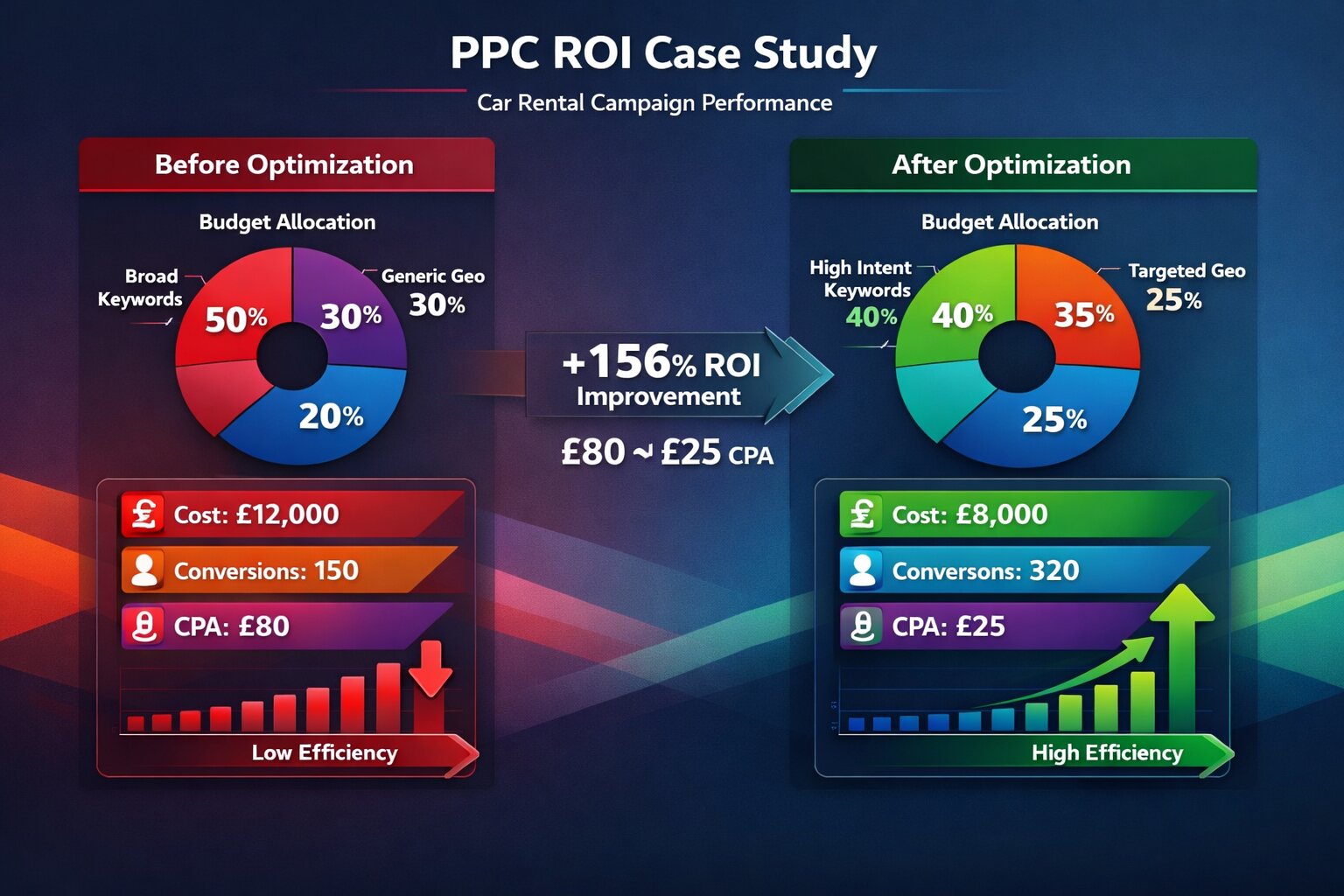
The booking volume increase of 53% from zero budget increase demonstrates the core argument: allocation, not budget size, drives performance. The Heathrow impression share improvement — from 44% to 78% — captured existing demand that was previously going to competitors. The call tracking implementation revealed a quarter of bookings that the previous optimization system was ignoring, allowing Smart Bidding to recalibrate toward the full conversion picture.
Common Budget Allocation Mistakes in Car Rental PPC
Scaling before conversion efficiency is stable. Increasing budget on a campaign that is not yet producing reliable ROAS data — fewer than 30 conversions per month — means funding a campaign whose Smart Bidding hasn't calibrated and whose performance data isn't statistically meaningful. The result is spending more to learn what a controlled budget would have revealed more cheaply.
Underfunding retargeting. In car rental accounts, retargeting consistently produces the strongest ROAS and lowest CPA of any campaign type. Allocating 10% of budget to a channel that delivers twice the return of acquisition campaigns is a structural misallocation that compounds month over month.
Treating all geographic locations equally. Equal budget distribution across airports, cities, and regions regardless of their individual performance is guaranteed inefficiency. The allocation should follow the data — locations with stronger ROAS receive more budget, locations with weak ROAS receive less.
Ignoring device-level conversion behavior. Airport campaigns with mobile conversion rates double those of desktop but equal mobile and desktop budgets (through equal bid adjustments) are systematically under-bidding for their converting audience.
Blind reliance on Smart Bidding without structural foundations. Smart Bidding on campaigns without sufficient conversion data, with mixed intent signals, or without call tracking producing the full conversion picture, optimizes toward a partial and potentially misleading dataset. The AI is only as good as the conversion signal it's given.
Not tracking call conversions. In car rental, phone bookings are a material share of revenue — particularly in premium and corporate segments. Campaigns that don't track calls are missing conversion events that would change their allocation decisions if they were visible. Call tracking is not optional in car rental PPC — it's a prerequisite for accurate budget optimization.
"More budget doesn't fix a distribution problem. I've seen accounts triple spend and watch CPA rise with it, because the additional money went into the same undifferentiated campaigns that were already inefficient. The question that should come before any budget decision is: where is the existing budget not going that it should be? Answer that honestly and you'll almost always find the performance improvement is internal — a reallocation, not an increase." — Jeffrey Mathew, Founder & CEO, Teckgeekz
Frequently Asked Questions
What is a good ROAS for car rental PPC campaigns?
It depends on the campaign type and market. Airport Presence campaigns in well-structured accounts typically produce 3.8–6.2x ROAS. Retargeting produces 4.5–7.0x. Brand campaigns 4.0–6.5x. Discovery and broad campaigns typically land between 1.5–2.5x, which is why they should receive minimal budget allocation in a performance-focused account. Blended account ROAS of 3.0–4.5x is a reasonable benchmark for a well-structured car rental account at steady state — below 2.5x indicates significant structural or allocation issues worth investigating before increasing budget.
How should PPC budgets be allocated across car rental campaign types?
At a high level: 45–50% to airport campaigns (the highest-converting intent), 18–22% to retargeting (the highest ROAS channel), 5–8% to brand campaigns (traffic protection at low cost), 10–15% to city and location campaigns, and the remainder distributed across tourist destination, competitor, and discovery campaigns based on account-specific performance data. These percentages should be treated as a starting framework, not a fixed formula — account data will reveal where the actual efficiency is and allocation should follow it.
Does AI improve ROI optimization in car rental PPC?
Yes — specifically through Smart Bidding's real-time bid decisions, portfolio bid strategies that allow Smart Bidding to work across campaigns, and predictive forecasting that informs scaling decisions. The material limitation is that AI optimizes within the structure and data it's given. Campaigns without call conversion tracking, without sufficient conversion volume, or with mixed intent signals will produce AI optimization toward an incomplete or misleading picture. The structural and tracking foundations must be in place before AI optimization produces its full potential value.
Why do CPAs rise during PPC scaling in car rental?
Because scaling typically means expanding into lower-intent traffic. The first bookings in a car rental account come from the highest-intent keywords and audiences — airport searches, booking abandoners, brand queries. As budgets increase and campaigns expand, the marginal traffic captured is progressively lower intent, lower conversion rate, and therefore higher CPA. Sustainable scaling avoids this by building new campaign structure — new airports, new geo targets, new audience segments — that maintains intent concentration as volume grows, rather than expanding existing campaigns into lower-quality traffic.
Should retargeting receive its own dedicated budget in car rental PPC? Yes, always. Retargeting's ROAS advantage over acquisition disappears when it has to compete for budget within shared campaigns or when it's funded as an afterthought at 10% of total spend. Car rental retargeting — particularly booking abandonment campaigns — consistently produces the lowest CPA and highest ROAS in the account. It deserves dedicated budget allocation sized to its performance, not a residual share of what acquisition campaigns don't use.
Key Takeaways
Budget allocation in car rental PPC is the decision that shapes everything downstream. Bid optimization, Smart Bidding, creative testing — all of these operate within the boundaries that allocation defines. Getting allocation right is the prerequisite for any other optimization to reach its potential.
Campaign structure for car rental PPC
Intent-based allocation — concentrating budget on airport campaigns, retargeting, and brand campaigns where conversion efficiency is highest — produces better returns than distributing spend proportionally across campaign types. The data in your own account will confirm the relative ROAS of each campaign type; allocation should follow that data.
Call conversion tracking is not optional. In car rental, phone bookings represent a material share of revenue. Campaigns that don't track calls are making allocation decisions based on incomplete conversion data — and Smart Bidding is optimizing toward the same incomplete picture.
Location-based PPC strategy for car rentals
Scaling sustainably requires identifying efficiency ceilings before increasing budget — the point at which additional spend in a campaign produces diminishing returns — and building new campaign structure for the next scaling phase rather than pushing more budget into saturated campaigns.
Retargeting strategy for car rental ads
AI optimization compounds the returns from well-structured allocation. It doesn't substitute for the structural decisions. Smart Bidding on campaigns with mixed intent signals and incomplete conversion tracking produces efficient delivery of the wrong outcomes.
How Teckgeekz Builds ROI-Focused PPC Systems for Car Rental
The budget frameworks we build for car rental clients start with conversion data, not convention. Every allocation decision is justified by account-level ROAS and CPA data by campaign type — not by what other accounts typically look like or what the default template suggests.
Call tracking is implemented before Smart Bidding strategy is set, because Smart Bidding on incomplete conversion data is a structural problem that no bid adjustment can fix. The full conversion picture — online bookings, phone bookings, chat enquiries — must be visible to the optimization system before it's asked to optimize.
Car rental PPC management
Scaling is approached as a staged process — efficiency consolidation first, impression share analysis second, adjacent structure third, budget increase last. Additional budget is deployed only into campaigns that have demonstrated conversion efficiency at current spend levels. The goal is not spending more. It's spending more efficiently — and having the structural foundation to absorb scale without watching CPA rise with it.
In this Series — Car Rental PPC:
Car Rental PPC Marketing: Turning Clicks and Calls into Confirmed Bookings
Car Rental PPC Campaign Structure: Building Google Ads Systems That Actually Convert
Landing Page Optimization for Car Rental PPC: Turning Clicks Into Actual Bookings
Retargeting Strategy for Car Rental Ads: Recovering Lost Bookings and Improving PPC Efficiency
Location-Based PPC Strategy for Car Rentals: Targeting the Right Users in the Right Places


Jeffrey Mathew
Founder & CEO • Travel Marketing Specialist
"With over 14 years of dominance in the travel and tech sectors, Jeffrey Mathew has engineered growth for hundreds of OTAs and airlines worldwide. He specializes in the intersection of Performance PPC and Agentic AI, building high-performance digital ecosystems for modern brands."
Start a Conversation
Ready to Elevate Your Business?
Fill out the form below and let's discuss how Teckgeekz can help you reach your goals.
Describe your project to unlock real-time AI service recommendations and matching portfolio cases.
Our Trusted Partners