Location-Based PPC Strategy for Car Rentals: Targeting the Right Users in the Right Places

Location is not a targeting setting in Car rental PPC campaign. It's an intent signal.
A user searching "car rental" from a device physically located at JFK Terminal 4 is in a fundamentally different state of mind from a user in suburban New Jersey searching the same phrase. The first user has a flight, a pickup time, and needs a vehicle within hours. The second might be planning a trip for next month, comparing prices out of curiosity, or researching for someone else entirely. Same keyword. Completely different intent. Completely different conversion probability.
Most car rental accounts don't account for this distinction at the campaign level. They run broad city-targeting across an entire metro area, mix airport traffic with local residential searches, and apply the same bids and messaging to users who are minutes from needing a car and users who are weeks away from making a decision. The result is a campaign that performs averagely across everything — which in a competitive, high-CPC category like car rental means it performs poorly where it matters most.
Location-based PPC strategy in car rental is about building campaigns that reflect the geographic reality of how users search and book — where they are when they search, what that location signals about their intent, and what message and experience that intent requires. Done well, it produces the sharpest segmentation available in the channel: sharper than demographic targeting, often sharper than keyword targeting, because geography in travel carries intent information that few other signals can match.
This guide covers how to structure geo-targeted campaigns for car rental PPC across airport, city, tourist, and radius targeting — including the specific configurations, bid adjustments, and creative decisions that separate high-performing location campaigns from broadly targeted ones. Both US and UK markets are covered throughout, with specific geographic examples for each.
Why Location Targeting Is the Highest-Leverage Segmentation in Car Rental PPC
Of all the segmentation dimensions available in Google Ads — keyword, audience, device, time of day, demographic — location carries the most concentrated intent signal in the car rental category. The reason is structural: car rental demand is almost entirely trip-driven, and trips are defined by geography.
When someone searches for a car at LAX, they are telling you their departure airport, their pickup timing (tied to their flight), and their need for a vehicle with specific characteristics (airport pickup capability, correct fleet for their destination). That single location signal contains more intent information than most keyword strings.
The economics follow the intent. Airport campaign keywords in major US hubs — LAX, JFK, ORD, MIA — consistently produce conversion rates two to three times higher than equivalent broad city campaigns targeting the same metro areas. In the UK, Heathrow, Gatwick, and Manchester airport campaign conversion rates regularly outperform city-centre equivalents by similar margins. The reason is not that airport users are intrinsically better customers — it's that their intent is more concentrated and their decision timeline is more urgent.
Budget that doesn't reflect this reality is being misallocated. An account that distributes geo budget evenly across airport and non-airport targeting is deliberately underinvesting in its highest-converting locations and overinvesting in lower-converting ones. The fix is structural, not operational — it requires separate campaigns for distinct location types, not bid adjustments applied to a single undifferentiated geo campaign.
Car rental PPC Calls
Understanding Car Rental Search Intent by Location Type
The four location types that define car rental demand each carry distinct intent signals, conversion timelines, and messaging requirements. Understanding these differences is the prerequisite for building campaigns that serve each one effectively.
Airport Intent Searches
Airport searches are the most valuable location-based traffic in car rental PPC. The user has a flight. They have dates. They have a pickup location. They're searching because they need transport, not because they're exploring options abstractly.
US examples: "LAX car rental", "JFK airport car hire", "O'Hare SUV rental same day", "Miami airport car rental terminal" UK examples: "Heathrow car hire", "Gatwick airport car hire one way", "Manchester airport 7 seater hire", "Edinburgh airport car hire"
The conversion characteristics that distinguish airport searches from every other location type: urgency is genuine rather than manufactured, the decision timeline is defined by a flight rather than an open preference, and mobile engagement is highest — users are frequently searching from the airport itself or in transit toward it.
The targeting implication: airport campaigns should be the highest-priority, highest-budget location segment in any car rental account. Missing impression share on these terms during peak travel periods is the most expensive geo targeting failure available.
Car Rental PPC Campaign Structure
Downtown and City Centre Searches
City searches carry a different intent profile. The user is not necessarily tied to a specific pickup time or date. They may be comparing options across providers, researching pricing for a future trip, or looking for a vehicle for local use rather than travel.
US examples: "car rental downtown Chicago", "luxury car hire Manhattan", "Chicago city centre car rental weekend" UK examples: "car hire central London", "Leeds city centre car hire", "Glasgow city car rental"
Conversion rates for city searches are lower than airport searches and decision cycles are longer. This does not make them unimportant — city campaigns serve a real segment — but it does mean they require different bid levels, different messaging emphasis, and different budget allocation relative to airport campaigns.
The specific challenge with downtown targeting is the breadth of intent within the segment. "Car rental downtown Chicago" could be a business traveler needing a vehicle for three days, a local resident whose car is in the shop, or a tourist planning a road trip. These sub-intents require different messages and ideally different campaigns — which is why city campaigns benefit from further segmentation by vehicle type and use case rather than running as a single broad city segment.
For additional technical context, review our in-depth analysis on AI & Business Automation.
Tourist Destination Searches
Tourist destination searches are geographically specific but purpose-driven rather than logistics-driven. The user is selecting a vehicle to enhance a trip experience — a convertible for a coastal drive, an SUV for a national park, a family minivan for a theme park visit.
US examples: "Orlando SUV rental family", "Miami convertible hire beach", "Las Vegas car rental strip", "Maui airport car hire" UK examples: "Scottish Highlands road trip car hire", "Cornwall car rental", "Lake District SUV hire"
The emotional dimension of these searches — vacation anticipation, experience planning, aspirational travel — means messaging that works for airport logistics falls flat here. A user searching "Maui convertible rental" is not primarily motivated by speed of pickup or price transparency. They're picturing the drive. Ad copy and landing pages that reflect the experience rather than just the transaction perform significantly better in this segment.
Seasonal concentration is also sharper here than in any other location type. Orlando family SUV demand peaks with school holidays. Scottish Highlands road trips concentrate in July and August. Las Vegas convention traffic clusters around major events. Tourist destination campaigns that don't build seasonal adjustment into their structure will consistently be over- or under-funded relative to actual demand.
Local and Residential Searches
"Van hire near me", "car rental open now", "same-day car hire [neighborhood]" — local and residential searches represent the most functional intent in the car rental category. The user has a practical need, usually urgent, and wants the closest available option.
These searches convert reasonably well — the urgency is genuine — but at lower booking values than airport or tourist searches. The vehicle types are often different (vans, small cars for errands or moving), the booking window is shorter, and the geographic precision required is tighter. A radius of 5–10 miles around the rental location is typically more appropriate than city-level targeting for these searches.
The temptation to de-prioritize local searches because they produce lower average booking values misses the efficiency opportunity. CPCs for local searches are generally lower than airport terms, and conversion rates for genuinely urgent local searches are high. The issue is not the segment — it's running it within a campaign that mixes its intent with airport or tourist traffic and averaging out the signals.
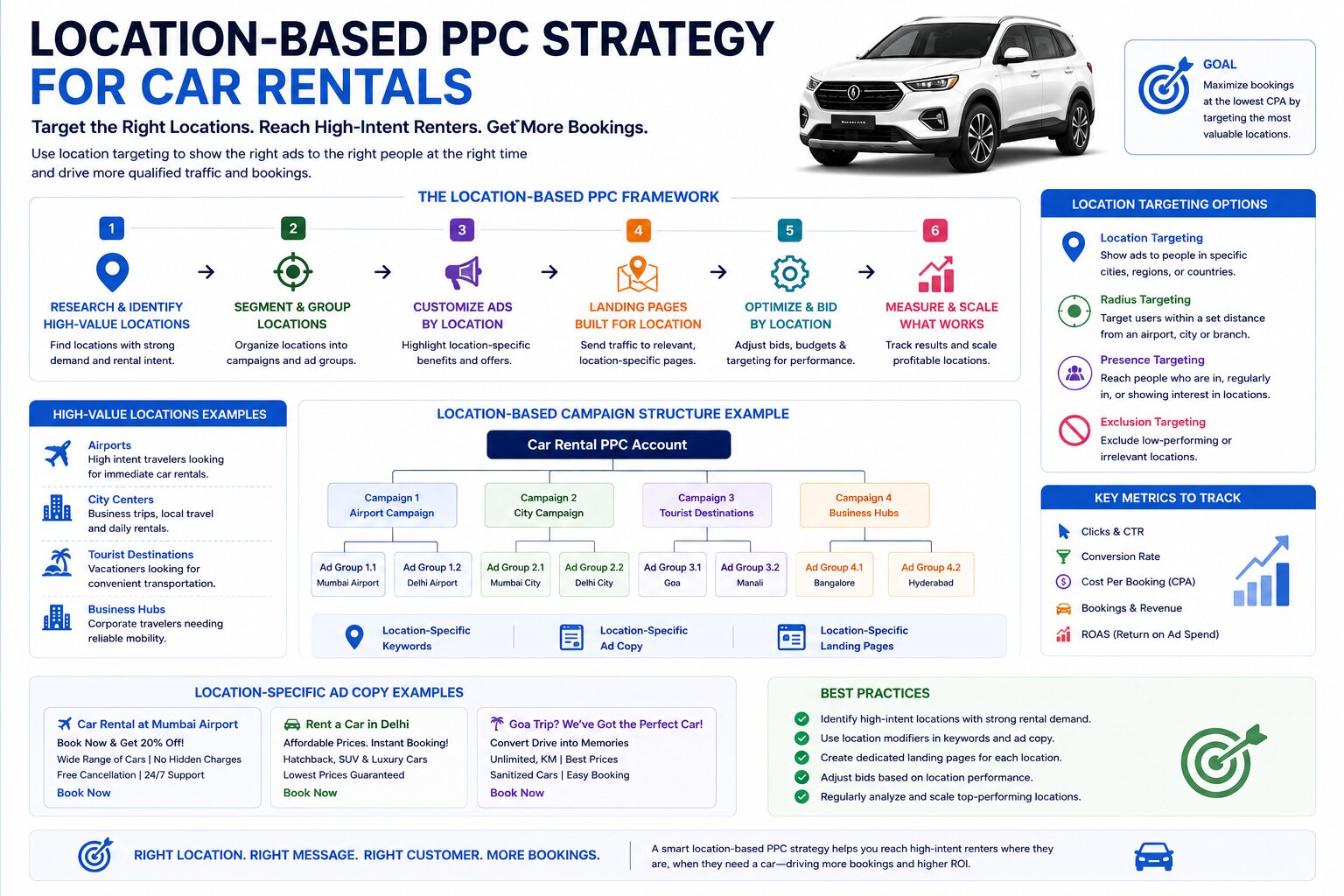
Location-based PPC strategy for car rentals
Presence vs. Interest — The Targeting Setting Most Accounts Ignore
Before building geo-targeted campaigns, there is a fundamental Google Ads configuration decision that most car rental accounts never explicitly make: Presence vs. Presence or Interest targeting.
This setting determines which users see your geo-targeted ads:
Presence only: Users physically located in the targeted area. A campaign targeting Heathrow airport with Presence targeting reaches users whose devices are physically at or near Heathrow.
Presence or Interest: Users physically in the area AND users anywhere who are searching for that location. A campaign targeting Heathrow with Presence or Interest reaches someone in Birmingham searching "Heathrow car hire" — they're not at Heathrow yet, but they're planning to be.
For car rental, both settings serve legitimate purposes — but they serve different audiences and should generally be used in separate campaigns rather than combined in one.
Presence targeting works best for same-day and urgent searches. A user physically at JFK who searches "car rental JFK" needs a vehicle now. The urgency is maximum. Bid aggressively for this audience.
Presence or Interest targeting works best for advance booking campaigns. A user in Manchester searching "Heathrow car hire" for a trip next month is in the planning phase. They're comparing options. The messaging, bid level, and conversion window are all different from the physically-present user.
Running both in the same campaign with the same bids and creative is the geo equivalent of mixing acquisition and retargeting audiences — the averages obscure what's actually happening in each segment, and optimization decisions made on blended data are wrong for both.
Car Rental PPC Marketing: Turning Clicks and Calls into Confirmed Bookings
Structuring Geo-Targeted Campaigns
The campaign structure that produces the best geo performance in car rental is not one campaign with geo bid adjustments — it's separate campaigns for distinct location types, each with their own budget, bidding strategy, creative, and landing page.
The architecture that works:
Campaign Type | Targeting Method | Bid Strategy | Budget Priority | Creative Focus |
|---|---|---|---|---|
Airport — specific (per major airport) | Presence only, 5-mile radius around terminal | Target ROAS / Max Conversions | Highest (45–50% of geo budget) | Urgency, fast pickup, terminal proximity |
Airport — interest (advance planners) | Presence or Interest, airport location | Target CPA | High (15–20%) | Availability, pricing, comparison-phase trust |
Tourist destination | Presence or Interest, destination radius | Target CPA | Medium (15–20%) | Experience, vehicle type, seasonal messaging |
City centre | Presence, city boundary | Target CPA | Medium (10–15%) | Local relevance, vehicle range, convenience |
Radius — local urgent | Presence only, 5–10 mile radius per location | Maximize Conversions | Lower (8–12%) | Same-day availability, proximity, speed |
Separate campaigns per major airport is not over-engineering — it's the configuration that allows budget to reflect actual airport-level demand. LAX and ORD do not have the same demand curve, the same competitive landscape, or the same seasonal patterns. A single "US airports" campaign averages across all of them and optimizes toward none of them precisely.
Car Rental PPC campaign Structure
Geo Bid Modifier Framework
Within campaigns that use manual or enhanced CPC bidding, location bid modifiers allow bids to adjust automatically based on where the user is searching from. For car rental, this is a meaningful optimisation lever — but only when the modifiers reflect actual performance data rather than assumptions.
The starting framework for car rental geo bid modifiers, to be refined with account-specific data:
Location Type | Suggested Bid Modifier | Rationale |
|---|---|---|
Airport terminal (0–2 mile radius) | +40% to +60% | Highest conversion rate, most urgent intent, most valuable traffic |
Airport approach (2–5 mile radius) | +20% to +40% | Still strong airport intent, slightly lower urgency |
City centre / downtown | +0% to +15% | Moderate conversion rate, competitive but not highest priority |
Tourist destination zones | +10% to +25% (seasonal) | Higher value bookings, strong conversion during peak season |
Residential / suburban | −10% to −20% | Lower conversion rate, lower booking value, lower priority |
Rural / low-demand areas | −30% to −50% | Rarely converts, budget conservation |
These modifiers compound with keyword, device, and time-of-day adjustments — so an airport search on mobile during peak evening hours may carry +60% location + +30% mobile + +20% time-of-day modifiers simultaneously. Building modifier logic that doesn't produce unintended compounding requires reviewing the combined adjustment impact, not each modifier in isolation.
Airport PPC Strategy — The Core of Car Rental Geo Targeting
Airport campaigns deserve their own strategic framework because they behave differently from every other location type in ways that affect every element of campaign management.
Why Airport Traffic Converts
The conversion advantage of airport traffic is not just about urgency — though urgency is real. It's about decision completeness. A user searching at an airport has already resolved all the upstream decisions that slow down non-airport bookings: they know where they're going, they know when they arrive, they know how long they need a vehicle. The only remaining decision is which provider. That is a much smaller decision than choosing a vehicle, choosing dates, and choosing a destination simultaneously.
This decision completeness is why airport campaigns consistently produce the lowest CPA in car rental PPC accounts when structured correctly — not because the clicks are cheap (they're not), but because the conversion rate on those clicks is high enough to offset the premium.
Airport-Specific Ad Messaging
Airport messaging should confirm the specific airport and address the specific concerns of an airport user — speed of pickup, shuttle availability, terminal proximity, and immediate availability. Generic car hire messaging that could appear for any location loses relevance points that cost Quality Score and CPC.
Effective airport ad structure:
Headline 1: "[Airport Name] Car Hire — Available Now" (location confirmation + availability) Headline 2: "Free Shuttle from Terminal — Book in 2 Minutes" (logistics reassurance + speed signal) Headline 3: "All Fees Included — No Airport Surcharges" (trust + hidden fee anxiety removal) Description 1: "Pick up at [Airport] in under 10 minutes. Vehicles available for immediate collection. Instant online booking." Description 2: "4.8/5 from 14,000 reviews. Free cancellation. Prices include all mandatory airport fees."
Every element answers a specific question the airport user is asking. The location is confirmed in headline 1. The logistics question (how do I get from the terminal to the car?) is answered in headline 2. The pricing anxiety (will there be surprise fees?) is addressed in headline 3.
Mobile Optimization for Airport Searches
Airport searches are disproportionately mobile. Users at or near airports search on phones — they're moving, they have one hand occupied, they need answers fast. The click-to-call extension is not optional for airport campaigns. A significant share of high-value airport car rental bookings in both the US and UK still happen by phone.
Mobile bid adjustments for airport campaigns should be positive — typically +20% to +40% relative to desktop for Presence-only airport targeting. The conversion data from mobile airport traffic justifies the premium.
Landing Page optimization for Car Rental PPC
Radius Targeting and Hyperlocal Campaigns
Radius targeting is the most precise geographic tool available in car rental PPC — and the most commonly misconfigured one.
The default mistake is setting radius targets too large. A 25-mile radius around Heathrow airport captures a significant portion of Greater London — users who may be searching for general car hire, not specifically airport-related transport. A 5-mile radius captures the genuine airport intent audience: users at or near the terminals, in airport hotels, or approaching from the motorway.
Radius sizing should be calibrated to the realistic travel behaviour associated with the location:
Airport terminals: 3–7 mile radius. Tight enough to capture genuine airport users without pulling in general city traffic.
City centre locations: 5–15 mile radius depending on city density. London and Manhattan warrant tighter radii than Chicago or Manchester because of transport alternatives — users farther out are more likely to use public transport.
Tourist attractions: 10–20 mile radius. Orlando theme parks draw visitors staying across a wide accommodation area. A tight radius misses a significant share of the relevant audience.
Individual rental locations: 3–8 mile radius. For operators with specific branch locations, radius targeting around each branch captures the most relevant local intent without competing with their own airport campaigns.
Stacking radii for bid adjustment: Rather than choosing one radius, layer multiple radius targets with decreasing bid modifiers as distance increases. 0–3 miles at +50%, 3–7 miles at +25%, 7–15 miles at base. This creates a bid gradient that reflects the declining intent signal as users move farther from the location.
Seasonal Location Targeting — Where and When Demand Concentrates
Car rental demand is seasonal everywhere, but the seasonal pattern varies significantly by location type. A single seasonal strategy applied across all geo campaigns will consistently mis-fund the portfolio.
Location | Peak Season | Shoulder | Off-Peak | Seasonal Action |
|---|---|---|---|---|
Florida airports (MCO, MIA) | Dec–April (winter sun), June–Aug (families) | May, Oct–Nov | Sept | Scale Dec–April; separate summer budget |
UK airports (Heathrow, Gatwick) | July–Aug (school summer), Dec (festive) | April–June, Sept–Oct | Jan–Mar | Major budget increase July; festive campaign separate |
Las Vegas (LAS) | Convention calendar-driven year-round | Feb, Aug | No true off-peak | Event calendar integration essential |
Scottish Highlands | July–Sept | May–June, Oct | Nov–April | Seasonal campaign pause Nov–April |
Orlando theme parks | School holidays (US and UK) | Shoulder between school periods | No true off-peak | UK school holiday calendar layered onto US |
NYC (JFK, LGA, EWR) | Summer, Thanksgiving, New Year | Spring, Fall | Jan–Feb | Strong year-round with holiday surges |
The Las Vegas row above points to one of the most underused geo strategies in car rental: event-based campaign activation. Las Vegas hosts CES (January), the Consumer Electronics Show (180,000 attendees), NAB Show (April), and dozens of other conventions that each drive temporary spikes in airport and city-centre car rental demand. A campaign that activates specifically around event dates — with event-specific messaging ("In Vegas for NAB? Fleet available from LAS") — captures intent that a standard campaign running static budgets will miss or underfund.
The same principle applies in the UK: Chelsea Flower Show drives London car hire demand in May. Glastonbury drives Somerset and Bristol airport searches in June. The Edinburgh Festival concentrates demand on EDI airport and city-centre Edinburgh searches from July through August. These are predictable, calendar-driven demand spikes that warrant dedicated campaign activations rather than hoping the standard campaign absorbs them.
The Presence vs. Interest Decision by Location Type
The Presence vs. Presence or Interest setting discussed earlier applies differently across location types, and getting it right per campaign type is one of the more impactful configuration decisions in geo targeting.
Location Type | Recommended Setting | Reasoning |
|---|---|---|
Airport — same-day and urgent | Presence only | Users physically at or near the airport need a vehicle now |
Airport — advance planning | Presence or Interest | Users anywhere planning a trip through a specific airport |
Tourist destination | Presence or Interest | Users planning a visit from outside the destination |
City centre — local users | Presence only | Residents and visitors physically in the city |
Event-based campaigns | Presence or Interest | Attendees planning travel before the event |
Retargeting geo audiences | N/A — audience-based | Prior site visitors regardless of current location |
The advance planning airport campaign deserves emphasis. A user in Birmingham searching "Heathrow car hire June" three weeks before their trip is a high-value prospect who will not appear in a Presence-only Heathrow campaign. Presence or Interest targeting captures them. Running this as a separate campaign from the Presence-only same-day airport campaign allows different bids, different messaging (planning-phase vs. immediate urgency), and different landing page experiences for each audience.
AI-Powered Geo Optimization in Car Rental PPC
AI has changed geo targeting in car rental PPC in three specific ways that are worth understanding concretely rather than abstractly.
Predictive location bidding — Smart Bidding strategies (Target ROAS, Target CPA, Maximize Conversions) incorporate location as a signal in real-time bid decisions. Google's system adjusts bids based on the historical conversion probability associated with the user's specific location, device, and search context simultaneously — not just location in isolation. This means an airport search on mobile at 6pm (peak pre-pickup window) gets a different bid than the same keyword from a residential address at 2pm.
The practical implication: Smart Bidding at the campaign level is doing location bid optimisation automatically at a granularity that manual bid modifiers can't match. But it requires clean campaign segmentation to calibrate correctly. A campaign mixing airport and residential traffic produces blended location signals that Smart Bidding can't optimise away — it will simply find the average performance point between the two, which is sub-optimal for both.
Dynamic audience geo segmentation — AI-driven audience tools identify geographic patterns in conversion data that aren't visible in manual reporting. Which specific postal codes within a city-level campaign are producing bookings? Which radius band around a tourist destination converts at what rate? These granular patterns can inform structural decisions — creating sub-campaigns or adjusting radius targets based on AI-surfaced geographic performance data rather than assumptions.
Real-time demand adjustment — Performance Max campaigns with geo targeting can adjust impression delivery in real time based on demand signals — increasing visibility in locations showing booking intent spikes (event-driven surges, weather events that increase local rental demand) without requiring manual campaign changes. For operators in markets with unpredictable demand spikes, this automated geo responsiveness is a genuine operational advantage.
The structural caveat holds here as it does throughout the cluster: AI optimises within the geographic structure it's given. A well-segmented geo account — airport campaigns separate from city campaigns, tourist destinations separate from local radius targeting — gives AI clean signals to work with. An account where all geo targeting is managed through bid adjustments on a single campaign gives AI averaged, mixed signals that produce averaged, mixed results.
Aligning Geo Campaigns with Ad Copy and Landing Pages
Geographic targeting creates a targeting precision that ad copy and landing pages must match to realise its value. A campaign that correctly targets users physically at Heathrow airport, then serves them a generic "car hire deals" ad that lands on a homepage, has used precise geo targeting to deliver an imprecise experience. The targeting worked. Everything downstream didn't.
The alignment principle: the geographic specificity of the campaign should be reflected in the ad and matched on the landing page.
Airport campaign alignment:
Ad: names the specific airport, addresses terminal proximity and pickup speed
Landing page: confirms airport in the H1, pre-populates the pickup location field, shows airport-specific trust signals (shuttle info, terminal opening hours)
Tourist destination campaign alignment:
Ad: references the destination experience, vehicle type relevant to the destination (SUV for national parks, convertible for coastal routes)
Landing page: destination-specific imagery, experience-led copy, vehicle category filtered to destination-appropriate options
Local radius campaign alignment:
Ad: proximity signals ("0.8 miles from you", "available today"), same-day messaging
Landing page: branch location map, same-day availability widget, click-to-call prominent
The landing page specificity for geo campaigns is not a small detail — it's where the conversion rate difference between a good geo campaign and a great one is realized. Users who see their specific airport named in the ad and confirmed immediately on the landing page experience relevance continuity that reduces hesitation and improves booking completion rates.
Landing page Optimization for Car Rental PPC
Ad copy and creative strategy for Car Rental PPC
Budget Allocation & ROI Optimization for Car Rental PPC
Negative Location Targeting — The Overlooked Efficiency Lever
Just as negative keywords prevent ads from serving against irrelevant searches, negative location targeting prevents campaigns from serving in locations that drain budget without producing bookings.
Most car rental accounts never configure negative location targeting. They set positive geo targets and assume everything outside those targets is excluded. It isn't — depending on campaign settings, ads can serve to users in excluded locations who are searching for the targeted location (the Presence or Interest effect in reverse).
Negative location targets worth configuring in car rental accounts:
Exclude competitor stronghold locations where a specific competitor dominates and CPC is inflated without proportional conversion opportunity. If a single incumbent rental brand owns 70% of the market at a specific regional airport, competing there at scale is expensive relative to the return. Excluding the immediate airport radius while maintaining broader city and tourist targeting captures the addressable opportunity without burning budget in an unwinnable auction.
Exclude locations with historically zero conversion. Pull 12 months of geographic performance data in Google Ads reporting. Identify locations within campaign targets that have generated clicks but zero bookings. These locations are consuming budget with no return. Negative targeting removes them.
Exclude locations where organic or direct traffic dominates. If your brand already has strong organic rankings for car hire searches in a specific city, running paid campaigns there produces expensive traffic duplication. The paid campaign captures clicks the organic listing would have anyway, at PPC cost.
Retargeting Geographic Audiences
Geographic segmentation extends into retargeting — and the retargeting behavior of different geo audiences varies enough to warrant separate retargeting campaigns by location type.
Airport intent visitors have short retargeting windows. A user who searched Heathrow car hire and didn't book has a decision cycle measured in days, not weeks. Retargeting them for 30 days with the same urgency-led messaging they needed in the first three days produces ad fatigue after day five and wasted spend thereafter.
Tourist destination visitors have longer consideration cycles. A user who visited an Orlando rental page in March for a June trip is in a planning phase that extends over weeks. Lower frequency, longer window, messaging that evolves from inspiration to value to urgency as the travel date approaches.
Local urgent visitors have the shortest windows of all. A user who searched "van hire near me" and didn't book has either found a vehicle elsewhere or deferred entirely. Retargeting beyond 48 hours is rarely productive for this audience.
Retargeting strategy for Car Rental Ads
US vs UK Location-Based PPC — Specific Geographic Differences
The general US/UK behavioral differences covered in previous posts manifest specifically at the geo targeting level in ways that require different campaign configurations.
Dimension | US Market | UK Market |
|---|---|---|
Airport importance | Dominant — drives 55–65% of total bookings | High — but rail alternatives (Heathrow Express, Gatwick Express) reduce airport-only dependency |
City centre demand | Significant in major metros | Strong — UK cities more compact, more walkable, city car hire has different use case profile |
Terminology | "car rental" throughout | "car hire" — campaign keywords must use UK terminology or Quality Score and match rates suffer |
Key airports | LAX, JFK, ORD, MIA, DFW, SFO, LAS | LHR, LGW, MAN, EDI, BHX, BRS, GLA |
Tourist geo patterns | National parks, coastal, theme park corridors | Coastal (Cornwall, Devon), highlands (Scotland), urban tourism (London, Edinburgh, Bath) |
Radius targeting density | Larger radii often appropriate — lower population density outside urban cores | Tighter radii often more efficient — higher population density means more competition in larger radii |
Competitive landscape | Enterprise, Hertz, Avis, Budget, National, Alamo | Enterprise, Europcar, Avis, Arnold Clark, Sixt, Hertz |
Mobile booking rate at airport | Very high — 65%+ of airport searches on mobile | High — 55–60% mobile at airports |
The terminology point deserves specific emphasis. Running US-built keyword lists in UK geo campaigns — "car rental Heathrow", "airport car rental London" — produces lower Quality Scores and worse match rates than UK-native keyword sets — "car hire Heathrow", "Heathrow airport car hire". This is not just a linguistic preference. It directly affects how Google evaluates keyword-to-search-query alignment, which affects CPC and impression share. UK campaigns need UK keyword sets, not translated US ones.
Market Insights: Geo Campaign Performance Benchmarks
Geo Campaign Type | Avg Conversion Rate | Typical CPC Range (US) | Typical CPC Range (UK) | Best Targeting Config |
|---|---|---|---|---|
Airport — Presence only | 4.5–7.5% | $5.00–$9.00 | £3.50–£7.00 | 3–5 mile radius, Presence only |
Airport — Presence or Interest | 2.5–4.0% | $3.50–$6.00 | £2.50–£5.00 | Location target + interest |
Tourist destination | 3.0–5.0% | $3.00–$6.00 | £2.00–£4.50 | 10–20 mile radius, seasonal budget |
City centre | 2.0–3.5% | $2.50–$5.00 | £1.80–£4.00 | City boundary, Presence |
Local radius | 2.5–4.0% | $1.80–$3.50 | £1.50–£3.00 | 3–8 mile radius, Presence only |
Event-based | 3.5–6.0% | $4.00–$8.00 | £3.00–£6.00 | Event radius, Presence or Interest |
The airport Presence-only conversion rates — 4.5–7.5% — are the highest in the table and justify the highest CPCs. At a 6% conversion rate on a $6 CPC, the cost per booking from airport traffic is $100 — which for an average car rental booking value of $300–$500 produces economics that make airport campaigns the most efficient acquisition channel in the account.
Case Study: Geo Strategy Restructure for a US Multi-Location Car Rental Operator
The Situation
A car rental operator with locations at three US airports (LAX, ORD, MIA) and city-centre branches in Los Angeles, Chicago, and Miami was running two campaigns: one for the US East (MIA + Miami city) and one for the US West/Midwest (LAX + ORD + Chicago + Los Angeles). All location types — airport, city centre, tourist — were mixed within each campaign. Geo bid modifiers had been set once and not reviewed in 18 months.
Before restructure:
Metric | Value |
|---|---|
Blended conversion rate | 2.3% |
Airport campaign impression share | 41% |
City campaign CPA | $79 |
Airport campaign CPA | $71 |
Wasted spend (non-converting geo zones) | Est. 24% of total budget |
Mobile conversion rate | 1.6% |
The 41% airport impression share was the most visible problem — the campaign was missing nearly 60% of available airport intent impressions during peak periods because budget was being shared with city and tourist traffic that converted at lower rates.
Strategy Implemented
The account was rebuilt into eight geo-targeted campaigns: one Presence-only airport campaign per airport hub (LAX, ORD, MIA), one Presence-or-Interest advance planning campaign per airport hub, one city-centre campaign per city (LA, Chicago, Miami), and one seasonal tourist destination campaign (Florida Keys, Chicago Riverwalk seasonal, LA coastal). Negative location targeting excluded three suburban zones that had generated 140 clicks and zero conversions over 12 months.
Airport campaign budgets were increased to 50% of total account spend, funded by reducing city campaign allocation. Separate mobile bid adjustments of +35% were applied to Presence-only airport campaigns. Landing pages were rebuilt per airport — LAX-specific, ORD-specific, MIA-specific — with pre-populated pickup fields and airport-specific trust signals.
Results After 90 Days
Metric | Before | After | Change |
|---|---|---|---|
Blended conversion rate | 2.3% | 4.6% | +100% |
Airport impression share | 41% | 74% | +33pts |
Airport campaign CPA | $71 | $39 | −45% |
City campaign CPA | $79 | $58 | −27% |
Mobile conversion rate | 1.6% | 3.8% | +138% |
Wasted spend (non-converting geo) | Est. 24% | Est. 6% | −75% |
The airport impression share improvement was the primary driver of booking volume increase — not a change in conversion rate on existing traffic, but a capture of intent that was previously going to competitors. The mobile conversion rate improvement came from airport-specific landing pages designed for mobile booking flow, not from a change in mobile bid adjustments.
Common Geo Targeting Mistakes in Car Rental PPC
Treating entire cities as a single geo unit. A city-level campaign targeting "Chicago" mixes downtown, O'Hare airport, suburban residential, and tourist areas — each with different intent profiles, conversion rates, and optimal messaging. City-level targeting without sub-segmentation produces averaged performance that's sub-optimal for every sub-segment.
Mixing airport and non-airport traffic in the same campaign. The two most common reasons airport campaigns underperform: they're competing for budget with city traffic that has lower conversion rates, and the optimisation signals they generate get averaged with non-airport data. Separating them is the single highest-impact structural change in most car rental accounts.
Ignoring the Presence vs. Presence or Interest setting. Leaving this on the default (Presence or Interest) for Presence-only campaigns means same-day airport campaigns are reaching advance planners who need a completely different message and bid level. The reverse error — Presence only for advance planning campaigns — misses the audience entirely.
Not adjusting for mobile at airport locations. Airport searches are overwhelmingly mobile. An account without positive mobile bid adjustments on airport Presence campaigns is under-bidding for its most valuable intent segment.
Setting radius targets too large. A 25-mile radius around an airport is not an airport campaign — it's a regional campaign. Tight radii keep geo campaigns targeted to the intent they're built for.
Ignoring event and seasonal demand spikes. Static geo budgets miss the predictable demand concentration that events and school holidays create at specific locations. Calendar-driven campaign activation is not an advanced tactic — it's a basic efficiency discipline in a category as seasonal as car rental.
"The best-performing geo campaigns I've seen don't just target locations — they target the behaviour that specific locations predict. A pin on a map doesn't convert. What converts is understanding what a user at that location is trying to do and building a campaign that speaks to exactly that." — Jeffrey Mathew, Founder & CEO, Teckgeekz
Key Takeaways
Location is the highest-leverage intent signal in car rental PPC. Where a user is searching from — or what location they're searching for — tells you more about their conversion probability, their timeline, and what they need to see than almost any other signal available.
Airport campaigns are not just the most important geo segment — they are the most important campaign type in most car rental accounts. Protecting impression share on airport intent, with tight radius targeting and Presence-only configuration for same-day traffic, is the geo targeting priority above all others.
The Presence vs. Presence or Interest setting is a strategic decision, not a default configuration. Same-day airport campaigns need Presence only. Advance planning campaigns need Presence or Interest. Running both in the same campaign produces averaged signals that misserve both audiences.
Radius targeting should be calibrated to actual catchment behaviour, not set at the largest defensible radius. Tighter is almost always better for intent concentration. Negative location targeting removes the geographic equivalent of wasted keyword spend.
Seasonal and event-based geo activation turns predictable demand spikes into structured campaign opportunities rather than unplanned budget pressure. The calendar for tourist destinations and major events is known in advance. The campaigns should be built in advance.
US and UK markets require separate geo configurations — different terminology, different airport sets, different radius calibrations, different seasonal triggers, different competitive landscapes.
In this Series — Car Rental PPC:
Car Rental PPC Marketing: Turning Clicks and Calls into Confirmed Bookings
Car Rental PPC Campaign Structure: Building Google Ads Systems That Actually Convert
Landing Page Optimization for Car Rental PPC: Turning Clicks Into Actual Bookings
How Teckgeekz Builds Location-Based PPC Systems for Car Rental
The geo campaigns we build for car rental clients start with geographic intent mapping — identifying which locations drive which types of demand, what the conversion behavior looks like at each location type, and what campaign configuration each location requires.
Airport campaigns are built first and funded proportionally to their conversion performance — not evenly alongside lower-converting segments. Radius calibration is based on historical conversion data from the account and market, not default settings. The Presence vs. Presence or Interest decision is made explicitly per campaign type, not left on default.
Seasonal and event activation is built into the campaign calendar before it's needed — not as a reactive response to demand spikes that have already peaked, but as a planned campaign layer that activates ahead of predictable demand concentrations.
AI optimization — Smart Bidding, Performance Max geo signals, dynamic bid adjustment — is applied within this geographic structure once conversion data at each location level is sufficient to produce reliable signals. The structure is always human-defined. The optimization within it is where machine learning compounds the gains.
The outcome is a geo strategy that doesn't just reach users in the right locations — it reaches the right users in those locations, with the right message, at the right point in their booking journey.


Jeffrey Mathew
Founder & CEO • Travel Marketing Specialist
"With over 14 years of dominance in the travel and tech sectors, Jeffrey Mathew has engineered growth for hundreds of OTAs and airlines worldwide. He specializes in the intersection of Performance PPC and Agentic AI, building high-performance digital ecosystems for modern brands."
Start a Conversation
Ready to Elevate Your Business?
Fill out the form below and let's discuss how Teckgeekz can help you reach your goals.
Describe your project to unlock real-time AI service recommendations and matching portfolio cases.
Our Trusted Partners